UT San Antonio Robotics Team Wins Global Competition
UT San Antonio Robotics Team Wins Global Competition
.png?width=854&height=480&ext=.png)
University of Texas at San Antonio freshmen used immersive engineering tools to design RoboRowdy, a 3D print farm robot that won a global Siemens challenge.
University of Texas at San Antonio (UT San Antonio) students set out to solve a real-world challenge. Along the way they learned how to use immersive engineering tools and work together as a multidisciplinary team. Their biggest lesson, however, was confidently competing in a contest that drew nearly 2,000 participants from prestigious engineering schools across the globe.
The competition was “a little intimidating, but winning it has been surreal,” said Andrew Romo, now a sophomore who was one of four mechanical engineering students from UT San Antonio’s Klesse College of Engineering and Integrated Design on Team 210 Robotics. The team of eight, led by Israel Elizondo, also a mechanical engineering student, made history when it earned a finalist spot as the first and only U.S. university team to reach that level of the competition.
After three demanding rounds of competition, the all-freshman team delivered on the promise they made at the beginning of the competition when they produced a working prototype. The team went on to win the Siemens Immersive Design Challenge with RoboRowdy, an autonomous, free-roaming robot designed to improve efficiency in 3D print farms.
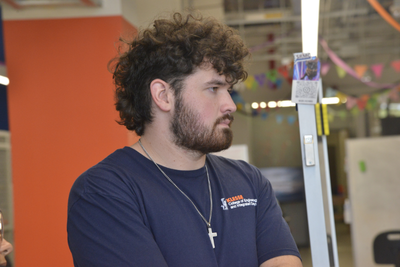 Team lead Israel Elizondo. Photo: UT San Antonio
The global competition highlights the use of immersive engineering to address practical problems. The team chose this robotic challenge because it was the “most feasible and impactful” concept they considered, Elizondo said. The project focused on a common problem in 3D print farms, where printers can sit idle for hours because post-processing still requires manual work. “Where technology evolved, workflow didn’t,” Elizondo told the judges during the team’s final presentation.
Team lead Israel Elizondo. Photo: UT San Antonio
The global competition highlights the use of immersive engineering to address practical problems. The team chose this robotic challenge because it was the “most feasible and impactful” concept they considered, Elizondo said. The project focused on a common problem in 3D print farms, where printers can sit idle for hours because post-processing still requires manual work. “Where technology evolved, workflow didn’t,” Elizondo told the judges during the team’s final presentation.
RoboRowdy is an autonomous, free-roaming robot designed to handle key post-processing tasks in mid- to large-scale 3D print farms. Once a print job is complete, the robot receives the call, uses onboard computing and precision navigation markers to drive to the printer, aligns itself with the machine, removes the completed part, cleans the plate, and restarts the next print.
By reducing the need for human intervention, RoboRowdy improves operational efficiency, reduces errors, and minimizes downtime. It can also limit workers’ exposure to fumes released during the 3D printing process. With vision feedback, the robot can detect problems and make real-time decisions during its autonomous sequence, increasing throughput and pointing to broader possibilities for additive manufacturing, the team concluded.
For the UT San Antonio students, immersive engineering meant learning to use Siemens Designcenter X to create a digital model of RoboRowdy before building the physical prototype. The software allowed the team to design, simulate, and validate each component in a virtual environment. That process helped the students connect the digital and physical sides of the project and gave them a clearer sense of how the robot would function before they committed to final parts.
The team also used Xpedition PCB and immersive headsets, which helped them see design issues that were less obvious on a standard screen. “Stepping inside the model, we discovered an opportunity for improvement to the wiring system,” Elizondo said. The team routed some wiring through the frame, improving accessibility and serviceability for a robot intended to operate in real-world conditions.
Simulation also helped the students test whether 3D-printed components could withstand real-world stresses before they produced physical parts. The process reduced waste and shortened prototyping cycles, they said, by allowing the team to refine the design before moving into fabrication.
For Romo, the experience changed “how he thinks about material choices and sustainability.” The project pushed the team to ask how engineers can solve problems without creating new ones for people or the environment, he said, and to weigh a design’s practicality alongside long-term impact.
Team 210 Robotics brought together students from several disciplines, including mechanical engineering, biomedical engineering, actuarial science, and mathematics. That range of perspectives became one of the team’s strengths, Romo said, because it pushed the students to approach the project more like a real-world engineering challenge.
 “In an engineering competition, it’s very easy to stay within engineering,” Romo said. “But we wanted to challenge ourselves and think about what it would be like in the workforce, where people come from different backgrounds. Engineering is collaboration across disciplines.” He added that hearing different ideas helped the team see problems and solutions they might have missed on their own.
Learning the Siemens software also became part of the team’s growth. Elizondo said working through the full interface and overcoming the learning curve gave the students an advantage. Darik Pratt, a sophomore mechanical engineering student, told judges that learning how to communicate with the software, revise designs, and respond to error messages was a skill he expected to use throughout his career.
For Elizondo, who led the group, the experience also strengthened his leadership skills. Classes and coursework still had to come first, Elizondo said, but the team had also made a commitment to compete. “At the end of the day, we promised that we were going to deliver, so we had to deliver,” he said. Leading the team meant keeping the group organized, focused, and on schedule while making sure school remained the priority. That balance, Elizondo said, became one of the biggest lessons of the challenge.
The experience also opened new opportunities for the group. Since the competition, the students have presented at Siemens Realize LIVE 2026 in Detroit, met university and community leaders, and launched a robotics organization on campus to continue building on the momentum. “It allowed us to make a lot of meaningful connections,” Romo said. Those connections, along with the technical and teamwork skills the students developed, have helped carry the project beyond the competition and into new opportunities on campus.
Cathy Cecere is membership content program manager.
The competition was “a little intimidating, but winning it has been surreal,” said Andrew Romo, now a sophomore who was one of four mechanical engineering students from UT San Antonio’s Klesse College of Engineering and Integrated Design on Team 210 Robotics. The team of eight, led by Israel Elizondo, also a mechanical engineering student, made history when it earned a finalist spot as the first and only U.S. university team to reach that level of the competition.
What RoboRowdy does
After three demanding rounds of competition, the all-freshman team delivered on the promise they made at the beginning of the competition when they produced a working prototype. The team went on to win the Siemens Immersive Design Challenge with RoboRowdy, an autonomous, free-roaming robot designed to improve efficiency in 3D print farms.
Team lead Israel Elizondo. Photo: UT San Antonio
RoboRowdy is an autonomous, free-roaming robot designed to handle key post-processing tasks in mid- to large-scale 3D print farms. Once a print job is complete, the robot receives the call, uses onboard computing and precision navigation markers to drive to the printer, aligns itself with the machine, removes the completed part, cleans the plate, and restarts the next print.
By reducing the need for human intervention, RoboRowdy improves operational efficiency, reduces errors, and minimizes downtime. It can also limit workers’ exposure to fumes released during the 3D printing process. With vision feedback, the robot can detect problems and make real-time decisions during its autonomous sequence, increasing throughput and pointing to broader possibilities for additive manufacturing, the team concluded.
Building in the digital world first
For the UT San Antonio students, immersive engineering meant learning to use Siemens Designcenter X to create a digital model of RoboRowdy before building the physical prototype. The software allowed the team to design, simulate, and validate each component in a virtual environment. That process helped the students connect the digital and physical sides of the project and gave them a clearer sense of how the robot would function before they committed to final parts.
The team also used Xpedition PCB and immersive headsets, which helped them see design issues that were less obvious on a standard screen. “Stepping inside the model, we discovered an opportunity for improvement to the wiring system,” Elizondo said. The team routed some wiring through the frame, improving accessibility and serviceability for a robot intended to operate in real-world conditions.
Simulation also helped the students test whether 3D-printed components could withstand real-world stresses before they produced physical parts. The process reduced waste and shortened prototyping cycles, they said, by allowing the team to refine the design before moving into fabrication.
For Romo, the experience changed “how he thinks about material choices and sustainability.” The project pushed the team to ask how engineers can solve problems without creating new ones for people or the environment, he said, and to weigh a design’s practicality alongside long-term impact.
Lessons beyond the win
Team 210 Robotics brought together students from several disciplines, including mechanical engineering, biomedical engineering, actuarial science, and mathematics. That range of perspectives became one of the team’s strengths, Romo said, because it pushed the students to approach the project more like a real-world engineering challenge.
Find a Competition
Go beyond the classroom or lab by putting engineering design principles to the test in ASME Student Competitions, available in both in-person and virtual formats,
Learning the Siemens software also became part of the team’s growth. Elizondo said working through the full interface and overcoming the learning curve gave the students an advantage. Darik Pratt, a sophomore mechanical engineering student, told judges that learning how to communicate with the software, revise designs, and respond to error messages was a skill he expected to use throughout his career.
For Elizondo, who led the group, the experience also strengthened his leadership skills. Classes and coursework still had to come first, Elizondo said, but the team had also made a commitment to compete. “At the end of the day, we promised that we were going to deliver, so we had to deliver,” he said. Leading the team meant keeping the group organized, focused, and on schedule while making sure school remained the priority. That balance, Elizondo said, became one of the biggest lessons of the challenge.
The experience also opened new opportunities for the group. Since the competition, the students have presented at Siemens Realize LIVE 2026 in Detroit, met university and community leaders, and launched a robotics organization on campus to continue building on the momentum. “It allowed us to make a lot of meaningful connections,” Romo said. Those connections, along with the technical and teamwork skills the students developed, have helped carry the project beyond the competition and into new opportunities on campus.
Cathy Cecere is membership content program manager.


The use of robotics in industrial settings continues to accelerate at a rapid pace. Explore this collection to learn more about automation, cobots, AI-enabled robots, customized robots, and drones.