Octopus-Inspired Robot Gets a Better Grip
Octopus-Inspired Robot Gets a Better Grip
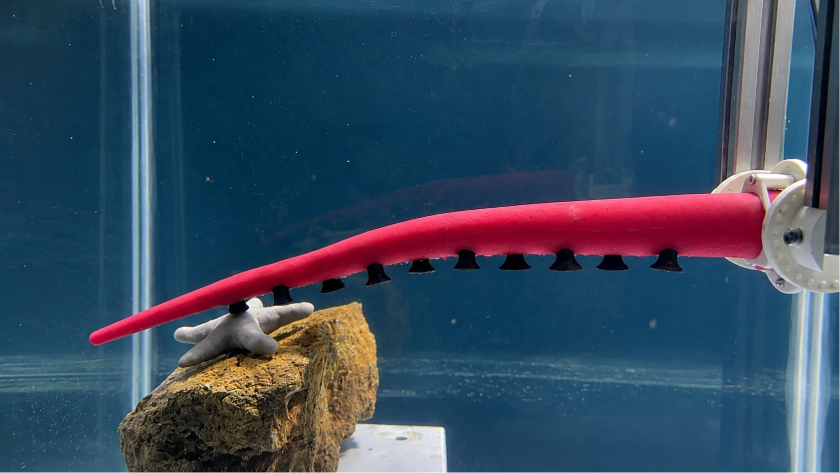
A new soft robotic arm shows how distributed sensing and control could help robots move and grasp more like living organisms.
About 15 years ago, Barbara Mazzolai and her colleagues asked a simple question: Could the extraordinary capabilities of the octopus inspire a completely new generation of robots?
That question led to the recent creation of a soft octopus-inspired robotic arm by researchers at the Italian Institute of Technology, where Mazzolai is the associate director for robotics and director of the Bioinspired Soft Robotics Laboratory. The tendon-driven soft robotic arm is equipped with intelligent suction cups that can grasp objects autonomously.
“The octopus is a fascinating animal because it can move, manipulate objects, and interact with its environment without relying on a rigid skeleton,” said Mazzolai. “Its arms are incredibly flexible, highly sensitive, and capable of processing sensory information and generating many motor responses locally within the arms, rather than relying entirely on the central brain.”
Researchers looked to this limber animal as a model for developing a more flexible robot, rather than a typical rigid robot. “Traditional rigid robotic arms work extremely well in factories, where everything is predictable, but they become much less effective when they need to handle fragile objects, work in confined spaces, or adapt to unknown conditions,” Mazzolai said.
One of the major challenges for robotics engineers has been to enable robots to safely interact with unstructured environments, such as those found in the sea. The octopus is exceptionally effective in the complex and unpredictable environment of the sea, so IIT researchers have been working to translate these biological principles into robotics.
“Rather than simply copying the octopus, we wanted to understand the principles behind its remarkable capabilities and use them to design robots that are more adaptable, safer, and more resilient,” Mazzolai said. The research was published in Nature Machine Intelligence.
The arm the IIT team developed is the result of many years of research and continuous refinement, Mazzolai said. Its development required expertise from biology, materials science, mechanical engineering, electronics, sensing, and control.
 Developed by the Istituto Italiano di Tecnologia, the robotic arm integrates tactile sensors into its suction cups to grasp and manipulate objects autonomously, even underwater. Image: IIT
After studying the biological octopus arm, researchers then explored engineering solutions. They investigated state-of-the-art sensing technologies to identify the most suitable approach for embedding sensors inside soft suction cups. They also developed compliant mechanical structures and fabrication techniques, and designed the electronic and control architectures that allow the robotic arm to autonomously interpret sensory information and adapt its grasp.
Developed by the Istituto Italiano di Tecnologia, the robotic arm integrates tactile sensors into its suction cups to grasp and manipulate objects autonomously, even underwater. Image: IIT
After studying the biological octopus arm, researchers then explored engineering solutions. They investigated state-of-the-art sensing technologies to identify the most suitable approach for embedding sensors inside soft suction cups. They also developed compliant mechanical structures and fabrication techniques, and designed the electronic and control architectures that allow the robotic arm to autonomously interpret sensory information and adapt its grasp.
“An important milestone came in 2019, when we developed an earlier version of the arm for Eni, one of Italy’s leading energy companies,” Mazzolai said. “The goal was to retrieve objects from narrow, oil-filled pipelines, providing a real-world application that helped validate many of the concepts we had been developing. That prototype already used tendon-driven actuation, while the suction cups were operated through an external pumping system.”
More recently, researchers developed a computational design framework that optimizes the routing of tendons inside the soft arm, allowing them to reproduce complex natural movements with only a few actuators. They combined that with optical sensors in the suction cups and an intelligent control architecture to create the current generation of the robotic arm.
The arm is made of a soft silicone body and, like its biological counterpart, it has no rigid skeleton. Instead, it moves through a network of tendon-like cables embedded inside the soft structure. By pulling different tendons, the system can bend, twist, and coil around objects, and adopt various shapes. The suction cups are connected to external water pumps, which helps them generate suction and firmly stick to surfaces.
“What makes this robotic arm unique, however, is not only its flexibility but also its ability to sense and react autonomously,” Mazzolai said. “Each of its 10 suction cups contains a miniaturized optical sensor that acts as an artificial mechanoreceptor.”
 The figure compares the octopus’s arm and nervous system with a soft robotic arm designed to sense contact, control suction, and adapt its grasp. Image: Nature Machine Intelligence
When the suction cup touches something, the sensor measures both the magnitude of the contact force and the direction it came from. This information is first processed locally by electronic circuits distributed along the arm before being sent to the central controller—an approach inspired by the peripheral nervous system of the octopus. The robot automatically adapts its grasp on the object, coordinating suction and arm movements without requiring external commands.
The figure compares the octopus’s arm and nervous system with a soft robotic arm designed to sense contact, control suction, and adapt its grasp. Image: Nature Machine Intelligence
When the suction cup touches something, the sensor measures both the magnitude of the contact force and the direction it came from. This information is first processed locally by electronic circuits distributed along the arm before being sent to the central controller—an approach inspired by the peripheral nervous system of the octopus. The robot automatically adapts its grasp on the object, coordinating suction and arm movements without requiring external commands.
The robotic arm is particularly effective when interacting with fragile or irregular objects and when vision alone is not sufficient, such as in cluttered or confined environments. It can gently grasp objects that weigh up to about 500 grams, both in air and underwater.
In the future, researchers see promising applications in underwater exploration, biological and environmental sampling, marine archaeology, and the safe retrieval of objects in narrow or difficult-to-access spaces.
This research is a significant advancement because it integrates soft robotics, distributed sensing, and distributed control into a single bioinspired system, Mazzolai said.
“Many soft robotic arms are compliant and can adapt their shape, and some also incorporate tactile sensors,” she explained. “Our contribution goes a step further by reproducing one of the key principles of the octopus: the tight integration between the body, the sensory system, and the control architecture.”
The implications of this research go beyond the robotic arm itself, she added.
“Our goal was to demonstrate that intelligence in robots does not need to reside only in a central processor,” Mazzolai said. “The same principles could be applied to many other fields, from medical robotics and minimally invasive surgery to agriculture and industrial manipulation, wherever robots need to interact safely and intelligently with uncertain, changing environments.”
Claudia Hoffacker is an independent writer from Minneapolis.
That question led to the recent creation of a soft octopus-inspired robotic arm by researchers at the Italian Institute of Technology, where Mazzolai is the associate director for robotics and director of the Bioinspired Soft Robotics Laboratory. The tendon-driven soft robotic arm is equipped with intelligent suction cups that can grasp objects autonomously.
“The octopus is a fascinating animal because it can move, manipulate objects, and interact with its environment without relying on a rigid skeleton,” said Mazzolai. “Its arms are incredibly flexible, highly sensitive, and capable of processing sensory information and generating many motor responses locally within the arms, rather than relying entirely on the central brain.”
Learning from the octopus
Researchers looked to this limber animal as a model for developing a more flexible robot, rather than a typical rigid robot. “Traditional rigid robotic arms work extremely well in factories, where everything is predictable, but they become much less effective when they need to handle fragile objects, work in confined spaces, or adapt to unknown conditions,” Mazzolai said.
One of the major challenges for robotics engineers has been to enable robots to safely interact with unstructured environments, such as those found in the sea. The octopus is exceptionally effective in the complex and unpredictable environment of the sea, so IIT researchers have been working to translate these biological principles into robotics.
“Rather than simply copying the octopus, we wanted to understand the principles behind its remarkable capabilities and use them to design robots that are more adaptable, safer, and more resilient,” Mazzolai said. The research was published in Nature Machine Intelligence.
The arm the IIT team developed is the result of many years of research and continuous refinement, Mazzolai said. Its development required expertise from biology, materials science, mechanical engineering, electronics, sensing, and control.
Developed by the Istituto Italiano di Tecnologia, the robotic arm integrates tactile sensors into its suction cups to grasp and manipulate objects autonomously, even underwater. Image: IIT
“An important milestone came in 2019, when we developed an earlier version of the arm for Eni, one of Italy’s leading energy companies,” Mazzolai said. “The goal was to retrieve objects from narrow, oil-filled pipelines, providing a real-world application that helped validate many of the concepts we had been developing. That prototype already used tendon-driven actuation, while the suction cups were operated through an external pumping system.”
More recently, researchers developed a computational design framework that optimizes the routing of tendons inside the soft arm, allowing them to reproduce complex natural movements with only a few actuators. They combined that with optical sensors in the suction cups and an intelligent control architecture to create the current generation of the robotic arm.
How the arm senses and grips
The arm is made of a soft silicone body and, like its biological counterpart, it has no rigid skeleton. Instead, it moves through a network of tendon-like cables embedded inside the soft structure. By pulling different tendons, the system can bend, twist, and coil around objects, and adopt various shapes. The suction cups are connected to external water pumps, which helps them generate suction and firmly stick to surfaces.
“What makes this robotic arm unique, however, is not only its flexibility but also its ability to sense and react autonomously,” Mazzolai said. “Each of its 10 suction cups contains a miniaturized optical sensor that acts as an artificial mechanoreceptor.”
The figure compares the octopus’s arm and nervous system with a soft robotic arm designed to sense contact, control suction, and adapt its grasp. Image: Nature Machine Intelligence
The robotic arm is particularly effective when interacting with fragile or irregular objects and when vision alone is not sufficient, such as in cluttered or confined environments. It can gently grasp objects that weigh up to about 500 grams, both in air and underwater.
Potential uses underwater and beyond
In the future, researchers see promising applications in underwater exploration, biological and environmental sampling, marine archaeology, and the safe retrieval of objects in narrow or difficult-to-access spaces.
This research is a significant advancement because it integrates soft robotics, distributed sensing, and distributed control into a single bioinspired system, Mazzolai said.
“Many soft robotic arms are compliant and can adapt their shape, and some also incorporate tactile sensors,” she explained. “Our contribution goes a step further by reproducing one of the key principles of the octopus: the tight integration between the body, the sensory system, and the control architecture.”
The implications of this research go beyond the robotic arm itself, she added.
“Our goal was to demonstrate that intelligence in robots does not need to reside only in a central processor,” Mazzolai said. “The same principles could be applied to many other fields, from medical robotics and minimally invasive surgery to agriculture and industrial manipulation, wherever robots need to interact safely and intelligently with uncertain, changing environments.”
Claudia Hoffacker is an independent writer from Minneapolis.


The use of robotics in industrial settings continues to accelerate at a rapid pace. Explore this collection to learn more about automation, cobots, AI-enabled robots, customized robots, and drones.