The Next Robotics Frontier
The Next Robotics Frontier
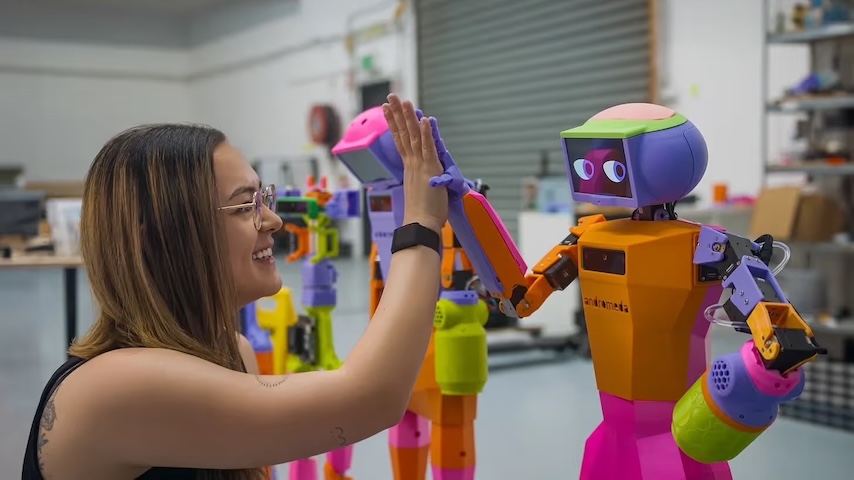
The robotics industry often focuses on scale, automation, and valuations. But a quieter group of founders is instead asking what robotics have overlooked as they innovate with compassion in mind.
For decades, the public imagination around robotics has been dominated by spectacle. The industry’s loudest promises have often centered on automation at scale, billion-dollar valuations, and futuristic machines designed to optimize productivity above all else. But beneath the noise, another movement has been taking shape—one led in large part by women founders who are approaching robotics from an entirely different starting point: human need.
For Andromeda founder Grace Brown, Tatum Robotics founder Samantha Johnson, and Skip founder Kathryn Zealand, robotics is not about replacing humans or chasing hype cycles. Their companies were born from personal encounters with loneliness, discrimination, and loss of independence.
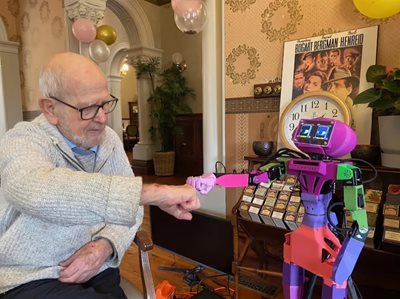 Andromeda is bringing its Abi companion robot to senior living centers to help bridge staffing and connection gaps. Photo: Andromeda
“My grandparents were in their 90s in Scotland while I was in California, and my mom was even farther away in New Zealand, so somehow I became the closest family member to them, and their care primarily fell on me,” Zealand explained. “After my grandfather passed, I spent a lot of time calling my grandmother, who was in the early stages of Alzheimer’s, asking things like, ‘Did you turn the oven off?’ It became a very real part of my daily life, and it made me realize how massive the global caregiving problem is and how desperately we need better technological solutions to support people aging at home.”
Andromeda is bringing its Abi companion robot to senior living centers to help bridge staffing and connection gaps. Photo: Andromeda
“My grandparents were in their 90s in Scotland while I was in California, and my mom was even farther away in New Zealand, so somehow I became the closest family member to them, and their care primarily fell on me,” Zealand explained. “After my grandfather passed, I spent a lot of time calling my grandmother, who was in the early stages of Alzheimer’s, asking things like, ‘Did you turn the oven off?’ It became a very real part of my daily life, and it made me realize how massive the global caregiving problem is and how desperately we need better technological solutions to support people aging at home.”
Compassion is the connective tissue among these founders, even as their technologies differ dramatically. Brown is building emotionally intelligent companion robots for older adults experiencing isolation. Zealand’s wearable robotic exoskeletons help people maintain mobility and independence. Johnson’s robotic communication system gives DeafBlind users unprecedented access to language, communication, and technology.
None of them started with the question, “How do we build the next unicorn company?” Instead, they began by asking what modern robotics had overlooked.
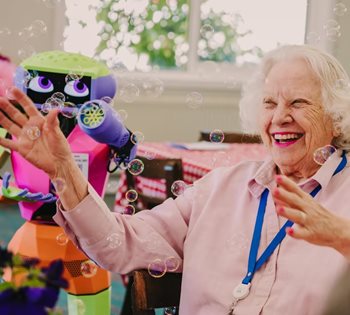 Abi speaks 90 languages and remembers previous conversations. And she sits one-on-one with residents who want to talk. Photo: Andromeda
“Melbourne had really strict lockdowns,” Brown recalled. “My family was in a different state. The state borders were shut down. My friends who were living in the dorm with me had all gone back to their own countries. It was the most isolating period of my life. At the five-month mark, I realized I hadn’t had a hug in so long.”
Abi speaks 90 languages and remembers previous conversations. And she sits one-on-one with residents who want to talk. Photo: Andromeda
“Melbourne had really strict lockdowns,” Brown recalled. “My family was in a different state. The state borders were shut down. My friends who were living in the dorm with me had all gone back to their own countries. It was the most isolating period of my life. At the five-month mark, I realized I hadn’t had a hug in so long.”
Roboticsin Robots That Work With Us: How Cobots Are Changing Manufacturing
What began as a passion project in her dorm soon became Abi, a soft, colorful social robot designed to provide connection and companionship. Unlike the metallic, hyper-industrial aesthetic commonly associated with robotics, Abi was intentionally designed to feel approachable and comforting. Her rounded form, playful colors, and expressive animations were crafted with emotional response in mind.
“Coming out of the pandemic, I realized the isolation and loneliness I experienced during lockdown is something millions of people feel every day, especially older adults,” Brown said. “Older generations are one of the most underserved populations in technology, yet more and more people need care while fewer people are entering the caregiving workforce.”
As Brown brought Abi into local care homes, she quickly realized many residents rarely or never received visitors. She described one resident who lost the ability to speak in English and reverted to his native language and isolated himself in his room for more than a year. The staff were worried but couldn’t communicate with him. When Abi greeted him in Chinese, he immediately responded.
“Within a week of Abi being in that home, he ended up going out of his bedroom, staying in the living room with Abi, and he would read Chinese poetry to her,” Brown said.
Those moments fundamentally shaped Andromeda’s philosophy. While much of the robotics industry focuses on locomotion, dexterity, and efficiency, Brown argues that emotional and social intelligence are proving just as important.
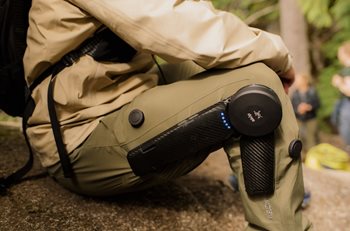 MO/GO is Skip’s first Movewear product. Lightweight motors provide powered assistance at the knee, supporting both flexion and extension. Photo: Skip
Her own grandparents’ struggles shaped the problem in personal terms. As their mobility declined, so did their social worlds. “Once someone stops being able to walk a mile, their entire universe gets smaller,” Zealand said.
MO/GO is Skip’s first Movewear product. Lightweight motors provide powered assistance at the knee, supporting both flexion and extension. Photo: Skip
Her own grandparents’ struggles shaped the problem in personal terms. As their mobility declined, so did their social worlds. “Once someone stops being able to walk a mile, their entire universe gets smaller,” Zealand said.
She became fascinated by the disconnect between existing mobility aids and the actual desires of users. Traditional walkers and medical devices often preserved safety at the expense of dignity.
“People wanted help actually doing the task they’re trying to do,” she explained.
And thus began MO/GO, Skip’s wearable robotic mobility system designed to assist movement while preserving freedom and autonomy.
 The MO/GO name stands for mountain goat, which is one of the world’s best climbers. The device provides users with a 40 percent boost by helping their legs do the hard work, especially in the quads and hamstrings. Photo: Skip
The lightweight wearable exoskeleton uses motors positioned at the knee joint to provide assistance while walking, climbing stairs, or standing. More importantly, it allows users to remain hands-free—something Zealand repeatedly heard was critical during user interviews.
The MO/GO name stands for mountain goat, which is one of the world’s best climbers. The device provides users with a 40 percent boost by helping their legs do the hard work, especially in the quads and hamstrings. Photo: Skip
The lightweight wearable exoskeleton uses motors positioned at the knee joint to provide assistance while walking, climbing stairs, or standing. More importantly, it allows users to remain hands-free—something Zealand repeatedly heard was critical during user interviews.
Rather than framing the product as a medical intervention, Zealand positioned it as an enabling technology, more akin to an e-bike than a hospital device.
Don’t Miss August’s Cover Story: Rocket Science Redesigned
“My grandfather had a walking stick, but he’d leave it at home because he’d say, ‘they’re for old people,’” Zealand said. “But he loved his e-bike because the e-bike is aspirational. It’s about helping you do something.”
That distinction became central to Skip’s entire product philosophy. The company’s marketing centers not on disability, but on joy, movement, and participation. The engineering decisions behind MO/GO were similarly shaped by empathy rather than technical spectacle. Zealand said her team constantly balanced performance with practicality, avoiding unnecessary complexity if it made the system heavier, more expensive, or more difficult to use.
“We don’t want to be a little bit useful,” Zealand explained. “We want to be transformative.”
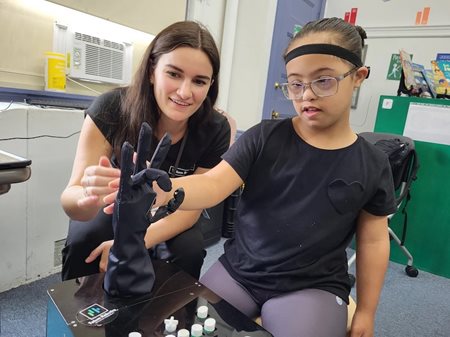 Tatum1 is the first tactile fingerspelling robotic system providing the DeafBlind community with independent access to tactile sign. Photo: Tatum Robotics
“I became really enamored with the community,” Johnson said. “I was reading about the hardships they were facing. This is such an underserved community.”
Tatum1 is the first tactile fingerspelling robotic system providing the DeafBlind community with independent access to tactile sign. Photo: Tatum Robotics
“I became really enamored with the community,” Johnson said. “I was reading about the hardships they were facing. This is such an underserved community.”
Tatum Robotics is changing outcomes for DeafBlind individuals. The company's design, Tatum1, is a robotic hand that translates English into tactile fingerspelling, enabling DeafBlind individuals to access text messages, phone calls, videos, books, and internet content that would otherwise remain inaccessible.
But Johnson insists the real innovation is not simply the robot itself. It’s the collaborative design process behind it. From the earliest prototypes, DeafBlind users became active collaborators in the design process. Rather than spending months perfecting theoretical designs, Johnson’s team moved rapidly, placing prototypes directly into users’ hands for immediate feedback.
Discover the Benefits of ASME Membership
“We don’t spend a month designing something,” Johnson said. “We spend three days, get feedback, and then come back to the board.”
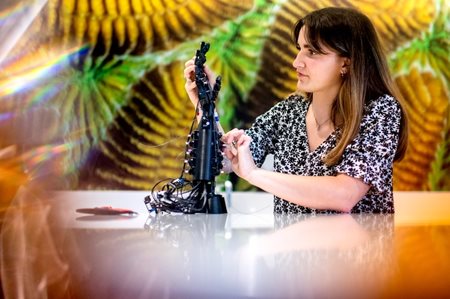 Tatum1 translates English into tactile ASL. Using linguistic and engineering techniques, Tatum1 translates English into tactile ASL. The device connects to WiFi, allowing for instantaneous feature and product updates as well. Photo: Tatum Robotics
Johnson wanted users to feel ownership and pride in the devices and their feedback rapidly transformed both the product and the company itself. DeafBlind users shaped everything from ergonomics to functionality to emotional experience. Some users even began naming their robots or referring to them affectionately as companions. One DeafBlind woman told Johnson something she still carries with her.
Tatum1 translates English into tactile ASL. Using linguistic and engineering techniques, Tatum1 translates English into tactile ASL. The device connects to WiFi, allowing for instantaneous feature and product updates as well. Photo: Tatum Robotics
Johnson wanted users to feel ownership and pride in the devices and their feedback rapidly transformed both the product and the company itself. DeafBlind users shaped everything from ergonomics to functionality to emotional experience. Some users even began naming their robots or referring to them affectionately as companions. One DeafBlind woman told Johnson something she still carries with her.
“She told me, ‘I love the robot because I feel smart,’” Johnson recalled. “But it had nothing to do with her smarts. She just had no learning material.”
Another user continued operating a beta prototype until its fingers were literally falling apart because he wanted to maximize every moment with the device.
“He was using it until 4 a.m. because he knew we were coming to take it back that morning for research,” Johnson said. “We know we can’t spend five more years making changes to this. We need to get something out now.”
For Johnson, Zealand, and Brown, it's moments like this that reinforce the urgency of getting functional technology into users’ hands rather than endlessly polishing prototypes for technical perfection and maximum profit.
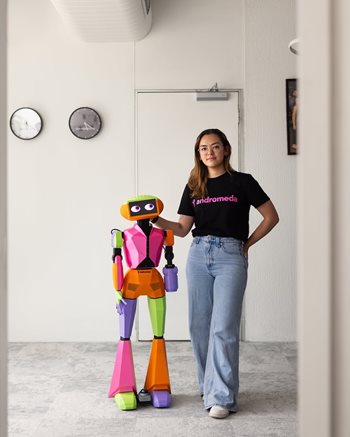 Andromeda founder Grace Brown. Photo: Andromeda
This pragmatism reflects a broader shift in how many younger engineers approach invention itself. Unlike previous generations constrained by expensive tooling and slow development cycles, today’s engineers can test ideas faster and more collaboratively than ever before.
Andromeda founder Grace Brown. Photo: Andromeda
This pragmatism reflects a broader shift in how many younger engineers approach invention itself. Unlike previous generations constrained by expensive tooling and slow development cycles, today’s engineers can test ideas faster and more collaboratively than ever before.
“There’s never been a better time to start something in the mechanical space,” Zealand said.
But perhaps the most striking commonality among these founders is not technical at all. It is the way they are attempting to redefine what leadership inside robotics companies can look like.
Zealand, who co-founded Skip alongside longtime collaborator Anna Roumiantseva, said the partnership allowed them to intentionally reject the stereotype of the hyper-aggressive solo founder who will do whatever it takes to make a sale.
“When you have a co-founder you really trust, it makes things like taking time off for family possible,” she said. “The company’s better for it because we’ve got two people thinking through problems together.”
This structure helps create a workplace culture rooted in collaboration rather than burnout, and Zealand believes shared leadership has ultimately made the company stronger, not weaker.
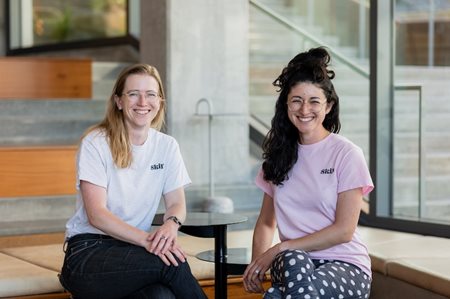 Skip co-founders Kathryn Zealand (left) and Anna Roumiantseva. Photo: Skip
Brown similarly rejects the zero-sum mentality she often encountered while fundraising and negotiating partnerships for Andromeda. Instead of maximizing every possible short-term gain, she focuses on creating sustainable, respectful relationships with employees, customers, and collaborators.
Skip co-founders Kathryn Zealand (left) and Anna Roumiantseva. Photo: Skip
Brown similarly rejects the zero-sum mentality she often encountered while fundraising and negotiating partnerships for Andromeda. Instead of maximizing every possible short-term gain, she focuses on creating sustainable, respectful relationships with employees, customers, and collaborators.
“I try my best to think about what’s fair,” Brown said. “If you can create an environment and a set of terms that brings out the best in people, that’s better for everyone.”
This mentality also shapes how these founders think about business itself. None reject profitability. Instead, they reject the idea that profitability must come at the expense of mission.
“I have no doubts we are going to be a multi-billion-dollar company,” Brown said. “But the mission is just so much greater. That’s always been what’s driving us.”
You Might Also Enjoy: Exoskeleton Improves Mobility for Stroke Survivors
Johnson echoed that sentiment, describing how difficult it was early on to find mentors whose vision of success aligned with her own. Many encouraged her to pivot toward more profitable applications in industrial robotics before returning to assistive technology later. Instead, Tatum Robotics spent years operating primarily through grants and community support while maintaining full control over the company’s direction and mission.
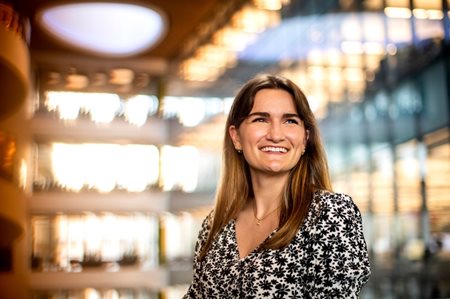 Tatum Robotics founder Samantha Johnson. Photo: Tatum Robotics
“We’ve done this for five years without losing our mission,” Johnson said. “You can still build a profitable business in the right way, for the right reasons.”
Tatum Robotics founder Samantha Johnson. Photo: Tatum Robotics
“We’ve done this for five years without losing our mission,” Johnson said. “You can still build a profitable business in the right way, for the right reasons.”
In an industry often obsessed with scale and disruption, their work suggests another possibility for robotics: technology designed not merely to optimize human systems, but to care for the humans inside them. That shift may become increasingly important as robots move out of laboratories and warehouses and into everyday life.
“There’s going to be billions of robots that colonize the world,” Brown said. “There’s going to be robots in hospitals and robots in schools, robots in grocery stores. But for them to effectively integrate into society, we have to connect with them emotionally.”
These founders are challenging one of the industry’s oldest assumptions: that efficiency alone defines innovation. Instead, they are proving that empathy, dignity, and community are as essential to the future of robotics as the technology itself.
Cassandra Kelly is a technology writer in Columbus, Ohio.
For Andromeda founder Grace Brown, Tatum Robotics founder Samantha Johnson, and Skip founder Kathryn Zealand, robotics is not about replacing humans or chasing hype cycles. Their companies were born from personal encounters with loneliness, discrimination, and loss of independence.
Andromeda is bringing its Abi companion robot to senior living centers to help bridge staffing and connection gaps. Photo: Andromeda
Compassion is the connective tissue among these founders, even as their technologies differ dramatically. Brown is building emotionally intelligent companion robots for older adults experiencing isolation. Zealand’s wearable robotic exoskeletons help people maintain mobility and independence. Johnson’s robotic communication system gives DeafBlind users unprecedented access to language, communication, and technology.
None of them started with the question, “How do we build the next unicorn company?” Instead, they began by asking what modern robotics had overlooked.
A much-needed connection
For Brown, the answer emerged during the pandemic while she was still a university student studying mechatronics engineering. Separated from her family for months and isolated in a dorm room, she found herself confronting a type of loneliness she had never previously understood.
Abi speaks 90 languages and remembers previous conversations. And she sits one-on-one with residents who want to talk. Photo: Andromeda
Roboticsin Robots That Work With Us: How Cobots Are Changing Manufacturing
What began as a passion project in her dorm soon became Abi, a soft, colorful social robot designed to provide connection and companionship. Unlike the metallic, hyper-industrial aesthetic commonly associated with robotics, Abi was intentionally designed to feel approachable and comforting. Her rounded form, playful colors, and expressive animations were crafted with emotional response in mind.
“Coming out of the pandemic, I realized the isolation and loneliness I experienced during lockdown is something millions of people feel every day, especially older adults,” Brown said. “Older generations are one of the most underserved populations in technology, yet more and more people need care while fewer people are entering the caregiving workforce.”
As Brown brought Abi into local care homes, she quickly realized many residents rarely or never received visitors. She described one resident who lost the ability to speak in English and reverted to his native language and isolated himself in his room for more than a year. The staff were worried but couldn’t communicate with him. When Abi greeted him in Chinese, he immediately responded.
“Within a week of Abi being in that home, he ended up going out of his bedroom, staying in the living room with Abi, and he would read Chinese poetry to her,” Brown said.
Those moments fundamentally shaped Andromeda’s philosophy. While much of the robotics industry focuses on locomotion, dexterity, and efficiency, Brown argues that emotional and social intelligence are proving just as important.
An enabling technology
Zealand arrived at robotics from a different path but landed on a remarkably similar conclusion. Originally trained as a physicist, she spent years focused on global impact work and emerging technologies before joining Google X. There, while evaluating moonshot-scale problems, she found herself increasingly drawn toward aging and mobility challenges.
MO/GO is Skip’s first Movewear product. Lightweight motors provide powered assistance at the knee, supporting both flexion and extension. Photo: Skip
She became fascinated by the disconnect between existing mobility aids and the actual desires of users. Traditional walkers and medical devices often preserved safety at the expense of dignity.
“People wanted help actually doing the task they’re trying to do,” she explained.
And thus began MO/GO, Skip’s wearable robotic mobility system designed to assist movement while preserving freedom and autonomy.
The MO/GO name stands for mountain goat, which is one of the world’s best climbers. The device provides users with a 40 percent boost by helping their legs do the hard work, especially in the quads and hamstrings. Photo: Skip
Rather than framing the product as a medical intervention, Zealand positioned it as an enabling technology, more akin to an e-bike than a hospital device.
Don’t Miss August’s Cover Story: Rocket Science Redesigned
“My grandfather had a walking stick, but he’d leave it at home because he’d say, ‘they’re for old people,’” Zealand said. “But he loved his e-bike because the e-bike is aspirational. It’s about helping you do something.”
That distinction became central to Skip’s entire product philosophy. The company’s marketing centers not on disability, but on joy, movement, and participation. The engineering decisions behind MO/GO were similarly shaped by empathy rather than technical spectacle. Zealand said her team constantly balanced performance with practicality, avoiding unnecessary complexity if it made the system heavier, more expensive, or more difficult to use.
“We don’t want to be a little bit useful,” Zealand explained. “We want to be transformative.”
Unlocking the inaccessible
Johnson’s journey with Tatum Robotics embodies a similar philosophy to both Skip and Andromeda. While still an engineering student at Northeastern University, she became involved with the DeafBlind community after meeting a DeafBlind peer through school programming and quickly recognized how little technology existed to support communication and independence for DeafBlind individuals.
Tatum1 is the first tactile fingerspelling robotic system providing the DeafBlind community with independent access to tactile sign. Photo: Tatum Robotics
Tatum Robotics is changing outcomes for DeafBlind individuals. The company's design, Tatum1, is a robotic hand that translates English into tactile fingerspelling, enabling DeafBlind individuals to access text messages, phone calls, videos, books, and internet content that would otherwise remain inaccessible.
But Johnson insists the real innovation is not simply the robot itself. It’s the collaborative design process behind it. From the earliest prototypes, DeafBlind users became active collaborators in the design process. Rather than spending months perfecting theoretical designs, Johnson’s team moved rapidly, placing prototypes directly into users’ hands for immediate feedback.
Discover the Benefits of ASME Membership
“We don’t spend a month designing something,” Johnson said. “We spend three days, get feedback, and then come back to the board.”
Tatum1 translates English into tactile ASL. Using linguistic and engineering techniques, Tatum1 translates English into tactile ASL. The device connects to WiFi, allowing for instantaneous feature and product updates as well. Photo: Tatum Robotics
“She told me, ‘I love the robot because I feel smart,’” Johnson recalled. “But it had nothing to do with her smarts. She just had no learning material.”
Another user continued operating a beta prototype until its fingers were literally falling apart because he wanted to maximize every moment with the device.
“He was using it until 4 a.m. because he knew we were coming to take it back that morning for research,” Johnson said. “We know we can’t spend five more years making changes to this. We need to get something out now.”
Redefining robotics leadership
For Johnson, Zealand, and Brown, it's moments like this that reinforce the urgency of getting functional technology into users’ hands rather than endlessly polishing prototypes for technical perfection and maximum profit.
Andromeda founder Grace Brown. Photo: Andromeda
“There’s never been a better time to start something in the mechanical space,” Zealand said.
But perhaps the most striking commonality among these founders is not technical at all. It is the way they are attempting to redefine what leadership inside robotics companies can look like.
Zealand, who co-founded Skip alongside longtime collaborator Anna Roumiantseva, said the partnership allowed them to intentionally reject the stereotype of the hyper-aggressive solo founder who will do whatever it takes to make a sale.
“When you have a co-founder you really trust, it makes things like taking time off for family possible,” she said. “The company’s better for it because we’ve got two people thinking through problems together.”
This structure helps create a workplace culture rooted in collaboration rather than burnout, and Zealand believes shared leadership has ultimately made the company stronger, not weaker.
Skip co-founders Kathryn Zealand (left) and Anna Roumiantseva. Photo: Skip
“I try my best to think about what’s fair,” Brown said. “If you can create an environment and a set of terms that brings out the best in people, that’s better for everyone.”
This mentality also shapes how these founders think about business itself. None reject profitability. Instead, they reject the idea that profitability must come at the expense of mission.
“I have no doubts we are going to be a multi-billion-dollar company,” Brown said. “But the mission is just so much greater. That’s always been what’s driving us.”
You Might Also Enjoy: Exoskeleton Improves Mobility for Stroke Survivors
Johnson echoed that sentiment, describing how difficult it was early on to find mentors whose vision of success aligned with her own. Many encouraged her to pivot toward more profitable applications in industrial robotics before returning to assistive technology later. Instead, Tatum Robotics spent years operating primarily through grants and community support while maintaining full control over the company’s direction and mission.
Tatum Robotics founder Samantha Johnson. Photo: Tatum Robotics
In an industry often obsessed with scale and disruption, their work suggests another possibility for robotics: technology designed not merely to optimize human systems, but to care for the humans inside them. That shift may become increasingly important as robots move out of laboratories and warehouses and into everyday life.
“There’s going to be billions of robots that colonize the world,” Brown said. “There’s going to be robots in hospitals and robots in schools, robots in grocery stores. But for them to effectively integrate into society, we have to connect with them emotionally.”
These founders are challenging one of the industry’s oldest assumptions: that efficiency alone defines innovation. Instead, they are proving that empathy, dignity, and community are as essential to the future of robotics as the technology itself.
Cassandra Kelly is a technology writer in Columbus, Ohio.


The use of robotics in industrial settings continues to accelerate at a rapid pace. Explore this collection to learn more about automation, cobots, AI-enabled robots, customized robots, and drones.