A Robot Rides the Wind
A Robot Rides the Wind
Hawks are powerful birds, no doubt, but one of their more amazing skills takes no power at all: floating on updrafts.
Who among us has not been inspired by birds? Their ability to soar, to glide, and to flap themselves through the air has turned the engineering-minded toward ornithological imitation for centuries. But there’s one bird ability that our machines have yet to reproduce: hovering in place in rising air, without expending energy.
“Kestrels, for example, are really adept at doing it,” said Michael Muehlebach, the research group leader for Learning and Dynamical Systems at the Max Planck Institute for Intelligent Systems, in Tuebingen, Germany, who happens to be a glider pilot. “They have very precise control of their wing shape, and they adapt each day to different weather conditions. This really motivated us to replicate this in the laboratory.”
To do that, Muehlebach and his colleague, Ghadeer Elmkaiel, a researcher in the same group at the Max Planck Institute, turned to the quadcopter. “One of the earliest puzzles that we wanted to solve was how do we find a simple mechanical design so that we can actuate all degrees of freedom with only four actuators, and in such a way that the design is really simple and elegant.”
You May Also Want to Read: Octopus-Inspired Robot Gets a Better Grip
You May Also Want to Read: Octopus-Inspired Robot Gets a Better Grip
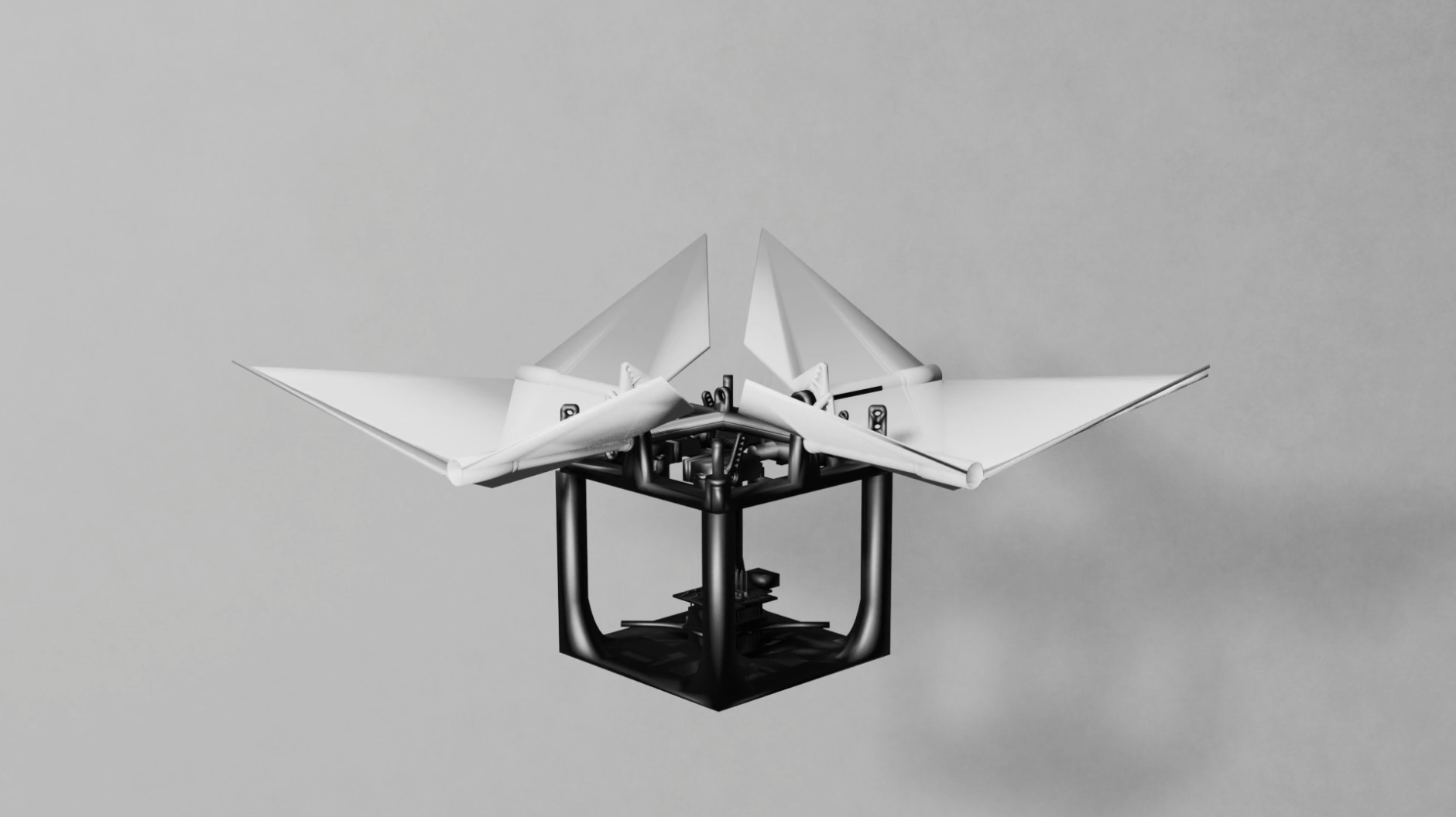
Muehlebach and Elmkaiel used an existing quadcopter, but swapped out the propellors at the end of each arm with flaps. The flaps can flatten to increase the area and the amount of airflow hitting the drone, sending it up. When the flaps are folded, air passes through and the drone can descend. By closing two neighboring flaps, and opening the other two, they can change direction. And to generate torque around the Z-axis, it can open opposite flaps and close the other two.
The first experiments revealed that their initial designs were not too far off the mark. But they had one little problem: The four flaps they were using were rigid and could only tilt one way or another, so in profile the drone took the shape of a V. That meant that when it was in a directional configuration, with one adjacent set of flaps up and the others down, it easily became unstable. A slight rotation would increase the surface area on one side, further increasing any tilt, and further amplifying instabilities.
To fix this issue, they turned to the next letter of the alphabet, the W. “It took me a while, looking at birds and like flying vehicles, to understand how they achieve this stability,” said Elmkaiel. “In heavy airflow, birds tilt their wings a little bit at the end. And sometimes they tilt the tail upward. And you also see that they sometimes have the wings higher than their body, so they have the center of mass lower.”
The new W-shaped configuration—with the flaps hinging in the center—essentially mimicked bird behavior in fast moving air. The researchers also put the battery below the flaps to lower the center of gravity.
Testing their hover-bot at length in an existing wind tunnel proved prohibitively expensive. So Muehlebach and Elmkaiel built their own. Their open design meant that their wind tunnel has more turbulence than found in a commercial tunnel, or in the wild, for that matter. So a successful flight there would mean probable success anywhere.
And, indeed, the drone—which they call Floaty—has managed to stay aloft in the upward draft for many half-hour long flights. It requires a minimum ten-meters-a-second upward air speed. Soon they will take the bot to a larger enclosed wind tunnel to test it further.
.jpg?width=4463&height=2975&ext=.jpg) Muehlebach and Elmkaiel test out Floaty. Image: Max Planck Institute
Muehlebach and Elmkaiel test out Floaty. Image: Max Planck Institute
And, of course, a hovering drone would make a great toy.
Have Muehlebach and Elmkaiel outdone nature with their drone’s hover-ability? “Birds can adjust their wings in much subtler ways to achieve something that we would need multiple movements to achieve,” said Elmkaiel. “Our system has only four motors, and it’s rigid. So I still think that birds are more efficient.”
Michael Abrams is a technology writer in Westfield, N.J.


The use of robotics in industrial settings continues to accelerate at a rapid pace. Explore this collection to learn more about automation, cobots, AI-enabled robots, customized robots, and drones.