Blaze-Battling Bots Ahead
Blaze-Battling Bots Ahead
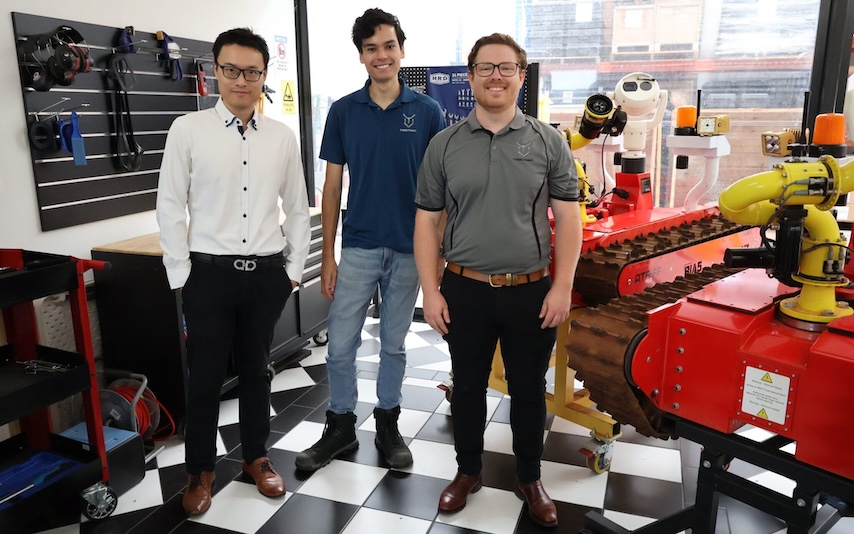
A novel system that uses AI-powered robots to extinguish fires could eliminate the need to put firefighters in dangerous situations.
Firefighting is a dangerous business. Conditions are constantly changing on the ground. Crews can be understaffed and overworked especially during high fire seasons, causing additional safety issues.
To make firefighting safer and more effective, engineers at Griffith University in Australia have developed a system for fighting fires remotely. It uses collaborative teams of AI-powered robots with extinguishing equipment on board, eliminating the need to insert firefighting personnel directly into high-risk situations.
“We were motivated by the need for autonomous UGV [unmanned ground vehicle] teams that can operate in hazardous, coordination-heavy missions with less human oversight,” said Timothy Mead, robotic software engineer for Cyborg Dynamics Engineering and spokesperson for the research team. “The key insight was that cooperation could be taught progressively: first single-agent navigation, then multi-agent pathfinding, and finally collaborative firefighting, allowing complex teamwork to emerge from a staged curriculum, rather than being manually engineered.”
Multiple real and simulated UGVs were trained through this structured three-stage AI learning curriculum. The team adopted an AI technique called multi-agent reinforcement learning (MARL) to build neural-network-based AI “agents” trained through a custom-designed curriculum, progressing from simple tasks such as single-robot navigation, to multi-robot navigation around obstacles, then finally to completing a complex firefighting scenario involving multiple robots and fires with obstacles.
Similar Reading: AI Drones Brave Smoke Plumes to Map Wildfires Faster
“This structured approach accelerates training convergence by systematically building sophisticated collaborative behaviors upon foundational skills, which enhances training stability and guides the agents towards learning effective and coordinated strategies,” said Zhe Hou, project lead chief investigator from Griffith University’s School of Information and Communication Technology.
The ability of the robots to self-organize and allocate tasks autonomously, such as splitting into teams to handle multiple fire outbreaks, also reduced the cognitive load on human operators, offering increased safety and operational efficiency in emergency situations.
One of the biggest research dilemmas was fine tuning which intermediary behaviors should be incentivized. If there was a lack of any specificity regarding how a goal should be completed, the result could be significantly reduced training times or behaviors that are not ideal in a real environment.
“However, with too much specificity, the agent cannot properly explore available policy options,” Mead explained. “Removing the benefit of the reinforcement learning approach whereby the policy discovers avenues toward completing the goals that we were not aware of, such as the development of yielding rules between agents that reduce the time they take to move through narrow passageways.”
One of the biggest surprises was seeing the emergent behaviors develop from the simulations, especially behaviors that were not predicted. These included positives, such as unexpected pathing which improved response times, as well as negatives, “such as abuses of poorly modeled physics that had to be fixed before continuing,” Mead added.
Some surprises also occurred during the transference from simulation to real-world scenarios. Many of these were in the form of unexpected sensor interactions, whereby the agents would avoid clearly traversable areas that had tall grass or attempt to drive over concrete pillars, both of these were caused by interactions the sensor had with real materials that were not accounted for in prior simulations.
“These were fixed by altering how our sensors were mounted and configured,” Mead said. “Some of these issues could be identified with more variance in prior training simulations. However, many factors encountered in the real world you are just not aware of until you start trying to implement these solutions.”
Discover the Benefits of ASME Membership
Mechanical engineers would be most interested in the real UGV deployment, integration of sensing and control, and translation of learned decisions into physical vehicle motion. How the work connects autonomy with real platform constraints, especially in navigation, mobility, and field robotics applications are also of keen interest.
The most innovative part of the research was the multi-stage curriculum-learning framework combined with a shared-network MARL architecture, which made training more stable and enabled sophisticated cooperative behavior. From a mechanical-engineering perspective, the hybrid testing setup was especially creative because it allowed multi-agent behaviors to be validated using a real UGV alongside simulated teammates, reducing the need for a full physical fleet.
The UGV successfully navigated around physical obstacles and teamed up with its simulated robot team members to locate and work together to extinguish multiple simulated fires. The results demonstrated a 99.67 percent success rate in navigating and extinguishing two fires, suggesting its strong potential for real-world deployment.
Looking ahead, the research team envisions further advancements in both the design of neural networks and sim-to-real transfer methodologies. Future work will also explore the adoption of the developed AI technique on other autonomous systems, such as autonomous underwater vehicles and drones.
Next steps include scaling the method to larger teams, improving robustness in less predictable environments, and performing real-world testing with multiple vehicles rather than the hybrid approach used in this research. “Over the next few years, this line of research is likely to move more toward solving the issues that occur with real-world applications that cannot be easily simulated,” Mead said.
Mark Crawford is a technology writer in Corrales, N.M.
To make firefighting safer and more effective, engineers at Griffith University in Australia have developed a system for fighting fires remotely. It uses collaborative teams of AI-powered robots with extinguishing equipment on board, eliminating the need to insert firefighting personnel directly into high-risk situations.
“We were motivated by the need for autonomous UGV [unmanned ground vehicle] teams that can operate in hazardous, coordination-heavy missions with less human oversight,” said Timothy Mead, robotic software engineer for Cyborg Dynamics Engineering and spokesperson for the research team. “The key insight was that cooperation could be taught progressively: first single-agent navigation, then multi-agent pathfinding, and finally collaborative firefighting, allowing complex teamwork to emerge from a staged curriculum, rather than being manually engineered.”
Multiple real and simulated UGVs were trained through this structured three-stage AI learning curriculum. The team adopted an AI technique called multi-agent reinforcement learning (MARL) to build neural-network-based AI “agents” trained through a custom-designed curriculum, progressing from simple tasks such as single-robot navigation, to multi-robot navigation around obstacles, then finally to completing a complex firefighting scenario involving multiple robots and fires with obstacles.
Similar Reading: AI Drones Brave Smoke Plumes to Map Wildfires Faster
“This structured approach accelerates training convergence by systematically building sophisticated collaborative behaviors upon foundational skills, which enhances training stability and guides the agents towards learning effective and coordinated strategies,” said Zhe Hou, project lead chief investigator from Griffith University’s School of Information and Communication Technology.
The ability of the robots to self-organize and allocate tasks autonomously, such as splitting into teams to handle multiple fire outbreaks, also reduced the cognitive load on human operators, offering increased safety and operational efficiency in emergency situations.
Research challenges
One of the biggest research dilemmas was fine tuning which intermediary behaviors should be incentivized. If there was a lack of any specificity regarding how a goal should be completed, the result could be significantly reduced training times or behaviors that are not ideal in a real environment.
“However, with too much specificity, the agent cannot properly explore available policy options,” Mead explained. “Removing the benefit of the reinforcement learning approach whereby the policy discovers avenues toward completing the goals that we were not aware of, such as the development of yielding rules between agents that reduce the time they take to move through narrow passageways.”
One of the biggest surprises was seeing the emergent behaviors develop from the simulations, especially behaviors that were not predicted. These included positives, such as unexpected pathing which improved response times, as well as negatives, “such as abuses of poorly modeled physics that had to be fixed before continuing,” Mead added.
Some surprises also occurred during the transference from simulation to real-world scenarios. Many of these were in the form of unexpected sensor interactions, whereby the agents would avoid clearly traversable areas that had tall grass or attempt to drive over concrete pillars, both of these were caused by interactions the sensor had with real materials that were not accounted for in prior simulations.
“These were fixed by altering how our sensors were mounted and configured,” Mead said. “Some of these issues could be identified with more variance in prior training simulations. However, many factors encountered in the real world you are just not aware of until you start trying to implement these solutions.”
Discover the Benefits of ASME Membership
Mechanical engineers would be most interested in the real UGV deployment, integration of sensing and control, and translation of learned decisions into physical vehicle motion. How the work connects autonomy with real platform constraints, especially in navigation, mobility, and field robotics applications are also of keen interest.
The most innovative part of the research was the multi-stage curriculum-learning framework combined with a shared-network MARL architecture, which made training more stable and enabled sophisticated cooperative behavior. From a mechanical-engineering perspective, the hybrid testing setup was especially creative because it allowed multi-agent behaviors to be validated using a real UGV alongside simulated teammates, reducing the need for a full physical fleet.
Next steps
The UGV successfully navigated around physical obstacles and teamed up with its simulated robot team members to locate and work together to extinguish multiple simulated fires. The results demonstrated a 99.67 percent success rate in navigating and extinguishing two fires, suggesting its strong potential for real-world deployment.
Looking ahead, the research team envisions further advancements in both the design of neural networks and sim-to-real transfer methodologies. Future work will also explore the adoption of the developed AI technique on other autonomous systems, such as autonomous underwater vehicles and drones.
Next steps include scaling the method to larger teams, improving robustness in less predictable environments, and performing real-world testing with multiple vehicles rather than the hybrid approach used in this research. “Over the next few years, this line of research is likely to move more toward solving the issues that occur with real-world applications that cannot be easily simulated,” Mead said.
Mark Crawford is a technology writer in Corrales, N.M.


The use of robotics in industrial settings continues to accelerate at a rapid pace. Explore this collection to learn more about automation, cobots, AI-enabled robots, customized robots, and drones.