Surface Roughness Accelerates Hydrogen Embrittlement
Surface Roughness Accelerates Hydrogen Embrittlement

A team at Chiba University has identified the causal relationship between the roughness of pipe surfaces and the development of hydrogen embrittlement.
Hydrogen technology holds great promise as a fuel source for developing sustainable, lower-cost industrial processes. Producing only water when consumed, hydrogen could help decarbonize industrial processes, power generation, and transportation. However, making this happen requires massive infrastructure investment and costly construction, ranging from high-pressure storage tanks to dedicated hydrogen pipelines.
Another reason hydrogen technology has yet to be embraced is the process of hydrogen embrittlement, whereby hydrogen interacts with the surfaces of metal pipes, creating atomic-scale defects that weaken the metal’s crystalline structure.
Minimal research has been conducted that explores the process of hydrogen embrittlement. It is also uncertain if standard metal surface treatments such as polishing or grinding affect pipe surfaces at the atomic level, contributing to material failure over time.
To explore this further, a research team from the Graduate School of Engineering at Chiba University in Japan decided to study surface roughness to see if this material property plays a role in the development of hydrogen embrittlement.
“The iron sheets were processed into dumbbell-shaped samples with a gauge section width of 15 millimeter and a length of 25 millimeter for subsequent use in tensile testing,” Chiari said. “The thickness was chosen to meet the limits of the maximum load capacity of the tensile testing machine. Solution treatment was conducted to remove any initial defects introduced during the manufacturing or machining process.”
More for You: Redefining Fuel Cell Durability
The samples were subjected to mechanical tension while being simultaneously charged with hydrogen by exposure to an electrolytic solution and an electrical current, leading to the formation of hydrogen-induced defects.
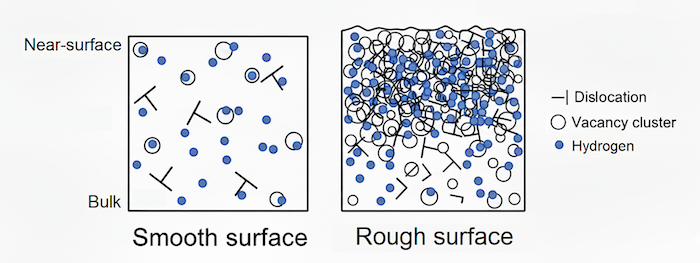 Illustrating how metals with a smoother surface are less prone to the accumulation of hydrogen-induced defects, namely dislocations and vacancy clusters. Photo: Chiba University
An important part of the study was using positron annihilation lifetime spectroscopy (PALS) to analyze defects. This highly sensitive, nondestructive method uses the antimatter particles of the electrons, called positrons, as atomic-scale probes to precisely locate and measure the size of defects, such as dislocations and vacancy clusters, within the material. By using a slow positron beam, the team was able to probe defects specifically in the shallow near-surface layers of the iron samples, isolating them from those in the bulk of the material.
Illustrating how metals with a smoother surface are less prone to the accumulation of hydrogen-induced defects, namely dislocations and vacancy clusters. Photo: Chiba University
An important part of the study was using positron annihilation lifetime spectroscopy (PALS) to analyze defects. This highly sensitive, nondestructive method uses the antimatter particles of the electrons, called positrons, as atomic-scale probes to precisely locate and measure the size of defects, such as dislocations and vacancy clusters, within the material. By using a slow positron beam, the team was able to probe defects specifically in the shallow near-surface layers of the iron samples, isolating them from those in the bulk of the material.
The data revealed that rougher surfaces result in greater accumulation of defects, thereby propagating hydrogen embrittlement. These results also provide new insights into how hydrogen-resistant materials can be designed using high-precision surface engineering.
“The SEM testing was also intended to check whether the surface morphology of the samples, whose surface shape had been altered by the surface treatment, changed by hydrogen addition,” Chiari said. “Looking at the SEM images of the set of hydrogen-free samples, the unpolished samples show no surface deformations.”
The SEM images and the PALS measurements of the surface-processed samples confirmed that mechanical polishing generated abundant dislocations in the near-surface layers “and that the dislocation density increased with growing surface coarseness,” Chiari added. “These dislocations are mostly concentrated in the 10-μm-thick uppermost layer.”
Discover the Benefits of ASME Membership
“Our team investigated the formation of hydrogen-related defects in surface-processed, hydrogen-charged, strained pure iron using PALS,” Chiari said. “The formation of strain-induced hydrogen-enhanced vacancy clusters was detected in the samples, and the vacancy clusters were found to grow in size with increasing surface roughness. The dense networks of dislocations caused by mechanical processing are also where crack initiation typically occurs.”
These findings provide experimental proof that a macroscopic feature such as surface coarseness can directly dictate the size of atomic defects that ultimately lead to cracks in a hydrogen environment. Furthermore, the successful application of PALS holds wider implications for materials science and engineering. This technique could become a new standard for material certification and in-service inspection.
Chiari and his team systematically analyzed how varying surface roughness by mechanical polishing affects dislocation density and mobility, hydrogen diffusion, and the formation of hydrogen-induced vacancies.
“Examination of both surface morphology and defect evolution in a hydrogen environment will provide us with deeper insights into the surface-enhanced mechanisms of hydrogen embrittlement, which are expected to ultimately guide the development of more hydrogen-resistant materials in the future,” Chiari said.
Mark Crawford is a technology writer in Corrales, N.M.
Another reason hydrogen technology has yet to be embraced is the process of hydrogen embrittlement, whereby hydrogen interacts with the surfaces of metal pipes, creating atomic-scale defects that weaken the metal’s crystalline structure.
Minimal research has been conducted that explores the process of hydrogen embrittlement. It is also uncertain if standard metal surface treatments such as polishing or grinding affect pipe surfaces at the atomic level, contributing to material failure over time.
To explore this further, a research team from the Graduate School of Engineering at Chiba University in Japan decided to study surface roughness to see if this material property plays a role in the development of hydrogen embrittlement.
Experimental approach
Led by assistant professor Luca Chiari, the research team designed an experiment to see how surface roughness influences the formation and size of various hydrogen-related defects. The researchers prepared high-purity (99.99 percent) iron sheets of 0.2 millimeter thickness for the study. Four different levels of surface roughness were fabricated using standard mechanical polishing techniques, including using emery paper of different grit sizes.“The iron sheets were processed into dumbbell-shaped samples with a gauge section width of 15 millimeter and a length of 25 millimeter for subsequent use in tensile testing,” Chiari said. “The thickness was chosen to meet the limits of the maximum load capacity of the tensile testing machine. Solution treatment was conducted to remove any initial defects introduced during the manufacturing or machining process.”
More for You: Redefining Fuel Cell Durability
The samples were subjected to mechanical tension while being simultaneously charged with hydrogen by exposure to an electrolytic solution and an electrical current, leading to the formation of hydrogen-induced defects.
Illustrating how metals with a smoother surface are less prone to the accumulation of hydrogen-induced defects, namely dislocations and vacancy clusters. Photo: Chiba University
The data revealed that rougher surfaces result in greater accumulation of defects, thereby propagating hydrogen embrittlement. These results also provide new insights into how hydrogen-resistant materials can be designed using high-precision surface engineering.
Results and next steps
The surface conditions of the mechanically polished samples that were strained by 10 percent in the atmosphere or in a hydrogen environment were first investigated by scanning electron microscopy (SEM).“The SEM testing was also intended to check whether the surface morphology of the samples, whose surface shape had been altered by the surface treatment, changed by hydrogen addition,” Chiari said. “Looking at the SEM images of the set of hydrogen-free samples, the unpolished samples show no surface deformations.”
The SEM images and the PALS measurements of the surface-processed samples confirmed that mechanical polishing generated abundant dislocations in the near-surface layers “and that the dislocation density increased with growing surface coarseness,” Chiari added. “These dislocations are mostly concentrated in the 10-μm-thick uppermost layer.”
Discover the Benefits of ASME Membership
“Our team investigated the formation of hydrogen-related defects in surface-processed, hydrogen-charged, strained pure iron using PALS,” Chiari said. “The formation of strain-induced hydrogen-enhanced vacancy clusters was detected in the samples, and the vacancy clusters were found to grow in size with increasing surface roughness. The dense networks of dislocations caused by mechanical processing are also where crack initiation typically occurs.”
These findings provide experimental proof that a macroscopic feature such as surface coarseness can directly dictate the size of atomic defects that ultimately lead to cracks in a hydrogen environment. Furthermore, the successful application of PALS holds wider implications for materials science and engineering. This technique could become a new standard for material certification and in-service inspection.
Chiari and his team systematically analyzed how varying surface roughness by mechanical polishing affects dislocation density and mobility, hydrogen diffusion, and the formation of hydrogen-induced vacancies.
“Examination of both surface morphology and defect evolution in a hydrogen environment will provide us with deeper insights into the surface-enhanced mechanisms of hydrogen embrittlement, which are expected to ultimately guide the development of more hydrogen-resistant materials in the future,” Chiari said.
Mark Crawford is a technology writer in Corrales, N.M.
A team at Chiba University has identified the causal relationship between the roughness of pipe surfaces and the development of hydrogen embrittlement.

Writer and editor at MC2 Solutions
Related Content


Oct 1, 2026
Engineering the Sounds of Silence

Many of the things that engineers create make a lot of noise. Now there’s a crop of engineers trying to turn the volume down for all of us.

Sep 10, 2026
Smarter Models for Faster Fusion Research

A Virginia Tech researcher is developing reduced models that could help fusion researchers make faster predictions with less computing power.


Sep 9, 2026
5 Myths About Borosilicate Glass
SCHOTT's Tina Gallo tackles five myths that may be causing engineers to underestimate borosilicate glass.

Jul 30, 2026
Ion Beams Speed Qualification for Nuclear Materials


By mimicking years of neutron damage in days, ion beam testing could dramatically reduce the time and cost of qualifying materials for advanced nuclear reactors.