The Remarkable Engineering of Shark Skeletons
The Remarkable Engineering of Shark Skeletons
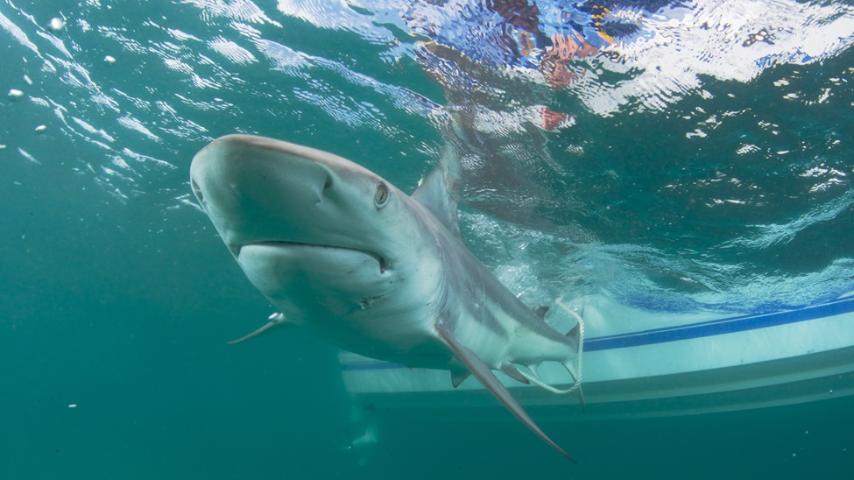
What makes sharks so agile? A lot depends on the bio-composite nature of the skeleton, researchers find.
For sharks to have evolved for close to 450 million years, they must be doing something right. Vivian Merk, assistant professor in the Department of Ocean and Mechanical Engineering and the Department of Chemistry and Biochemistry at Florida Atlantic University, is exploring whether the secret for their evolutionary success might lie in their skeletal system.
Shark spines act like springs, storing and releasing energy with each tailbeat that helps propel them through the water. It’s one of the reasons why sharks move gracefully at high speeds without any whiplash.
Merk’s research group focuses primarily on biological materials and biocomposites, studying how to engineer natural materials for more desirable properties. For example, mineralizing wood into composites might make it a little harder or stiffer. Mushroom-derived composite materials are another avenue of exploration.
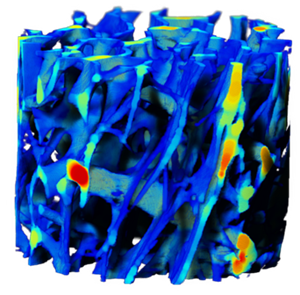 An X-ray nanotomography reconstruction of the intermediale cartilage of a blacktip shark. The colors indicate the thickness of the struts. Image: Florida Atlantic University
For the shark research work, she draws on the study of biomineralization, which focuses on the skeletal elements of living organisms. The team used synchrotron X-ray nanotomography—the technique uses intense X-rays to create detailed visual 3D images of tiny objects—to study samples of the skeletal system from the blacktip shark (Carcharhinus limbatus). These animals are fairly common, live in different environments, and wash up on shore more frequently. No sharks were killed for the research.
An X-ray nanotomography reconstruction of the intermediale cartilage of a blacktip shark. The colors indicate the thickness of the struts. Image: Florida Atlantic University
For the shark research work, she draws on the study of biomineralization, which focuses on the skeletal elements of living organisms. The team used synchrotron X-ray nanotomography—the technique uses intense X-rays to create detailed visual 3D images of tiny objects—to study samples of the skeletal system from the blacktip shark (Carcharhinus limbatus). These animals are fairly common, live in different environments, and wash up on shore more frequently. No sharks were killed for the research.
The researchers evaluated samples from different areas of three individual sharks. Apart from very minor differences like the thicknesses of the trabeculae, the structures looked very similar. The shark skeleton comprises mineralized cartilage, as opposed to bone, which is what the human skeleton is made of. Cartilage is flexible and shock-absorbing connective tissue, the kind found in joints, ears, and the nose. On the other hand, bone is hard and rigid vascular tissue.
The shark’s skeletal structure is like a biphasic composite: some areas are completely unmineralized and others are fairly stiff and mineralized. It includes bioapatite, commonly found in biomineral structures like teeth, and other components like collagen and some sugars. The inorganic and organic molecules combine in different ratios, which lead to different spatial arrangements and mechanical properties. The reasons for the different arrangements are still being studied.
Given that shark vertebrae have to constantly flex while swimming, it would make sense that they would need to be made of material that can handle that kind of strain. Through in-situ mechanical testing, other researchers found that shark cartilage can take physiological strains of 4 percent, much higher than bone. Equally important, the skeleton withstands strain from multiple directions and was found to demonstrate impressive resistance to catastrophic failure.
Discover the Benefits of ASME Membership
“The shark vertebrae have to flex a lot, so it’s a different load situation and biomechanics than land-based animals,” Merk said. The vertebrae along the tail are usually stiffer than along the torso because the shark uses the tail for underwater propulsion.
Many factors, including the shark species and its age, influence the characteristics of cartilage. What’s especially striking is that it exhibits both high toughness and high stiffness, which is hard to achieve in engineered materials. These desirable characteristics could be a result of regions of collagen fibers and bioapatite crystallites in preferred orientation. While different regions had different orientations, within each area the fibers are all aligned in one specific direction.
Having bioapatite crystals oriented in multiple directions could improve toughness, which is beneficial for multi-directional loads. After all, in nature you don’t have loads from only one direction, Merk pointed out. Because sharks have to move around, the loads will be different at any given time.
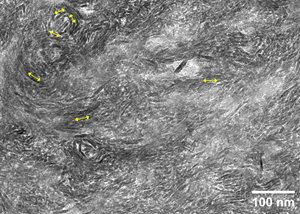 The intermediale cartilage of a blacktip shark with arrows pointing toward the internal mineralized network that supports and reinforces the structure. Image: Florida Atlantic University
The key is that certain areas of the skeletal system like the tail are more reinforced than the rest. Anterior and posterior areas of the shark vertebrae, for example, had different degrees of mineralization. “You are combining a softer matrix with a harder one in more intricate spatially distributed ways,” Merk said.
The intermediale cartilage of a blacktip shark with arrows pointing toward the internal mineralized network that supports and reinforces the structure. Image: Florida Atlantic University
The key is that certain areas of the skeletal system like the tail are more reinforced than the rest. Anterior and posterior areas of the shark vertebrae, for example, had different degrees of mineralization. “You are combining a softer matrix with a harder one in more intricate spatially distributed ways,” Merk said.
Another intriguing finding was the presence of helical fiber structures based primarily on collagen. The layered design acts as a shock absorber with the fibers and minerals working together to absorb and dissipate forces without letting cracks spread.
The only downside to the skeletal structure is that sharks don’t have repair mechanisms or cells that can kick into action when a really dramatic fracture does occur.
Future work will focus on studying unmineralized portions of the shark cartilage to better understand how that contributes to the overall mechanics of movement. Researchers will also examine the orientation of collagen fibers to clarify their role in strength and toughness. The findings from the shark research have ramifications for the development of bioengineered materials in applications that call for high impact resistance and toughness.
Poornima Apte is a technology writer based in Walpole, Mass.
Shark spines act like springs, storing and releasing energy with each tailbeat that helps propel them through the water. It’s one of the reasons why sharks move gracefully at high speeds without any whiplash.
The composition of shark skeletal structures
Merk’s research group focuses primarily on biological materials and biocomposites, studying how to engineer natural materials for more desirable properties. For example, mineralizing wood into composites might make it a little harder or stiffer. Mushroom-derived composite materials are another avenue of exploration.
An X-ray nanotomography reconstruction of the intermediale cartilage of a blacktip shark. The colors indicate the thickness of the struts. Image: Florida Atlantic University
The researchers evaluated samples from different areas of three individual sharks. Apart from very minor differences like the thicknesses of the trabeculae, the structures looked very similar. The shark skeleton comprises mineralized cartilage, as opposed to bone, which is what the human skeleton is made of. Cartilage is flexible and shock-absorbing connective tissue, the kind found in joints, ears, and the nose. On the other hand, bone is hard and rigid vascular tissue.
The shark’s skeletal structure is like a biphasic composite: some areas are completely unmineralized and others are fairly stiff and mineralized. It includes bioapatite, commonly found in biomineral structures like teeth, and other components like collagen and some sugars. The inorganic and organic molecules combine in different ratios, which lead to different spatial arrangements and mechanical properties. The reasons for the different arrangements are still being studied.
Cartilage strength, a key factor
Given that shark vertebrae have to constantly flex while swimming, it would make sense that they would need to be made of material that can handle that kind of strain. Through in-situ mechanical testing, other researchers found that shark cartilage can take physiological strains of 4 percent, much higher than bone. Equally important, the skeleton withstands strain from multiple directions and was found to demonstrate impressive resistance to catastrophic failure. Discover the Benefits of ASME Membership
“The shark vertebrae have to flex a lot, so it’s a different load situation and biomechanics than land-based animals,” Merk said. The vertebrae along the tail are usually stiffer than along the torso because the shark uses the tail for underwater propulsion.
Bio-composites in nature
Many factors, including the shark species and its age, influence the characteristics of cartilage. What’s especially striking is that it exhibits both high toughness and high stiffness, which is hard to achieve in engineered materials. These desirable characteristics could be a result of regions of collagen fibers and bioapatite crystallites in preferred orientation. While different regions had different orientations, within each area the fibers are all aligned in one specific direction. Having bioapatite crystals oriented in multiple directions could improve toughness, which is beneficial for multi-directional loads. After all, in nature you don’t have loads from only one direction, Merk pointed out. Because sharks have to move around, the loads will be different at any given time.
The intermediale cartilage of a blacktip shark with arrows pointing toward the internal mineralized network that supports and reinforces the structure. Image: Florida Atlantic University
Another intriguing finding was the presence of helical fiber structures based primarily on collagen. The layered design acts as a shock absorber with the fibers and minerals working together to absorb and dissipate forces without letting cracks spread.
The only downside to the skeletal structure is that sharks don’t have repair mechanisms or cells that can kick into action when a really dramatic fracture does occur.
Future work will focus on studying unmineralized portions of the shark cartilage to better understand how that contributes to the overall mechanics of movement. Researchers will also examine the orientation of collagen fibers to clarify their role in strength and toughness. The findings from the shark research have ramifications for the development of bioengineered materials in applications that call for high impact resistance and toughness.
Poornima Apte is a technology writer based in Walpole, Mass.
What makes sharks so agile? A lot depends on the bio-composite nature of the skeleton, researchers find.

Technology writer
Related Content

Apr 7, 2026
A Viral Solution to Sustainable Rare Earth Mining

Genetically engineered viruses have unlocked a cleaner and more efficient way to extract rare earth minerals.
Mar 26, 2026
Printing a Stronger Aluminum Alloy

Feb 19, 2026
Surface Roughness Accelerates Hydrogen Embrittlement

A team at Chiba University has identified the causal relationship between the roughness of pipe surfaces and the development of hydrogen embrittlement.
Feb 17, 2026
Mining Seaweed for Minerals

The new frontier of extracting critical minerals from kelp.