Mining Seaweed for Minerals
Mining Seaweed for Minerals
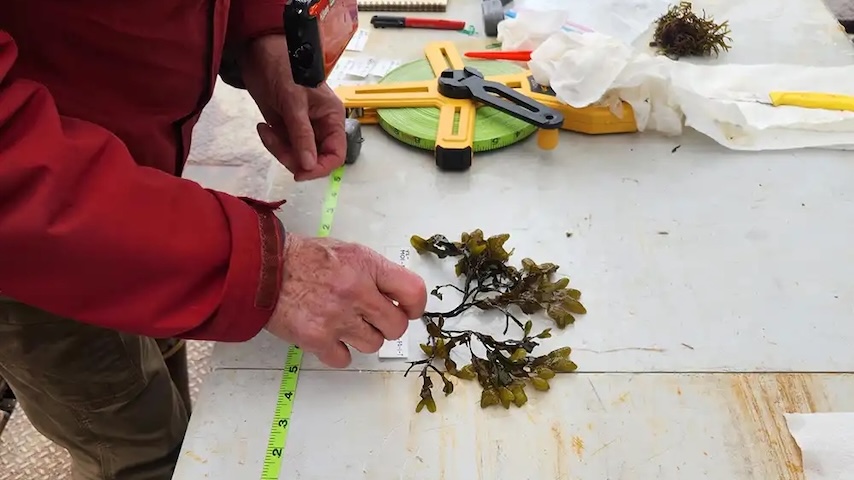
The new frontier of extracting critical minerals from kelp.
As the search for rare earth elements (REE) extends to the most unlikely places, the U.S. Department of Energy’s National Renewable Energy Laboratory (NREL), in collaboration with a team at the University of Alaska Fairbanks, is exploring the possibilities of seaweed mining.
The research team, including analytical chemist Stephanie Van Wychen and principal scientist Lieve Laurens, traveled to Ketchikan, Alaska, last spring to determine if seaweed might be even easier to mine than soil for critical minerals. Its focus was discovering how seaweed accumulates minerals and which ones it’s most likely to absorb, which would help NREL to derive biomimetic or bioinspired alternatives that could be built in the lab to help with the “biomining” process.
“The timing is urgent, because critical minerals are supply-chain-limited. That, and/or their use, is increasing in the economy,” Laurens explained. “Establishing a U.S.-based supply chain is one of the main reasons behind the funding agency here calling for proposals in this space.”
A few years ago, the Advanced Research Projects Agency-Energy [ARPA-E] called for “high impact” exploratory ideas that would help secure the U.S. supply of REEs, which include 17 chemical elements that support numerous products from hard drives to x-ray imaging.
“The team in Alaska had been looking for a while in southeast Alaska, so downstream of the Bokan Mountain, which is one of the largest rare earth reserves in the United States, to recover critical minerals that are just running down, and specifically rare earth elements,” Laurens said. “So together, all of us pitched the idea: ‘Can we look at how much is being captured? How much is running off down the mountain, in the streams, how much is ending up in the ocean?’”
You Might Also Enjoy: Rare Earth Recovery from End-of-Life Devices is Just One Solution
The goal was to look in the stream up to Moira Bay and look in the bay to measure the REEs in the water, collecting water samples at two depths and considering pH, temperatures, and recorded conductivity for each seaweed site, Van Wychen explained. Though this research is new, the concept is not.
“In the First World War, people really started an entire industry in California of growing kelp off the coast and bringing it in for potassium, for gunpowder, from the seaweed. So, there’s this whole story from back in the First World War of recovering minerals from seaweed,” Laurens said. “We’re not the first to look for that. I think the combination is in the uniqueness is the location in Alaska, teaming up with the geologists and geochemists to start to quantify the fluxes and to quantify where they are in the bay and where they are in the seaweed. But people have known for a long time that seaweed has a lot of minerals.”
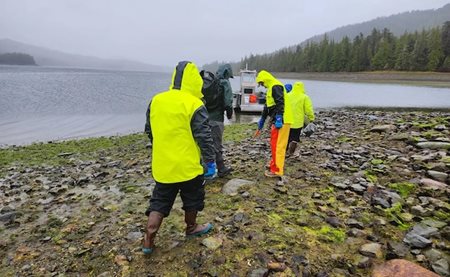 A team searches for seaweed samples on the shore of Moira Bay, Alaska. Photo: Stefanie Van Wychen, NREL
“We took specific seaweed species we have and then verified that the methods that are used by the industry, like commercial labs, work for the seaweed species that we’re looking at. And then you need to make sure that you’re recovering or that you’re able to solubilize all of the elements of interest,” Van Wychen explained. “There’s a lot of making sure that you can hit the detection limit needed, because there are a lot of these that are low level, so you need that sensitivity. So, it’s a lot of lab work on how you prep the samples, how you make sure that you don’t contaminate the samples—because there are metals everywhere.”
A team searches for seaweed samples on the shore of Moira Bay, Alaska. Photo: Stefanie Van Wychen, NREL
“We took specific seaweed species we have and then verified that the methods that are used by the industry, like commercial labs, work for the seaweed species that we’re looking at. And then you need to make sure that you’re recovering or that you’re able to solubilize all of the elements of interest,” Van Wychen explained. “There’s a lot of making sure that you can hit the detection limit needed, because there are a lot of these that are low level, so you need that sensitivity. So, it’s a lot of lab work on how you prep the samples, how you make sure that you don’t contaminate the samples—because there are metals everywhere.”
One challenge they encountered was how to prevent contamination when working with the equipment they have.
Discover the Benefits of ASME Membership
“We were figuring out how to freeze-dry them in the bags, and get them in there, and only open them just a little bit and homogenize everything in the bag [was the challenge]. Because some of the parts, like the seaweed, are like little rocks,” Van Wychen said. Like most experiments, it took “a little trial and error and creativity,” she added.
Other challenges included scalability and how to avoid using scissors throughout the analysis, as scissors themselves contain metals. “How do we not use what we always use? Because we’re looking at such a low load of concentration,” Laurens added.
Overall, the team looked at four to five seaweed species, generally referred to as kelp (brown seaweed), collecting more than 1,400 samples to test.
“It’s several orders of magnitude—we’re still calculating how many orders of magnitude, but it’s significant," said Laurens, adding that what makes these findings exciting is that the seaweeds themselves are capable of enriching for these elements.
“We know the composition of the seaweed for close to 300 samples now, and we’re able to draw these really cool correlations between what the organic composition is, what the structure is of these organics, and then what the elemental composition is,” she added. “And that’s sort of the uniqueness that a lot of people that publish in this space don’t necessarily have.”
More for You: A Deep Dive into the Future of Sargassum Innovation
This new knowledge brings up more questions and possibilities. “Once you get to the causation, you can then build new devices. And that’s really in the back of our minds. How do we build something new from how we know this works. And we can get to that. And we have a couple of hypotheses that we’re now writing proposals on to study more,” Laurens said.
The researchers are now building an inventory of interest areas that have both parts of the equation: a promising water source combined with the seaweed. And investigating other findings from researchers worldwide.
In the future, Laurens and her team have big plans. “I’d love to see seaweed farms that take off in some of these very strategic locations. That would be fantastic. An entire seaweed industry, and then maybe what we call a biorefinery of some of these materials," Laurens said. “A biorefinery would be where you get your biomass feedstock. Like corn stover [leftover plant material] that’s left on the field after the harvest, can you derive more value from seaweed farming? Can you make fuels from things that people are considering waste?”
Laurens said they will continue to learn from nature, eventually even building products and processes mimicking nature’s fascinating patterns—down to the last kelp.
Alexandra Frost is an independent writer and content strategist in Cincinnati.
The research team, including analytical chemist Stephanie Van Wychen and principal scientist Lieve Laurens, traveled to Ketchikan, Alaska, last spring to determine if seaweed might be even easier to mine than soil for critical minerals. Its focus was discovering how seaweed accumulates minerals and which ones it’s most likely to absorb, which would help NREL to derive biomimetic or bioinspired alternatives that could be built in the lab to help with the “biomining” process.
The next mining frontier
Government funding is focused on seaweed for this time-sensitive project.“The timing is urgent, because critical minerals are supply-chain-limited. That, and/or their use, is increasing in the economy,” Laurens explained. “Establishing a U.S.-based supply chain is one of the main reasons behind the funding agency here calling for proposals in this space.”
A few years ago, the Advanced Research Projects Agency-Energy [ARPA-E] called for “high impact” exploratory ideas that would help secure the U.S. supply of REEs, which include 17 chemical elements that support numerous products from hard drives to x-ray imaging.
“The team in Alaska had been looking for a while in southeast Alaska, so downstream of the Bokan Mountain, which is one of the largest rare earth reserves in the United States, to recover critical minerals that are just running down, and specifically rare earth elements,” Laurens said. “So together, all of us pitched the idea: ‘Can we look at how much is being captured? How much is running off down the mountain, in the streams, how much is ending up in the ocean?’”
You Might Also Enjoy: Rare Earth Recovery from End-of-Life Devices is Just One Solution
The goal was to look in the stream up to Moira Bay and look in the bay to measure the REEs in the water, collecting water samples at two depths and considering pH, temperatures, and recorded conductivity for each seaweed site, Van Wychen explained. Though this research is new, the concept is not.
“In the First World War, people really started an entire industry in California of growing kelp off the coast and bringing it in for potassium, for gunpowder, from the seaweed. So, there’s this whole story from back in the First World War of recovering minerals from seaweed,” Laurens said. “We’re not the first to look for that. I think the combination is in the uniqueness is the location in Alaska, teaming up with the geologists and geochemists to start to quantify the fluxes and to quantify where they are in the bay and where they are in the seaweed. But people have known for a long time that seaweed has a lot of minerals.”
Research process
Van Wychen developed a process for understanding the chemistry of seaweed and the interactions that happen within it regarding REEs. She used inductively coupled plasma (ICP), an analytical technique that is used to measure elements at high temperatures, that help break down the sample into specific atoms that researchers can then trace and study.
A team searches for seaweed samples on the shore of Moira Bay, Alaska. Photo: Stefanie Van Wychen, NREL
One challenge they encountered was how to prevent contamination when working with the equipment they have.
Discover the Benefits of ASME Membership
“We were figuring out how to freeze-dry them in the bags, and get them in there, and only open them just a little bit and homogenize everything in the bag [was the challenge]. Because some of the parts, like the seaweed, are like little rocks,” Van Wychen said. Like most experiments, it took “a little trial and error and creativity,” she added.
Other challenges included scalability and how to avoid using scissors throughout the analysis, as scissors themselves contain metals. “How do we not use what we always use? Because we’re looking at such a low load of concentration,” Laurens added.
Overall, the team looked at four to five seaweed species, generally referred to as kelp (brown seaweed), collecting more than 1,400 samples to test.
Findings and future
Subsequent analysis revealed that seaweed is essentially like a sponge soaking up REEs from the water at a significant concentration factor.“It’s several orders of magnitude—we’re still calculating how many orders of magnitude, but it’s significant," said Laurens, adding that what makes these findings exciting is that the seaweeds themselves are capable of enriching for these elements.
“We know the composition of the seaweed for close to 300 samples now, and we’re able to draw these really cool correlations between what the organic composition is, what the structure is of these organics, and then what the elemental composition is,” she added. “And that’s sort of the uniqueness that a lot of people that publish in this space don’t necessarily have.”
More for You: A Deep Dive into the Future of Sargassum Innovation
This new knowledge brings up more questions and possibilities. “Once you get to the causation, you can then build new devices. And that’s really in the back of our minds. How do we build something new from how we know this works. And we can get to that. And we have a couple of hypotheses that we’re now writing proposals on to study more,” Laurens said.
The researchers are now building an inventory of interest areas that have both parts of the equation: a promising water source combined with the seaweed. And investigating other findings from researchers worldwide.
In the future, Laurens and her team have big plans. “I’d love to see seaweed farms that take off in some of these very strategic locations. That would be fantastic. An entire seaweed industry, and then maybe what we call a biorefinery of some of these materials," Laurens said. “A biorefinery would be where you get your biomass feedstock. Like corn stover [leftover plant material] that’s left on the field after the harvest, can you derive more value from seaweed farming? Can you make fuels from things that people are considering waste?”
Laurens said they will continue to learn from nature, eventually even building products and processes mimicking nature’s fascinating patterns—down to the last kelp.
Alexandra Frost is an independent writer and content strategist in Cincinnati.
The new frontier of extracting critical minerals from kelp.

Journalist in Cincinnati
Related Content


Oct 1, 2026
Engineering the Sounds of Silence

Many of the things that engineers create make a lot of noise. Now there’s a crop of engineers trying to turn the volume down for all of us.


Sep 9, 2026
5 Myths About Borosilicate Glass
SCHOTT's Tina Gallo tackles five myths that may be causing engineers to underestimate borosilicate glass.

Jul 30, 2026
Ion Beams Speed Qualification for Nuclear Materials


By mimicking years of neutron damage in days, ion beam testing could dramatically reduce the time and cost of qualifying materials for advanced nuclear reactors.
Jun 23, 2026
Defects to Boost Strength
New research into the tiniest of metals has revealed that defects can make a nanoscaled object stronger.