Imaging Tool Reveals Oral Cancer Early
Imaging Tool Reveals Oral Cancer Early
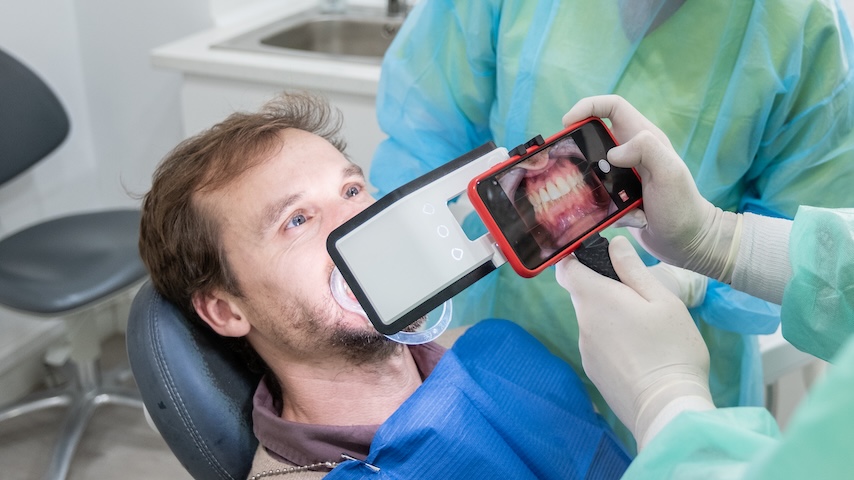
A smartphone-based device uses an imaging system and referral algorithm to help dental clinicians identify suspicious lesions.
According to the American Cancer Society, 12,770 people in the United States have died of oral cancer in 2025. Many of those deaths could have been prevented by earlier detection.
“Early detection of oral cancer is essential because survival rates decrease as the disease progresses,” said Ruchika Mitbander, a postdoctoral fellow at Rice University’s Department of Bioengineering. “Yet, in community dental settings—especially in underserved or low-resource regions—providers often lack tools to reliably identify lesions that require specialist referral.”
Dentists and dental hygienists are usually the first ones to notice lesions in the mouth, as most individuals don’t always have the expertise to distinguish between benign and potentially malignant conditions.
This major gap in early detection motivated the Rice research team to create the mDOC, or mobile Detection of Oral Cancer—a low-cost smartphone-based imaging device and algorithm designed to support clinicians in identifying suspicious lesions earlier and more consistently, said Mitbander, who received her doctorate in bioengineering from Rice in May 2025.
The research team tested mDOC in a dental clinic setting to assess whether it could help clinicians determine when a patient needs to be referred to an oral cancer specialist. Mitbander was the first author of the study, recently published in Biophotonics Discovery.
Autofluorescence imaging uses specific illumination at a wavelength of 405 nanometers (nm) to reveal tissue changes that may not be visible under normal light. A loss in fluorescence can indicate abnormal tissue changes.
More for You: Using Old Smartphones to Monitor Nature
The mDOC system captures paired white-light and autofluorescence images of the oral cavity while also collecting patient risk factors. The images and patient data—such as age, smoking history, and lesion location—are processed by a machine-learning model, which generates a recommendation regarding whether the lesion should be evaluated by a specialist.
The imaging process itself takes about 3.5 minutes, making it practical for real clinical environments. It easily fits into the workflow of a routine dental checkup.
The goal of this study was to optimize and assess the mDOC device for referral management in a dental clinic setting, where the prevalence of oral lesions is low. Researchers developed a multi-input mDOC referral algorithm using new and previously gathered data from high-prevalence and healthy groups. A rehearsal training method was used to retain learning from prior datasets and improve the algorithm’s performance in a typical dental office.
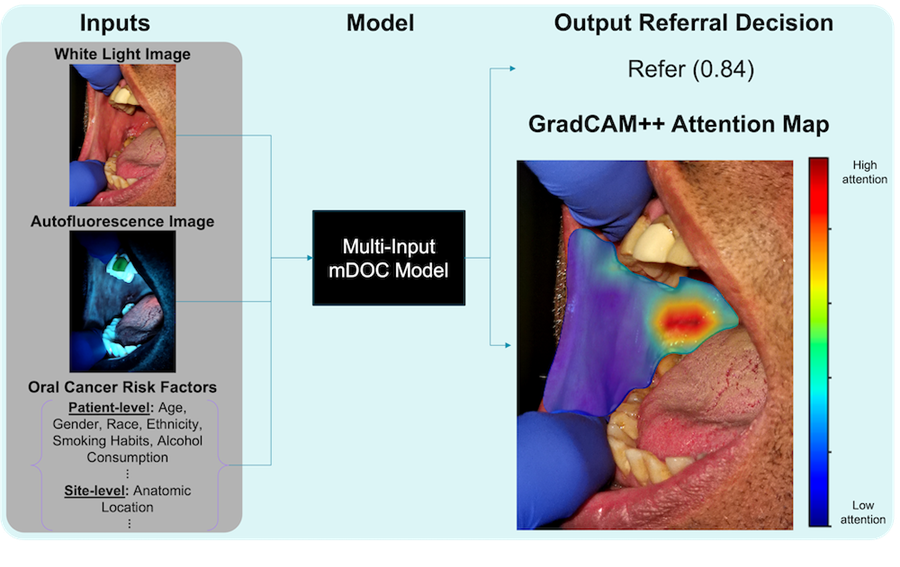 Analysis of an anatomic site using the mDOC model involves multiple inputs: images of clinically relevant regions are masked, cropped, resized for analysis, and passed through the mDOC system, along with oral cancer risk factors. Image: R. Mitbander et al.
Still, the test revealed that the mDOC device does a much better job than unaided dental clinicians, as they missed 100 percent of the cases that should have been referred.
Discover the Benefits of ASME Membership
The device also represents a huge improvement over tools that are currently available to detect oral cancer, Mitbander said. Several factors make mDOC unique—it combines two types of light imaging into a single, portable device and it uses a multi-input algorithm (white-light image + autofluorescence image + patient risk factors) to recommend when a specialist referral is appropriate.
While the potential expansion of mDOC use is great, Mitbander is most excited about the impact mDOC could have on people suffering from oral cancer.
“mDOC has the potential to play a significant role in the early detection of oral cancer in dental care settings,” she said. “Earlier detection of oral cancer in primary dental settings could drastically improve patient outcomes. It could also reduce disparities by helping clinics in underserved or rural communities access diagnostic support in a timely manner.”
Claudia Hoffacker is an independent writer in Minneapolis.
“Early detection of oral cancer is essential because survival rates decrease as the disease progresses,” said Ruchika Mitbander, a postdoctoral fellow at Rice University’s Department of Bioengineering. “Yet, in community dental settings—especially in underserved or low-resource regions—providers often lack tools to reliably identify lesions that require specialist referral.”
Dentists and dental hygienists are usually the first ones to notice lesions in the mouth, as most individuals don’t always have the expertise to distinguish between benign and potentially malignant conditions.
This major gap in early detection motivated the Rice research team to create the mDOC, or mobile Detection of Oral Cancer—a low-cost smartphone-based imaging device and algorithm designed to support clinicians in identifying suspicious lesions earlier and more consistently, said Mitbander, who received her doctorate in bioengineering from Rice in May 2025.
The research team tested mDOC in a dental clinic setting to assess whether it could help clinicians determine when a patient needs to be referred to an oral cancer specialist. Mitbander was the first author of the study, recently published in Biophotonics Discovery.
How mDOC works
There are two key components to the mDOC: the imaging system and the referral algorithm. The imaging system combines two types of light. A smartphone flash is used for white-light imaging, while custom optics enable autofluorescence imaging.Autofluorescence imaging uses specific illumination at a wavelength of 405 nanometers (nm) to reveal tissue changes that may not be visible under normal light. A loss in fluorescence can indicate abnormal tissue changes.
More for You: Using Old Smartphones to Monitor Nature
The mDOC system captures paired white-light and autofluorescence images of the oral cavity while also collecting patient risk factors. The images and patient data—such as age, smoking history, and lesion location—are processed by a machine-learning model, which generates a recommendation regarding whether the lesion should be evaluated by a specialist.
The imaging process itself takes about 3.5 minutes, making it practical for real clinical environments. It easily fits into the workflow of a routine dental checkup.
Developing the algorithm
One of the biggest challenges the researchers faced was training the machine-learning model to recognize concerning lesions and develop an algorithm that would make accurate referral recommendations in the dental clinic. They needed expert-reviewed images to train the model, but there weren’t many available, so they had to create that data. This involved collecting data from 50 patients at two dental offices, and having the images reviewed by expert clinicians, whose decisions served as the ground truth for training and testing the algorithm.The goal of this study was to optimize and assess the mDOC device for referral management in a dental clinic setting, where the prevalence of oral lesions is low. Researchers developed a multi-input mDOC referral algorithm using new and previously gathered data from high-prevalence and healthy groups. A rehearsal training method was used to retain learning from prior datasets and improve the algorithm’s performance in a typical dental office.
Analysis of an anatomic site using the mDOC model involves multiple inputs: images of clinically relevant regions are masked, cropped, resized for analysis, and passed through the mDOC system, along with oral cancer risk factors. Image: R. Mitbander et al.
Putting mDOC to the test
After training the model, it was tested on a dataset obtained from a low-prevalence population. The system correctly identified 60 percent of the lesions that experts recommended for referral, while avoiding unnecessary referrals in most cases. However, it also produced 21 false positives, indicating room for improvement.Still, the test revealed that the mDOC device does a much better job than unaided dental clinicians, as they missed 100 percent of the cases that should have been referred.
Discover the Benefits of ASME Membership
The device also represents a huge improvement over tools that are currently available to detect oral cancer, Mitbander said. Several factors make mDOC unique—it combines two types of light imaging into a single, portable device and it uses a multi-input algorithm (white-light image + autofluorescence image + patient risk factors) to recommend when a specialist referral is appropriate.
The future looks bright
In addition to detecting oral cancer, mDOC has the potential to be used in other ways, Mitbander said. It could be adapted for use in tracking the progression of lesions. It could also be integrated with other sources of imaging data, such as cytology, to provide immediate guidance. And it could be used in other health settings that have limited access to specialists.While the potential expansion of mDOC use is great, Mitbander is most excited about the impact mDOC could have on people suffering from oral cancer.
“mDOC has the potential to play a significant role in the early detection of oral cancer in dental care settings,” she said. “Earlier detection of oral cancer in primary dental settings could drastically improve patient outcomes. It could also reduce disparities by helping clinics in underserved or rural communities access diagnostic support in a timely manner.”
Claudia Hoffacker is an independent writer in Minneapolis.
A smartphone-based device uses an imaging system and referral algorithm to help dental clinicians identify suspicious lesions.

Independent writer and editor
Related Content

Sep 1, 2026
The Next Robotics Frontier


The robotics industry often focuses on scale, automation, and valuations. But a quieter group of founders is instead asking what robotics have overlooked as they innovate with compassion in mind.
Aug 27, 2026
Reimagining Prosthetic Design

Smart tech and 3D printing transform socket design, making prosthetics lighter, more comfortable, and shaped by the patient's own movement.

Aug 20, 2026
Artificial Muscles That Move to Sound

Microbubbles of varying sizes embedded in polymers have different acoustic responses, which can help move artificial muscles made from this material.
Jul 14, 2026
A Better Step for People with Above-Knee Amputations

MIT researchers designed an affordable prosthetic foot that helps people with above-knee amputations achieve a more natural stride.