A New Window into Deadly Brain Cancer
A New Window into Deadly Brain Cancer

By briefly opening the blood–brain barrier, researchers can detect tumor signals in blood samples using a microfluidic device, offering faster insight into the efficacy of glioblastoma therapies.
Glioblastoma is one of the deadliest cancers known. The most common and aggressive brain tumor in adults, it comes with a grim prognosis: fewer than 5 percent of patients survive five years after diagnosis, and median survival is typically just 12 to 15 months. Even with surgery, chemotherapy, and radiation, clinicians often have little real-time insight into whether a treatment is working.
That uncertainty is fueling a new study in which researchers from the University of Michigan are looking into a new way to work around the brain’s natural defenses and monitor tumor response through a simple blood test.
Engineers and clinicians recently collaborated to use a different kind of signal: extracellular vesicles. These nanoscale sacs, released by nearly all cells, carry proteins and other molecular cargo that reflect the identity and condition of their parent cells. “Even though extracellular vesicles are tiny, they carry cell-specific cargo and with proper technology, we can learn a lot about their parent tumor,” said Abha Kumari, a graduate student at the University of Michigan and co-first author of the study published in Nature Communications.
Extracellular vesicles are roughly 250 times smaller than the width of a human hair, yet even they struggle to cross an intact blood–brain barrier.
More for You: A Mechanical Biomarker for Brain Health?
The barrier is designed to be almost impenetrable, explained Sunitha Nagrath, Dwight F. Benton Professor of Chemical Engineering and a member of the Rogel Cancer Center. Tight junctions between endothelial cells leave virtually no gaps, allowing only select molecules—such as glucose or certain amino acids with dedicated transporters—to pass. Vesicles generally lack those mechanisms, meaning that under normal conditions, only limited numbers escape from the brain into the blood.
The research team saw an opportunity in this limitation. In earlier work, their clinical collaborators had implanted a small ultrasound-based device into the skulls of glioblastoma patients. When activated, the device temporarily opens the blood–brain barrier, allowing chemotherapy drugs to reach the tumor more effectively. For the current study, the researchers asked a new question: could these openings also allow tumor-derived extracellular vesicles to enter the bloodstream, making it possible to monitor treatment response through blood samples?
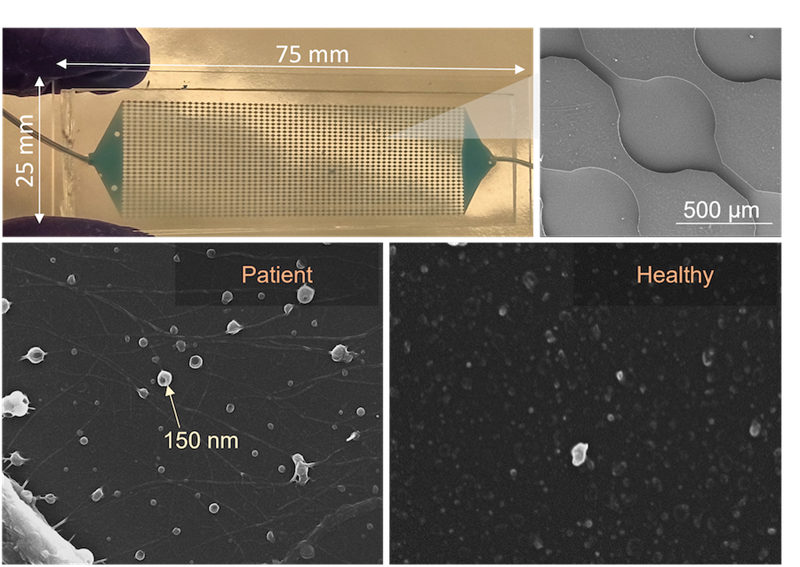 Microfluidic devices were designed to isolate extracellular vesicles from cell media and patient plasma. Each device is fabricated from a PDMS top and glass slide bottom. Each chip has 30 × 60 microwells. Photo: Youngblood and Kumari, et. al.
To find out, the team designed a specialized chip capable of processing very small volumes of plasma—about 300 microliters—and guiding them through microscopic channels that increase the chances of detecting rare tumor-derived vesicles. The chip’s surface was chemically modified to capture vesicles displaying phosphatidylserine, a lipid more commonly exposed on vesicles released by tumor cells than by healthy cells.
Microfluidic devices were designed to isolate extracellular vesicles from cell media and patient plasma. Each device is fabricated from a PDMS top and glass slide bottom. Each chip has 30 × 60 microwells. Photo: Youngblood and Kumari, et. al.
To find out, the team designed a specialized chip capable of processing very small volumes of plasma—about 300 microliters—and guiding them through microscopic channels that increase the chances of detecting rare tumor-derived vesicles. The chip’s surface was chemically modified to capture vesicles displaying phosphatidylserine, a lipid more commonly exposed on vesicles released by tumor cells than by healthy cells.
Isolating those vesicles from the overwhelming background of vesicles released by normal tissues is one of the field’s major technical hurdles. “Every living cell releases extracellular vesicles as part of normal metabolism,” Nagrath said. “The challenge is not just finding vesicles but finding the ones that actually come from the tumor.” By integrating microfluidic sensitivity with disease-relevant surface chemistry, the team enriched glioblastoma-associated vesicles from patient blood samples.
Discover the Benefits of ASME Membership
The vesicles also carried impactful biological information. The team detected higher levels of brain-associated proteins, including GFAP and SERPINA3, in patient-derived vesicles compared with samples from healthy individuals. The changes in vesicle levels over time correlated with how patients responded to therapy. Patients who showed stronger vesicle responses after paclitaxel delivery tended to have better survival outcomes.
Timing mattered. Kumari noted that blood samples collected within about 75 minutes of opening the blood–brain barrier captured the clearest vesicle signal. Differences between patients became apparent after just one chemotherapy cycle. “We were able to see extracellular vesicle patterns that were predictive of whether patients were susceptible or resistant to the drug from samples that were collected in less than a month’s gap,” she said.
The researchers believe the vesicle-based monitoring strategy has broader potential because it relies on small blood samples and relatively straightforward analysis. As a result, it could be adapted to patients receiving other treatments. The team is already following a new cohort of glioblastoma patients at Northwestern University who are undergoing immunotherapy.
“We hope that our detection method can also capture information about extracellular vesicles, regardless of what treatment procedure is used for glioblastoma,” Kumari said. For a disease where time is short and treatment decisions are often clouded by uncertainty, the development of a method to gauge whether a therapy is working quickly could make a profound difference for patients, she said.
Annemarie Mannion is a technology writer in Chicago.
That uncertainty is fueling a new study in which researchers from the University of Michigan are looking into a new way to work around the brain’s natural defenses and monitor tumor response through a simple blood test.
A different signal
Standard care for glioblastoma usually begins with surgery to remove as much of the tumor as possible, followed by chemotherapy and radiation. But one of the disease’s greatest challenges is the blood–brain barrier, a tightly sealed network of endothelial cells that protects the brain from toxins. While essential for normal health, this barrier blocks many cancer drugs from reaching tumors and prevents tumor-derived biomarkers from easily escaping into the bloodstream. As a result, doctors often rely on imaging scans that can lag behind biological changes or on invasive sampling of cerebrospinal fluid.Engineers and clinicians recently collaborated to use a different kind of signal: extracellular vesicles. These nanoscale sacs, released by nearly all cells, carry proteins and other molecular cargo that reflect the identity and condition of their parent cells. “Even though extracellular vesicles are tiny, they carry cell-specific cargo and with proper technology, we can learn a lot about their parent tumor,” said Abha Kumari, a graduate student at the University of Michigan and co-first author of the study published in Nature Communications.
Extracellular vesicles are roughly 250 times smaller than the width of a human hair, yet even they struggle to cross an intact blood–brain barrier.
More for You: A Mechanical Biomarker for Brain Health?
The barrier is designed to be almost impenetrable, explained Sunitha Nagrath, Dwight F. Benton Professor of Chemical Engineering and a member of the Rogel Cancer Center. Tight junctions between endothelial cells leave virtually no gaps, allowing only select molecules—such as glucose or certain amino acids with dedicated transporters—to pass. Vesicles generally lack those mechanisms, meaning that under normal conditions, only limited numbers escape from the brain into the blood.
The research team saw an opportunity in this limitation. In earlier work, their clinical collaborators had implanted a small ultrasound-based device into the skulls of glioblastoma patients. When activated, the device temporarily opens the blood–brain barrier, allowing chemotherapy drugs to reach the tumor more effectively. For the current study, the researchers asked a new question: could these openings also allow tumor-derived extracellular vesicles to enter the bloodstream, making it possible to monitor treatment response through blood samples?
Microfluidic devices were designed to isolate extracellular vesicles from cell media and patient plasma. Each device is fabricated from a PDMS top and glass slide bottom. Each chip has 30 × 60 microwells. Photo: Youngblood and Kumari, et. al.
Isolating those vesicles from the overwhelming background of vesicles released by normal tissues is one of the field’s major technical hurdles. “Every living cell releases extracellular vesicles as part of normal metabolism,” Nagrath said. “The challenge is not just finding vesicles but finding the ones that actually come from the tumor.” By integrating microfluidic sensitivity with disease-relevant surface chemistry, the team enriched glioblastoma-associated vesicles from patient blood samples.
All in the timing
The researchers analyzed more than 130 plasma samples from 18 patients with advanced glioblastoma who were undergoing chemotherapy. Blood was drawn before and after opening the blood-brain barrier during each treatment cycle. The results revealed that when the barrier was opened to deliver the chemotherapy drug paclitaxel, levels of tumor-derived extracellular vesicles in the blood rose for many patients, often within minutes.Discover the Benefits of ASME Membership
The vesicles also carried impactful biological information. The team detected higher levels of brain-associated proteins, including GFAP and SERPINA3, in patient-derived vesicles compared with samples from healthy individuals. The changes in vesicle levels over time correlated with how patients responded to therapy. Patients who showed stronger vesicle responses after paclitaxel delivery tended to have better survival outcomes.
Timing mattered. Kumari noted that blood samples collected within about 75 minutes of opening the blood–brain barrier captured the clearest vesicle signal. Differences between patients became apparent after just one chemotherapy cycle. “We were able to see extracellular vesicle patterns that were predictive of whether patients were susceptible or resistant to the drug from samples that were collected in less than a month’s gap,” she said.
The researchers believe the vesicle-based monitoring strategy has broader potential because it relies on small blood samples and relatively straightforward analysis. As a result, it could be adapted to patients receiving other treatments. The team is already following a new cohort of glioblastoma patients at Northwestern University who are undergoing immunotherapy.
“We hope that our detection method can also capture information about extracellular vesicles, regardless of what treatment procedure is used for glioblastoma,” Kumari said. For a disease where time is short and treatment decisions are often clouded by uncertainty, the development of a method to gauge whether a therapy is working quickly could make a profound difference for patients, she said.
Annemarie Mannion is a technology writer in Chicago.
By briefly opening the blood–brain barrier, researchers can detect tumor signals in blood samples using a microfluidic device, offering faster insight into the efficacy of glioblastoma therapies.

Freelance writer based in Chicago
Related Content

Jun 8, 2026
Engineering for Adaptability and Function First

A research team at Arizona State University has engineered a better pediatric prosthetic for real-world use.
May 7, 2026
Inclusive Wearable Sensors Improve Equity in Health Care

Existing pulse oximetry level sensors can get confused when a person’s skin has more melanin. A new sensor is changing that.
May 5, 2026
A Tattoo that Harvests Biomechanical Energy

Monitoring ECG and EMG signals without adhesive, hardwiring, or batteries is possible thanks to a newly engineered e-tattoo.

Mar 10, 2026
Modeling Guides Challenging Pelvis Surgeries
Patient-Specific models help surgeons evaluate bone grafts and implants for safer, more effective spinopelvic reconstruction after complex cancer surgeries.