Using Old Smartphones to Monitor Nature
Using Old Smartphones to Monitor Nature
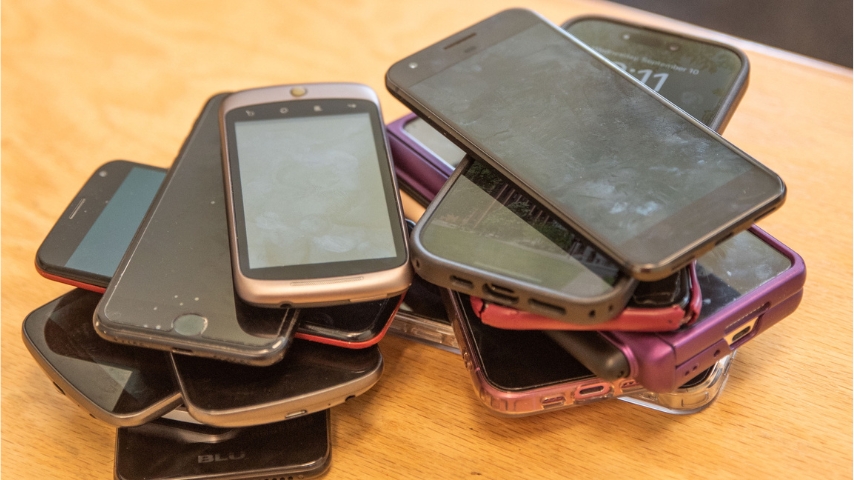
Cost limits deployment of hardware systems that closely track the environment. A University of Massachusetts Amherst researcher is addressing the problem using cameras from used smartphones.
Given the worrying regularity with which consumers replace their mobile phones—roughly 2.5 years on average—it would be neat if there were a way to repurpose the devices.
VP Nguyen, assistant professor of information and computer sciences at the University of Massachusetts Amherst, is working on using the camera functionality in discarded phones to monitor natural phenomena and aid the cause of environmental sustainability.
“We want to continue to monitor the environment and continue generating data, but we want to do that in an environmentally protective way,” Nguyen said, “one way to do that is to leverage what people are already throwing away.”
The development and maintenance of phenotype networks—a way to determine causal relationships between genes and traits—helps study the effects of various factors, including climate change, on nature. These studies depend on systematically monitoring data about flora and fauna over time.
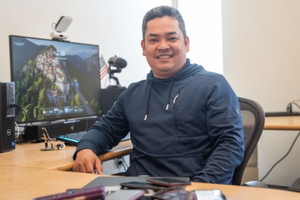 VP Nguyen Photo: University of Massachusetts Amherst
Machine learning can radically improve efficiencies in monitoring by scaling the process more rapidly, but effective algorithms need large banks of data. A computer vision program that tracks how leaves change color, for example, will need a large selection of training data from actual images of leaves under varying environmental conditions.
VP Nguyen Photo: University of Massachusetts Amherst
Machine learning can radically improve efficiencies in monitoring by scaling the process more rapidly, but effective algorithms need large banks of data. A computer vision program that tracks how leaves change color, for example, will need a large selection of training data from actual images of leaves under varying environmental conditions.
Phenotype networks to gather and harness such data are already in place but deployment in new areas is slow, limited partly by the costs of hardware. The most expensive component, the sensor camera, costs nearly $200. It’s this problem that Nguyen is looking to solve. Using the camera from discarded smartphones addresses two problems. It decreases the cost of monitoring hardware—a used cellphone can cost as little as $35—while also rescuing the phone from becoming e-waste, at least for the foreseeable future.
By lowering the cost barrier to adoption, Nguyen is hoping to expand the deployment of sensor cameras so machine learning algorithms that drive phenotype networks can learn from more data samples—more quickly.
It’s not just the cost of the hardware that Nguyen is addressing. The research also solves the problem of power delivery for these devices in a sustainable fashion.
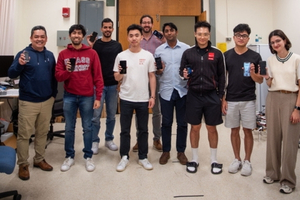 VP Nguyen (left) and his research team Photo: University of Massachusetts Amherst
Because old phones have dead batteries that no longer work, they can’t reliably power the camera. The monitoring system needs energy to take pictures—each camera might take pictures at the frequency of every 15 minutes—and to process machine learning algorithms on the device.
VP Nguyen (left) and his research team Photo: University of Massachusetts Amherst
Because old phones have dead batteries that no longer work, they can’t reliably power the camera. The monitoring system needs energy to take pictures—each camera might take pictures at the frequency of every 15 minutes—and to process machine learning algorithms on the device.
To overcome the energy problem, the team is developing a biodegradable case around the phone with a capacitor array that harvests energy from the environment and funnels that power to the sensor. Nguyen plans to make the system use energy-aware computing strategies to use the built-in AI processing power of existing smartphones, including those with dedicated AI hardware, to run intelligent sensing and analysis.
“The industry has put a lot of time and effort into miniaturizing and optimizing the smartphone. Many of the new smartphones have really good memory and good computational capabilities and can run lightweight machine learning algorithms,” Nguyen said.
Energy-aware computing strategies enable battery-free smartphones to continue their work even when power from harvested energy is unstable. Instead of failing or losing progress when energy runs low, the system breaks AI tasks into smaller steps, completes only what can be powered at the moment, and saves its progress before power cuts off.
If a device cannot finish the next step, it shifts the work to a connected phone, allowing monitoring to continue. Using such an approach, the system can take advantage of the phone’s AI integration even when energy from renewable sources is not reliable.
Once the camera data is gathered, the hardware system runs a low-powered machine learning algorithm and relays results to the cloud. Connectivity to the cloud is through a LoRaWAN network or an NB (narrow band) IoT SIM card. While both methods are established methods for connectivity for the Internet of Things (IoT), they each have their set of advantages and disadvantages. LoRaWAN connectivity adds ($30) to the cost of the device, while the latter is much less expensive at an annual cost of about a dollar.
Another hurdle: When hardware and software operate together, they must be compatible, a mandate that not all phone models meet. Newer models are more sure bets.
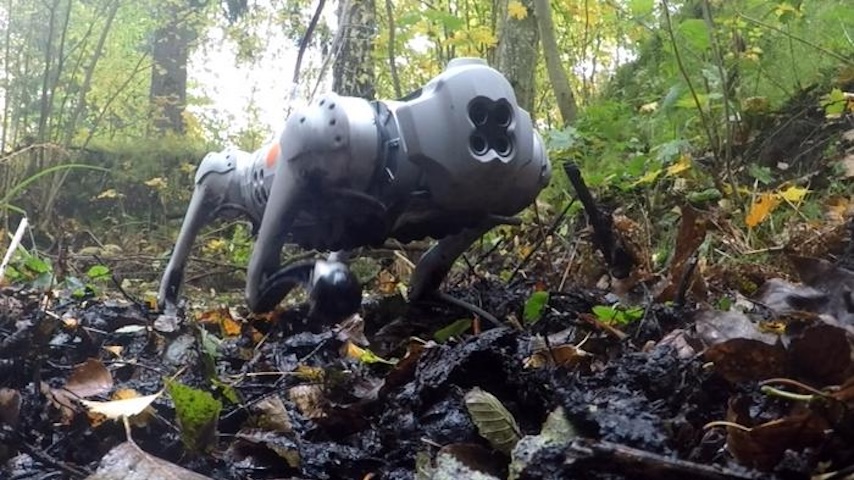 Nguyen expects to share the protocols for developing the phenotype camera monitors through an open-source model so interested parties can join the effort and scale the deployment of cameras. “We want to build a platform to support DIY activities where we can publish reference designs so people can follow it themselves,” Nguyen said.
Nguyen is leading this effort with two colleagues at the College of Information and Computer Sciences at the University of Massachusetts Amherst—Professor Deepak Ganesan and Assistant Professor Hui Guan. Two partners are on board to deploy what Nguyen and team are developing.
The PhenoCam network, from Northern Arizona University, is a bank of cameras that tracks the impact of climate change on flora, especially trees. And GaugeCam, from the University of Nebraska in Lincoln, monitors rivers.
Nguyen has wider ambitions for the cameras: He suggests they can be used for other environmental problems such as pollution monitoring.
Poornima Apte is a technology writer based in Walpole, Mass.
VP Nguyen, assistant professor of information and computer sciences at the University of Massachusetts Amherst, is working on using the camera functionality in discarded phones to monitor natural phenomena and aid the cause of environmental sustainability.
“We want to continue to monitor the environment and continue generating data, but we want to do that in an environmentally protective way,” Nguyen said, “one way to do that is to leverage what people are already throwing away.”
The use of cameras in nature
The development and maintenance of phenotype networks—a way to determine causal relationships between genes and traits—helps study the effects of various factors, including climate change, on nature. These studies depend on systematically monitoring data about flora and fauna over time.
VP Nguyen Photo: University of Massachusetts Amherst
Phenotype networks to gather and harness such data are already in place but deployment in new areas is slow, limited partly by the costs of hardware. The most expensive component, the sensor camera, costs nearly $200. It’s this problem that Nguyen is looking to solve. Using the camera from discarded smartphones addresses two problems. It decreases the cost of monitoring hardware—a used cellphone can cost as little as $35—while also rescuing the phone from becoming e-waste, at least for the foreseeable future.
By lowering the cost barrier to adoption, Nguyen is hoping to expand the deployment of sensor cameras so machine learning algorithms that drive phenotype networks can learn from more data samples—more quickly.
Solving the battery issue
It’s not just the cost of the hardware that Nguyen is addressing. The research also solves the problem of power delivery for these devices in a sustainable fashion.
VP Nguyen (left) and his research team Photo: University of Massachusetts Amherst
To overcome the energy problem, the team is developing a biodegradable case around the phone with a capacitor array that harvests energy from the environment and funnels that power to the sensor. Nguyen plans to make the system use energy-aware computing strategies to use the built-in AI processing power of existing smartphones, including those with dedicated AI hardware, to run intelligent sensing and analysis.
“The industry has put a lot of time and effort into miniaturizing and optimizing the smartphone. Many of the new smartphones have really good memory and good computational capabilities and can run lightweight machine learning algorithms,” Nguyen said.
Energy-aware computing strategies enable battery-free smartphones to continue their work even when power from harvested energy is unstable. Instead of failing or losing progress when energy runs low, the system breaks AI tasks into smaller steps, completes only what can be powered at the moment, and saves its progress before power cuts off.
If a device cannot finish the next step, it shifts the work to a connected phone, allowing monitoring to continue. Using such an approach, the system can take advantage of the phone’s AI integration even when energy from renewable sources is not reliable.
Gathering and harnessing environmental data
Once the camera data is gathered, the hardware system runs a low-powered machine learning algorithm and relays results to the cloud. Connectivity to the cloud is through a LoRaWAN network or an NB (narrow band) IoT SIM card. While both methods are established methods for connectivity for the Internet of Things (IoT), they each have their set of advantages and disadvantages. LoRaWAN connectivity adds ($30) to the cost of the device, while the latter is much less expensive at an annual cost of about a dollar.
Another hurdle: When hardware and software operate together, they must be compatible, a mandate that not all phone models meet. Newer models are more sure bets.
Blog: The Critters Have It
Engineers have long built upon nature's blueprints—some recent inventions range from a robot that soothes to better drone wings.
Nguyen is leading this effort with two colleagues at the College of Information and Computer Sciences at the University of Massachusetts Amherst—Professor Deepak Ganesan and Assistant Professor Hui Guan. Two partners are on board to deploy what Nguyen and team are developing.
The PhenoCam network, from Northern Arizona University, is a bank of cameras that tracks the impact of climate change on flora, especially trees. And GaugeCam, from the University of Nebraska in Lincoln, monitors rivers.
Nguyen has wider ambitions for the cameras: He suggests they can be used for other environmental problems such as pollution monitoring.
Poornima Apte is a technology writer based in Walpole, Mass.


Explore ASME's commitment to sustainability, addressing climate challenges through innovation, policy, & workforce development. Get informed and involved!