Fabrication Method Leads to Soft Robotics Advances
Fabrication Method Leads to Soft Robotics Advances
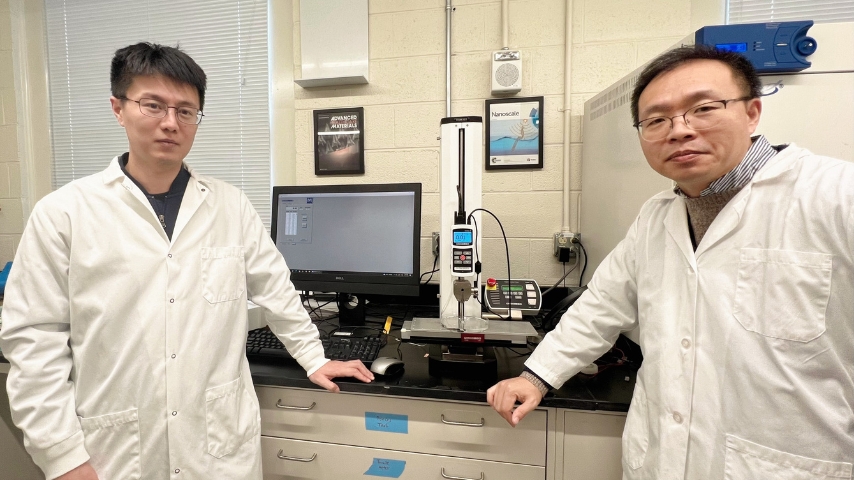
University of Virginia researchers have created water-navigating soft robots to help prove the viability of their fabrication method that includes dropping liquid polymer on liquid substrate.
Manufacturing soft robotics has historically required dropping a polymer skin coating on a solid substrate like glass and then peeling the soft film off the solid surface—a challenging process that often results in tearing.
Researchers at the University of Virginia (UVA) recently developed HydroSpread, a fabrication method that involves dropping a liquid polymer on a liquid substrate, allowing the polymer to spread naturally and peel easily from the substrate.
To prove the method’s viability, the research team created HydroFlexor and HydroBuckler, soft robots that can navigate on water. The technologies are two years in the making and are a culmination of Xu’s experience working on simulations and electronics.
“I started to think about how to use mechanics to explore a different manufacturing technology that can improve the yield or quality of flexible electronics manufacturing,” said Baoxing Xu, professor of mechanical and aerospace engineering at UVA’s School of Engineering and Applied Science. “When we talk about manufacturing, we try to avoid damage or fracture of the material itself. That’s why we started to figure out how to improve the film.”
Using a liquid versus a solid substrate results in an ultra-thin and uniform film that can be easily peeled from the surface without damage. “On solids, we can’t make film very soft and also peel it off easily without causing materials damage,” Xu said. “We assumed we could make softer film on liquids and wanted to see whether it could be possible.”
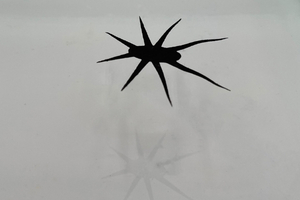 HydroBuckler
Using a liquid substrate increases surface smoothness and leads to significantly weaker film/substrate interactions, which allows the film to be peeled off more easily. Once a soft film is created, it can be shaped with high-resolution laser printing in a variety of patterns, from basic strips and shapes to complex and precise designs, thanks to its liquid substrate.
HydroBuckler
Using a liquid substrate increases surface smoothness and leads to significantly weaker film/substrate interactions, which allows the film to be peeled off more easily. Once a soft film is created, it can be shaped with high-resolution laser printing in a variety of patterns, from basic strips and shapes to complex and precise designs, thanks to its liquid substrate.
“We can shape the film with a regular laser cut, which is scalable and patentable,” Xu said.
The film can be embedded with technology like sensors that use radio frequency to wirelessly transfer data gathered. HydroSpread also is compatible with polymeric and composite inks, according to the research paper submitted by Xu and his team, “Processing soft thin films on liquid surface for seamless creation of on-liquid walkable devices.” This opens the potential for applications in soft electronics, sensors, and actuators.
As a result, technologies fabricated with HydroSpread can be an asset in environmental monitoring and may have a broader impact on healthcare and other industries where flexible materials can provide innovative solutions.
To test HydroSpread’s ability to create soft robots more easily and efficiently, the UVA team—which includes two doctoral and two graduate students at UVA—developed HydroFlexor and HydroBuckler. Though both robots have the same goal of navigating water to collect data, they use different motion modes to locomote.
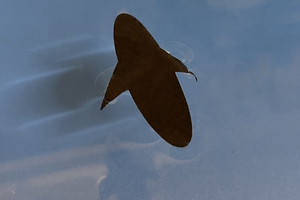 HydroFlexor
HydroBuckler is inspired by a water spider, relying on wings that bend (or buckle) to move it smoothly across the surface of water. It’s always in contact with the water through its many “legs.” HydroFlexor includes fins that use a paddling motion to propel the robot across the water, maintaining constant contact with the water’s surface.
HydroFlexor
HydroBuckler is inspired by a water spider, relying on wings that bend (or buckle) to move it smoothly across the surface of water. It’s always in contact with the water through its many “legs.” HydroFlexor includes fins that use a paddling motion to propel the robot across the water, maintaining constant contact with the water’s surface.
Both robots, including their fins and wings, are printed and cut while still on the liquid substrate, enabling ultraconformal assembly and contact without mechanical delivery or alignment, according to the research paper.
To make the robots move, the team uses infrared heaters, which instigate the robots’ movements across the water. Speed and direction are controlled by adjusting the amount of heat. The team believes future models may be powered by electric, magnetic, or optical fields.
HydroBuckler and HydroFlexor carry custom sensors in the film that allow data like water quality to be tracked for contamination and pollution with increased accuracy. The team manufactured sensors specifically for the soft robots, as all options available on the market were too rigid to connect to a soft device. The custom sensors are small and lightweight to successfully integrate with the soft robots.
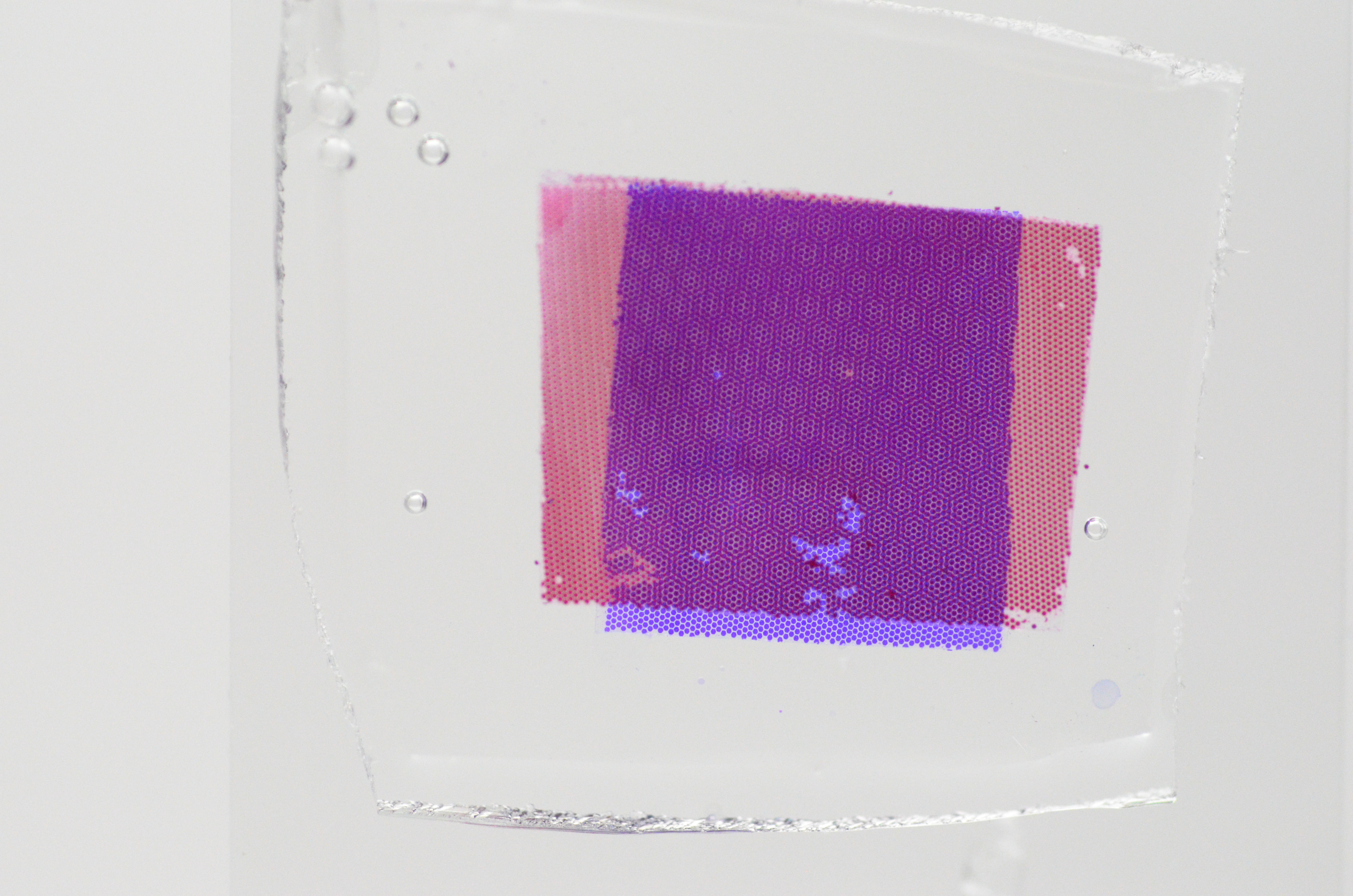 Soft robots embedded with sensors that can send data back to the operator results in a more effective way to gather information from water and other liquids. Typically, devices designed to move on water are rigid and very complicated to manufacture, and they don’t maintain conformal contact with the liquid—leaving potential gaps in data.
“We argue that rigid devices and liquids don’t make perfect contact,” Xu said. ”They are a mechanical mismatch because there is not good contact between the device and the liquid itself, which is not ideal to detect compounds or contamination in the liquids.”
HydroFlexor and HydroBuckler are evidence of the future technology that can be created using HydroSpread, which could revolutionize robotics by providing a more efficient technique to create soft robots in different shapes and patterns that can easily navigate liquid surfaces.
Jessica Porter is a freelance writer in New York City.
Researchers at the University of Virginia (UVA) recently developed HydroSpread, a fabrication method that involves dropping a liquid polymer on a liquid substrate, allowing the polymer to spread naturally and peel easily from the substrate.
To prove the method’s viability, the research team created HydroFlexor and HydroBuckler, soft robots that can navigate on water. The technologies are two years in the making and are a culmination of Xu’s experience working on simulations and electronics.
“I started to think about how to use mechanics to explore a different manufacturing technology that can improve the yield or quality of flexible electronics manufacturing,” said Baoxing Xu, professor of mechanical and aerospace engineering at UVA’s School of Engineering and Applied Science. “When we talk about manufacturing, we try to avoid damage or fracture of the material itself. That’s why we started to figure out how to improve the film.”
The science behind HydroSpread
Using a liquid versus a solid substrate results in an ultra-thin and uniform film that can be easily peeled from the surface without damage. “On solids, we can’t make film very soft and also peel it off easily without causing materials damage,” Xu said. “We assumed we could make softer film on liquids and wanted to see whether it could be possible.”
HydroBuckler
“We can shape the film with a regular laser cut, which is scalable and patentable,” Xu said.
The film can be embedded with technology like sensors that use radio frequency to wirelessly transfer data gathered. HydroSpread also is compatible with polymeric and composite inks, according to the research paper submitted by Xu and his team, “Processing soft thin films on liquid surface for seamless creation of on-liquid walkable devices.” This opens the potential for applications in soft electronics, sensors, and actuators.
As a result, technologies fabricated with HydroSpread can be an asset in environmental monitoring and may have a broader impact on healthcare and other industries where flexible materials can provide innovative solutions.
Proof of concept: HydroFlexor and HydroBuckler
To test HydroSpread’s ability to create soft robots more easily and efficiently, the UVA team—which includes two doctoral and two graduate students at UVA—developed HydroFlexor and HydroBuckler. Though both robots have the same goal of navigating water to collect data, they use different motion modes to locomote.
HydroFlexor
Both robots, including their fins and wings, are printed and cut while still on the liquid substrate, enabling ultraconformal assembly and contact without mechanical delivery or alignment, according to the research paper.
To make the robots move, the team uses infrared heaters, which instigate the robots’ movements across the water. Speed and direction are controlled by adjusting the amount of heat. The team believes future models may be powered by electric, magnetic, or optical fields.
HydroBuckler and HydroFlexor carry custom sensors in the film that allow data like water quality to be tracked for contamination and pollution with increased accuracy. The team manufactured sensors specifically for the soft robots, as all options available on the market were too rigid to connect to a soft device. The custom sensors are small and lightweight to successfully integrate with the soft robots.
Cephalopod Skin Sparks Next-Gen Soft Robotics
Squids, cuttlefish, and other cephalopods are masters of disguise. Now, chemists at the University of Nebraska have created skin that mimics these shape-shifting sea creatures.
“We argue that rigid devices and liquids don’t make perfect contact,” Xu said. ”They are a mechanical mismatch because there is not good contact between the device and the liquid itself, which is not ideal to detect compounds or contamination in the liquids.”
HydroFlexor and HydroBuckler are evidence of the future technology that can be created using HydroSpread, which could revolutionize robotics by providing a more efficient technique to create soft robots in different shapes and patterns that can easily navigate liquid surfaces.
Jessica Porter is a freelance writer in New York City.


The use of robotics in industrial settings continues to accelerate at a rapid pace. Explore this collection to learn more about automation, cobots, AI-enabled robots, customized robots, and drones.