Strawberry Picking Using AI Vision, Silicone Fingers, and a Fan
Strawberry Picking Using AI Vision, Silicone Fingers, and a Fan
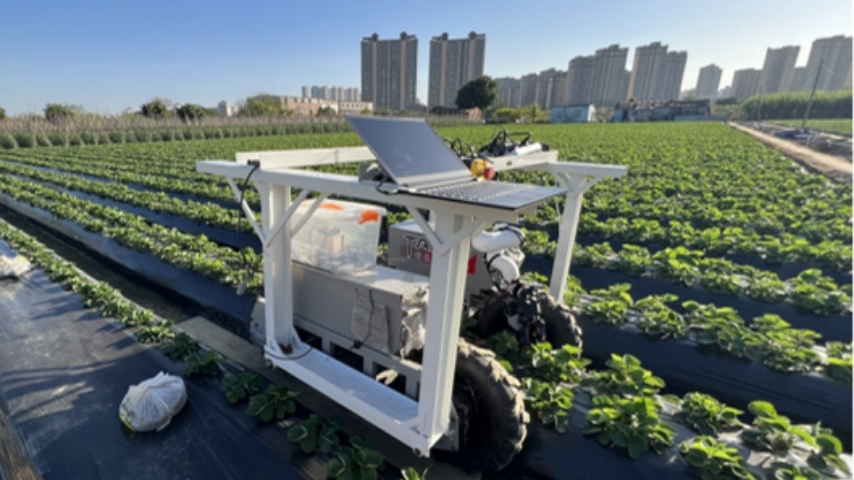
Harvesting strawberries is hard, but now Washington State University researchers designed a robot with an AI vision system, soft silicone fingers, and a fan that moves leaves to get at hidden fruit.
If you’ve ever grown strawberries, you understand the difficulty of harvesting a truly full crop. Strawberries do not ripen evenly, often mature one at a time, and tend to hide beneath a dense canopy of leaves. Their stems are delicate, the fruit bruises easily, and the plants grow low to the ground. Together, these traits make strawberries one of the hardest commercial crops to harvest and one of the few still almost entirely dependent on human labor.
But growers are facing sustained labor shortages and rising production demands. Many crops, from apples to tomatoes, have benefited from decades of automation research, while strawberries, despite being a $3 billion U.S. industry, have lagged behind. A new robotic harvester designed by a Washington State University–led team aims to change that. Their system can “see” and pick ripe berries with a level of nuance that brings automation a step closer to matching human judgment in the field.
“We recognized that occlusion is the major issue,” said lead researcher Zixuan He. “It’s a very common problem for growers, but there is almost no work focused on actively removing the leaf occlusion.” The design, development and testing of the robotic harvester is covered in “Improving picking efficiency under occlusion: Design, development, and field evaluation of an innovative robotic strawberry harvester,” published in Computers and Electronics in Agriculture.
The project began as an NSF-funded effort centered on computer vision for fruit detection rather than picking. But when He and his colleagues visited commercial farms, they noticed something essential: Growers constantly use their hands to sweep leaves aside before harvesting. That simple behavior, which is rarely addressed in automation research, became the central insight for the team’s solution.
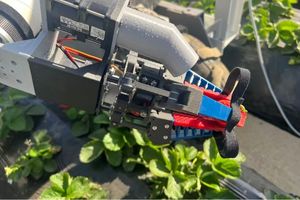 A robotic harvester combines an AI visioning system and a fan to pick strawberries hidden under leaves. Photo: Zixuan He
The prototype integrates mechanical and computational systems tailored to the complexities of soft-fruit harvesting. A global RGB–depth camera mounted above the canopy captures both color information and 3D geometry. The data flows into a two-stage AI pipeline that detects fruit, determines ripeness, and classifies whether the berry is fully visible or hidden behind leaves or stems.
A robotic harvester combines an AI visioning system and a fan to pick strawberries hidden under leaves. Photo: Zixuan He
The prototype integrates mechanical and computational systems tailored to the complexities of soft-fruit harvesting. A global RGB–depth camera mounted above the canopy captures both color information and 3D geometry. The data flows into a two-stage AI pipeline that detects fruit, determines ripeness, and classifies whether the berry is fully visible or hidden behind leaves or stems.
Early iterations showed that typical classification networks struggled when occlusion was partial or irregular. So, the team added a dedicated object-detection step to isolate each strawberry before further analysis.
“We introduced another combined method: object detection plus classification,” He explained. “First we detect the fruit with a bounding box, then we classify whether the strawberry is totally visible or covered by the canopy.”
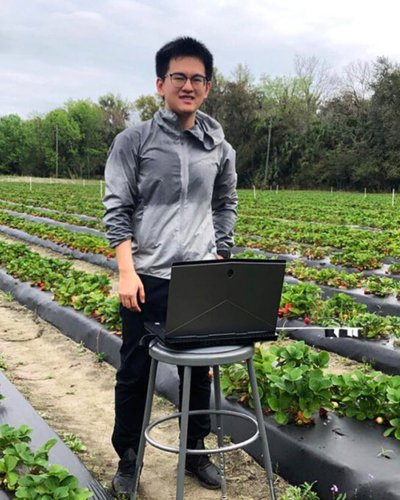 Zixuan He designed and developed a robotic harvesting system for strawberries. Photo: Xiangling Kong
Bounding boxes dramatically reduced background noise and allowed the classifier to focus on ripeness cues such as red color percentage, shape, and pixel area. This combination of spatial localization and region-specific classification gives the robot a level of subtlety that earlier systems lacked. Instead of treating every berry-like object as harvest-ready, the robot can decide when to pick, when to wait, and when to reposition for a better view—an essential trait for a crop that ripens one fruit at a time.
Zixuan He designed and developed a robotic harvesting system for strawberries. Photo: Xiangling Kong
Bounding boxes dramatically reduced background noise and allowed the classifier to focus on ripeness cues such as red color percentage, shape, and pixel area. This combination of spatial localization and region-specific classification gives the robot a level of subtlety that earlier systems lacked. Instead of treating every berry-like object as harvest-ready, the robot can decide when to pick, when to wait, and when to reposition for a better view—an essential trait for a crop that ripens one fruit at a time.
Once a ripe, visible berry is identified, the vision system transmits only the necessary 3D coordinates and classification results to a robotic manipulator. A small fan mounted next to the camera directs airflow to lift obstructing leaves, recreating the leaf-moving action of human pickers. With the berry exposed, a six-degree-of-freedom robotic arm equipped with a soft, compliant end-effector reaches in and removes the fruit without damaging the plant.
These components form a tightly integrated platform in which perception, decision-making, and physical interaction occur as a continuous cycle, and the results are promising. The system achieved a mean average precision of 80.5 percent in strawberry detection and 93.2 percent accuracy in classifying occluded versus visible fruit. And in outdoor field trials, the picking rate increased from 58.1 percent without the fan to 73.9 percent with it.
Although the prototype shows clear potential, hurdles stand between the lab and commercial farms. The current system uses a 6-DOF industrial robotic arm—accurate but too expensive, too delicate, and too maintenance-heavy for large-scale agricultural use. For real-world deployment, the team will need to design a low-cost, rugged, and easily cleaned manipulator that can withstand dirt, humidity, and long operating hours.
Speed is another key challenge. Human pickers can harvest a berry in roughly five to six seconds without breaking stride. The research team hopes to lower the robot’s cycle time from 20 seconds to around seven seconds, a threshold that would make the technology far more competitive.
Despite these challenges, He notes that the system is not intended to replace human labor entirely. “It is a very promising supply to the manual labor, especially during the tiring and long harvesting season,” he said. In states such as California and Florida, where most U.S. strawberries are grown, the workforce often drops by half mid-season due to the intense physical demand of this crop and the overwhelming heat. A reliable robotic assistant could help stabilize production during those periods rather than displace workers.
The team is preparing new NSF proposals to continue developing the system, with priorities including adaptive airflow control, multi-arm coordination, improved field ruggedness, and expanded trials with commercial partners. If successful, the technology could serve as a model for automating other high-value crops with irregular ripening patterns and significant occlusion.
While still early in its development, the robot represents a meaningful step toward a future in which soft-fruit harvesting is safer, more efficient, and more resilient to labor shortages.
Cassandra Kelly is a technology writer in Columbus, Ohio.
But growers are facing sustained labor shortages and rising production demands. Many crops, from apples to tomatoes, have benefited from decades of automation research, while strawberries, despite being a $3 billion U.S. industry, have lagged behind. A new robotic harvester designed by a Washington State University–led team aims to change that. Their system can “see” and pick ripe berries with a level of nuance that brings automation a step closer to matching human judgment in the field.
“We recognized that occlusion is the major issue,” said lead researcher Zixuan He. “It’s a very common problem for growers, but there is almost no work focused on actively removing the leaf occlusion.” The design, development and testing of the robotic harvester is covered in “Improving picking efficiency under occlusion: Design, development, and field evaluation of an innovative robotic strawberry harvester,” published in Computers and Electronics in Agriculture.
Sweeping leaves aside before harvesting
The project began as an NSF-funded effort centered on computer vision for fruit detection rather than picking. But when He and his colleagues visited commercial farms, they noticed something essential: Growers constantly use their hands to sweep leaves aside before harvesting. That simple behavior, which is rarely addressed in automation research, became the central insight for the team’s solution.
A robotic harvester combines an AI visioning system and a fan to pick strawberries hidden under leaves. Photo: Zixuan He
Early iterations showed that typical classification networks struggled when occlusion was partial or irregular. So, the team added a dedicated object-detection step to isolate each strawberry before further analysis.
“We introduced another combined method: object detection plus classification,” He explained. “First we detect the fruit with a bounding box, then we classify whether the strawberry is totally visible or covered by the canopy.”
Zixuan He designed and developed a robotic harvesting system for strawberries. Photo: Xiangling Kong
Once a ripe, visible berry is identified, the vision system transmits only the necessary 3D coordinates and classification results to a robotic manipulator. A small fan mounted next to the camera directs airflow to lift obstructing leaves, recreating the leaf-moving action of human pickers. With the berry exposed, a six-degree-of-freedom robotic arm equipped with a soft, compliant end-effector reaches in and removes the fruit without damaging the plant.
These components form a tightly integrated platform in which perception, decision-making, and physical interaction occur as a continuous cycle, and the results are promising. The system achieved a mean average precision of 80.5 percent in strawberry detection and 93.2 percent accuracy in classifying occluded versus visible fruit. And in outdoor field trials, the picking rate increased from 58.1 percent without the fan to 73.9 percent with it.
Commercial challenges
Although the prototype shows clear potential, hurdles stand between the lab and commercial farms. The current system uses a 6-DOF industrial robotic arm—accurate but too expensive, too delicate, and too maintenance-heavy for large-scale agricultural use. For real-world deployment, the team will need to design a low-cost, rugged, and easily cleaned manipulator that can withstand dirt, humidity, and long operating hours.
Speed is another key challenge. Human pickers can harvest a berry in roughly five to six seconds without breaking stride. The research team hopes to lower the robot’s cycle time from 20 seconds to around seven seconds, a threshold that would make the technology far more competitive.
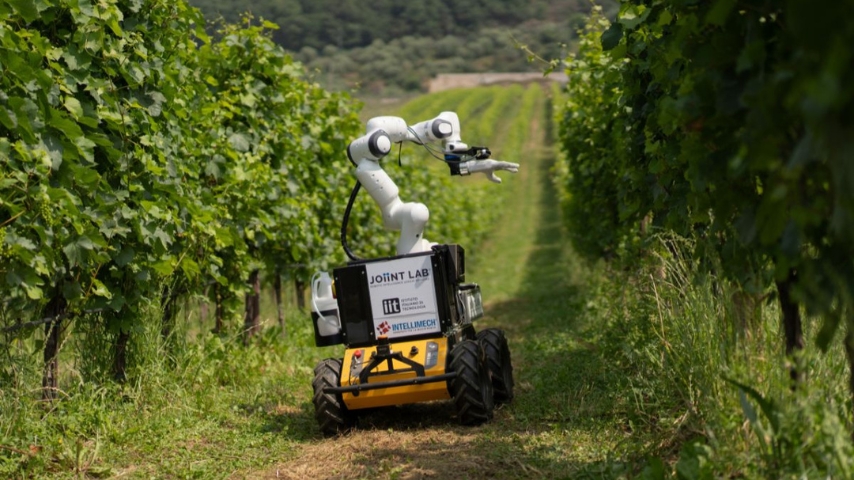
Robot Introduces Technology to Terroir
Italian Institute of Technology’s Soft Robotics for Human Cooperation and Rehabilitation Laboratory is working on innovative technology to support economic growth and sustainable agriculture.
Despite these challenges, He notes that the system is not intended to replace human labor entirely. “It is a very promising supply to the manual labor, especially during the tiring and long harvesting season,” he said. In states such as California and Florida, where most U.S. strawberries are grown, the workforce often drops by half mid-season due to the intense physical demand of this crop and the overwhelming heat. A reliable robotic assistant could help stabilize production during those periods rather than displace workers.
The team is preparing new NSF proposals to continue developing the system, with priorities including adaptive airflow control, multi-arm coordination, improved field ruggedness, and expanded trials with commercial partners. If successful, the technology could serve as a model for automating other high-value crops with irregular ripening patterns and significant occlusion.
While still early in its development, the robot represents a meaningful step toward a future in which soft-fruit harvesting is safer, more efficient, and more resilient to labor shortages.
Cassandra Kelly is a technology writer in Columbus, Ohio.


The use of robotics in industrial settings continues to accelerate at a rapid pace. Explore this collection to learn more about automation, cobots, AI-enabled robots, customized robots, and drones.