A Better Step for People with Above-Knee Amputations
A Better Step for People with Above-Knee Amputations
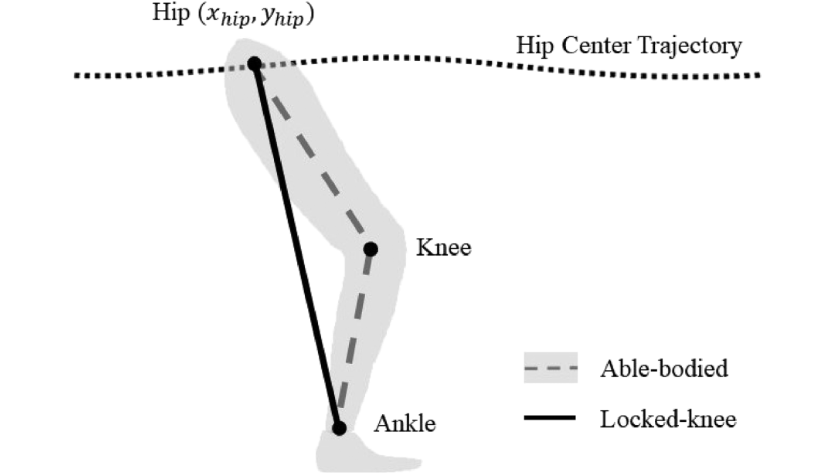
Researchers designed an affordable prosthetic foot that helps people with above-knee amputations achieve a more natural stride.
The knee, to state the obvious, has a lot to do with the way we walk. Among other benefits, the hinge in the middle of our legs allows those legs to move at the hip with an efficient, more or less back-and-forth motion. Try walking without bending your knees, and you’ll find that your hips swing out a bit to accommodate the stiff leg.
People with above-knee amputations typically walk without flexing their knee during the early part of the step. Despite this difference from the strides of people with below-knee amputations, both are typically given the same type of prosthetic foot.
“If we look at the prosthetic feet that are available on the market, there are prosthetic feet that are designed for both below- and above-knee amputations. There are prosthetic feet that are designed just for below-knee amputations. And there’s nothing designed for just above-knee amputations—which makes no sense, because people with above-knee amputations have a different gait to begin with,” said Nina Petelina, a researcher at MIT GEAR lab at the time of this study. As a result, the prosthetic feet used for above-knee amputations may not absorb ground forces in efficient, natural, or comfortable ways.
You Might Also Like: Engineering for Adaptability and Function First
Though prosthetic knees on the market can give people with above-knee amputations a more able-bodied gait, and therefore allow them to use the same type of foot as people with below-knee amputations, they are prohibitively expensive for most people in much of the world.
Petelina first investigated whether an affordable prosthetic knee could replicate the initial bend that happens after the foot strikes the ground. “What I noticed is that no matter how much I tried to replicate that early stance flexion functionality, it was just not going to happen. No solution could be low cost and work well for that,” Petelina said.
It all came down to the foot.
“Having good, predictable replication of the ground reaction forces orientation and location at the foot throughout the step is especially important in low resource settings, where patients are very unlikely to have access to these fancy microprocessor high-tech knees,” said Amanda Stack, also a mechanical engineer and researcher at MIT.
What Petelina had done was create a system, which they call the Hip Trajectory Error (HTE) framework, for building customized feet for people with above-knee amputations. After taking some basic information from a patient—mass, height, and foot length—an optimizer calculates the shape and stiffness of an ideal foot for handling the load of body weight during a stride. “It can predict how the foot will deflect, where the hip is going to be located, and the trajectory through the step,” Petelina said.
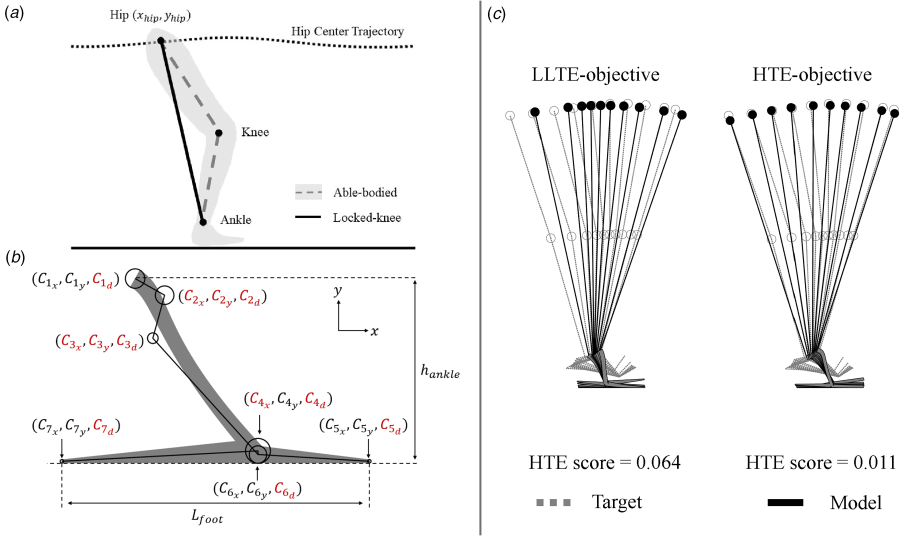 The figure shows how the Hip Trajectory Error framework works: first, by modeling hip motion during a step; second, by defining the foot prototype’s shape and stiffness; and third, by comparing the predicted performance of feet designed for above-knee and below-knee amputations.
The research team compared the ground reaction forces of able-bodied feet to those of below-knee amputations and those of above-knee amputations. The differences were revealing. “It really shows that you should not use prosthetic feet designed for people with below-knee amputations on people with above-knee amputations,” Petelina said.
Though the feet they subsequently produced were tailored for each individual using the optimizer, the feet for people with above-knee amputations showed consistent differences from the standard ones for people with below-knee amputations. Because they don’t need to bend with the flex of a knee, the heels absorb more of the shock. There’s less curve to the new feet, and they have longer heels.
Discover the Benefits of ASME Membership
What’s more, after just 15 minutes of walking with above-knee-designed feet, people with above-knee amputations achieved walking performance similar to what they experienced with carefully fitted and tuned daily-use prosthetic feet. The users noticed the difference right away, and some even said it felt like their sockets fit better. Longer-term studies may show even greater improvements.
Because the feet are intended for lower-income patients, the team used Nylon 6/6, a far less expensive material than the carbon fiber often used in prosthetic feet. The Nylon 6/6 feet performed as well or better than their carbon fiber counterparts, suggesting they could be affordable for people in low-income settings.
What’s next for the project? “We need to make sure that it meets the needs of the people that would distribute it,” Stack said. “We need to do socio-technical economic analyses to understand the actual needs of the clinical landscape where we want to have these distributed.” They are hoping to do long term studies, likely in India, where there’s a need and where they have partners.
“Oftentimes you’ll have a technology that performs really well in a lab. It meets all the appropriate standards, and then you bring it to a low-resource setting somewhere, and distribute it, and it immediately breaks,” Stack said. “Or it doesn’t meet some cultural need, or it doesn’t meet some other social need that you didn’t consider as an engineer, but that you would learn if people actually used it in their real lives.”
Michael Abrams is a technology writer in Westfield, N.J.
People with above-knee amputations typically walk without flexing their knee during the early part of the step. Despite this difference from the strides of people with below-knee amputations, both are typically given the same type of prosthetic foot.
“If we look at the prosthetic feet that are available on the market, there are prosthetic feet that are designed for both below- and above-knee amputations. There are prosthetic feet that are designed just for below-knee amputations. And there’s nothing designed for just above-knee amputations—which makes no sense, because people with above-knee amputations have a different gait to begin with,” said Nina Petelina, a researcher at MIT GEAR lab at the time of this study. As a result, the prosthetic feet used for above-knee amputations may not absorb ground forces in efficient, natural, or comfortable ways.
You Might Also Like: Engineering for Adaptability and Function First
Though prosthetic knees on the market can give people with above-knee amputations a more able-bodied gait, and therefore allow them to use the same type of foot as people with below-knee amputations, they are prohibitively expensive for most people in much of the world.
Petelina first investigated whether an affordable prosthetic knee could replicate the initial bend that happens after the foot strikes the ground. “What I noticed is that no matter how much I tried to replicate that early stance flexion functionality, it was just not going to happen. No solution could be low cost and work well for that,” Petelina said.
Taking prosthetic design in stride
It all came down to the foot.
“Having good, predictable replication of the ground reaction forces orientation and location at the foot throughout the step is especially important in low resource settings, where patients are very unlikely to have access to these fancy microprocessor high-tech knees,” said Amanda Stack, also a mechanical engineer and researcher at MIT.
What Petelina had done was create a system, which they call the Hip Trajectory Error (HTE) framework, for building customized feet for people with above-knee amputations. After taking some basic information from a patient—mass, height, and foot length—an optimizer calculates the shape and stiffness of an ideal foot for handling the load of body weight during a stride. “It can predict how the foot will deflect, where the hip is going to be located, and the trajectory through the step,” Petelina said.
The figure shows how the Hip Trajectory Error framework works: first, by modeling hip motion during a step; second, by defining the foot prototype’s shape and stiffness; and third, by comparing the predicted performance of feet designed for above-knee and below-knee amputations.
The research team compared the ground reaction forces of able-bodied feet to those of below-knee amputations and those of above-knee amputations. The differences were revealing. “It really shows that you should not use prosthetic feet designed for people with below-knee amputations on people with above-knee amputations,” Petelina said.
Though the feet they subsequently produced were tailored for each individual using the optimizer, the feet for people with above-knee amputations showed consistent differences from the standard ones for people with below-knee amputations. Because they don’t need to bend with the flex of a knee, the heels absorb more of the shock. There’s less curve to the new feet, and they have longer heels.
Discover the Benefits of ASME Membership
What’s more, after just 15 minutes of walking with above-knee-designed feet, people with above-knee amputations achieved walking performance similar to what they experienced with carefully fitted and tuned daily-use prosthetic feet. The users noticed the difference right away, and some even said it felt like their sockets fit better. Longer-term studies may show even greater improvements.
Affordable prosthetics for low-resource settings
Because the feet are intended for lower-income patients, the team used Nylon 6/6, a far less expensive material than the carbon fiber often used in prosthetic feet. The Nylon 6/6 feet performed as well or better than their carbon fiber counterparts, suggesting they could be affordable for people in low-income settings.
What’s next for the project? “We need to make sure that it meets the needs of the people that would distribute it,” Stack said. “We need to do socio-technical economic analyses to understand the actual needs of the clinical landscape where we want to have these distributed.” They are hoping to do long term studies, likely in India, where there’s a need and where they have partners.
“Oftentimes you’ll have a technology that performs really well in a lab. It meets all the appropriate standards, and then you bring it to a low-resource setting somewhere, and distribute it, and it immediately breaks,” Stack said. “Or it doesn’t meet some cultural need, or it doesn’t meet some other social need that you didn’t consider as an engineer, but that you would learn if people actually used it in their real lives.”
Michael Abrams is a technology writer in Westfield, N.J.
Researchers designed an affordable prosthetic foot that helps people with above-knee amputations achieve a more natural stride.

Freelance writer based in New Jersey
Related Content

Sep 1, 2026
The Next Robotics Frontier


The robotics industry often focuses on scale, automation, and valuations. But a quieter group of founders is instead asking what robotics have overlooked as they innovate with compassion in mind.
Aug 27, 2026
Reimagining Prosthetic Design

Smart tech and 3D printing transform socket design, making prosthetics lighter, more comfortable, and shaped by the patient's own movement.

Aug 20, 2026
Artificial Muscles That Move to Sound

Microbubbles of varying sizes embedded in polymers have different acoustic responses, which can help move artificial muscles made from this material.
Jul 13, 2026
Exoskeleton Improves Mobility for Stroke Survivors

University of Utah researchers are piloting a 5.5-pound wearable robotic solution to help individuals with hemiparesis walk.