A Self-Steering, Beetle-Like Robot, Sans Electronics
A Self-Steering, Beetle-Like Robot, Sans Electronics
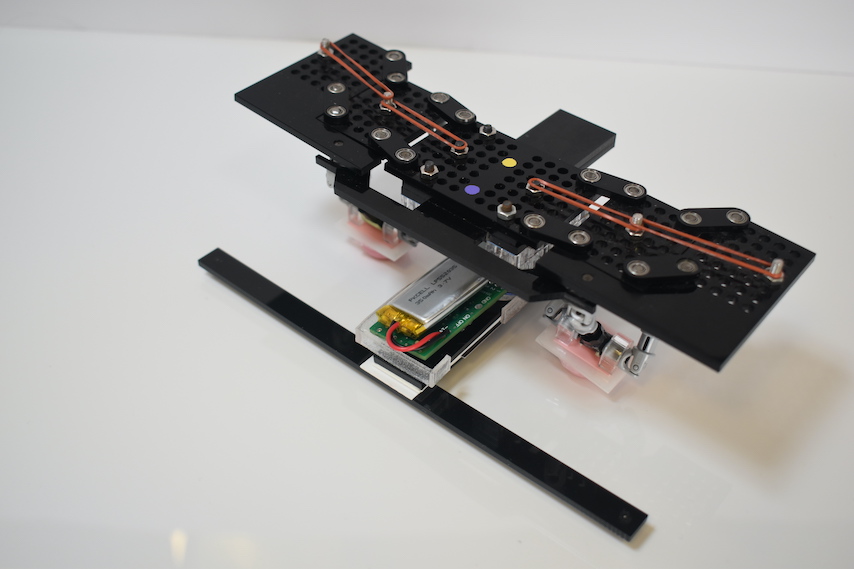
A beetle-like robot from Harvard SEAS navigates obstacles without sensors or code, relying on elastic energy and joint geometry to mechanically decide how and when to move.
A new robot from Harvard’s School of Engineering and Applied Sciences (SEAS) takes a minimalist approach to mechanical movement, using only rubber bands, levers, and carefully shaped joints to demonstrate a level of control and responsiveness that many roboticists typically achieve through electronics, computation, or sensing hardware.
“The idea isn’t to counter computerization,” said Leon Kamp, lead author on the research and a graduate student whose background spans engineering and architecture. “It’s more of a different way of doing things—another item in the toolbox.”
At a glance, the robot resembles a small beetle, complete with long, flexible antennae sweeping ahead as it crawls across a surface. Its body is composed of block-like units, each with a simple rotational joint.
But instead of designing these joints for efficiency and smooth rotation, which is a standard goal in robotics, the team did the opposite. The researchers intentionally introduced mechanical resistance, threading a rubber band across each joint so that it must stretch as the joint rotates. This added energy cost became the foundation for sequencing the robot’s movements.
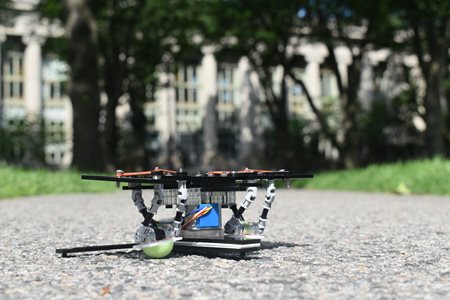 By embedding decision-making into its mechanical structure, this Harvard SEAS robot responds to obstacles through elastic energy shifts rather than electronics. image: Harvard’s School of Engineering and Applied Sciences
When one of the antennae gently touches an obstacle, that small deformation pulls on the corresponding rubber band, subtly changing the joint’s energy landscape. That tiny shift, on the order of a millimeter, causes the robot’s gait to reverse, allowing it to turn and avoid the object.
By embedding decision-making into its mechanical structure, this Harvard SEAS robot responds to obstacles through elastic energy shifts rather than electronics. image: Harvard’s School of Engineering and Applied Sciences
When one of the antennae gently touches an obstacle, that small deformation pulls on the corresponding rubber band, subtly changing the joint’s energy landscape. That tiny shift, on the order of a millimeter, causes the robot’s gait to reverse, allowing it to turn and avoid the object.
The mechanism is so sensitive that the robot reliably reroutes itself with less than one newton of contact force. And it does all this entirely mechanically—no sensors, no motors altering direction, no microcontroller running a behavior script.
Kamp explained that the research builds upon more than six years of work in the Bertoldi Group on energy-based sequencing in multistable structures. Early studies showed that rubber bands or elastic shells could be arranged so that certain movements required less energy than others, creating predictable sequences of motion.
“What we actually do is place the rubber band over the unit so that if it stretches, you get a bit of energy cost from moving a joint,” he said. “By adjusting how the band stretches over the joint’s trajectory, we can shape the joint’s energy landscape.”
That energy landscape determines the robot’s behavior. When two joints are connected, the robot naturally follows the path of least resistance. If one rubber band exerts less tension, that joint rotates first, but if the geometry introduces bistability, the return motion can follow a completely different path. With the right configuration, the robot executes a full stepping cycle: lift, swing, lower, retract. Change the band configuration and the robot reverses direction.
You May Want To Read: The Best of Both Worlds for Robotic Swarms
This form of mechanical programming echoes ideas from physical logic and analog computation: the mechanism itself decides how to move based on the arrangement of elastic energy. Kamp noted that this project evolved from many iterations and contributions.
“Multiple people kind of slowly built ideas,” he said. “These mechanisms were doing something funny, stepping in all these ways, and we didn’t really know an application for it. That changed when we started thinking about closing the loop with physical inputs.”
Introducing antennae was the breakthrough that transformed the work from a clever mechanism into a robot capable of interacting with its environment. A gentle brush against a wall or object shifts the rubber band just enough to switch the gait sequence. Kamp designed the antennae to be extremely soft but not so compliant that they introduced noise or instability.
“If you make them too stiff, the robot just pushes into the wall. If they’re too soft, the difference in energy becomes smaller and it’s very hard to get it to do what you want,” he said.
Balancing all of these variables – friction with the ground, antenna stiffness, band elasticity, fabrication imperfections – proved one of the project’s biggest engineering challenges. The team discovered that small variations could affect behavior. But with careful tuning, they struck the right balance between sensitivity and stability.
Despite its mechanical intelligence, Kamp does not view the robot as a response against AI or digital robotics. Instead, he sees it as complementary.
Discover the Benefits of ASME Membership
“You don’t always need fancy electronics to perform basic physical functions,” he said. “You can put that intelligence or energy into other aspects of what the robot needs to do.”
He hopes this approach can help roboticists work in environments where wiring, sensors, or battery-powered components are impractical, such as soft robots, micro-robots, or small-scale devices constrained by size, power, or fabrication complexity.
Kamp is already applying these ideas in several new directions. In collaboration with Rob Wood’s lab, he is exploring insect-scale robots driven by a single actuator, where passive sensing might again play a role in allowing the robot to adapt to obstacles.
Beyond locomotion, he is also drawn to the idea of reprogrammable materials—systems whose mechanical behavior can be altered without electronics. Kamp’s ongoing work in origami-inspired structures aims to create sheets that can fold into multiple shapes using purely elastic rules, a concept that could lead to adaptive aerospace surfaces, deployable structures, or multifunctional robots.
Cassandra Kelly is a technology writer in Columbus, Ohio.
“The idea isn’t to counter computerization,” said Leon Kamp, lead author on the research and a graduate student whose background spans engineering and architecture. “It’s more of a different way of doing things—another item in the toolbox.”
At a glance, the robot resembles a small beetle, complete with long, flexible antennae sweeping ahead as it crawls across a surface. Its body is composed of block-like units, each with a simple rotational joint.
But instead of designing these joints for efficiency and smooth rotation, which is a standard goal in robotics, the team did the opposite. The researchers intentionally introduced mechanical resistance, threading a rubber band across each joint so that it must stretch as the joint rotates. This added energy cost became the foundation for sequencing the robot’s movements.
By embedding decision-making into its mechanical structure, this Harvard SEAS robot responds to obstacles through elastic energy shifts rather than electronics. image: Harvard’s School of Engineering and Applied Sciences
The mechanism is so sensitive that the robot reliably reroutes itself with less than one newton of contact force. And it does all this entirely mechanically—no sensors, no motors altering direction, no microcontroller running a behavior script.
Kamp explained that the research builds upon more than six years of work in the Bertoldi Group on energy-based sequencing in multistable structures. Early studies showed that rubber bands or elastic shells could be arranged so that certain movements required less energy than others, creating predictable sequences of motion.
“What we actually do is place the rubber band over the unit so that if it stretches, you get a bit of energy cost from moving a joint,” he said. “By adjusting how the band stretches over the joint’s trajectory, we can shape the joint’s energy landscape.”
That energy landscape determines the robot’s behavior. When two joints are connected, the robot naturally follows the path of least resistance. If one rubber band exerts less tension, that joint rotates first, but if the geometry introduces bistability, the return motion can follow a completely different path. With the right configuration, the robot executes a full stepping cycle: lift, swing, lower, retract. Change the band configuration and the robot reverses direction.
You May Want To Read: The Best of Both Worlds for Robotic Swarms
This form of mechanical programming echoes ideas from physical logic and analog computation: the mechanism itself decides how to move based on the arrangement of elastic energy. Kamp noted that this project evolved from many iterations and contributions.
“Multiple people kind of slowly built ideas,” he said. “These mechanisms were doing something funny, stepping in all these ways, and we didn’t really know an application for it. That changed when we started thinking about closing the loop with physical inputs.”
Introducing antennae was the breakthrough that transformed the work from a clever mechanism into a robot capable of interacting with its environment. A gentle brush against a wall or object shifts the rubber band just enough to switch the gait sequence. Kamp designed the antennae to be extremely soft but not so compliant that they introduced noise or instability.
“If you make them too stiff, the robot just pushes into the wall. If they’re too soft, the difference in energy becomes smaller and it’s very hard to get it to do what you want,” he said.
Balancing all of these variables – friction with the ground, antenna stiffness, band elasticity, fabrication imperfections – proved one of the project’s biggest engineering challenges. The team discovered that small variations could affect behavior. But with careful tuning, they struck the right balance between sensitivity and stability.
Despite its mechanical intelligence, Kamp does not view the robot as a response against AI or digital robotics. Instead, he sees it as complementary.
Discover the Benefits of ASME Membership
“You don’t always need fancy electronics to perform basic physical functions,” he said. “You can put that intelligence or energy into other aspects of what the robot needs to do.”
He hopes this approach can help roboticists work in environments where wiring, sensors, or battery-powered components are impractical, such as soft robots, micro-robots, or small-scale devices constrained by size, power, or fabrication complexity.
Kamp is already applying these ideas in several new directions. In collaboration with Rob Wood’s lab, he is exploring insect-scale robots driven by a single actuator, where passive sensing might again play a role in allowing the robot to adapt to obstacles.
Beyond locomotion, he is also drawn to the idea of reprogrammable materials—systems whose mechanical behavior can be altered without electronics. Kamp’s ongoing work in origami-inspired structures aims to create sheets that can fold into multiple shapes using purely elastic rules, a concept that could lead to adaptive aerospace surfaces, deployable structures, or multifunctional robots.
Cassandra Kelly is a technology writer in Columbus, Ohio.
A beetle-like robot from Harvard SEAS navigates obstacles without sensors or code, relying on elastic energy and joint geometry to mechanically decide how and when to move.

Author and owner of Like-Minded Marketing
Related Content

Mar 2, 2026
Deep Sea Device Captures Whale Communication

A deep-sea device developed by Harvard researchers captures whale communication.
Feb 24, 2026
Wearable Exoskeleton Uses AI to Assist Human Movement


An AI-controlled exoskeleton developed at Georgia Tech can reduce biological joint effort by providing assistive torque at the hip and knee.

Feb 9, 2026
Tiny Robots Now Can Explore and Treat the Body

A McMaster roboticist is developing tiny magnetic robots that have the ability to deliver drugs, take biopsies, and explore hard to reach areas inside the body.
Jan 27, 2026
Fabrication Method Leads to Soft Robotics Advances

UVA researchers have created water-navigating soft robots to help prove the viability of their fabrication method that includes liquid polymer and substrate.