Bio-Logger Puts Whales on Record
Bio-Logger Puts Whales on Record
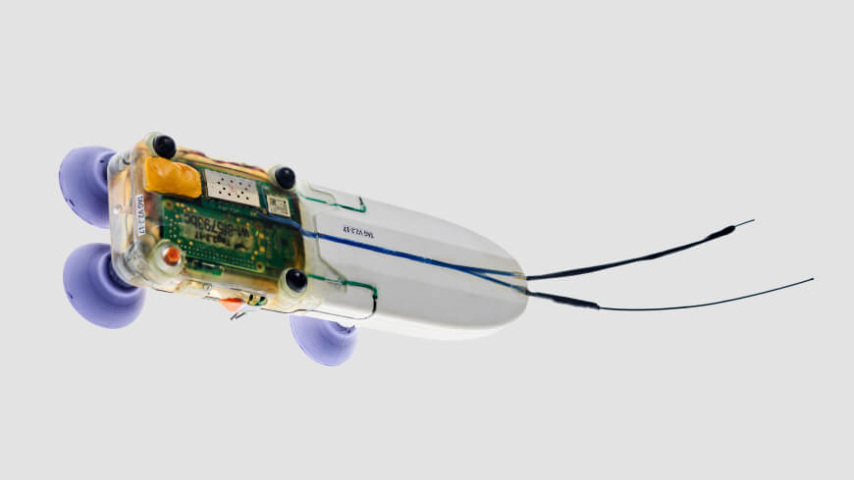
The scientific quest to decode whale song is aided by a new generation of underwater recording devices inspired by soft robotics.
In the unfathomable depths of the ocean, sperm whales produce sophisticated combinations of rhythmic clicks that can travel for miles. For decades, scientists have tried to understand this complex style of communication, but were often stymied by an inability to follow sperm whales deep below the surface, where the majority of these staccato transmissions occur.
Now, a multi-disciplinary research group from Project Cetacean Translation Initiative (CETI), including engineers from Harvard University’s John A. Paulson School of Engineering and Applied Sciences (SEAS), have developed a unique “bio-logger” listening device to capture this unique form of whale song. The team hopes to pair it with machine learning in order to decode and understand whale communication.
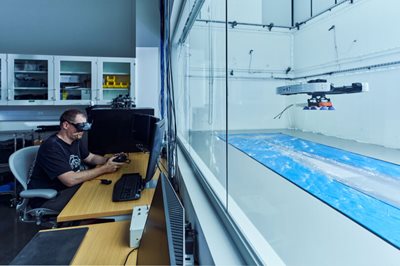 Lead Engineer at Project CETI, Daniel Vogt, testing equipment in the lab. Photo: Spencer Lowell
“There are many ways we can listen to whales—you can hear their clicks from quite far away,” said Daniel Vogt, lead engineer at Project CETI. “We have listening stations that float on the water, and we can put devices on moving boats. But because [sperm whales] spend most of the time under the water—15 minutes up to 1000 meters under the water and 10 minutes at the surface to breathe—it’s hard to capture the communication and all the context around it using those ways.”
Lead Engineer at Project CETI, Daniel Vogt, testing equipment in the lab. Photo: Spencer Lowell
“There are many ways we can listen to whales—you can hear their clicks from quite far away,” said Daniel Vogt, lead engineer at Project CETI. “We have listening stations that float on the water, and we can put devices on moving boats. But because [sperm whales] spend most of the time under the water—15 minutes up to 1000 meters under the water and 10 minutes at the surface to breathe—it’s hard to capture the communication and all the context around it using those ways.”
To address the issue, Vogt and colleagues developed the bio-logger, a listening “tag” built with soft robotics, placed directly on the sperm whale. It allows researchers to record “crisp” sound, much like a person wearing a microphone on their collar, as well as get information about what is happening in the ocean while communications are taking place. But coming up with the right design meant addressing a series of challenges, starting with how to attach the tag to the whale.
Discover the Benefits of ASME Membership
“We don’t want to penetrate the skin or use something that might be harmful. We are using suction cups—and it was hard to know how to design them because we had no idea what the surface we are attaching the tag to looks or feels like,” Vogt said. “We only had some vague descriptions like a car tire.”
The second challenge was the depth at which whales can dive. At 1000 meters, temperatures drop, and pressure rises. The device would have to function despite these extreme conditions.
“We can’t have any voids in the tags, otherwise it will implode because of the high pressure,” he said. “So, we have to have a design where everything just holds together and works.”
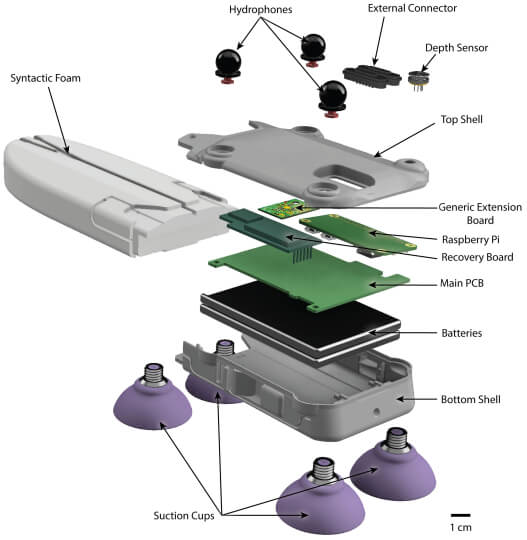 A view of the CETI bio-logger's main components. Image: Harvard University
The team explored combining hard and soft materials, based on Vogt’s expertise in soft robotic design. The resulting tag includes three synchronized hydrophones, a variety of sensors, including pressure and depth, a printed circuit board, GPS logging, batteries, transmission equipment, and suction cups.
“There are a lot of little tricks involved with getting things to work underwater so your electronics don’t crush under pressure, and withstand a harsh environment,” he said. “We want people to get inspiration from our work so they do not need to reinvent the wheel.”
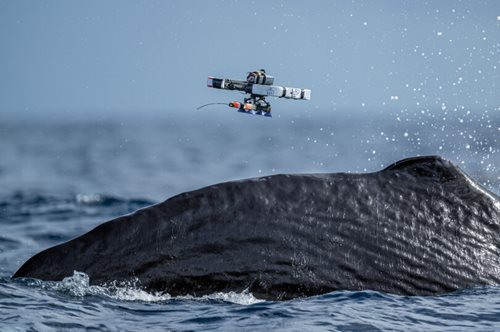 The non-invasive bio-logger attaches to the skin of sperm whales via suction cups designed by Harvard robotics researchers with specially adapted drones. Photo: Jaime Rojo
The Project CETI team deploys the bio-logger via drone as the whales surface to breathe. The synchronized hydrophones allow researchers to record multiple whales communicating to help them “connect the dots.” They have successfully deployed the device in the Caribbean to record sperm whales during numerous deep-sea dives. With those recordings in hand, Project CETI hopes to leverage machine learning techniques to decode the messages.
The non-invasive bio-logger attaches to the skin of sperm whales via suction cups designed by Harvard robotics researchers with specially adapted drones. Photo: Jaime Rojo
The Project CETI team deploys the bio-logger via drone as the whales surface to breathe. The synchronized hydrophones allow researchers to record multiple whales communicating to help them “connect the dots.” They have successfully deployed the device in the Caribbean to record sperm whales during numerous deep-sea dives. With those recordings in hand, Project CETI hopes to leverage machine learning techniques to decode the messages.
Yet, Vogt said, he and his team are already working on a new and improved version of the bio-logger. They want to add satellite capabilities to help recover the tag at the end of each mission.
“This will give us an estimate of where the tag is anywhere in the world, which will really ease the recovery,” he said. “But beyond that, we are also trying to make the tag much smaller.”
The current size works well for sperm whales, which Vogt said are “enormous,” but to listen to sounds from other species, a smaller bio-logger would be beneficial. Vogt would also like to make the tags more energy efficient.
“That would allow longer deployments, less drag on the tag, and simplify our drone delivery,” he said.
 But what’s most important to Vogt is that he and his team can share their advances with the rest of the research community. That’s why all of their work is open source and available to the public.
“Obviously, our tag is very focused on Project CETI’s goals and mission,” he said. “But we want to go toward the openness of science, sharing our design so other research groups could use these bio-loggers for other purposes and species. This work could translate to many other projects, anything that requires studying sound and other sensing capabilities, and I hope that what we’ve learned will be there to help make things easier and get them faster to completion.”
Kayt Sukel is a technology writer and author in Houston.
Now, a multi-disciplinary research group from Project Cetacean Translation Initiative (CETI), including engineers from Harvard University’s John A. Paulson School of Engineering and Applied Sciences (SEAS), have developed a unique “bio-logger” listening device to capture this unique form of whale song. The team hopes to pair it with machine learning in order to decode and understand whale communication.
Lead Engineer at Project CETI, Daniel Vogt, testing equipment in the lab. Photo: Spencer Lowell
To address the issue, Vogt and colleagues developed the bio-logger, a listening “tag” built with soft robotics, placed directly on the sperm whale. It allows researchers to record “crisp” sound, much like a person wearing a microphone on their collar, as well as get information about what is happening in the ocean while communications are taking place. But coming up with the right design meant addressing a series of challenges, starting with how to attach the tag to the whale.
Discover the Benefits of ASME Membership
“We don’t want to penetrate the skin or use something that might be harmful. We are using suction cups—and it was hard to know how to design them because we had no idea what the surface we are attaching the tag to looks or feels like,” Vogt said. “We only had some vague descriptions like a car tire.”
The second challenge was the depth at which whales can dive. At 1000 meters, temperatures drop, and pressure rises. The device would have to function despite these extreme conditions.
“We can’t have any voids in the tags, otherwise it will implode because of the high pressure,” he said. “So, we have to have a design where everything just holds together and works.”
A view of the CETI bio-logger's main components. Image: Harvard University
The team explored combining hard and soft materials, based on Vogt’s expertise in soft robotic design. The resulting tag includes three synchronized hydrophones, a variety of sensors, including pressure and depth, a printed circuit board, GPS logging, batteries, transmission equipment, and suction cups.
“There are a lot of little tricks involved with getting things to work underwater so your electronics don’t crush under pressure, and withstand a harsh environment,” he said. “We want people to get inspiration from our work so they do not need to reinvent the wheel.”
The non-invasive bio-logger attaches to the skin of sperm whales via suction cups designed by Harvard robotics researchers with specially adapted drones. Photo: Jaime Rojo
Yet, Vogt said, he and his team are already working on a new and improved version of the bio-logger. They want to add satellite capabilities to help recover the tag at the end of each mission.
“This will give us an estimate of where the tag is anywhere in the world, which will really ease the recovery,” he said. “But beyond that, we are also trying to make the tag much smaller.”
The current size works well for sperm whales, which Vogt said are “enormous,” but to listen to sounds from other species, a smaller bio-logger would be beneficial. Vogt would also like to make the tags more energy efficient.
“That would allow longer deployments, less drag on the tag, and simplify our drone delivery,” he said.
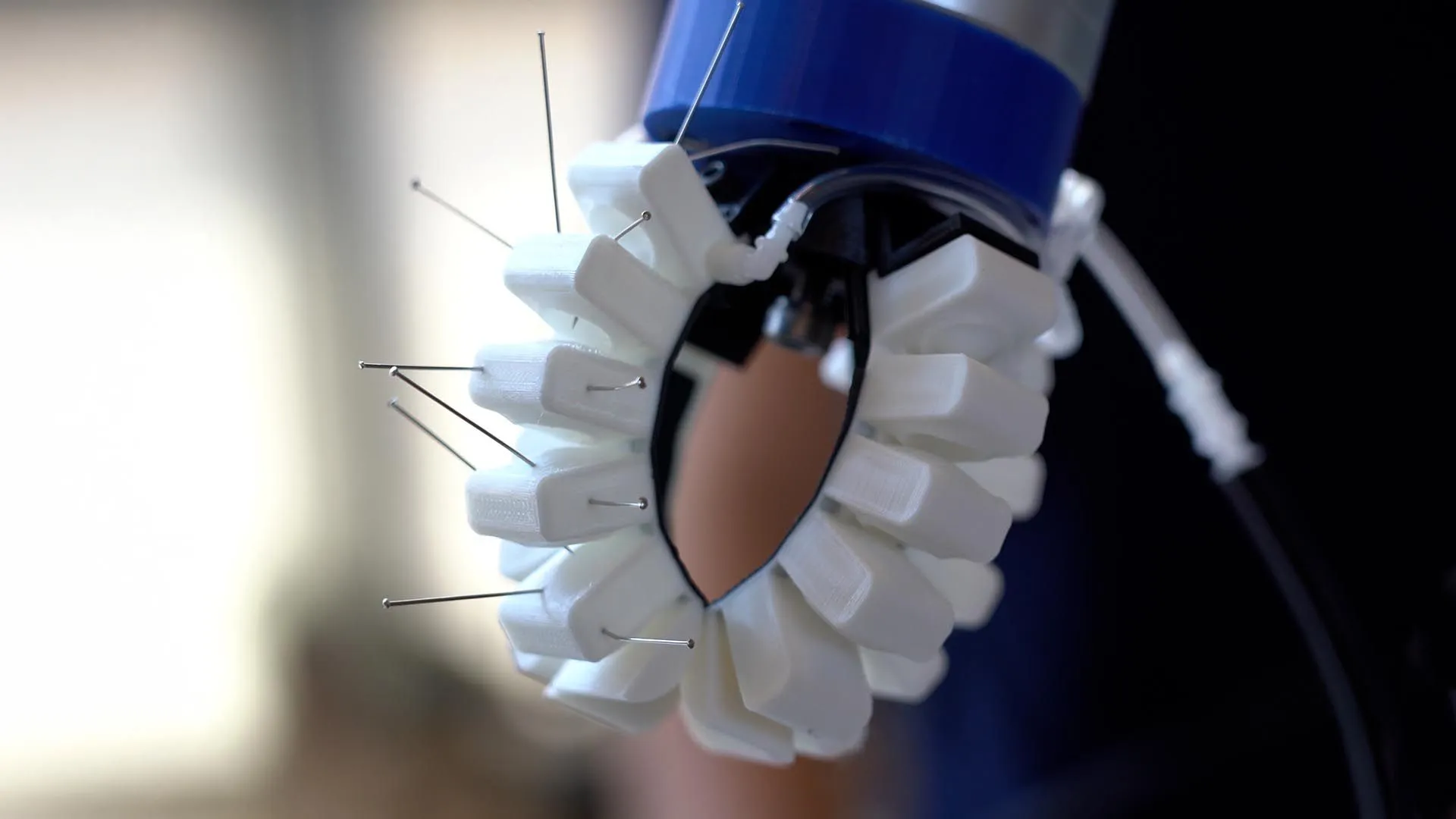
Soft Robots Borrow from the Toy Aisle
The bistability of fidget poppers inspires enhanced walking and grasping capabilities for soft robots.
“Obviously, our tag is very focused on Project CETI’s goals and mission,” he said. “But we want to go toward the openness of science, sharing our design so other research groups could use these bio-loggers for other purposes and species. This work could translate to many other projects, anything that requires studying sound and other sensing capabilities, and I hope that what we’ve learned will be there to help make things easier and get them faster to completion.”
Kayt Sukel is a technology writer and author in Houston.
The scientific quest to decode whale song is aided by a new generation of underwater recording devices inspired by soft robotics.

Freelance writer, author, and ghostwriter
Related Content

Sep 15, 2026
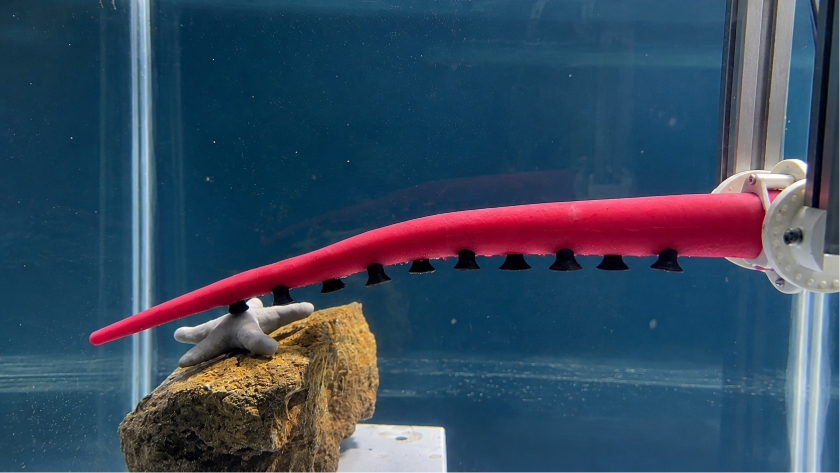
Octopus-Inspired Robot Gets a Better Grip


A new soft robotic arm shows how distributed sensing and control could help robots move and grasp more like living organisms.
Sep 1, 2026
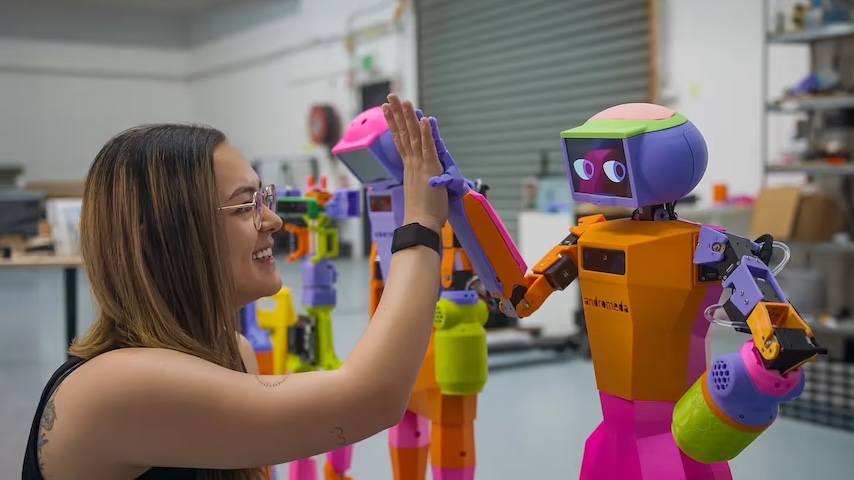
The Next Robotics Frontier

The robotics industry often focuses on scale, automation, and valuations. But a quieter group of founders is instead asking what robotics have overlooked as they innovate with compassion in mind.
Aug 20, 2026
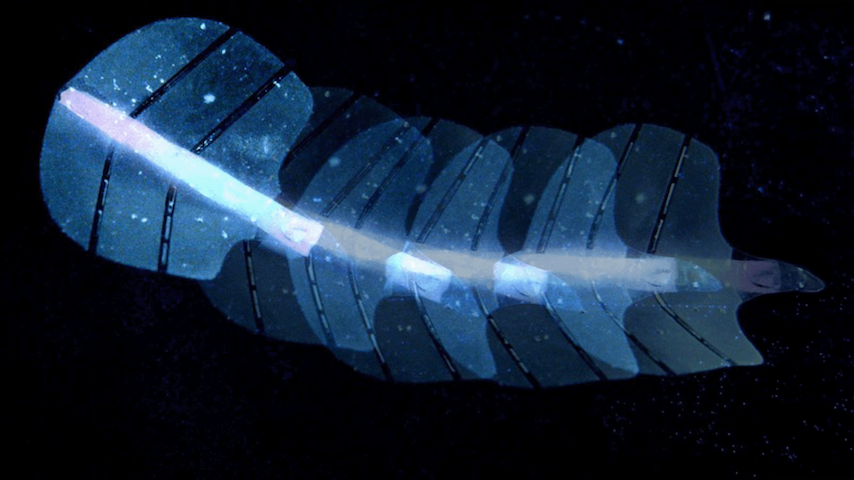
Artificial Muscles That Move to Sound

Microbubbles of varying sizes embedded in polymers have different acoustic responses, which can help move artificial muscles made from this material.
Jul 13, 2026
Exoskeleton Improves Mobility for Stroke Survivors

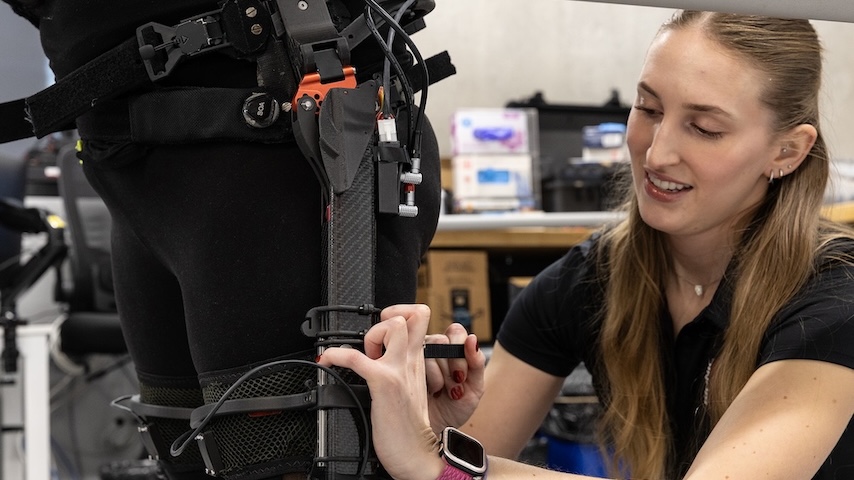
University of Utah researchers are piloting a 5.5-pound wearable robotic solution to help individuals with hemiparesis walk.