Engineering Through Times of Change
Engineering Through Times of Change
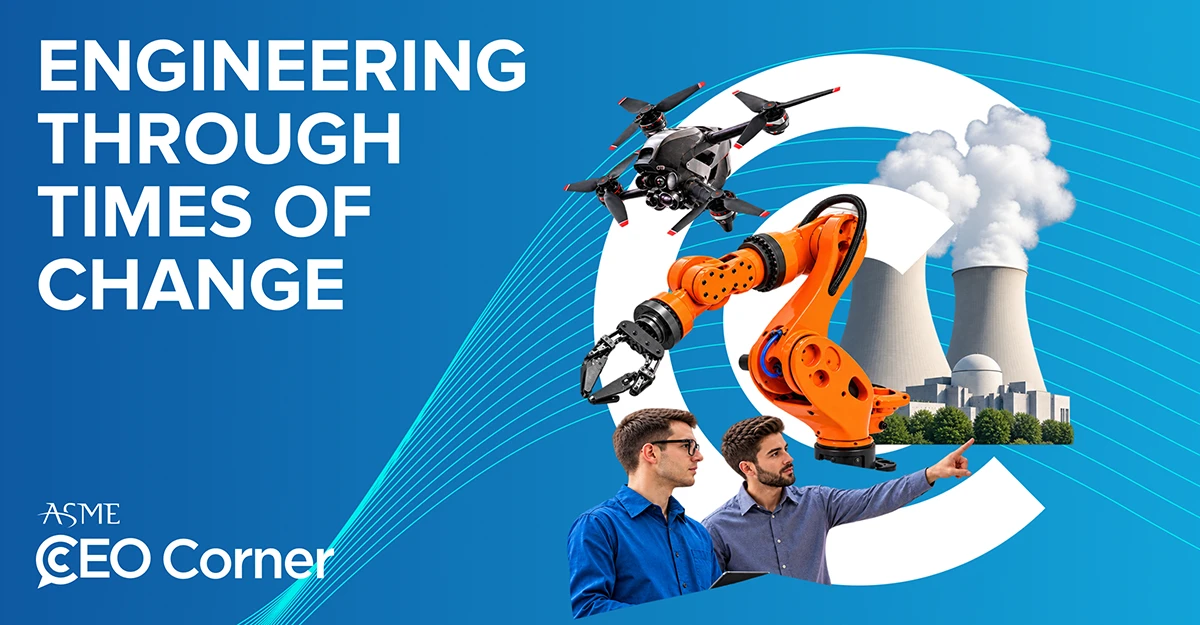
September marks a season of transition; students return to classrooms, professionals pursue new opportunities, and organizations prepare for the months ahead. From seasons of renewal to eras of technological transformation, change brings both challenges and opportunities, creating a need for trusted institutions that help engineers navigate uncertainty and turn emerging possibilities into meaningful progress. Throughout its history, ASME has connected expertise, knowledge, standards, and community to help engineers adapt to change, drive innovation, and advance solutions for a more prosperous future.
From Industrial Revolution to Industry Standards
ASME was born from a period of profound technological change.
Founded in 1880 during the Industrial Revolution, the Society provided engineers with a forum to share knowledge, collaborate, and navigate the opportunities and challenges created by emerging technologies. With factories, railroads, steam engines, and large manufacturing systems transforming society, engineers needed trusted ways to exchange knowledge and address the challenges accompanying rapid technological progress.
When industrial advancement exposed new risks, ASME became part of the solution. Following a series of deadly boiler explosions, including the 1905 Grover Shoe Factory disaster, the Society developed the Boiler and Pressure Vessel Code (BPVC), first published in 1915. By establishing a common framework for reliability, the BPVC helped transform lessons learned into engineering best practices, creating a foundation that future generations could build upon.
Since then, ASME has developed and maintained more than 500 standards spanning industries from energy and manufacturing to transportation. As technologies evolved, so did ASME's role, helping engineers navigate new challenges and opportunities while ensuring innovation remained consistent and impactful.
Navigating the Digital Transformation
Just as the Industrial Revolution transformed how engineers designed, built, and operated the systems that powered modern society, the digital revolution has reshaped how engineers access information, collaborate, and solve problems. Beginning with the advent of the microprocessor and personal computing, this transformation has accelerated through connected technologies, advanced simulation, and digital platforms.
Today, artificial intelligence is driving the next wave of change, redefining how engineers learn, make decisions, and apply technical knowledge. As AI and digitization reshape industries, they are also creating new opportunities for engineers, from developing intelligent systems and digital infrastructure to applying data-driven insights in ways that were unimaginable just a decade ago. Emerging roles in AI, automation, digital engineering, and advanced analytics are expanding what engineering careers can look like and creating new pathways for technical professionals.
As these opportunities evolve, engineers must continually adapt their skills and knowledge while relying on trusted sources of information to navigate an increasingly complex technological landscape. ASME is helping lead that transition by ensuring trusted engineering knowledge is available in the formats, platforms, and workflows engineers use every day:
- ASME's partnership with Wiley extends the reach of trusted engineering knowledge while allowing ASME to retain ownership, editorial authority, and stewardship of its content. The collaboration modernizes how engineers discover and apply technical information.
- ASME and Articul8 AI created an AI model for engineering standards, making trusted guidance easier to access and integrate into engineers' workflows.
By modernizing how engineering knowledge is distributed and applied, ASME is helping prepare future generations of engineers to navigate emerging technologies, make informed decisions, and innovate with confidence.
Accelerating the Next Industrial Revolution
The next industrial revolution is being driven by converging advances in clean energy, artificial intelligence, advanced manufacturing, and digital systems. As industries modernize infrastructure, improve efficiency, and deploy next-generation technologies, engineers are playing a central role in shaping the future of energy and industry.
ASME supports this transformation by advancing clean and affordable technologies, improving industrial efficiency, preparing the next generation of engineers, and helping hard-to-abate industries scale more effective, resilient practices.
This transformation cannot be achieved in isolation. Success depends on convening engineers, investors, entrepreneurs, policymakers, and industry leaders to accelerate innovation and move solutions from breakthrough to buildout. The ASME CATALYZE Summit convenes the engineering ecosystem to tackle the technical, economic, workforce, and scale-up challenges between innovation and deployment.
ASME develops the standards that help technologies scale. CATALYZE brings together the people who create, fund, deploy, and govern sustainable technologies. Together, they help accelerate progress and turn innovation into impact. By connecting leaders across engineering, manufacturing, energy, technology, and investment, CATALYZE fosters the collaboration needed to move ideas beyond discussion and into action.
Building on a Foundation of Trust
The next chapter of engineering will be shaped by artificial intelligence, advanced manufacturing, clean energy, and innovations we cannot yet predict. While technologies evolve, the need for trusted knowledge, reliable standards, and meaningful collaboration endures. As the pace of change continues to accelerate, ASME remains committed to empowering engineers to shape the future and advance engineering for the benefit of humanity.
With regards,

Tom Costabile, P. E., FASME
ASME Executive Director/CEO
With regards,
Tom Costabile, P. E., FASME
ASME Executive Director/CEO

P.E., FASME Executive Director/CEO
Related Content

Oct 22, 2026
Developing Talent Where Impact Happens

How the E4C Fellowship helps early-career engineers build skills in sustainable development and energy access, featuring fellows from ASU’s LEAPS lab.
Oct 21, 2026
Manufacturing Engineer Shares and Adapts

Connections are vital to create networking, training, and community engagement opportunities, along with access to critical resources.

Oct 21, 2026
ESOPs Makes Mechanical Engineers Stakeholders


Mechanical engineers are uniquely positioned to shift into fast-growing sectors.

Oct 20, 2026
The Evolution of the Plug-In Hybrid