Soft Robots Made Fast and Cheap
Soft Robots Made Fast and Cheap
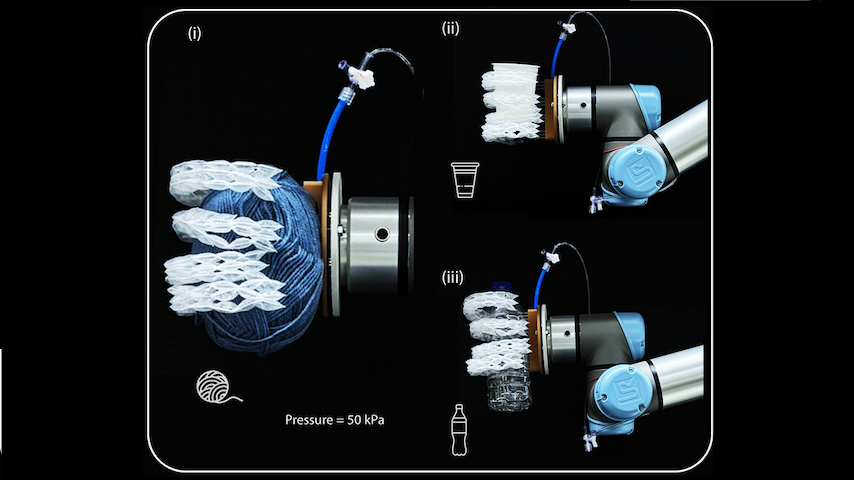
A new ultra-low-cost fabrication method makes soft robots faster and cheaper to build, opening the field to wider use in research and education.
In keeping with the idea that affordability drives accessibility, a team of engineers at Oxford University has developed a rapid, low-cost method for manufacturing soft robots—an advance that could significantly broaden access to robotics in both research and education. By simplifying the materials and tools required, the approach lowers barriers that have traditionally limited who can design, build, and experiment with these systems.
Using easily found, commercially available tools—including a standard vacuum sealer and a desktop laser cutter—the researchers fabricated soft robotic actuators in less than 10 minutes, with each unit costing under 10 cents in materials, representing a shift from conventional fabrication techniques, which often depend on expensive elastomers, intricate molding processes, or high-end 3D printing technologies.
Soft robots are machines constructed from flexible materials that allow them to bend, stretch, and adapt. They’re gaining increasing traction for their versatility and are particularly useful in applications that require gentle interaction, such as handling fragile objects, as well as in environments that are unpredictable or hazardous. Despite their promise, however, the adoption of soft robotics has been hindered by the cost and complexity of existing manufacturing approaches. The Oxford team addressed this challenge by reducing the process to its most essential components.
“Thermoplastic pouches are inexpensive, widely available, and already designed to hold pressure,” said Antonio Forte, associate professor at Oxford’s Engineering Science Department. “By combining vacuum sealing with laser cutting, we realized we could turn a very simple material into a programmable actuator platform with minimal processing.”
More for You: Move with the Current
Over the course of six months, the team produced and tested various prototypes, ranging from simple pouch-based structures and basic bending actuators to more advanced systems, including inverse-designed geometries, grippers, crawling robots, and swimming robots. Each iteration helped refine both the fabrication technique and the underlying design principles.
A lightbulb moment came after the team encountered repeated difficulties in achieving reliable seals between layers of thermoplastic using the laser cutter.
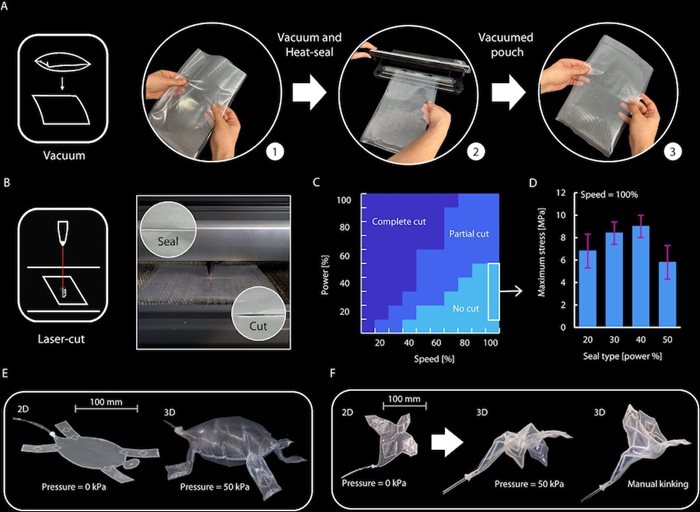 Inflatable actuator manufacturing process. A. Vacuuming thermoplastic pouches. B. Laser cutting pouches. C. Effect of laser cutter speed/power on cut type. D. Tensile strength test on pouch seal. (E) Inflatable turtle. (F) Inflatable bird with bistable wings. Image: Rezanejad, et al.
“We eventually realized the issue was a tiny air gap between the layers,” said Ashkan Rezanejad, a postdoctoral researcher at Oxford’s Department of Engineering Science and lead author of a study on the research published in Advanced Science. “That led to the key idea: What if we vacuum it first? Once we removed the air gap, the laser could reliably seal the material. That was the breakthrough that made the whole method work.”
Inflatable actuator manufacturing process. A. Vacuuming thermoplastic pouches. B. Laser cutting pouches. C. Effect of laser cutter speed/power on cut type. D. Tensile strength test on pouch seal. (E) Inflatable turtle. (F) Inflatable bird with bistable wings. Image: Rezanejad, et al.
“We eventually realized the issue was a tiny air gap between the layers,” said Ashkan Rezanejad, a postdoctoral researcher at Oxford’s Department of Engineering Science and lead author of a study on the research published in Advanced Science. “That led to the key idea: What if we vacuum it first? Once we removed the air gap, the laser could reliably seal the material. That was the breakthrough that made the whole method work.”
With the introduction of vacuum sealing, the fabrication process became far more consistent and straightforward.
The team demonstrated the effectiveness of their method through a series of functional prototypes. Among them was a soft robotic gripper capable of lifting objects many times its own weight, highlighting the strength and efficiency of the actuators. They also developed lightweight robots capable of crawling and swimming, showcasing the versatility of the design. Performance testing further revealed that the actuators could endure up to 100,000 inflation/deflation cycles while maintaining most of their functionality, indicating strong durability.
Discover the Benefits of ASME Membership
The technique also allows for more complex forms of actuation. By stacking bending actuators and selectively activating them, the researchers were able to achieve multi-axis movement, including bending in different directions and even out-of-plane motion. For applications requiring precise control, the system can be paired with sensing technologies such as pressure sensors, embedded strain sensors, or external vision-based tracking. These inputs can then be integrated with the team’s geometric and surrogate models to enable closed-loop control.
In addition to its low material cost, the manufacturing process is efficient and requires minimal manual labor. The combination of vacuum sealing and laser cutting allows for a largely automated workflow, reducing the need for hands-on intervention.
Looking ahead, the team sees a wide range of potential applications across multiple fields.
“We see strong potential in soft robotics applications such as grippers, lightweight mobile robots, and adaptive systems,” Forte said. “More broadly, this could be used in biomedical devices, wearables, search-and-rescue robots, and educational or low-cost robotic platforms where accessibility, scalability, and rapid prototyping are important.”
Annemarie Mannion is a technology writer in Chicago.
Using easily found, commercially available tools—including a standard vacuum sealer and a desktop laser cutter—the researchers fabricated soft robotic actuators in less than 10 minutes, with each unit costing under 10 cents in materials, representing a shift from conventional fabrication techniques, which often depend on expensive elastomers, intricate molding processes, or high-end 3D printing technologies.
Soft robots are machines constructed from flexible materials that allow them to bend, stretch, and adapt. They’re gaining increasing traction for their versatility and are particularly useful in applications that require gentle interaction, such as handling fragile objects, as well as in environments that are unpredictable or hazardous. Despite their promise, however, the adoption of soft robotics has been hindered by the cost and complexity of existing manufacturing approaches. The Oxford team addressed this challenge by reducing the process to its most essential components.
The right seal
A key breakthrough came with the use of thermoplastic pouches, which are already designed to hold pressure, making them well suited for use in pneumatic actuation, and which helped researchers to take a different approach to thinking about soft robotic design.“Thermoplastic pouches are inexpensive, widely available, and already designed to hold pressure,” said Antonio Forte, associate professor at Oxford’s Engineering Science Department. “By combining vacuum sealing with laser cutting, we realized we could turn a very simple material into a programmable actuator platform with minimal processing.”
More for You: Move with the Current
Over the course of six months, the team produced and tested various prototypes, ranging from simple pouch-based structures and basic bending actuators to more advanced systems, including inverse-designed geometries, grippers, crawling robots, and swimming robots. Each iteration helped refine both the fabrication technique and the underlying design principles.
A lightbulb moment came after the team encountered repeated difficulties in achieving reliable seals between layers of thermoplastic using the laser cutter.
Inflatable actuator manufacturing process. A. Vacuuming thermoplastic pouches. B. Laser cutting pouches. C. Effect of laser cutter speed/power on cut type. D. Tensile strength test on pouch seal. (E) Inflatable turtle. (F) Inflatable bird with bistable wings. Image: Rezanejad, et al.
With the introduction of vacuum sealing, the fabrication process became far more consistent and straightforward.
Complex actuation
Following this breakthrough, the team switched its focus to understanding and controlling how the actuators bend and deform. This required an in-depth geometrical study to identify the parameters that govern motion and to enable the inverse design of specific target shapes. Such capability is essential for creating actuators that perform predictable and repeatable movements. To achieve this, the researchers combined Finite Element Method simulations with a surrogate modeling approach, allowing them to systematically map geometric inputs to resulting deformations.The team demonstrated the effectiveness of their method through a series of functional prototypes. Among them was a soft robotic gripper capable of lifting objects many times its own weight, highlighting the strength and efficiency of the actuators. They also developed lightweight robots capable of crawling and swimming, showcasing the versatility of the design. Performance testing further revealed that the actuators could endure up to 100,000 inflation/deflation cycles while maintaining most of their functionality, indicating strong durability.
Discover the Benefits of ASME Membership
The technique also allows for more complex forms of actuation. By stacking bending actuators and selectively activating them, the researchers were able to achieve multi-axis movement, including bending in different directions and even out-of-plane motion. For applications requiring precise control, the system can be paired with sensing technologies such as pressure sensors, embedded strain sensors, or external vision-based tracking. These inputs can then be integrated with the team’s geometric and surrogate models to enable closed-loop control.
In addition to its low material cost, the manufacturing process is efficient and requires minimal manual labor. The combination of vacuum sealing and laser cutting allows for a largely automated workflow, reducing the need for hands-on intervention.
Looking ahead, the team sees a wide range of potential applications across multiple fields.
“We see strong potential in soft robotics applications such as grippers, lightweight mobile robots, and adaptive systems,” Forte said. “More broadly, this could be used in biomedical devices, wearables, search-and-rescue robots, and educational or low-cost robotic platforms where accessibility, scalability, and rapid prototyping are important.”
Annemarie Mannion is a technology writer in Chicago.


The use of robotics in industrial settings continues to accelerate at a rapid pace. Explore this collection to learn more about automation, cobots, AI-enabled robots, customized robots, and drones.