Rooftop Solar Could Help Cool Buildings, Not Just Power Them
Rooftop Solar Could Help Cool Buildings, Not Just Power Them
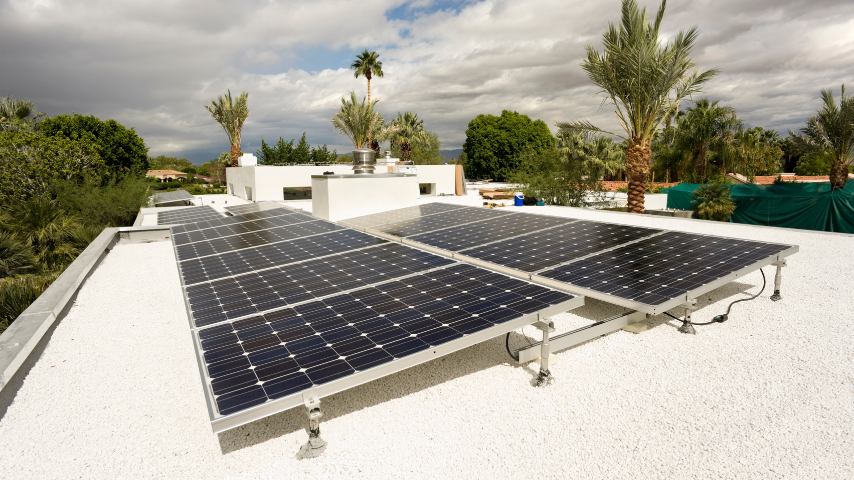
A new study suggests that the shade cast by rooftop solar panels could become a more important design tool for buildings looking to cut heat gain and fossil fuel use.
Rooftop solar panels have long offered a secondary benefit beyond electricity generation: shading the roof surface below. But researchers at the University of Surrey say that passive cooling effect deserves more attention as a building-design strategy.
A recent study showed that photovoltaic (PV) arrays can reduce heat transfer into buildings when paired with phase change materials, reframing rooftop solar as both a power source and a thermal-management tool for off-grid buildings that rely on diesel generators.
“Through this research, we demonstrated that solar panels can serve dual purposes: electricity generation and passive thermal shading,” explained Mahmoud Shafiee, professor of energy resilience at the University of Surrey.
The air gap relies on a “stack effect” to drive heat away from the structure. As the sun heats the PV cells, the air in the space beneath them rises, creating a pressure differential that pulls cooler ambient air through the gap. Constant convective flow carries away thermal energy that otherwise would have been conducted through the roof assembly. And in the study’s modeled building scenario, the shading effect reduced heating demand by 14.3 percent and cooling demand by 7.2 percent.
More For You: The End of Brittle Solar
To handle the remaining heat flux, researchers integrated phase change materials (PCMs) into the roof assembly. These materials function as thermal sponges by exploiting the physics of latent heat. During the day, the material absorbs solar energy and changes state from a solid to a liquid. Because the material uses this energy for the phase change itself, the PCM temperature remains constant, effectively blocking heat transfer into the building. Once the ambient temperature drops, the liquid PCM releases the stored energy back into the atmosphere as it solidifies.
The analysis centered on a BioPCM derived from plant-based fats and oils. This bio-based alternative outperforms traditional paraffin or salt-hydrate PCMs due to its 77°F (25°C) melting point, which aligns with human comfort ranges. Unlike paraffin, which poses fire risks, or salt hydrates, which suffer from phase segregation and corrosion, this plant-derived material maintained stability across thousands of cycles. The researchers specifically selected the material for its resistance to supercooling, ensuring the PCM reliably recharged even in climates with high nighttime ambient temperatures.
The dual-sided approach prevented heat accumulation within the insulation layer. With one PCM layer, heat saturated the insulation, eventually migrating into the living space. The dual-layer strategy instead created a thermal dead zone, significantly improving peak temperature reduction and stabilizing the building's internal mean radiant temperature.
Discover the Benefits of ASME Membership
“By combining PV shading with sandwiched PCM layers, we reduced energy costs and increased the renewable share of the total energy load, ultimately diminishing the reliance on diesel generators in off-grid locations,” explained Shafiee. By quantifying these savings, researchers demonstrated that sustainable geometry could offer a more cost-effective path than traditional fossil fuel consumption or expensive mechanical system overhauls.
“While our focus was off-grid applications, our results indirectly support scalability to high-rise buildings, commercial buildings, urban offices, hospitals, and data centers,” explained Shafiee.
The research reframed the relationship between building envelopes and renewable energy by prioritizing passive geometry over complex mechanical hardware. By assigning double duty to rooftop solar and deploying strategic PCM sandwiches, the study showed a path to substantially reduce carbon emissions while slashing operational costs. These findings show that even modest modifications to a roof’s thermal layout could stabilize internal environments and diminish reliance on fossil fuels.
Nicole Imeson is an engineer and writer in Calgary, Alta.
A recent study showed that photovoltaic (PV) arrays can reduce heat transfer into buildings when paired with phase change materials, reframing rooftop solar as both a power source and a thermal-management tool for off-grid buildings that rely on diesel generators.
“Through this research, we demonstrated that solar panels can serve dual purposes: electricity generation and passive thermal shading,” explained Mahmoud Shafiee, professor of energy resilience at the University of Surrey.
How rooftop solar panels reduce building heat
Traditional roofs act as thermal batteries, absorbing solar energy throughout the day and radiating that heat into the building at night. By mounting PV panels with a specific air gap, designers could change how heat moved through the roof assembly. The panels intercepted direct solar radiation, so more solar radiation struck the panel surface instead of the roof membrane.The air gap relies on a “stack effect” to drive heat away from the structure. As the sun heats the PV cells, the air in the space beneath them rises, creating a pressure differential that pulls cooler ambient air through the gap. Constant convective flow carries away thermal energy that otherwise would have been conducted through the roof assembly. And in the study’s modeled building scenario, the shading effect reduced heating demand by 14.3 percent and cooling demand by 7.2 percent.
More For You: The End of Brittle Solar
To handle the remaining heat flux, researchers integrated phase change materials (PCMs) into the roof assembly. These materials function as thermal sponges by exploiting the physics of latent heat. During the day, the material absorbs solar energy and changes state from a solid to a liquid. Because the material uses this energy for the phase change itself, the PCM temperature remains constant, effectively blocking heat transfer into the building. Once the ambient temperature drops, the liquid PCM releases the stored energy back into the atmosphere as it solidifies.
The analysis centered on a BioPCM derived from plant-based fats and oils. This bio-based alternative outperforms traditional paraffin or salt-hydrate PCMs due to its 77°F (25°C) melting point, which aligns with human comfort ranges. Unlike paraffin, which poses fire risks, or salt hydrates, which suffer from phase segregation and corrosion, this plant-derived material maintained stability across thousands of cycles. The researchers specifically selected the material for its resistance to supercooling, ensuring the PCM reliably recharged even in climates with high nighttime ambient temperatures.
Why PCM placement matters more than thickness
With material properties established, the research team identified that PCM efficacy depended more on strategic placement than on thickness. After testing 30 different arrangements, they discovered that a sandwich configuration performed more effectively than a single, thick layer of PCM. By placing a thin layer—just over 1 cm—on both sides of the roof insulation, the system could intercept heat flux from two directions: external solar gain and internal heat generated by occupants and equipment.The dual-sided approach prevented heat accumulation within the insulation layer. With one PCM layer, heat saturated the insulation, eventually migrating into the living space. The dual-layer strategy instead created a thermal dead zone, significantly improving peak temperature reduction and stabilizing the building's internal mean radiant temperature.
Cutting diesel use in off-grid buildings
The shift away from diesel functioned as both a financial and an environmental imperative. The study showed that these simple roof modifications could reduce energy costs to approximately $0.15/kWh, while renewable sources supplied more than half of the total energy demand. This transition resulted in a carbon emission reduction between 41 percent and 54 percent.Discover the Benefits of ASME Membership
“By combining PV shading with sandwiched PCM layers, we reduced energy costs and increased the renewable share of the total energy load, ultimately diminishing the reliance on diesel generators in off-grid locations,” explained Shafiee. By quantifying these savings, researchers demonstrated that sustainable geometry could offer a more cost-effective path than traditional fossil fuel consumption or expensive mechanical system overhauls.
Can solar roof shading help urban buildings?
While the study primarily addressed off-grid buildings, the principles could offer adaptability for high-density urban environments. In these settings, shading could mitigate the impact of the urban heat island effect by lowering the roof's surface temperature. This could reduce the thermal stress on rooftop equipment, allowing mechanical systems to meet interior cooling demands with significantly lower energy consumption. The dual-action strategy could yield significant advantages.“While our focus was off-grid applications, our results indirectly support scalability to high-rise buildings, commercial buildings, urban offices, hospitals, and data centers,” explained Shafiee.
The research reframed the relationship between building envelopes and renewable energy by prioritizing passive geometry over complex mechanical hardware. By assigning double duty to rooftop solar and deploying strategic PCM sandwiches, the study showed a path to substantially reduce carbon emissions while slashing operational costs. These findings show that even modest modifications to a roof’s thermal layout could stabilize internal environments and diminish reliance on fossil fuels.
Nicole Imeson is an engineer and writer in Calgary, Alta.


Explore ASME's commitment to sustainability, addressing climate challenges through innovation, policy, & workforce development. Get informed and involved!