Modeling Guides Challenging Pelvis Surgeries
Modeling Guides Challenging Pelvis Surgeries

Patient-Specific models help surgeons evaluate bone grafts and implants for safer, more effective spinopelvic reconstruction after complex cancer surgeries.
Researchers at Rice University developed models to demonstrate the mechanical implications of spinopelvic reconstruction techniques after a hemipelvectomy. Hemipelvectomies involve removing a tumor from the pelvis, which also often means amputating sections of the spine, sacrum, and pelvis.
For reconstruction, surgeons must determine what bone to graft, what implants to use, and how the structure should be assembled—all factors that are highly specific to the patient. Surgeons make these decisions based on knowledge and experience, but they have very little standard data to guide their choices.
“For this complex surgery, a systematic or quantitative way to say ‘this is the optimal choice for the best response after surgery’ is very beneficial,” said Raudel Avila, professor of mechanical engineering at Rice University. “This surgery involves [amputation and the patient’s] quality of life depends on how structurally sound the reconstruction is.”
To support surgeons and patients, Rice University researchers worked with The University of Texas MD Anderson Cancer Center to create technology for reconstruction guidance. They used de-identified CT and MRI scans of a patient with spinopelvic osteosarcoma to build a reconstructed pelvis 3D model that simulated the mechanical loads of various surgical options.
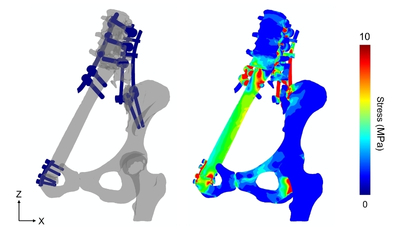 Reconstructed pelvic model showing implant locations and von Mises stress under a 500 N compressive load representative of sitting, highlighting stress concentrations in the implants and at bone–implant interfaces. Image: Ritika Menghani/Rice University
According to the research paper published in the Journal of the Mechanical Behavior of Biomedical Materials, the 3D model simulated stress distributions in bone and implant components of the reconstructed pelvis under quasi-static sitting conditions. These circumstances represent the post-operative recovery phase when problems are most likely to appear.
Reconstructed pelvic model showing implant locations and von Mises stress under a 500 N compressive load representative of sitting, highlighting stress concentrations in the implants and at bone–implant interfaces. Image: Ritika Menghani/Rice University
According to the research paper published in the Journal of the Mechanical Behavior of Biomedical Materials, the 3D model simulated stress distributions in bone and implant components of the reconstructed pelvis under quasi-static sitting conditions. These circumstances represent the post-operative recovery phase when problems are most likely to appear.
The team created a 3D model for the fully reconstructed pelvis model based on scan data using the software programs Blender and COMSOL, according to the paper. Then, they exported the 3D mesh to finite element software ABAQUS/Standard to conduct the mechanical simulations.
Along with the anatomically accurate 3D model, researchers created lower-dimensional models that use the same information. The 1D beam theory model provides information on the bone’s graft flexural behavior, including variables such as stiffness, area, and length of bone. The 2D composite truss model provides insight into the reconstruction setup based on geometrical features and the bones used for grafting. Both models compute quickly, providing guidance in seconds. A full 3D model takes hours or days.
“All models are complementary to each other. The rapid assessment of choices is good for lower-dimension models. For things like length, area, and materials, you get instant answers,” Avila said. “For a more personalized mechanical evaluation, you can see the way the stress develops in the bones and implants, and that requires a full-on, patient-specific model.”
.jpg?width=400&height=200&ext=.jpg) Three-dimensional finite element models of a healthy pelvis and a surgically reconstructed pelvis with a pedicled tibial graft and fixation hardware, including the distribution of cortical and cancellous bone. Image: Ritika Menghani/Rice University
Surgeons can use model results, along with their training and expertise, to guide patients regarding options and expectations based on data.
Three-dimensional finite element models of a healthy pelvis and a surgically reconstructed pelvis with a pedicled tibial graft and fixation hardware, including the distribution of cortical and cancellous bone. Image: Ritika Menghani/Rice University
Surgeons can use model results, along with their training and expertise, to guide patients regarding options and expectations based on data.
“It’s a good add-on to the patient’s clinical picture in terms of bone graft choices when they have amputations and complex reconstructions. They will have to live with [the] consequences,” Avila said. “They have reassurance that it’s being performed by top-notch surgical teams and there’s scientific benefits to the biomechanical choices they’re making.”
Long before surgery begins, surgeons can use the models to run simulations and assess whether the bone’s area and lengths are compatible with reconstruction requirements. The models give surgeons confidence that their choices are justified from an engineering standpoint.
“We wanted to make sure we were doing something relevant for the clinician,” Avila said. “Can we make these claims that the bone you select and the techniques you use really translate to something actionable to surgeons and the field? When we make recommendations, they need to be grounded in engineering mechanics.”
Researchers already made key findings by reviewing model data. Surgeons typically choose the femur, tibia, or fibula for bone grafts. The models showed the femur and tibia performed better when compared to the thinner fibula because they have larger cross-sectional areas.
They also found commonalities in the hardware material used to anchor the graft to the pelvis and spine during reconstruction, which most often is titanium, stainless steel, magnesium, or polymer based. In high load scenarios, stiffer metals such as titanium and stainless steel are more effective when looking at preventing screw breakage, while polymer reduces stress shielding.
 The researchers, an engineering team led by Avila joined by a clinical team directed by Justin Bird with The University of Texas MD Anderson Cancer Center’s Department of Orthopedic Oncology, worked on the project for approximately one year.
The team developed models using de-identified, post-operative patient information. The researchers have not used them to guide surgical decisions. Researchers plan to build a database of completed reconstructions to create a library of data. In the future, they hope surgeons will be able to access the technology to run simulations based on a large pool of data that help guide decisions for actual patients.
Jessica Porter is a freelance writer in New York City.
For reconstruction, surgeons must determine what bone to graft, what implants to use, and how the structure should be assembled—all factors that are highly specific to the patient. Surgeons make these decisions based on knowledge and experience, but they have very little standard data to guide their choices.
“For this complex surgery, a systematic or quantitative way to say ‘this is the optimal choice for the best response after surgery’ is very beneficial,” said Raudel Avila, professor of mechanical engineering at Rice University. “This surgery involves [amputation and the patient’s] quality of life depends on how structurally sound the reconstruction is.”
Engineering a better approach
To support surgeons and patients, Rice University researchers worked with The University of Texas MD Anderson Cancer Center to create technology for reconstruction guidance. They used de-identified CT and MRI scans of a patient with spinopelvic osteosarcoma to build a reconstructed pelvis 3D model that simulated the mechanical loads of various surgical options.
Reconstructed pelvic model showing implant locations and von Mises stress under a 500 N compressive load representative of sitting, highlighting stress concentrations in the implants and at bone–implant interfaces. Image: Ritika Menghani/Rice University
The team created a 3D model for the fully reconstructed pelvis model based on scan data using the software programs Blender and COMSOL, according to the paper. Then, they exported the 3D mesh to finite element software ABAQUS/Standard to conduct the mechanical simulations.
Along with the anatomically accurate 3D model, researchers created lower-dimensional models that use the same information. The 1D beam theory model provides information on the bone’s graft flexural behavior, including variables such as stiffness, area, and length of bone. The 2D composite truss model provides insight into the reconstruction setup based on geometrical features and the bones used for grafting. Both models compute quickly, providing guidance in seconds. A full 3D model takes hours or days.
“All models are complementary to each other. The rapid assessment of choices is good for lower-dimension models. For things like length, area, and materials, you get instant answers,” Avila said. “For a more personalized mechanical evaluation, you can see the way the stress develops in the bones and implants, and that requires a full-on, patient-specific model.”
Three-dimensional finite element models of a healthy pelvis and a surgically reconstructed pelvis with a pedicled tibial graft and fixation hardware, including the distribution of cortical and cancellous bone. Image: Ritika Menghani/Rice University
“It’s a good add-on to the patient’s clinical picture in terms of bone graft choices when they have amputations and complex reconstructions. They will have to live with [the] consequences,” Avila said. “They have reassurance that it’s being performed by top-notch surgical teams and there’s scientific benefits to the biomechanical choices they’re making.”
Long before surgery begins, surgeons can use the models to run simulations and assess whether the bone’s area and lengths are compatible with reconstruction requirements. The models give surgeons confidence that their choices are justified from an engineering standpoint.
“We wanted to make sure we were doing something relevant for the clinician,” Avila said. “Can we make these claims that the bone you select and the techniques you use really translate to something actionable to surgeons and the field? When we make recommendations, they need to be grounded in engineering mechanics.”
Data-driven discoveries
Researchers already made key findings by reviewing model data. Surgeons typically choose the femur, tibia, or fibula for bone grafts. The models showed the femur and tibia performed better when compared to the thinner fibula because they have larger cross-sectional areas. They also found commonalities in the hardware material used to anchor the graft to the pelvis and spine during reconstruction, which most often is titanium, stainless steel, magnesium, or polymer based. In high load scenarios, stiffer metals such as titanium and stainless steel are more effective when looking at preventing screw breakage, while polymer reduces stress shielding.
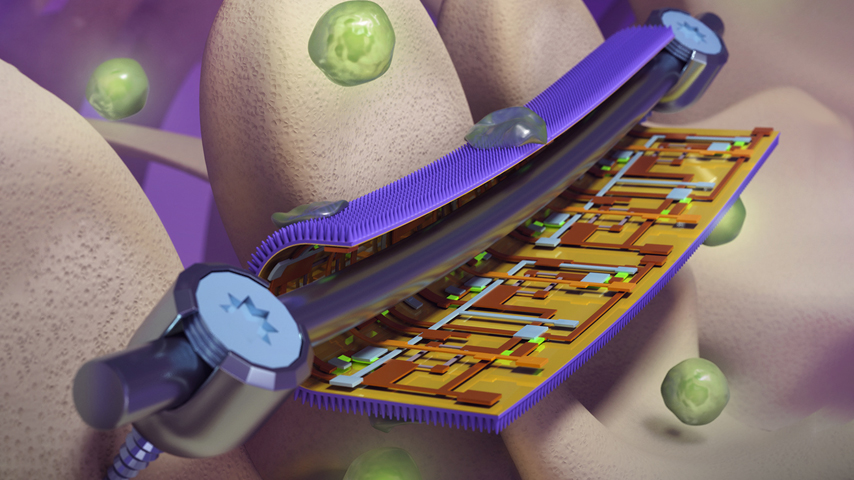
Smart Coatings on Implants Transmit Health Data in Real Time
A foil coating with nanostructures for orthopedic implants virtually eliminates bacterial growth and can detect when implants are starting to fail.
The team developed models using de-identified, post-operative patient information. The researchers have not used them to guide surgical decisions. Researchers plan to build a database of completed reconstructions to create a library of data. In the future, they hope surgeons will be able to access the technology to run simulations based on a large pool of data that help guide decisions for actual patients.
Jessica Porter is a freelance writer in New York City.
Patient-Specific models help surgeons evaluate bone grafts and implants for safer, more effective spinopelvic reconstruction after complex cancer surgeries.

Freelance writer in New York
Related Content

Sep 1, 2026
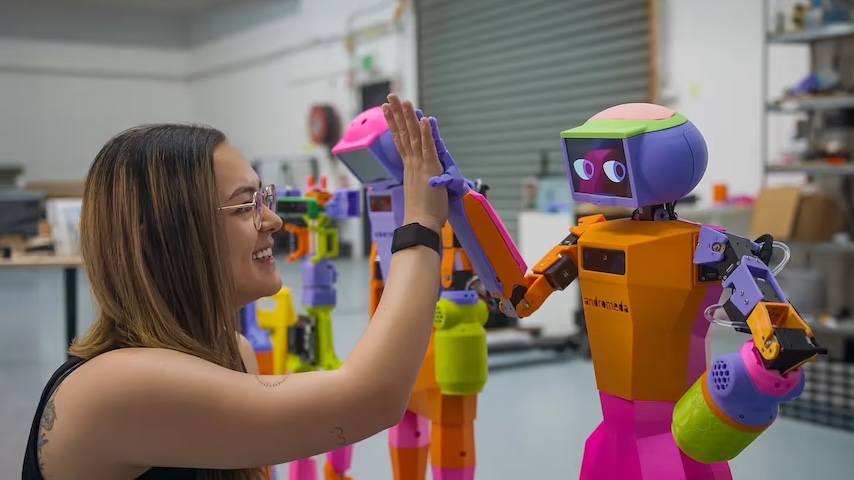
The Next Robotics Frontier


The robotics industry often focuses on scale, automation, and valuations. But a quieter group of founders is instead asking what robotics have overlooked as they innovate with compassion in mind.
Aug 27, 2026
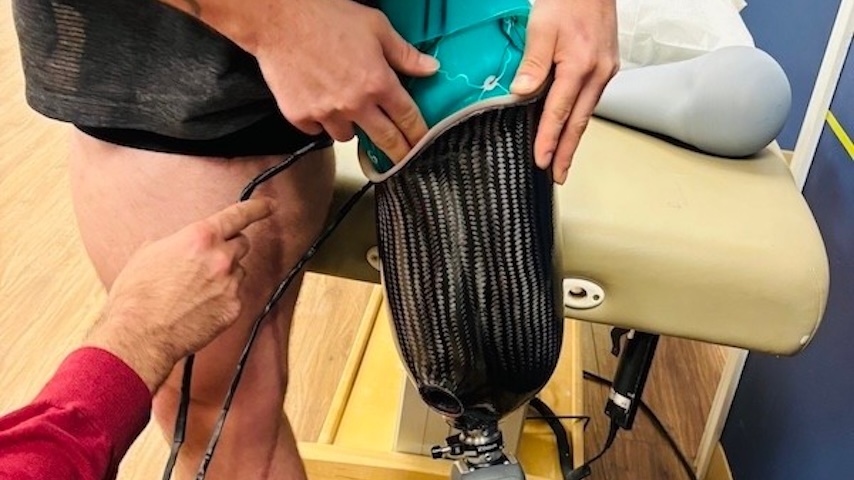
Reimagining Prosthetic Design

Smart tech and 3D printing transform socket design, making prosthetics lighter, more comfortable, and shaped by the patient's own movement.
Aug 20, 2026
Artificial Muscles That Move to Sound

Microbubbles of varying sizes embedded in polymers have different acoustic responses, which can help move artificial muscles made from this material.
Jul 14, 2026
A Better Step for People with Above-Knee Amputations

MIT researchers designed an affordable prosthetic foot that helps people with above-knee amputations achieve a more natural stride.