Heat Exchangers Get a Polymer Makeover
Heat Exchangers Get a Polymer Makeover
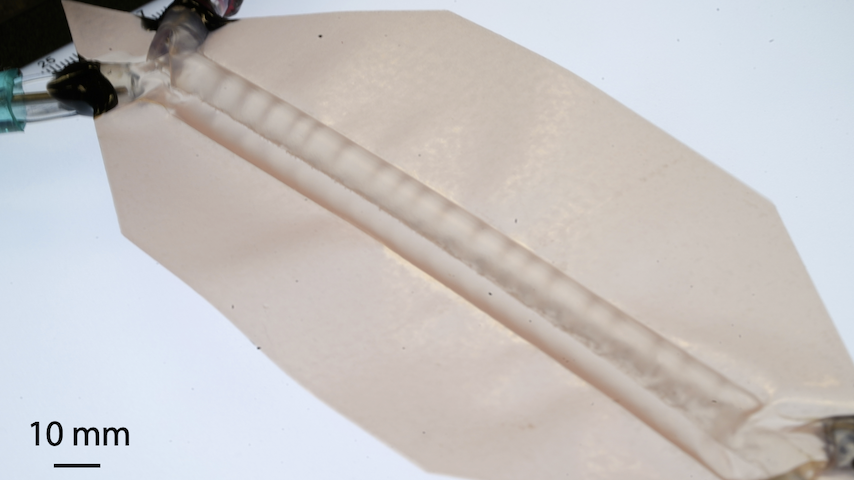
As demand for heat exchangers grows, traditional metal units don’t meet all use cases effectively. Plastic equivalents might fill the gap.
A team of researchers at Rice University, led by Daniel J. Preston, assistant professor of mechanical engineering, has developed and tested a low-cost, easy-to-deploy, high-performance heat exchanger made with thin sheets of polymer.
Metal heat exchangers have provided reliable thermal management across a variety of industries, but their limitations are becoming increasingly difficult to overlook. Material and manufacturing costs for traditional units are steep. In addition, metal is susceptible to chemical corrosion and fouling, which is the accumulation of unwanted materials such as rust, algae, and more.
These challenges play out against a backdrop where the need for effective and low-cost thermal management solutions is increasing. The proliferation of data centers — nearly 3,000 new data centers were being planned or constructed across the country in late 2025, adding to the 4,000 operational ones, according to the American Edge project — is driving demand for effective thermal management.
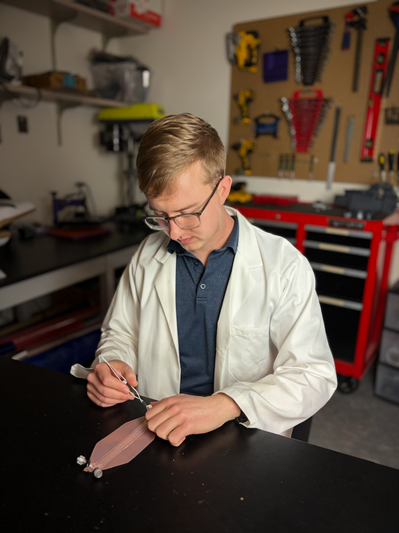 Richard Fontenot, lead author of the study and doctoral candidate in mechanical engineering at Rice University, inspects a polymeric heat exchanger in the lab. Photo: Preston Innovation Lab/Rice University
The polymer alternative checked all the requirements. “We were able to achieve performance comparable to metal-based alternatives while leveraging some advantages inherent to polymers such as corrosion and fouling resistance in addition to substantially lower cost,” said Richard Fontenot, doctoral candidate in mechanical engineering, and lead author of a related study published in Advanced Science. (These polymer heat exchangers achieved a heat transfer capacity per cost up to 4x higher than state-of-the-art equivalents).
Richard Fontenot, lead author of the study and doctoral candidate in mechanical engineering at Rice University, inspects a polymeric heat exchanger in the lab. Photo: Preston Innovation Lab/Rice University
The polymer alternative checked all the requirements. “We were able to achieve performance comparable to metal-based alternatives while leveraging some advantages inherent to polymers such as corrosion and fouling resistance in addition to substantially lower cost,” said Richard Fontenot, doctoral candidate in mechanical engineering, and lead author of a related study published in Advanced Science. (These polymer heat exchangers achieved a heat transfer capacity per cost up to 4x higher than state-of-the-art equivalents).
The flexible polymer heat exchangers can be flat-packed and subsequently deployed to 60-times their original volume for use, a characteristic that will be especially useful in space applications.
But why choose polymers, specifically thermoplastics, from all available candidate materials? First, early literature on polymer-based heat exchangers has shown promise, but designs have stalled because they have not delivered desired advantages. But their light weight and low costs show a lot of promise. And because thermoplastics are transparent, it’s easier to detect fouling and blockage and clean the unit, Fontenot pointed out.
Discover the Benefits of ASME Membership
Convinced of thermoplastics’ potential in heat exchangers, the Rice team started with analytical modeling to further explore them as candidates.
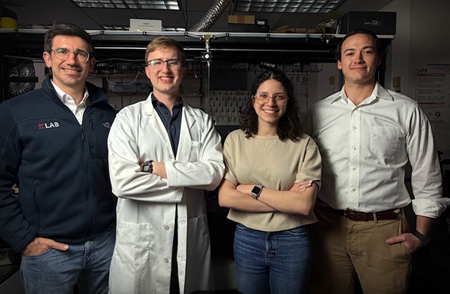 From left: Daniel Preston, assistant professor of mechanical engineering, and mechanical engineering doctoral candidates Richard Fontenot, Sofia Urbina, and Barclay Jumet. Photo: Amanda Johnson/Rice University
Thermal heat exchangers must be manufactured with a low heat resistance to heat transfer so they can let the heat pass through its walls. While the focus on the material used to make the exchanger is warranted, the thermal resistance of the circulating fluid also matters. “What most people don’t realize is that there’s also a thermal resistance associated with heat transfer within the fluid streams themselves,” Preston said.
From left: Daniel Preston, assistant professor of mechanical engineering, and mechanical engineering doctoral candidates Richard Fontenot, Sofia Urbina, and Barclay Jumet. Photo: Amanda Johnson/Rice University
Thermal heat exchangers must be manufactured with a low heat resistance to heat transfer so they can let the heat pass through its walls. While the focus on the material used to make the exchanger is warranted, the thermal resistance of the circulating fluid also matters. “What most people don’t realize is that there’s also a thermal resistance associated with heat transfer within the fluid streams themselves,” Preston said.
The finding, the result of analytical modeling, is radical because it means that the material used to construct the heat exchanger is not as big a factor in its performance as we once thought (or at least not that big a deal).
To fabricate a trial specimen, Fontenot used a sheet lamination technique to hermetically seal ultrathin polymer sheets, each of which is approximately 50 µm.
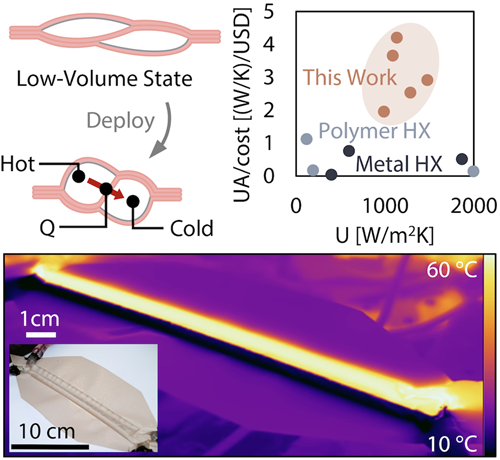 These flexible, transparent, and deployable polymer heat exchangers achieve a heat transfer capacity per cost up to four times higher than current state of the art heat exchangers, surpassing both metal and other polymer counterparts. Image: Preston Innovation Lab/Rice University
While polymers are good candidates, the team had to overcome a fabrication challenge: Thin and flexible polymer sheets can buckle when there’s a lot of liquid sloshing around. To prevent such instabilities from blocking flow, channels should not overlap exactly. Fontenot offset the polymer sheets by at least 20 percent while still delivering a good area for heat exchange. (The area of overlap needs to be optimized because it’s one of the key factors influencing the performance of the heat exchanger, Preston pointed out.)
These flexible, transparent, and deployable polymer heat exchangers achieve a heat transfer capacity per cost up to four times higher than current state of the art heat exchangers, surpassing both metal and other polymer counterparts. Image: Preston Innovation Lab/Rice University
While polymers are good candidates, the team had to overcome a fabrication challenge: Thin and flexible polymer sheets can buckle when there’s a lot of liquid sloshing around. To prevent such instabilities from blocking flow, channels should not overlap exactly. Fontenot offset the polymer sheets by at least 20 percent while still delivering a good area for heat exchange. (The area of overlap needs to be optimized because it’s one of the key factors influencing the performance of the heat exchanger, Preston pointed out.)
The researchers tested two materials, nylon and polyethylene, in a high concentration of hydrochloric acid to simulate conditions of a hostile environment for the device like those encountered in chemical processing or desalination plants. The nylon unit failed within a mere 10 seconds while the polyethylene heat exchanger remained operational for over a month without any material degradation. Aluminum also failed within a few minutes, further validating the conclusion that not all metals make good candidates for thermal heat exchangers in difficult operating environments.
Most of the experiments were conducted at 60 ℃, and the team successfully tested the heat exchanger at this temperature for an extended period of time of over a week. “Given that the material is thermoplastic, there would be some temperature where you would have compromised performance, and that temperature may be lower than metal counterparts, but we found that the other benefits certainly outweigh the potential cap on temperature,” Preston said.
Poornima Apte is a technology writer based in Walpole, Mass.
Metal heat exchangers have provided reliable thermal management across a variety of industries, but their limitations are becoming increasingly difficult to overlook. Material and manufacturing costs for traditional units are steep. In addition, metal is susceptible to chemical corrosion and fouling, which is the accumulation of unwanted materials such as rust, algae, and more.
These challenges play out against a backdrop where the need for effective and low-cost thermal management solutions is increasing. The proliferation of data centers — nearly 3,000 new data centers were being planned or constructed across the country in late 2025, adding to the 4,000 operational ones, according to the American Edge project — is driving demand for effective thermal management.
Richard Fontenot, lead author of the study and doctoral candidate in mechanical engineering at Rice University, inspects a polymeric heat exchanger in the lab. Photo: Preston Innovation Lab/Rice University
The flexible polymer heat exchangers can be flat-packed and subsequently deployed to 60-times their original volume for use, a characteristic that will be especially useful in space applications.
The role of analytical modeling
Validation to consider a non-metal source to manufacture heat exchangers came from nature. Certain species of sharks and tuna have bundles of blood vessels called rete mirabile, which act as heat exchangers to regulate body temperature. It’s proof that effective heat exchange can occur even between components that have low thermal conductivity.But why choose polymers, specifically thermoplastics, from all available candidate materials? First, early literature on polymer-based heat exchangers has shown promise, but designs have stalled because they have not delivered desired advantages. But their light weight and low costs show a lot of promise. And because thermoplastics are transparent, it’s easier to detect fouling and blockage and clean the unit, Fontenot pointed out.
Discover the Benefits of ASME Membership
Convinced of thermoplastics’ potential in heat exchangers, the Rice team started with analytical modeling to further explore them as candidates.
From left: Daniel Preston, assistant professor of mechanical engineering, and mechanical engineering doctoral candidates Richard Fontenot, Sofia Urbina, and Barclay Jumet. Photo: Amanda Johnson/Rice University
The finding, the result of analytical modeling, is radical because it means that the material used to construct the heat exchanger is not as big a factor in its performance as we once thought (or at least not that big a deal).
Additional lab testing
But geometry does play a role. Because thermal resistance increases with thickness, the walls of the heat exchanger must be very thin. The team tested various thicknesses and found a 22 percent drop in performance when doubling the thickness. “On the other hand, even if one were to make the sheet infinitely thin, the performance only increases by an additional 25 percent, so we’re already getting pretty close to the best possible performance that we can get,” Preston said.To fabricate a trial specimen, Fontenot used a sheet lamination technique to hermetically seal ultrathin polymer sheets, each of which is approximately 50 µm.
These flexible, transparent, and deployable polymer heat exchangers achieve a heat transfer capacity per cost up to four times higher than current state of the art heat exchangers, surpassing both metal and other polymer counterparts. Image: Preston Innovation Lab/Rice University
The researchers tested two materials, nylon and polyethylene, in a high concentration of hydrochloric acid to simulate conditions of a hostile environment for the device like those encountered in chemical processing or desalination plants. The nylon unit failed within a mere 10 seconds while the polyethylene heat exchanger remained operational for over a month without any material degradation. Aluminum also failed within a few minutes, further validating the conclusion that not all metals make good candidates for thermal heat exchangers in difficult operating environments.
Most of the experiments were conducted at 60 ℃, and the team successfully tested the heat exchanger at this temperature for an extended period of time of over a week. “Given that the material is thermoplastic, there would be some temperature where you would have compromised performance, and that temperature may be lower than metal counterparts, but we found that the other benefits certainly outweigh the potential cap on temperature,” Preston said.
Poornima Apte is a technology writer based in Walpole, Mass.
As demand for heat exchangers grows, traditional metal units don’t meet all use cases effectively. Plastic equivalents might fill the gap.

Technology writer
Related Content


Oct 7, 2026
Better Listening Builds Better Careers


For engineers, better listening can reveal critical information, strengthen trust, and lead to smarter decisions.

Oct 5, 2026
Where Digital Meets Physical

Mechanical engineers become indispensable as they bridge the gap between digital models and physical reality.

Oct 1, 2026
Engineering the Sounds of Silence

Many of the things that engineers create make a lot of noise. Now there’s a crop of engineers trying to turn the volume down for all of us.

Oct 1, 2026
Unlocking the Power of Wave Energy


Researchers at the University of Michigan have developed wave energy converters that may improve energy independence for remote coastal and island communities.