Engineering the Sounds of Silence
Engineering the Sounds of Silence

Many of the things that engineers create make a lot of noise. Now there’s a crop of engineers trying to turn the volume down for all of us.
The outside world is noisy. Increasing amounts of traffic, flights, leaf blowers, other machines, and of course, more vocal exertions from our species alone, than ever before. Thankfully, for the sound sensitive among us, as well as anyone who occasionally wants to just turn things down, sound is a physical wave, and as such, can be muffled, reflected, and canceled.
Engineers are at the forefront of figuring out how to best quiet things down. Ingenuity, algorithms, and metamaterials are coming together in ever more clever ways to better silence our industries and homes, both indoors and outdoors.
“I have one garbage truck that comes every morning at 7:00 on the other side of the street, and it waits there for a while, while it picks the garbage, and the engine is running at a really low frequency, and it’s very annoying,” said Aman Jindal, founder and CEO of DeNoize. He has made it his business to eliminate—or minimize at least—sounds like the garbage truck across the street.
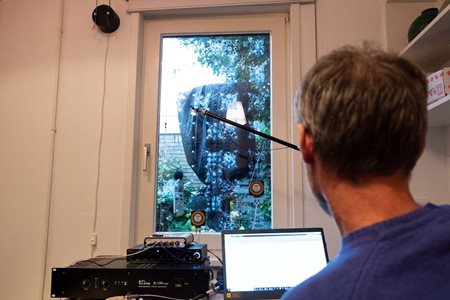 DeNoize researchers test the company’s smart soundproof windows in a real-life home environment in Zwanenburg, the Netherlands. Photo: DeNoize
Though there are many regulations that go into the construction of buildings to keep them efficient, healthy, and standing, few deal with the ever-growing issue of noise pollution. There are no requirements that a building next to a highway or a nightclub have some material or method for dealing with the noise that might leach through. Needless to say, the residents or employees inside such a building might wish otherwise.
DeNoize researchers test the company’s smart soundproof windows in a real-life home environment in Zwanenburg, the Netherlands. Photo: DeNoize
Though there are many regulations that go into the construction of buildings to keep them efficient, healthy, and standing, few deal with the ever-growing issue of noise pollution. There are no requirements that a building next to a highway or a nightclub have some material or method for dealing with the noise that might leach through. Needless to say, the residents or employees inside such a building might wish otherwise.
As it happens, the vast majority of noise that works its way inside buildings to irritate its inhabitants comes through its windows. Rather than building windowless structures, Jindal has found a way to use the windows themselves to actively cut the noise passing through them.
“The smart way to do it is using a similar concept to the one used in noise-canceling headphones, which is actively interfering with the noise signals to cancel them. And that’s where it started theoretically,” he explained.
Jindal, whose background is in mechanical and aerospace engineering, teamed up with acoustic engineer Olivier Schevin in 2019. At the time, Schevin told him that it would take five or six years and millions of Euros to accomplish, but “it’s an interesting challenge to solve, so let’s start,” Jindal recalled.
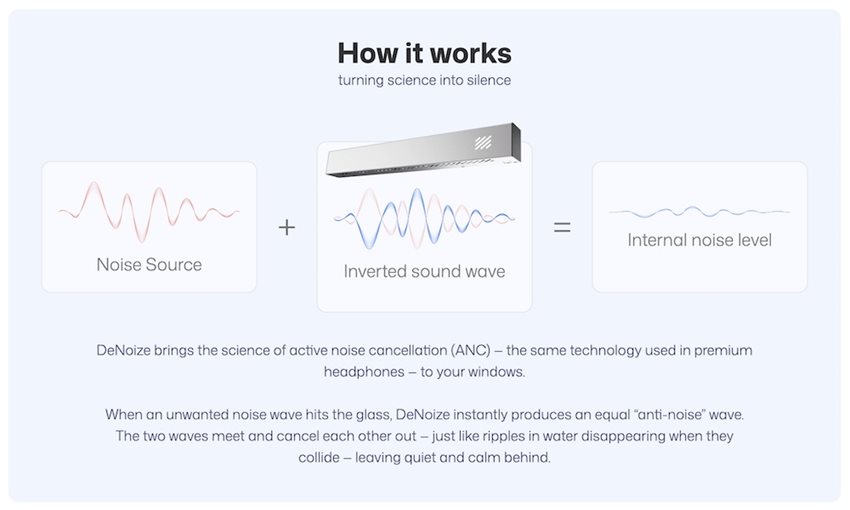 A diagram explaining how the DeNoize technology works. Image: DeNoize
The challenge, it turned out, was determining what noise should be canceled. Because “destructive interference,” as the active noise-canceling technique is called, is easy when it’s aimed at a single point, as it is in headphones. Simply emitting sound waves out of phase with the ones you want to cancel is the standard technique. But things aren’t so simple when the target is larger than an earhole, to say nothing of an entire room.
A diagram explaining how the DeNoize technology works. Image: DeNoize
The challenge, it turned out, was determining what noise should be canceled. Because “destructive interference,” as the active noise-canceling technique is called, is easy when it’s aimed at a single point, as it is in headphones. Simply emitting sound waves out of phase with the ones you want to cancel is the standard technique. But things aren’t so simple when the target is larger than an earhole, to say nothing of an entire room.
“If you want to do global control, you need to figure out what metrics to cancel that would lead to, on average, lower energy in the whole environment. Figuring that out was challenging,” Jindal said. “But I think the more challenging part is to make it work. You can understand the physics and the wave theories, and the panel vibrations are pretty well known. But really, making it work is a completely different beast because any mismatch in signal processing, any mismatch in timing, breaks the system. But you wouldn’t know why it’s not working.”
 After years of controlled laboratory environments and prototype refinement, DeNoize recently began a pilot program to deploy active noise cancelling technology in actual homes across the Netherlands. Photo: DeNoize
Furthermore, the structures of glass panes are all different from each other. So, getting them to vibrate right requires some kind of self-learning mechanism. As a result, the DeNoize system does a lot more than simple wave propagation. The device learns from whatever setting it’s in, calibrating itself to both the environment and the glass itself. Essentially, microphones on one side of the glass pick up the incoming noise, that data is processed, and then vibrational actuators set the window in motion. In short, the glass becomes a speaker.
After years of controlled laboratory environments and prototype refinement, DeNoize recently began a pilot program to deploy active noise cancelling technology in actual homes across the Netherlands. Photo: DeNoize
Furthermore, the structures of glass panes are all different from each other. So, getting them to vibrate right requires some kind of self-learning mechanism. As a result, the DeNoize system does a lot more than simple wave propagation. The device learns from whatever setting it’s in, calibrating itself to both the environment and the glass itself. Essentially, microphones on one side of the glass pick up the incoming noise, that data is processed, and then vibrational actuators set the window in motion. In short, the glass becomes a speaker.
And that means the windows can do more than just mute sounds. Sometimes too much blocked noise can sound dull or unnatural, so users can choose to let certain sounds, like bird songs and rain, come through.
Jindal and his team have tested the psychological power of their system. They ran an experiment where they asked people to spend the night in a house outfitted with their noise canceling windows, near Amsterdam’s Schiphol Airport. About 70 percent of volunteers said they slept better when the system was on than when it was off.
While the noise-sensitive among us might be eager to install such windows, they’ll only be available in The Netherlands sometime near the end of this year. A worldwide launch is still pending.
Not all sound is noise, to be sure. A friend in conversation, for instance, might be worth hearing. But in a noisy restaurant, or on a factory floor, that rapport can be drowned in the sea of surrounding cacophony. Voices, specifically, can be difficult to distinguish for the hard of hearing, when they are awash in a background of babble, a roar of traffic, or the clinks and clanks of a café.
But now, thanks to researchers at the University of Washington, we’ll soon be able to hear just the people we want to hear, regardless of the marching band, jet engines, and cackling crowd that may surround them. With their headphones, users need merely look at who they’re talking to, and the system will filter out the target voice from the background.
Don’t Miss September’s Cover Story: The Next Robotics Frontier
To do that, the researchers needed a piece of software that could live on a smartphone, sample speech in real-time, use it to filter a voice from all other incoming sounds, and play that through the headphone’s speakers—all within a matter of 20 milliseconds. Doing that would be a lot simpler if it could pre-sample the voices we listen to as well, but Bandhav Veluri, the doctoral student who led the research (now at Sesame AI working on conversational AI) and his colleagues wanted a device that could be used in fresh situations with fresh voices and minimal fiddling with an app.
“The challenge here is finding a clean example of that person. We cannot go around asking for a clean speech sample of the all the people that we want to hear—that would be a very bad user experience,” Veluri said. To solve that problem, he and his team made the headphones take a sample of sound that included directional information. That, it turns out, is sufficient for the neural network to isolate the target speaker.
The result they came up with samples a mere two to five seconds of sound within an 18-degree angle determined by where the user is facing. The voice of the person they’re looking at can, subsequently, be cranked up to the user’s preferred level, all with less than 20 milliseconds of latency.
The phone could also potentially store details on people with whom a user regularly speaks for instant use at any time. Outward-looking cameras (on earbuds or smart glasses) could associate a person who was talking with one of many stored voices. However, if those voices were to be stored on the device or on the cloud, it could raise legal and ethical issues. But, however it might evolve, we may soon be able to hear the people that are talking to us in any situation whenever we want.
Canceling the noise that comes down our ear canals or enters our homes through the windows, is, no doubt, a great boon to the peace of those with such technology. But to make the outdoors, highways, and skyways quieter, some noise has to be nipped at the source. And many of those sources, especially in the areas of automotive, aviation, and HVAC, are simply tubes with airflow.
There’s a slight issue with reducing sound in such situations: typically, when you try to cut the noise of an airflow, you cut the airflow too. But now Chen Shen, a professor of mechanical engineering at Rowan University, and his colleagues, have created a metamaterial that quashes noise in a pipe but leaves the flow untouched.
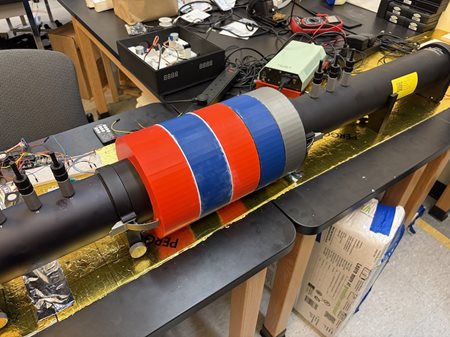 The muffler installed on a test apparatus. Photo: Chen Shen/Rowan University
Shen is not the first to attempt such a thing, but previous efforts had some disadvantages. “Although they can potentially achieve broadband performance, their geometry is usually very complicated, and also their shape is not so uniform, which means they occupy a large space,” he said. The duct Shen developed is essentially an unobstructed tube surrounded by slit-like cavities of various lengths. Each cavity targets a specific frequency, reflecting it back and essentially nullifying it.
The muffler installed on a test apparatus. Photo: Chen Shen/Rowan University
Shen is not the first to attempt such a thing, but previous efforts had some disadvantages. “Although they can potentially achieve broadband performance, their geometry is usually very complicated, and also their shape is not so uniform, which means they occupy a large space,” he said. The duct Shen developed is essentially an unobstructed tube surrounded by slit-like cavities of various lengths. Each cavity targets a specific frequency, reflecting it back and essentially nullifying it.
The geometry manages to turn back between 90 and 95 percent of the sound waves in the airflow. As a result, the metamaterial manages to reduce the noise by more than 36 decibels, which is like turning a near deafening sound into a mere burble, all with negligible impact to the air flow. Part of the goal was, of course, to limit the radius of the ducts. But in situations where space was not an issue, the performance would be even greater.
Discover the Benefits of ASME Membership
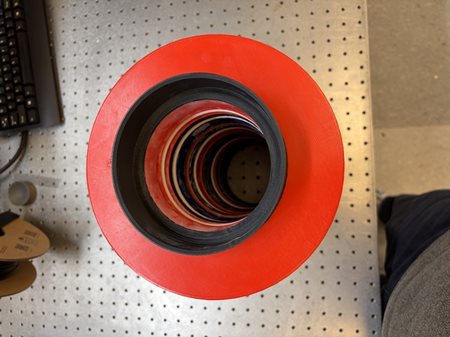 A look inside the muffler. Photo: Chen Shen/Rowan University
There is, of course, much work to be done before the Shen’s metamaterial gets out in the world to make it a quieter place. For one thing, manufacturing and scalability issues have yet to be tackled. And the team needs to find a way to target specific applications, as not all airflow scenarios are alike. Where flow speeds are not that high, and similar to what Shen used in the lab, slight adjustments of cavity sizes should be sufficient.
A look inside the muffler. Photo: Chen Shen/Rowan University
There is, of course, much work to be done before the Shen’s metamaterial gets out in the world to make it a quieter place. For one thing, manufacturing and scalability issues have yet to be tackled. And the team needs to find a way to target specific applications, as not all airflow scenarios are alike. Where flow speeds are not that high, and similar to what Shen used in the lab, slight adjustments of cavity sizes should be sufficient.
“But if you’re talking about really high-speed airflow, then maybe the entire structure needs to be changed because its acoustic behavior can be completely different,” Shen said.
And there are other situations where it’s preferable to absorb sound rather than reflect it. “Servers, for example, are so delicate, they do not function well with strong vibrations,” Shen added. “If we are just rejecting sound, then it’s still interacting with those small electronic components.” He hopes to eventually make a similar metamaterial that can absorb, rather than just reflect, offending frequencies.
Noise from above isn’t just from airplanes anymore. The duct-free whine of a drone can annoy anyone in any locale. Vitor T. Valente, an assistant teaching professor of Aerospace Engineering at Penn State University, wanted to see if that noise could be mitigated. So, he developed an algorithm to electronically synchronize the rotors of a hexacopter.
“Sound is a mechanical wave,” Valente said. “If I can synchronize the noise sources, I can make those waves match, out-of-phase, and get some attenuation targeting some area in space.” With a stationary drone on a stand, he was able to do exactly that.
“The rotors were spinning at approximately 19,000 RPM, and we were able to keep track of the phase within 12 degrees error, maximum. So, that was a pretty cool result,” he said. And a quiet result, as the hexacopter noise dropped by approximately 15 decibels at some frequencies.
However, the experiment was in less than real conditions. Not only was the drone not actually flying, but its rotors were all spinning at very similar RPM throughout, unlike an airborne drone, where rotors spin at different speeds during regular flight. So now Valente is tackling the more complex problem of quieting a drone when its rotors are turning at different speeds. “We had to go back and revise some key assumptions,” he said. “So, that’s still ongoing work.”
But some things that fly are more silent than planes and hexacopter. Take the Atlas moth, the largest moth in the world. Despite its enormous size—it has a wingspan of 10 to 12 inches—it’s an easy target for bats, or would be, but for the acoustic camo it’s developed over the eons.
More Sound Innovation: A Device to Tune In or Out
The echolocation of bats, of course, is a matter of sending out sound waves and hearing how they are reflected, a kind of biological sonar. To hide from this acoustical search and destroy, the moths, though deaf themselves, are able to suppress sound that hits them thanks to the structure of the tiny scales on their wings.
Marc Holderied, a professor of sensory biology at the University of Bristol, was fascinated by the silk moths he saw in their natural habitat in Costa Rica some 30 years ago. When he then discovered their sound camouflaging abilities, he became obsessed and soon began developing a sound-dampening wallpaper modeled after the scales of the similarly sound-camouflaging Atlas moth.
These moths only need to wrangle the narrow band of high frequency that bats use to escape their detection, so their scales are microscopic. Holderied’s scales are much larger—but still quite thin—in an effort to mute a broader band of frequencies.
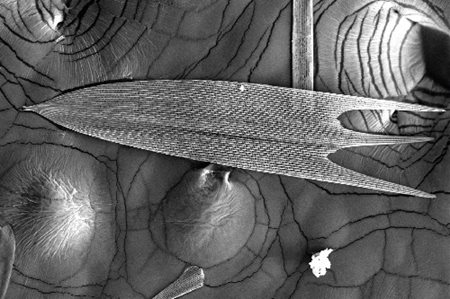 An up-close view of the wing scales on a sound-camouflaging Atlas moth. Photo: University of Bristol
“The fundamental principle of our technology is exactly the same,” he said. “This is a passive technology.” The scales, when enlarged, look like a handful of oddly cut ridged potato chips. This “moth inspired plastic,” as he’s calling it, is a mere 14 millimeters thick, but capable of blocking as much sound as two feet of concrete.
An up-close view of the wing scales on a sound-camouflaging Atlas moth. Photo: University of Bristol
“The fundamental principle of our technology is exactly the same,” he said. “This is a passive technology.” The scales, when enlarged, look like a handful of oddly cut ridged potato chips. This “moth inspired plastic,” as he’s calling it, is a mere 14 millimeters thick, but capable of blocking as much sound as two feet of concrete.
Just months ago, he incorporated his company, Attacus Acoustics (named after the latin name for the moth, Attacus Atlas in Latin), and he is now working to use his product where thinness and quietude are most valued together: on an airplane. That means recreating the metamaterial with fireproof materials. “Every solution has its constraints,” Holderied said. “But we live in a modern age, and there are so many materials you can draw from.”
Holderied is also branching out to other critters. “Evolution is the best inventor ever,” he said. “We are working on a moth that looks exactly like a stick. Really, like a broken stick. But it doesn’t only look like a stick, it also sounds like a stick, which is amazing.”
Those hoping for a stick-like silence in their domiciles may someday have relief thanks to Holderied’s efforts.
Michael Abrams is a technology writer in Westfield, N.J.
Engineers are at the forefront of figuring out how to best quiet things down. Ingenuity, algorithms, and metamaterials are coming together in ever more clever ways to better silence our industries and homes, both indoors and outdoors.
Canceling out
“I have one garbage truck that comes every morning at 7:00 on the other side of the street, and it waits there for a while, while it picks the garbage, and the engine is running at a really low frequency, and it’s very annoying,” said Aman Jindal, founder and CEO of DeNoize. He has made it his business to eliminate—or minimize at least—sounds like the garbage truck across the street.
DeNoize researchers test the company’s smart soundproof windows in a real-life home environment in Zwanenburg, the Netherlands. Photo: DeNoize
As it happens, the vast majority of noise that works its way inside buildings to irritate its inhabitants comes through its windows. Rather than building windowless structures, Jindal has found a way to use the windows themselves to actively cut the noise passing through them.
“The smart way to do it is using a similar concept to the one used in noise-canceling headphones, which is actively interfering with the noise signals to cancel them. And that’s where it started theoretically,” he explained.
Jindal, whose background is in mechanical and aerospace engineering, teamed up with acoustic engineer Olivier Schevin in 2019. At the time, Schevin told him that it would take five or six years and millions of Euros to accomplish, but “it’s an interesting challenge to solve, so let’s start,” Jindal recalled.
A diagram explaining how the DeNoize technology works. Image: DeNoize
“If you want to do global control, you need to figure out what metrics to cancel that would lead to, on average, lower energy in the whole environment. Figuring that out was challenging,” Jindal said. “But I think the more challenging part is to make it work. You can understand the physics and the wave theories, and the panel vibrations are pretty well known. But really, making it work is a completely different beast because any mismatch in signal processing, any mismatch in timing, breaks the system. But you wouldn’t know why it’s not working.”
After years of controlled laboratory environments and prototype refinement, DeNoize recently began a pilot program to deploy active noise cancelling technology in actual homes across the Netherlands. Photo: DeNoize
And that means the windows can do more than just mute sounds. Sometimes too much blocked noise can sound dull or unnatural, so users can choose to let certain sounds, like bird songs and rain, come through.
Jindal and his team have tested the psychological power of their system. They ran an experiment where they asked people to spend the night in a house outfitted with their noise canceling windows, near Amsterdam’s Schiphol Airport. About 70 percent of volunteers said they slept better when the system was on than when it was off.
While the noise-sensitive among us might be eager to install such windows, they’ll only be available in The Netherlands sometime near the end of this year. A worldwide launch is still pending.
Filtering noise
Not all sound is noise, to be sure. A friend in conversation, for instance, might be worth hearing. But in a noisy restaurant, or on a factory floor, that rapport can be drowned in the sea of surrounding cacophony. Voices, specifically, can be difficult to distinguish for the hard of hearing, when they are awash in a background of babble, a roar of traffic, or the clinks and clanks of a café.
But now, thanks to researchers at the University of Washington, we’ll soon be able to hear just the people we want to hear, regardless of the marching band, jet engines, and cackling crowd that may surround them. With their headphones, users need merely look at who they’re talking to, and the system will filter out the target voice from the background.
Don’t Miss September’s Cover Story: The Next Robotics Frontier
To do that, the researchers needed a piece of software that could live on a smartphone, sample speech in real-time, use it to filter a voice from all other incoming sounds, and play that through the headphone’s speakers—all within a matter of 20 milliseconds. Doing that would be a lot simpler if it could pre-sample the voices we listen to as well, but Bandhav Veluri, the doctoral student who led the research (now at Sesame AI working on conversational AI) and his colleagues wanted a device that could be used in fresh situations with fresh voices and minimal fiddling with an app.
“The challenge here is finding a clean example of that person. We cannot go around asking for a clean speech sample of the all the people that we want to hear—that would be a very bad user experience,” Veluri said. To solve that problem, he and his team made the headphones take a sample of sound that included directional information. That, it turns out, is sufficient for the neural network to isolate the target speaker.
The result they came up with samples a mere two to five seconds of sound within an 18-degree angle determined by where the user is facing. The voice of the person they’re looking at can, subsequently, be cranked up to the user’s preferred level, all with less than 20 milliseconds of latency.
The phone could also potentially store details on people with whom a user regularly speaks for instant use at any time. Outward-looking cameras (on earbuds or smart glasses) could associate a person who was talking with one of many stored voices. However, if those voices were to be stored on the device or on the cloud, it could raise legal and ethical issues. But, however it might evolve, we may soon be able to hear the people that are talking to us in any situation whenever we want.
Select waves only
Canceling the noise that comes down our ear canals or enters our homes through the windows, is, no doubt, a great boon to the peace of those with such technology. But to make the outdoors, highways, and skyways quieter, some noise has to be nipped at the source. And many of those sources, especially in the areas of automotive, aviation, and HVAC, are simply tubes with airflow.
There’s a slight issue with reducing sound in such situations: typically, when you try to cut the noise of an airflow, you cut the airflow too. But now Chen Shen, a professor of mechanical engineering at Rowan University, and his colleagues, have created a metamaterial that quashes noise in a pipe but leaves the flow untouched.
The muffler installed on a test apparatus. Photo: Chen Shen/Rowan University
The geometry manages to turn back between 90 and 95 percent of the sound waves in the airflow. As a result, the metamaterial manages to reduce the noise by more than 36 decibels, which is like turning a near deafening sound into a mere burble, all with negligible impact to the air flow. Part of the goal was, of course, to limit the radius of the ducts. But in situations where space was not an issue, the performance would be even greater.
Discover the Benefits of ASME Membership
A look inside the muffler. Photo: Chen Shen/Rowan University
“But if you’re talking about really high-speed airflow, then maybe the entire structure needs to be changed because its acoustic behavior can be completely different,” Shen said.
And there are other situations where it’s preferable to absorb sound rather than reflect it. “Servers, for example, are so delicate, they do not function well with strong vibrations,” Shen added. “If we are just rejecting sound, then it’s still interacting with those small electronic components.” He hopes to eventually make a similar metamaterial that can absorb, rather than just reflect, offending frequencies.
Airborne sound and inspiration
Noise from above isn’t just from airplanes anymore. The duct-free whine of a drone can annoy anyone in any locale. Vitor T. Valente, an assistant teaching professor of Aerospace Engineering at Penn State University, wanted to see if that noise could be mitigated. So, he developed an algorithm to electronically synchronize the rotors of a hexacopter.
“Sound is a mechanical wave,” Valente said. “If I can synchronize the noise sources, I can make those waves match, out-of-phase, and get some attenuation targeting some area in space.” With a stationary drone on a stand, he was able to do exactly that.
“The rotors were spinning at approximately 19,000 RPM, and we were able to keep track of the phase within 12 degrees error, maximum. So, that was a pretty cool result,” he said. And a quiet result, as the hexacopter noise dropped by approximately 15 decibels at some frequencies.
However, the experiment was in less than real conditions. Not only was the drone not actually flying, but its rotors were all spinning at very similar RPM throughout, unlike an airborne drone, where rotors spin at different speeds during regular flight. So now Valente is tackling the more complex problem of quieting a drone when its rotors are turning at different speeds. “We had to go back and revise some key assumptions,” he said. “So, that’s still ongoing work.”
But some things that fly are more silent than planes and hexacopter. Take the Atlas moth, the largest moth in the world. Despite its enormous size—it has a wingspan of 10 to 12 inches—it’s an easy target for bats, or would be, but for the acoustic camo it’s developed over the eons.
More Sound Innovation: A Device to Tune In or Out
The echolocation of bats, of course, is a matter of sending out sound waves and hearing how they are reflected, a kind of biological sonar. To hide from this acoustical search and destroy, the moths, though deaf themselves, are able to suppress sound that hits them thanks to the structure of the tiny scales on their wings.
Marc Holderied, a professor of sensory biology at the University of Bristol, was fascinated by the silk moths he saw in their natural habitat in Costa Rica some 30 years ago. When he then discovered their sound camouflaging abilities, he became obsessed and soon began developing a sound-dampening wallpaper modeled after the scales of the similarly sound-camouflaging Atlas moth.
These moths only need to wrangle the narrow band of high frequency that bats use to escape their detection, so their scales are microscopic. Holderied’s scales are much larger—but still quite thin—in an effort to mute a broader band of frequencies.
An up-close view of the wing scales on a sound-camouflaging Atlas moth. Photo: University of Bristol
Just months ago, he incorporated his company, Attacus Acoustics (named after the latin name for the moth, Attacus Atlas in Latin), and he is now working to use his product where thinness and quietude are most valued together: on an airplane. That means recreating the metamaterial with fireproof materials. “Every solution has its constraints,” Holderied said. “But we live in a modern age, and there are so many materials you can draw from.”
Holderied is also branching out to other critters. “Evolution is the best inventor ever,” he said. “We are working on a moth that looks exactly like a stick. Really, like a broken stick. But it doesn’t only look like a stick, it also sounds like a stick, which is amazing.”
Those hoping for a stick-like silence in their domiciles may someday have relief thanks to Holderied’s efforts.
Michael Abrams is a technology writer in Westfield, N.J.
Many of the things that engineers create make a lot of noise. Now there’s a crop of engineers trying to turn the volume down for all of us.

Freelance writer based in New Jersey
Related Content


Sep 29, 2026
An Engineering Landmark in Tractor Innovation

The Hart-Parr Model 3 is the first tractor to be mass produced with an internal combustion engine, earning its designation as a Historical Mechanical Engineering Landmark.


Sep 9, 2026
5 Myths About Borosilicate Glass
SCHOTT's Tina Gallo tackles five myths that may be causing engineers to underestimate borosilicate glass.
Sep 3, 2026
5 Mechanical Innovations to Watch in 2026

From adaptive safety belts to biomechanical drug delivery, these recent mechanical engineering breakthroughs are setting the stage for the future.

Sep 1, 2026
The Next Robotics Frontier


The robotics industry often focuses on scale, automation, and valuations. But a quieter group of founders is instead asking what robotics have overlooked as they innovate with compassion in mind.