As Energy Needs Rise, Demand for Temporary Engineers Grows
As Energy Needs Rise, Demand for Temporary Engineers Grows

Data centers and power projects are boosting demand for temporary mechanical engineers. But the outlook across sectors is mixed even as contract roles still offer high pay and a way to build skills.
“Demand for temporary engineers is boosted by growth in the economy,” explained staffing Industry Analysts (SIA) Senior Research Analyst Amy Horvat, who specializes in engineering staffing. She noted that this is true because temporary engineering work touches nearly every part of the economy.
Much of today’s engineering work, for example, is driven by energy, infrastructure, and industrial modernization. “Engineering is benefiting from increased spending on factories and data centers, where skills are needed to design and execute building projects—and engineers are also critical to operating the completed facilities,” Horvat said.
Tariffs early last year dampened manufacturing and construction. SIA reported that general uncertainty led many clients to pause spending and hiring. Conditions improved late in 2025, however. In its latest US Staffing Industry Forecast, SIA reported that 64 percent of respondents to its bimonthly Pulse survey reported revenue growth in December, and a net 33 percent reported increases in new orders. And that optimism has continued into 2026.
Mechanical engineering is well suited for contract hiring because projects tend to run in boom-and-bust cycles, with periods when a surge of resources is necessary. “Most companies will look at full-time employees as the core of their population, but whether it’s seasonal or to ramp up for a project, they often want to top off with contract workers,” explained Jorge Puente, vice president of Kelly’s engineering division, in “Contract Staffing Is Popular, but Has Its Downsides.”
 Mechanical engineering accounts for the largest share of placements in Puente’s group. “In our Kelly Engineering business, [up to] 6 percent of our requests are for mechanical engineers,” Puente said. “That’s huge for a single discipline.”
Puente noted that an engineering firm may need short-term help to meet a new product launch deadline—or to finish a punch list while staff engineers move on to other client projects. Staffing services such as Kelly hire and onboard engineers, place them on the staffing firm’s payroll, and bill the client an hourly rate.
As growth and innovation continue across many sectors, mechanical engineers are well positioned for steady opportunity. Many specialize in a particular sector or skill set—such as automotive, aerospace, or biomedical—and clients continue to rely on flexible workforce options to match shifting project needs.
For mechanical engineers and others, the arrangement can make a lot of sense. Temporary work offers several advantages, Horvat said. Often, “contract work offers higher pay rates than full-time employment roles, as employers are looking to attract the best or difficult-to-find talent,” she explained.
Along with better pay, temporary jobs often include the same types of benefits as full-time roles, including healthcare and paid leave plans (often paid by the staffing firm). “In engineering, temporary contracts also tend to be fairly lengthy, with most lasting at least a year and a half and many lasting longer than two years, which provides workers with a nice blend of short-term stability and long-term flexibility to grow their careers,” Horvat said.
Temporary work is also a good way to gain exposure to a new project or industry. “In engineering, the first job a worker takes during or after college often determines their career path. For workers looking for a change, temporary work is a great way to expand their resume and gain experience in a new field,” she explained.
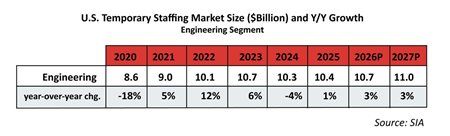
Currently, the engineering staffing market is forecast to expand 3 percent in 2026, before growing another 3 percent in 2027. “Data centers and power infrastructure projects are expected to drive gains,” Horvat said.
 New data center projects—which are in various stages, from initial investment and site location through to construction—are massive in scale and encompass a range of phases and roles, she said. “Data center growth is also increasing engineering staffing demand in the power and telecom sectors, as these massive projects must be connected to existing infrastructure or—in the case of power—new co-located power facilities are planned, implemented, and then connected to the grid,” she said.
Horvat pointed out that beyond connection projects, the massive loads of power consumed by data centers are also prompting upgrades to existing power utility infrastructure. “While utilities need to be able to handle the large loads of electricity consumed by data centers without disrupting supply to other consumers, they also must be prepared to handle swings in usage caused by sudden outages,” she said.
“When data centers go offline, abruptly stopping the flow of power, the entire grid has the potential to be overloaded, a [risk] that needs to be accounted for and planned for ahead of time,” Horvat added.
Additionally, competition for engineering talent is rising as data-center projects blend traditional engineering needs with demand for digital and IT expertise. A similar dynamic is playing out in advanced manufacturing. Firms that have traditionally specialized in software and other digital roles are increasingly exploring opportunities to provide more traditional engineering talent—often by expanding work with existing clients.
Traditional sectors such as energy are major employers of temporary engineers, Horvat said. That includes oil and gas players as well as renewables—particularly solar suppliers. “Engineering services firms, which employ a broad range of engineers to provide various services to their clients, are also big employers of temporary workers, as is the federal government,” she added.
Currently, the most growth is stemming from the power and utilities industries, including among companies that supply parts needed to support new buildouts in these areas. “We have also seen good demand in construction, parts of aerospace and defense, and for advanced manufacturing capabilities,” Horvat added.
Still, outside the data-center boom, engineering staffing performance varies by industry:
• Massive layoffs at many of the major oil and gas companies (i.e., Exxon, Chevron, ConocoPhillips, and BP) in 2025 all contributed to lower demand in traditional energy, where the decoupling of price and output from employment has continued as drilling technology and use of offshoring advance.
• In contrast, demand in the renewable segment has been steady, due mainly to steady demand for technicians in solar projects. Demand for staffing in wind energy, in contrast, has cooled significantly following changes in government policy implemented by the Trump administration.
• In nuclear power, demand remains small, with a limited number of clients and a small pool of talent, making it difficult to recruit. However, there continue to be positive signs that growth will expand over the next few years. Companies with established operations in this sector are the most likely to benefit.
• Mining, though also a smaller segment, has seen engineering demand increase as access to key critical minerals used in batteries, semiconductors, and other advanced technologies remain top-of-mind for many producers.
• Aerospace and defense are mixed. Commercial aerospace projects saw some revival in 2025, while cuts to government spending dampened demand on the federal side. However, rising geopolitical tensions and ongoing conflicts are likely to support demand going forward.
• According to the BLS, employment in the semiconductor industry—which had gained much attention in 2023 and 2024 as a potential area for massive growth in engineering staffing—remained significantly down in 2025. However, engineering staffing firms with long-established semiconductor operations have continued to see growth in this market, as projects that were commissioned in 2021-2022 are beginning to come online.
Cathy Cecere is membership content program manager.
Much of today’s engineering work, for example, is driven by energy, infrastructure, and industrial modernization. “Engineering is benefiting from increased spending on factories and data centers, where skills are needed to design and execute building projects—and engineers are also critical to operating the completed facilities,” Horvat said.
Tariffs early last year dampened manufacturing and construction. SIA reported that general uncertainty led many clients to pause spending and hiring. Conditions improved late in 2025, however. In its latest US Staffing Industry Forecast, SIA reported that 64 percent of respondents to its bimonthly Pulse survey reported revenue growth in December, and a net 33 percent reported increases in new orders. And that optimism has continued into 2026.
Contract work fits engineering
Mechanical engineering is well suited for contract hiring because projects tend to run in boom-and-bust cycles, with periods when a surge of resources is necessary. “Most companies will look at full-time employees as the core of their population, but whether it’s seasonal or to ramp up for a project, they often want to top off with contract workers,” explained Jorge Puente, vice president of Kelly’s engineering division, in “Contract Staffing Is Popular, but Has Its Downsides.”
Puente noted that an engineering firm may need short-term help to meet a new product launch deadline—or to finish a punch list while staff engineers move on to other client projects. Staffing services such as Kelly hire and onboard engineers, place them on the staffing firm’s payroll, and bill the client an hourly rate.
As growth and innovation continue across many sectors, mechanical engineers are well positioned for steady opportunity. Many specialize in a particular sector or skill set—such as automotive, aerospace, or biomedical—and clients continue to rely on flexible workforce options to match shifting project needs.
For mechanical engineers and others, the arrangement can make a lot of sense. Temporary work offers several advantages, Horvat said. Often, “contract work offers higher pay rates than full-time employment roles, as employers are looking to attract the best or difficult-to-find talent,” she explained.
Along with better pay, temporary jobs often include the same types of benefits as full-time roles, including healthcare and paid leave plans (often paid by the staffing firm). “In engineering, temporary contracts also tend to be fairly lengthy, with most lasting at least a year and a half and many lasting longer than two years, which provides workers with a nice blend of short-term stability and long-term flexibility to grow their careers,” Horvat said.
Temporary work is also a good way to gain exposure to a new project or industry. “In engineering, the first job a worker takes during or after college often determines their career path. For workers looking for a change, temporary work is a great way to expand their resume and gain experience in a new field,” she explained.
Data centers keep demand elevated
Currently, the engineering staffing market is forecast to expand 3 percent in 2026, before growing another 3 percent in 2027. “Data centers and power infrastructure projects are expected to drive gains,” Horvat said.
The Importance of Mechatronics for Modern Engineering
Mechatronics is behind the development of a wide range of products and machines—from household items as simple as a diaper to innovative technology as sophisticated as electric vehicles.
Horvat pointed out that beyond connection projects, the massive loads of power consumed by data centers are also prompting upgrades to existing power utility infrastructure. “While utilities need to be able to handle the large loads of electricity consumed by data centers without disrupting supply to other consumers, they also must be prepared to handle swings in usage caused by sudden outages,” she said.
“When data centers go offline, abruptly stopping the flow of power, the entire grid has the potential to be overloaded, a [risk] that needs to be accounted for and planned for ahead of time,” Horvat added.
Additionally, competition for engineering talent is rising as data-center projects blend traditional engineering needs with demand for digital and IT expertise. A similar dynamic is playing out in advanced manufacturing. Firms that have traditionally specialized in software and other digital roles are increasingly exploring opportunities to provide more traditional engineering talent—often by expanding work with existing clients.
Uneven demand across industries
Traditional sectors such as energy are major employers of temporary engineers, Horvat said. That includes oil and gas players as well as renewables—particularly solar suppliers. “Engineering services firms, which employ a broad range of engineers to provide various services to their clients, are also big employers of temporary workers, as is the federal government,” she added.
Currently, the most growth is stemming from the power and utilities industries, including among companies that supply parts needed to support new buildouts in these areas. “We have also seen good demand in construction, parts of aerospace and defense, and for advanced manufacturing capabilities,” Horvat added.
Still, outside the data-center boom, engineering staffing performance varies by industry:
• Massive layoffs at many of the major oil and gas companies (i.e., Exxon, Chevron, ConocoPhillips, and BP) in 2025 all contributed to lower demand in traditional energy, where the decoupling of price and output from employment has continued as drilling technology and use of offshoring advance.
• In contrast, demand in the renewable segment has been steady, due mainly to steady demand for technicians in solar projects. Demand for staffing in wind energy, in contrast, has cooled significantly following changes in government policy implemented by the Trump administration.
• In nuclear power, demand remains small, with a limited number of clients and a small pool of talent, making it difficult to recruit. However, there continue to be positive signs that growth will expand over the next few years. Companies with established operations in this sector are the most likely to benefit.
• Mining, though also a smaller segment, has seen engineering demand increase as access to key critical minerals used in batteries, semiconductors, and other advanced technologies remain top-of-mind for many producers.
• Aerospace and defense are mixed. Commercial aerospace projects saw some revival in 2025, while cuts to government spending dampened demand on the federal side. However, rising geopolitical tensions and ongoing conflicts are likely to support demand going forward.
• According to the BLS, employment in the semiconductor industry—which had gained much attention in 2023 and 2024 as a potential area for massive growth in engineering staffing—remained significantly down in 2025. However, engineering staffing firms with long-established semiconductor operations have continued to see growth in this market, as projects that were commissioned in 2021-2022 are beginning to come online.
Cathy Cecere is membership content program manager.


Learning is a lifelong journey. Explore our growing collection of free learning resources and articles.