On The Move: Driving The Future of Transportation
On The Move: Driving The Future of Transportation
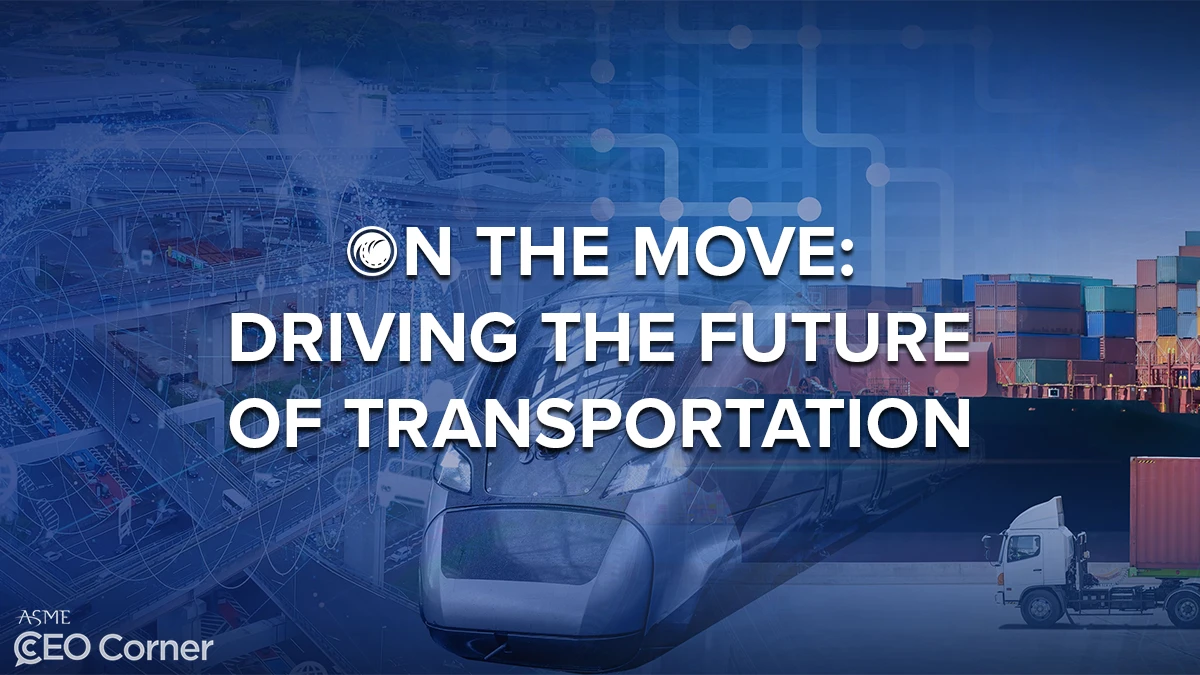
A strong transportation system shapes the pace and direction of societal progress. Steam locomotives and nationwide rail travel ignited economic expansion in the United States, a momentum carried forward by the combustion engines that power automobiles and the cargo ships transporting global freight.
Today, that legacy of innovation faces a new set of pressures. Evolving global conditions and rapid advances in automation are shaping a new path forward for mobility. In response, engineering leaders from every discipline are coming together to develop solutions that will move people, goods, and ideas in the years ahead.
Engineering The Next Wave of Mobility
The electrification movement is transforming all aspects of society, and transportation is no exception. Electrification—the conversion from non-electric energy to fully electric—is emerging as a strategy to save energy costs, support grid flexibility, and move towards low-carbon solutions. Both agricultural and industrial systems have adopted electric technologies, and transportation is taking steps to modernize.
Engineers around the world are finding creative ways to keep pace with these efforts, starting with replacing outdated technology in cars, trucks, and public transportation. Although internal combustion engines (ICE) and hybrid vehicles are still the right solution for many, electric vehicles (EVs) are increasingly in demand with consumers and companies, with global sales up 20% in 2025. Additionally, innovators are powering automobiles, trains, and cargo ships using solar power, hydrogen, and ammonia — renewable energy options that can sustain transportation systems.
At the same time, the industry is navigating a second major transformation: automation. Artificial intelligence (AI) and machine learning (ML) technologies are creating new opportunities and are widely adopted to manage traffic patterns, optimize public transit, and improve freight and logistics operations. Autonomous vehicles (AVs) are entering US cities as alternatives to taxis or rideshares. Even as engineers harness AI/ML and automation to strengthen transportation systems and enhance safety, the technology still raises questions about reliability, privacy, and ethical applications.
In this environment, ASME has a responsibility to guide standards and create spaces for engineering experts to convene and envision the future of transportation.
Shaping Progress Through Standards and Community
ASME has supported the transportation industry for over a century. The Internal Combustion Engine Division (ICED), which celebrated its 100th anniversary in 2021, built a legacy of leadership and a foundation of knowledge that continues to shape engineering.
ASME’s Rail Transportation Division (RTD), founded in 1920, pioneered the advances that defined rail engineering – steam locomotives and later diesel electrics, the first passenger trains, high-speed trains, and more. Other ASME divisions, such as the Dynamic Systems and Control Division (DSCD), the Design Engineering Division (DED), and the Ocean, Offshore, and Arctic Engineering Division (OOAE), also contribute to global transportation.
As transportation technologies evolve and new challenges emerge, ASME recognizes the need to address a diverse set of mobility areas. Drawing on the success and leadership of ICED, ASME launched the Transportation Systems Division (TSD) to expand beyond engines alone, encompassing electrification, autonomous systems, sustainability, safety, and integrated mobility. TSD is designed to connect experts from diverse sectors and specialties to meet the field’s most demanding priorities and approach transportation as an interconnected system across land and sea.
The division’s inaugural conference, DRIVN, will bring together the innovators shaping the next era of transportation engineering. Pronounced “driven,” the event will bring a broad spectrum of propulsion and mobility technologies under one roof, spanning electrification, internal combustion engines, hybrid systems, autonomy, safety, and sustainability. Designed as a deeply technical forum, DRIVN will feature cutting‑edge research, high‑impact presentations, and panel discussions with leaders across the mobility ecosystem.
The program is derived from the ICE Forward Symposium and former Joint Rail Conference, offering continuity for long-standing participants while expanding the community to reflect the full spectrum of modern mobility technologies. DRIVN is set to become the premier global forum for cross-platform collaboration, supporting the ideas needed to develop cleaner, safer transportation systems. Engineers will drive the future of movement across land and sea this September in Detroit.
The Road Ahead
Global transportation is a constantly evolving system that depends on engineers to keep it safe, reliable, and sustainable. As mechanical engineers respond to the electrification movement and AI implementation in transportation systems, significant challenges remain as these innovations evolve. Rest assured, the ASME community is committed to navigating the changing mobility sector while ensuring smarter, cleaner, and more efficient progress across the globe.
With regards,

Tom Costabile, P. E., FASME
ASME Executive Director/CEO

P.E., FASME Executive Director/CEO
Related Content

Oct 14, 2026
How Glass Is Quietly Shaping the Future of Automotive Engineering

Oct 12, 2026
From Disruption to Optimization: The Role of Simulation in Modern Refining

Digital simulation is helping refiners improve efficiency, troubleshoot operational challenges, and adapt to an increasingly complex energy landscape.

Oct 12, 2026
Podcast: Standards as the Backbone of Nuclear & Fusion Energy
Lester Su and Dale Matthews explore how codes and standards support quality and innovation as nuclear and fusion technologies continue to advance.

Oct 7, 2026
Better Listening Builds Better Careers


For engineers, better listening can reveal critical information, strengthen trust, and lead to smarter decisions.