Fueling Immunity from Within
Fueling Immunity from Within
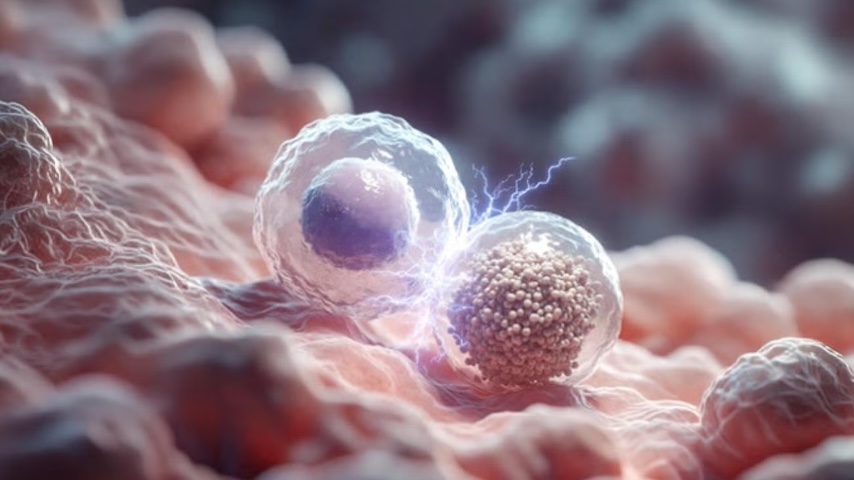
An implantable system extends the life of cancer-fighting cells.
For decades, immunotherapy has held promise as one of the most elegant approaches to cancer treatment: empower the body’s own immune system to recognize and destroy tumors. In practice, however, that promise has been uneven, particularly against solid tumors, where immune cells often falter before the fight is won.
Researchers at the University of California, Los Angeles are advancing a new approach that reframes the problem not as one of targeting, but of endurance. Their solution is an implantable, bioengineered “charging station” designed to sustain and amplify immune cell activity directly within the tumor environment.
“It’s a hard battle for the body,” said study co-lead Lili Yang, a professor of microbiology, immunology & molecular genetics. “When cancer occurs, it means the immune system has already been fighting for a long time. It doesn’t mean the cells are not functional—they just need a boost.”
That need for a boost reflects a central limitation in modern immunotherapy. While techniques such as CAR-T cell therapy have shown striking success in certain blood cancers, their effectiveness drops sharply in solid tumors. The issue is not necessarily that immune cells fail to reach the tumor, but that they lose strength once they arrive.
Study co-lead Song Li, Chancellor’s Professor of Bioengineering at the UCLA Samueli School of Engineering, compares the problem to a vehicle attempting to climb a hill without sufficient fuel. “If you run out of gas or electricity, you cannot go up,” he said.
The material is fabricated into microparticles that can be injected near tumors, where they disperse through the surrounding tissue. Each particle acts as a localized depot or “charging station” that delivers a carefully engineered combination of biochemical signals. These include α-galactosylceramide, a glycolipid that selectively activates invariant natural killer T (iNKT) cells, and interleukin-15, a cytokine that promotes immune cell proliferation and survival.
“These are two critical signals,” Li said. “One activates the cells, the other stimulates proliferation and expansion.”
More for You: A Tattoo that Harvests Biomechanical Energy
To achieve sustained delivery, the researchers employ a hierarchical design. Nanoparticles made of PLGA—a biodegradable polymer commonly used in dissolvable sutures—are embedded within the larger alginate microparticles.
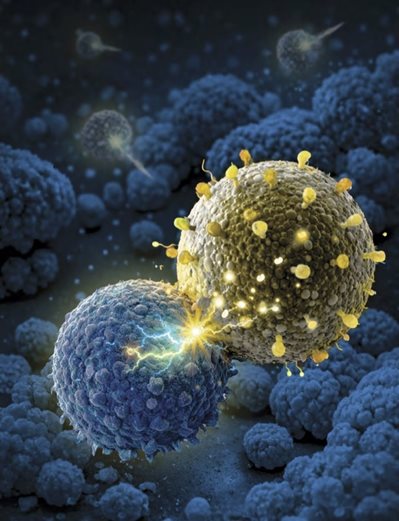 T-cell charging stations at work. Image: Haochen Nan and Song Li/UCLA
Although alginate itself is not inherently bioactive, its properties allow for controlled persistence within the body. Depending on formulation, the microparticles can remain functional for a long period of time.
T-cell charging stations at work. Image: Haochen Nan and Song Li/UCLA
Although alginate itself is not inherently bioactive, its properties allow for controlled persistence within the body. Depending on formulation, the microparticles can remain functional for a long period of time.
“In vivo, these cells would last one to two months, providing immune surveillance,” Li said, adding that degradation can be tuned through material composition and ionic interactions.
The result is both an increase in cell number and an enhancement in their ability to attack tumors, both initially and over an extended period.
“Each cell is like a special force soldier,” Yang said. “But numbers matter. You cannot expect one single soldier to win the battle.” With the right signals, those cells multiply rapidly and gain strength, transforming a small, exhausted population into a coordinated and sustained immune response, she explained.
That sustained response is the ultimate goal. Researchers track performance using a combination of release profiling, imaging, and biological assays, with the aim of achieving stronger cytotoxic activity, longer persistence, and resistance to immune cell exhaustion.
A key innovation lies in the type of immune cell the system supports. The team focuses on invariant natural killer T cells, a rare but powerful immune population that offers advantages over traditional T-cell therapies. Unlike conventional approaches, which require harvesting and engineering each patient’s own cells, iNKT cells can be used in an allogeneic, off-the-shelf format.
“Now we don’t need to treat patients one by one,” Yang said. “We can manufacture a product, store it, and use it when needed.”
Discover the Benefits of ASME Membership
This shift has major implications for scalability and cost. Current CAR-T therapies can exceed $300,000 per treatment, with additional logistical burdens related to manufacturing and patient-specific processing. By contrast, Li estimated that an iNKT-based approach could reduce manufacturing costs to less than $10,000.
The fabrication of the microparticles themselves reflects a blend of mechanical and biomedical engineering. Using microfluidic techniques, the team can produce highly uniform particles, ensuring consistent delivery behavior.
Though promising, bringing an implantable biomaterial and cell therapy platform to the clinic will require extensive validation, regulatory approval, and manufacturing development. The team is currently advancing toward clinical trials with human studies potentially beginning within the next one to two years.
Beyond cancer, the platform may extend to other immune-related conditions, including autoimmune diseases such as multiple sclerosis and lupus, where modulating immune function could have a broad therapeutic impact.
For now, the work stands as an example of how engineering principles can reshape the future of medicine. The researchers are treating immune response not as a fixed biological limitation, but as a system that can be supported, sustained, and ultimately strengthened through design.
“It’s always a learning curve when you go across disciplines,” Yang said. “But that’s where innovation happens.”
Cassandra Kelly is a technology writer in Columbus, Ohio.
Researchers at the University of California, Los Angeles are advancing a new approach that reframes the problem not as one of targeting, but of endurance. Their solution is an implantable, bioengineered “charging station” designed to sustain and amplify immune cell activity directly within the tumor environment.
“It’s a hard battle for the body,” said study co-lead Lili Yang, a professor of microbiology, immunology & molecular genetics. “When cancer occurs, it means the immune system has already been fighting for a long time. It doesn’t mean the cells are not functional—they just need a boost.”
That need for a boost reflects a central limitation in modern immunotherapy. While techniques such as CAR-T cell therapy have shown striking success in certain blood cancers, their effectiveness drops sharply in solid tumors. The issue is not necessarily that immune cells fail to reach the tumor, but that they lose strength once they arrive.
Study co-lead Song Li, Chancellor’s Professor of Bioengineering at the UCLA Samueli School of Engineering, compares the problem to a vehicle attempting to climb a hill without sufficient fuel. “If you run out of gas or electricity, you cannot go up,” he said.
How it works
The device introduces a localized, persistent support system that provides immune cells with the biochemical “fuel” needed to proliferate, remain active, and continue attacking tumors over time. At its core is a microscale delivery platform built from alginate, a biocompatible polymer derived from seaweed. Alginate is already widely used in medical applications and is low cost and safe.The material is fabricated into microparticles that can be injected near tumors, where they disperse through the surrounding tissue. Each particle acts as a localized depot or “charging station” that delivers a carefully engineered combination of biochemical signals. These include α-galactosylceramide, a glycolipid that selectively activates invariant natural killer T (iNKT) cells, and interleukin-15, a cytokine that promotes immune cell proliferation and survival.
“These are two critical signals,” Li said. “One activates the cells, the other stimulates proliferation and expansion.”
More for You: A Tattoo that Harvests Biomechanical Energy
To achieve sustained delivery, the researchers employ a hierarchical design. Nanoparticles made of PLGA—a biodegradable polymer commonly used in dissolvable sutures—are embedded within the larger alginate microparticles.
T-cell charging stations at work. Image: Haochen Nan and Song Li/UCLA
“In vivo, these cells would last one to two months, providing immune surveillance,” Li said, adding that degradation can be tuned through material composition and ionic interactions.
Sustained response
From an engineering standpoint, the system operates through a combination of diffusion-driven transport and direct cell-material interaction. The microparticles establish chemical gradients that recruit immune cells from surrounding tissue. Once cells approach the particles, contact with the surface delivers stronger activation signals, effectively “recharging” them.The result is both an increase in cell number and an enhancement in their ability to attack tumors, both initially and over an extended period.
“Each cell is like a special force soldier,” Yang said. “But numbers matter. You cannot expect one single soldier to win the battle.” With the right signals, those cells multiply rapidly and gain strength, transforming a small, exhausted population into a coordinated and sustained immune response, she explained.
That sustained response is the ultimate goal. Researchers track performance using a combination of release profiling, imaging, and biological assays, with the aim of achieving stronger cytotoxic activity, longer persistence, and resistance to immune cell exhaustion.
A key innovation lies in the type of immune cell the system supports. The team focuses on invariant natural killer T cells, a rare but powerful immune population that offers advantages over traditional T-cell therapies. Unlike conventional approaches, which require harvesting and engineering each patient’s own cells, iNKT cells can be used in an allogeneic, off-the-shelf format.
“Now we don’t need to treat patients one by one,” Yang said. “We can manufacture a product, store it, and use it when needed.”
Discover the Benefits of ASME Membership
This shift has major implications for scalability and cost. Current CAR-T therapies can exceed $300,000 per treatment, with additional logistical burdens related to manufacturing and patient-specific processing. By contrast, Li estimated that an iNKT-based approach could reduce manufacturing costs to less than $10,000.
The fabrication of the microparticles themselves reflects a blend of mechanical and biomedical engineering. Using microfluidic techniques, the team can produce highly uniform particles, ensuring consistent delivery behavior.
Though promising, bringing an implantable biomaterial and cell therapy platform to the clinic will require extensive validation, regulatory approval, and manufacturing development. The team is currently advancing toward clinical trials with human studies potentially beginning within the next one to two years.
Beyond cancer, the platform may extend to other immune-related conditions, including autoimmune diseases such as multiple sclerosis and lupus, where modulating immune function could have a broad therapeutic impact.
For now, the work stands as an example of how engineering principles can reshape the future of medicine. The researchers are treating immune response not as a fixed biological limitation, but as a system that can be supported, sustained, and ultimately strengthened through design.
“It’s always a learning curve when you go across disciplines,” Yang said. “But that’s where innovation happens.”
Cassandra Kelly is a technology writer in Columbus, Ohio.
An implantable system extends the life of cancer-fighting cells.

Author and owner of Like-Minded Marketing
Related Content


Oct 7, 2026
Better Listening Builds Better Careers


For engineers, better listening can reveal critical information, strengthen trust, and lead to smarter decisions.
Oct 5, 2026
Where Digital Meets Physical

Mechanical engineers become indispensable as they bridge the gap between digital models and physical reality.

Oct 1, 2026
Engineering the Sounds of Silence

Many of the things that engineers create make a lot of noise. Now there’s a crop of engineers trying to turn the volume down for all of us.
Oct 1, 2026
Unlocking the Power of Wave Energy


Researchers at the University of Michigan have developed wave energy converters that may improve energy independence for remote coastal and island communities.