Crawling from Shop to Space
Crawling from Shop to Space
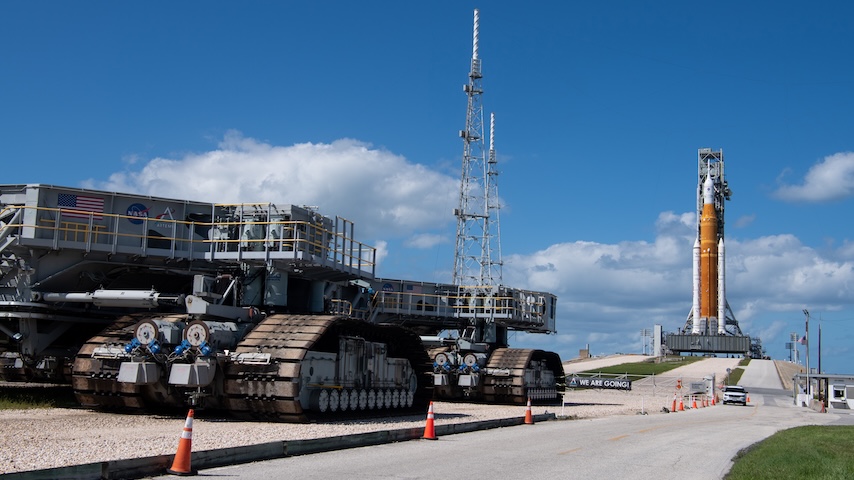
More than six decades after they were first put to work, NASA’s crawler transporters—the world’s largest delivery vehicles—are still schlepping rockets from the workshop to the launch pad.
Engineering a giant rocket, filling it with a handful of astronauts and sending it off to the moon is a major feat of human ingenuity, determination, technical knowhow, and whatnot, sure to be remembered for the rest of history. But hauling that 400,000-pound-rocket from the place it was built, down a three-and-a-half-mile road to the place it will take off from (or 4.3 miles to launch pad B), is an equally amazing triumph of engineering.
It was 1962, with the Space Race in full swing, that NASA decided to build the most powerful rocket the world had ever seen, The Saturn V, in an effort to get to the moon before any other world power might do so. The rocket was to be so powerful that an accident at liftoff had the potential to destroy anything nearby the launch pad. So they decided the rocket would be built in one place (the Vehicle Assembly Building) and do it’s taking-off some miles away.
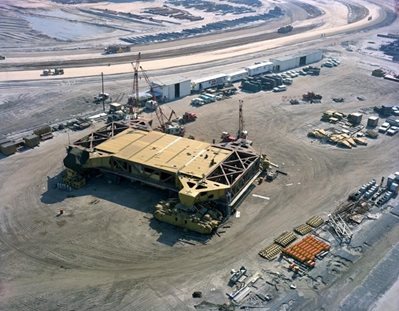 An aerial view of an original crawler transporter in 1964. Photo: NASA
Engineers pitched a few ideas for this mission: putting a platform on rails, building a canal and floating it, or even making a massive vehicle with tires.
An aerial view of an original crawler transporter in 1964. Photo: NASA
Engineers pitched a few ideas for this mission: putting a platform on rails, building a canal and floating it, or even making a massive vehicle with tires.
A little analysis proved that none of these were practical or even possible with that kind of weight. Tires would pop, rails would buckle, and water would be displaced. For some months the committee meant to figure it out was stumped. Then a young soldier reported on the amazing mining equipment he had seen at his father’s farm. The shovel he saw there had a platform as big as a football field, he said, and tracks that were eight feet tall.
The person he was talking to, Garland Johnston, took the idea and ran with it. Soon NASA had some conceptual designs and was ready to accept bidding for the job of turning them into a rolling reality.
More for You: A Landmark Rocket Sent Humanity to the Moon
“They basically just showed a steel platform that had four corners, and on those four corners there were four tanklike structures, and that’s about all it was,” said John Giles, NASA’s engineering operations manager for development and operations for NASA’s crawler-transporters, as they came to be known.
Eventually, a company out of Ohio, Marion Power and Shovel, known for making massive dragline cranes on giant tracks, won the job. Using concepts from their cranes and other vehicles, they had moving crawlers built within two years.
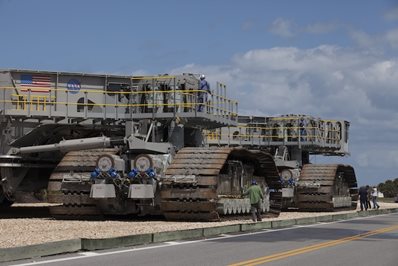 Technicians walk alongside NASA’s upgraded crawler-transporter 2 as it moves along the crawlerway. Photo: NASA
However simple the concept, once built, the crawlers were—and are—gargantuan, dwarfing people and objects around them, everything other than the loads they carry.
Technicians walk alongside NASA’s upgraded crawler-transporter 2 as it moves along the crawlerway. Photo: NASA
However simple the concept, once built, the crawlers were—and are—gargantuan, dwarfing people and objects around them, everything other than the loads they carry.
Their statistics alone are wow-worthy. Each transporter weighs 6.65 million pounds and is 131 feet long and 114 feet wide. They stand 20 feet tall—or 26 feet tall when their JEL (Jacking, Equalizing, and Leveling) cylinders are extended. The tracks alone stand 10 feet tall, with 57 shoes per track. Each crawler has 16 375-horsepower motors powered by two 16-cylinder Alco diesel engines at 2,750 horsepower each, and two 16-cylinder Cummins Power diesel engines that are 2,750 horsepower each for AC power. Sixteen jacking hydraulic cylinders keep the platform within two inches of alignment, while the hydraulic systems carry 2,500 gallons of fluid, and crawler fuel tanks hold 5,000 gallons of diesel. Each transporter has more than three miles of electrical wiring. And despite all that, they’re still driven, and steered, by hand.
They were also designated as an ASME Mechanical Engineering Landmark in February 1977.
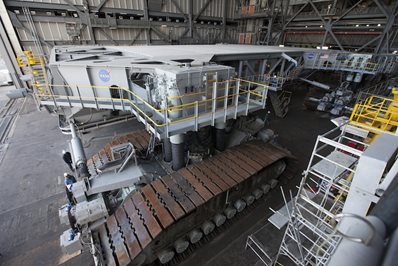 NASA’s upgraded crawler-transporter 2 starting its trek from the Vehicle Assembly Building to Launch Pad 39B in March 2016. Photo: NASA
For these behemoths, it makes more sense to talk about gallons per mile than miles per gallon, as each vehicle burns 165 gallons for each mile it moves (or one gallon every 32 feet).
NASA’s upgraded crawler-transporter 2 starting its trek from the Vehicle Assembly Building to Launch Pad 39B in March 2016. Photo: NASA
For these behemoths, it makes more sense to talk about gallons per mile than miles per gallon, as each vehicle burns 165 gallons for each mile it moves (or one gallon every 32 feet).
The most remarkable number of all, though, is 60—the number of years the crawler transporters have been at work.
“They have been changed over the years, as technology has gotten better, and as we’ve learned better ways to do things, but there is still an awful lot of original equipment on the crawlers that is six decades old,” Giles said.
The biggest and most essential change made since they were first revved up was not to the crawlers themselves but the ground they drive on. The path the crawlers were going to roll over was originally supposed to be asphalt. But when the first crawler went out for its first test drive it was immediately clear, after it made its first turn, that asphalt wasn’t going to work.
Discover the Benefits of ASME Membership
“It just ripped it up, just shredded it,” Giles said. “It looked like waves on the ocean—they learned real quick that they were going to have to completely rethink the crawlerway.”
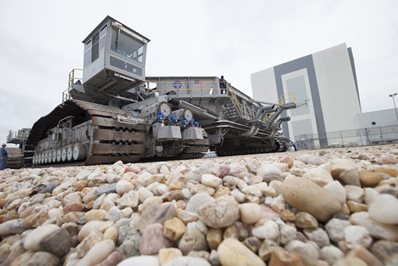 Crawlerway rock is visible as NASA’s upgraded crawler-transporter 2 returns to the Vehicle Assembly Building at the agency’s Kennedy Space Center in 2016. Photo: NASA
Subsequent studies revealed that river rock of a certain size, that had been rounded by centuries under moving water, would make the best surface for the crawlers. Over time the rock gets crushed by the weight of the crawler and has to be replaced—roughly every ten years.
Crawlerway rock is visible as NASA’s upgraded crawler-transporter 2 returns to the Vehicle Assembly Building at the agency’s Kennedy Space Center in 2016. Photo: NASA
Subsequent studies revealed that river rock of a certain size, that had been rounded by centuries under moving water, would make the best surface for the crawlers. Over time the rock gets crushed by the weight of the crawler and has to be replaced—roughly every ten years.
River rock is just the right size and shape to absorb most of the vibrations created by having 3,000 to 6,000 tons pass over it. And the crawlers have no shock absorbers. Moving at the right speed helps minimize any roughness to their travels. The Joint Loads Task Team, out of the Marshall Space Flight Center, modeled the crawlers and reported that 0.83 miles per hour was the ideal speed for the smoothest ride.
“And then they told us that 0.7 miles an hour is a bad number, because that’s when you have the most vibrations,” Giles said. “So, it’s a constant battle to keep it at the right speeds, because we do have to change speeds when we go around turns or up hills and stuff like that.”
After the crawlers hauled the two Saturn V rockets to their launch pads, they went on to carry the Saturn IB rocket for the Skylab 2 mission, Space Shuttles Enterprise, Columbia and Discovery, and jockeyed the mobile launchers to and from the launch pads as weather and testing demanded.
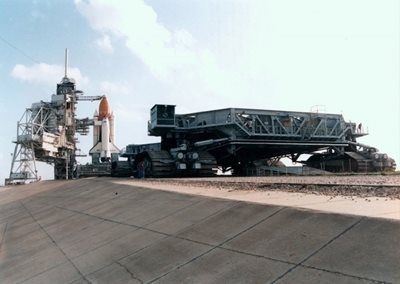 After bringing the space shuttle to the launch pad in 1996, the crawler transporter heads home. Photo: NASA
The biggest changes to the crawlers came when they were called on to haul the Ares V rocket, slated to weigh 18 million pounds.
After bringing the space shuttle to the launch pad in 1996, the crawler transporter heads home. Photo: NASA
The biggest changes to the crawlers came when they were called on to haul the Ares V rocket, slated to weigh 18 million pounds.
“The crawlers were originally designed to lift 12 million pounds, so that was a 50 percent increase,” Giles said. “We couldn’t have done that had this crawler been computer designed and computer modeled in the 1960s, because it would have been designed with only 10 or 20 percent extra capacity. So luckily, when you’re designing something with a slide rule, because those are so difficult to use, you throw on huge factors of safety. So, we actually looked at it and said, ‘Well, we actually can increase this by 50 percent.’”
But to handle that weight, there still had to be a little tweaking. They needed bigger and stronger roller bearings, more steel in the trucks, new jacking cylinders, bigger brakes, and their gear boxes had to be rebuilt. Those upgrades took two and a half years—then the program was cancelled. But that meant the crawlers were well equipped to haul the Space Launch System rocket Artemis 1, which weighed a mere 5.75 million pounds.
From the Pages of Mechanical Engineering: Artemis Transcends Apollo
In all those journeys from the VAB to the launch pads and back (a total of 2,500 miles), the crawlers have never had a serious breakdown.
“That would be a really bad day—so our goal is for that never to happen,” Giles said. There was one time when, while rolling out a shuttle, they paused because it had rained and the wet crawlerway had put dirt and grit between the belts and roller bearings.
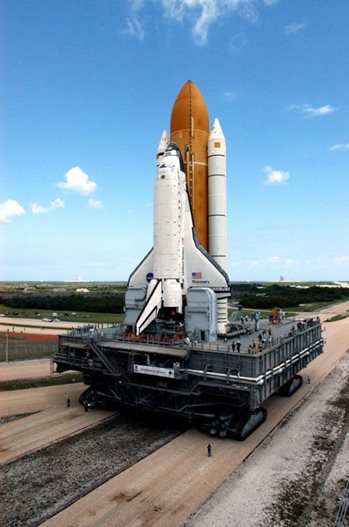 The space shuttle sits on a crawler transporter in 2005. Photo: NASA
“It didn’t get stuck. We just didn’t want to keep rolling, because we didn’t want to grind that sand into our roller bearing,” Giles added. “So, we stopped for a little bit and got some hoses out, washed that grit out of our bearings, and continued on.”
The space shuttle sits on a crawler transporter in 2005. Photo: NASA
“It didn’t get stuck. We just didn’t want to keep rolling, because we didn’t want to grind that sand into our roller bearing,” Giles added. “So, we stopped for a little bit and got some hoses out, washed that grit out of our bearings, and continued on.”
The crawlers owe their 60 years of successful operation to two things, according to Giles. The first is all the sensors that have been added: accelerometers, thermocouples, and stress and strain gauges, allow the crawler engineers and operators to keep the vehicles in peak condition. The second is keeping everything well lubricated. “Most mining equipment is expected to run 24/7, basically until it fails, and then they fix it,” Giles explained. “We can’t take that chance, so we lubricate everything and keep it running so it hopefully never fails.”
Despite the crawlers’ longevity and successful error-free deliveries, every once in a while, someone thinks that modern engineering and design techniques could do better than what was dreamed up and built in the 1960s. At the end of both the Apollo and Shuttle programs, NASA looked into the possibility of building new crawlers with more current technology.
“In both cases, the study reports came back that what we’re using is the only thing we can use,” Giles said. “If we redesigned it, we would use different metals in certain places, we would strengthen things in different places, we might design the truck structure a little differently, we would go to an AC variable frequency drive for the motors—so in smaller areas, we would upgrade to newer technology.
“But the actual design of the crawlers I don’t think will ever change.”
Michael Abrams is a technology writer in Westfield, N.J.
It was 1962, with the Space Race in full swing, that NASA decided to build the most powerful rocket the world had ever seen, The Saturn V, in an effort to get to the moon before any other world power might do so. The rocket was to be so powerful that an accident at liftoff had the potential to destroy anything nearby the launch pad. So they decided the rocket would be built in one place (the Vehicle Assembly Building) and do it’s taking-off some miles away.
An inspired concept
A handful of miles is not a particularly long trek for car, truck, or even human on foot, but at that time no one had previously shipped anything weighing as much as the Saturn V from one place to another, however far apart. Just how that might be done was a question that NASA had to answer before anyone could be sent moonward.
An aerial view of an original crawler transporter in 1964. Photo: NASA
A little analysis proved that none of these were practical or even possible with that kind of weight. Tires would pop, rails would buckle, and water would be displaced. For some months the committee meant to figure it out was stumped. Then a young soldier reported on the amazing mining equipment he had seen at his father’s farm. The shovel he saw there had a platform as big as a football field, he said, and tracks that were eight feet tall.
The person he was talking to, Garland Johnston, took the idea and ran with it. Soon NASA had some conceptual designs and was ready to accept bidding for the job of turning them into a rolling reality.
More for You: A Landmark Rocket Sent Humanity to the Moon
“They basically just showed a steel platform that had four corners, and on those four corners there were four tanklike structures, and that’s about all it was,” said John Giles, NASA’s engineering operations manager for development and operations for NASA’s crawler-transporters, as they came to be known.
Eventually, a company out of Ohio, Marion Power and Shovel, known for making massive dragline cranes on giant tracks, won the job. Using concepts from their cranes and other vehicles, they had moving crawlers built within two years.
Feats of engineering
Technicians walk alongside NASA’s upgraded crawler-transporter 2 as it moves along the crawlerway. Photo: NASA
Their statistics alone are wow-worthy. Each transporter weighs 6.65 million pounds and is 131 feet long and 114 feet wide. They stand 20 feet tall—or 26 feet tall when their JEL (Jacking, Equalizing, and Leveling) cylinders are extended. The tracks alone stand 10 feet tall, with 57 shoes per track. Each crawler has 16 375-horsepower motors powered by two 16-cylinder Alco diesel engines at 2,750 horsepower each, and two 16-cylinder Cummins Power diesel engines that are 2,750 horsepower each for AC power. Sixteen jacking hydraulic cylinders keep the platform within two inches of alignment, while the hydraulic systems carry 2,500 gallons of fluid, and crawler fuel tanks hold 5,000 gallons of diesel. Each transporter has more than three miles of electrical wiring. And despite all that, they’re still driven, and steered, by hand.
They were also designated as an ASME Mechanical Engineering Landmark in February 1977.
NASA’s upgraded crawler-transporter 2 starting its trek from the Vehicle Assembly Building to Launch Pad 39B in March 2016. Photo: NASA
The most remarkable number of all, though, is 60—the number of years the crawler transporters have been at work.
“They have been changed over the years, as technology has gotten better, and as we’ve learned better ways to do things, but there is still an awful lot of original equipment on the crawlers that is six decades old,” Giles said.
The biggest and most essential change made since they were first revved up was not to the crawlers themselves but the ground they drive on. The path the crawlers were going to roll over was originally supposed to be asphalt. But when the first crawler went out for its first test drive it was immediately clear, after it made its first turn, that asphalt wasn’t going to work.
Discover the Benefits of ASME Membership
“It just ripped it up, just shredded it,” Giles said. “It looked like waves on the ocean—they learned real quick that they were going to have to completely rethink the crawlerway.”
Crawlerway rock is visible as NASA’s upgraded crawler-transporter 2 returns to the Vehicle Assembly Building at the agency’s Kennedy Space Center in 2016. Photo: NASA
River rock is just the right size and shape to absorb most of the vibrations created by having 3,000 to 6,000 tons pass over it. And the crawlers have no shock absorbers. Moving at the right speed helps minimize any roughness to their travels. The Joint Loads Task Team, out of the Marshall Space Flight Center, modeled the crawlers and reported that 0.83 miles per hour was the ideal speed for the smoothest ride.
“And then they told us that 0.7 miles an hour is a bad number, because that’s when you have the most vibrations,” Giles said. “So, it’s a constant battle to keep it at the right speeds, because we do have to change speeds when we go around turns or up hills and stuff like that.”
Still crawling
The crawlers themselves have been tweaked and modified over the years. The left and right “zero-turn” style handles eventually became a steering wheel, seals, and rubber gaskets have been replaced many times, the engines have been overhauled with new pistons, rods, heads, fuel pumps, and camshafts, and computers and sensors have been added (though they remain 1990s-era computers).After the crawlers hauled the two Saturn V rockets to their launch pads, they went on to carry the Saturn IB rocket for the Skylab 2 mission, Space Shuttles Enterprise, Columbia and Discovery, and jockeyed the mobile launchers to and from the launch pads as weather and testing demanded.
After bringing the space shuttle to the launch pad in 1996, the crawler transporter heads home. Photo: NASA
“The crawlers were originally designed to lift 12 million pounds, so that was a 50 percent increase,” Giles said. “We couldn’t have done that had this crawler been computer designed and computer modeled in the 1960s, because it would have been designed with only 10 or 20 percent extra capacity. So luckily, when you’re designing something with a slide rule, because those are so difficult to use, you throw on huge factors of safety. So, we actually looked at it and said, ‘Well, we actually can increase this by 50 percent.’”
But to handle that weight, there still had to be a little tweaking. They needed bigger and stronger roller bearings, more steel in the trucks, new jacking cylinders, bigger brakes, and their gear boxes had to be rebuilt. Those upgrades took two and a half years—then the program was cancelled. But that meant the crawlers were well equipped to haul the Space Launch System rocket Artemis 1, which weighed a mere 5.75 million pounds.
From the Pages of Mechanical Engineering: Artemis Transcends Apollo
In all those journeys from the VAB to the launch pads and back (a total of 2,500 miles), the crawlers have never had a serious breakdown.
“That would be a really bad day—so our goal is for that never to happen,” Giles said. There was one time when, while rolling out a shuttle, they paused because it had rained and the wet crawlerway had put dirt and grit between the belts and roller bearings.
The space shuttle sits on a crawler transporter in 2005. Photo: NASA
The crawlers owe their 60 years of successful operation to two things, according to Giles. The first is all the sensors that have been added: accelerometers, thermocouples, and stress and strain gauges, allow the crawler engineers and operators to keep the vehicles in peak condition. The second is keeping everything well lubricated. “Most mining equipment is expected to run 24/7, basically until it fails, and then they fix it,” Giles explained. “We can’t take that chance, so we lubricate everything and keep it running so it hopefully never fails.”
Despite the crawlers’ longevity and successful error-free deliveries, every once in a while, someone thinks that modern engineering and design techniques could do better than what was dreamed up and built in the 1960s. At the end of both the Apollo and Shuttle programs, NASA looked into the possibility of building new crawlers with more current technology.
“In both cases, the study reports came back that what we’re using is the only thing we can use,” Giles said. “If we redesigned it, we would use different metals in certain places, we would strengthen things in different places, we might design the truck structure a little differently, we would go to an AC variable frequency drive for the motors—so in smaller areas, we would upgrade to newer technology.
“But the actual design of the crawlers I don’t think will ever change.”
Michael Abrams is a technology writer in Westfield, N.J.
More than six decades after they were first put to work, NASA’s crawler transporters—the world’s largest delivery vehicles—are still schlepping rockets from the workshop to the launch pad.

Freelance writer based in New Jersey
Related Content


Apr 2, 2026
On The Move: Driving The Future of Transportation


Apr 2, 2026
Ultra-Fine 3D Printing with a Mosquito’s Mouth


A nature-inspired solution merges the feeding tube of a mosquito with a 3D printer that can achieve a surprising resolution.

Apr 1, 2026
Workforce Blog: Strategic Philanthropy Closes the Talent Gap
Corporate partners invest in workforce development and the greater good.
Apr 1, 2026
Additive Screen Printing: Technology and Scalability for Micro-Structured Components

A screen-based additive process enables the mass production of high-resolution metal and ceramic components at industrial scale.