Engineering in Motorsports: Training Future Engineers Trackside
Engineering in Motorsports: Training Future Engineers Trackside
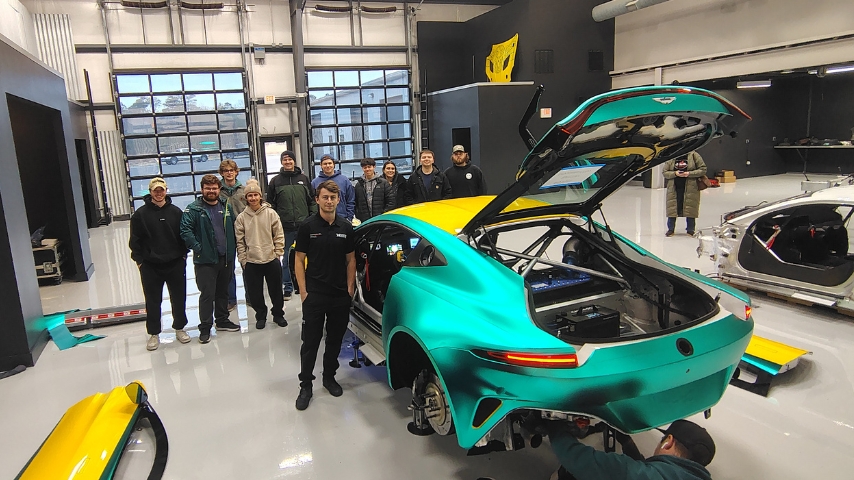
University of Delaware mechanical engineering students take classroom concepts to Daytona, learning more about real-time race data, design decisions, and the demands of endurance racing.
People love fast cars for the thrill of speed. For Steve Timmins, an adjunct professor of mechanical engineering at the University of Delaware (UD), that passion has become course curriculum. His motorsports design and maintenance courses give students experience with the thermodynamics of high-performance vehicles. They work hands-on with car engines, suspensions, chassis, and aerodynamic design.
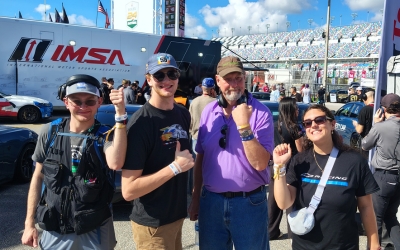 Ford Racing allowed three students and Steve Timmins (second from right) a chance to ride along during a high-speed practice run, or “hot lap.”
“I’m a car guy,” Timmins explained. He currently owns a company that specializes in race preparation, as well as building engines and transmissions for high-performance vehicles. Timmins, who owns 30 Porsches, has also been racing the high-performance German sports car since 1988.
Ford Racing allowed three students and Steve Timmins (second from right) a chance to ride along during a high-speed practice run, or “hot lap.”
“I’m a car guy,” Timmins explained. He currently owns a company that specializes in race preparation, as well as building engines and transmissions for high-performance vehicles. Timmins, who owns 30 Porsches, has also been racing the high-performance German sports car since 1988.
In 1984 Timmins earned degrees in accounting and finance at UD. He then earned his bachelor’s degree in mechanical engineering in 1988 and his doctorate in mechanical engineering in 1997. He began working at the university as an IT professional, but his big personality and devotion to fast cars made him a natural for the role of instructor.
It was Timmins who decided the “kids from Formula SAE were just working too hard to not get credit.” Formula SAE is a design competition where student teams develop Formula-style race cars. “The rules are that most parts, including the entire chassis, have to be new each year,” he said. “Most remaining parts including suspension and aero bits are manufactured in-house.”
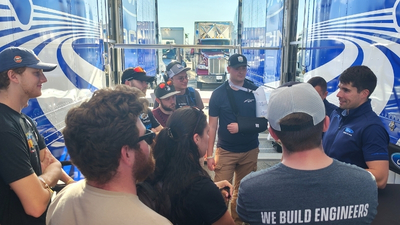 In Daytona, the class visited Ford Racing race engineers and toured their team trailer.
Timmins’ own motorsports work takes him to Daytona International Speedway each year, where he once hosted a live webcast from the “pit.” So while UD’s senior design course has been in place since 2017, the latest course—Engineering in Motorsports—now allows students to travel and connect concepts learned in the classroom to a real-world racing environment.
In Daytona, the class visited Ford Racing race engineers and toured their team trailer.
Timmins’ own motorsports work takes him to Daytona International Speedway each year, where he once hosted a live webcast from the “pit.” So while UD’s senior design course has been in place since 2017, the latest course—Engineering in Motorsports—now allows students to travel and connect concepts learned in the classroom to a real-world racing environment.
Before departing for their whirlwind trip this year, the students visited Van der Steur Racing, in New Jersey Motorsports Park. There were two cars being prepared for Daytona, one for the 24-hour race and one for the four-hour enduro held the previous Friday. Team Manager and Crew Chief Chris Deely gave the students a tour. Deely took this course in 2017 and graduated in 2019. One of the professional drivers for the Rolex 24 also took the course. Rory Van der Steur graduated from UD in 2024.
In the week between the Roar before the Rolex 24 and the race itself, students tour museums and race shops in Florida. They visit Brumos Classic, the heart of Porsche motorsports in the 1970s and 80s; The American Muscle Car Museum, which has more than 200 Porsches and a few hundred more classics; Alex Job Restorations, where they restore vintage race cars. They also spend time at the Don Garlits Museum of Drag Racing where the 94-year-old Garlits, a.k.a. “Big Daddy,” (considered the granddaddy of drag racing) gave a lively talk about his 60+ year career and many world championships.
At the Rolex 24 at Daytona Speedway the students have unprecedented access to the garages, pits, teams, and drivers. The race itself is one of many 24-hour races in the world, but its prestige in the racing world is comparable to one other famous 24-hour race, the Le Mans in France.
Maintaining a race car for 24 hours is no easy feat. The experience challenges drivers, teams, and manufacturers to complete as many laps as possible over a full day and night of racing. Meanwhile, the students learn the technology behind modern race cars and how that technology has changed over time.
The annual experience is building a strong alumni network that’s interested in helping student engineers learn more about fast cars. A dozen alumni advisors are there for the students as mentors for the motorsports courses which are some of the toughest in the program.
“Students consistently report that this is one of the most informative courses they take, as it gives real-world context to their engineering academics,” Timmins said. Most gain a better understanding of how vehicle design has evolved through history, for example.
 “We go to the race shop. There you start to look at the difference between a racing part and a standard part, and how much more complicated it is, and how much lighter it is, and the different materials,” he explained. At the race they see how computers monitor data coming off of the car in real time. For example, “you experience how the tires are performing,” Timmins explained as tire temperature across the tread and pressure are monitored and relayed back to the engineering team.
At the track there may be 25 engineers watching the data and another 100 back at the shop feeding the driver information, he said. Timmins explained that this gives the driver an edge to not only outlast the other cars, make it to the end, but also be the fastest.
“And that is what makes endurance racing so unique. You can win by just under two seconds after 24 hours of racing,” he explained. That last-lap battle is where year-long preparation pays off. Timmins said, “The driver has been battling that same car for the last 24 hours and it comes down to the last second of the race.”
Cathy Cecere is membership content program manager.
Ford Racing allowed three students and Steve Timmins (second from right) a chance to ride along during a high-speed practice run, or “hot lap.”
In 1984 Timmins earned degrees in accounting and finance at UD. He then earned his bachelor’s degree in mechanical engineering in 1988 and his doctorate in mechanical engineering in 1997. He began working at the university as an IT professional, but his big personality and devotion to fast cars made him a natural for the role of instructor.
From Formula SAE to Daytona
It was Timmins who decided the “kids from Formula SAE were just working too hard to not get credit.” Formula SAE is a design competition where student teams develop Formula-style race cars. “The rules are that most parts, including the entire chassis, have to be new each year,” he said. “Most remaining parts including suspension and aero bits are manufactured in-house.”
In Daytona, the class visited Ford Racing race engineers and toured their team trailer.
Before departing for their whirlwind trip this year, the students visited Van der Steur Racing, in New Jersey Motorsports Park. There were two cars being prepared for Daytona, one for the 24-hour race and one for the four-hour enduro held the previous Friday. Team Manager and Crew Chief Chris Deely gave the students a tour. Deely took this course in 2017 and graduated in 2019. One of the professional drivers for the Rolex 24 also took the course. Rory Van der Steur graduated from UD in 2024.
In the week between the Roar before the Rolex 24 and the race itself, students tour museums and race shops in Florida. They visit Brumos Classic, the heart of Porsche motorsports in the 1970s and 80s; The American Muscle Car Museum, which has more than 200 Porsches and a few hundred more classics; Alex Job Restorations, where they restore vintage race cars. They also spend time at the Don Garlits Museum of Drag Racing where the 94-year-old Garlits, a.k.a. “Big Daddy,” (considered the granddaddy of drag racing) gave a lively talk about his 60+ year career and many world championships.
At the Rolex 24 at Daytona Speedway the students have unprecedented access to the garages, pits, teams, and drivers. The race itself is one of many 24-hour races in the world, but its prestige in the racing world is comparable to one other famous 24-hour race, the Le Mans in France.
Maintaining a race car for 24 hours is no easy feat. The experience challenges drivers, teams, and manufacturers to complete as many laps as possible over a full day and night of racing. Meanwhile, the students learn the technology behind modern race cars and how that technology has changed over time.
Hands-on learning is key
The annual experience is building a strong alumni network that’s interested in helping student engineers learn more about fast cars. A dozen alumni advisors are there for the students as mentors for the motorsports courses which are some of the toughest in the program. “Students consistently report that this is one of the most informative courses they take, as it gives real-world context to their engineering academics,” Timmins said. Most gain a better understanding of how vehicle design has evolved through history, for example.
Student Engineers at UCI Build a WWI Biplane
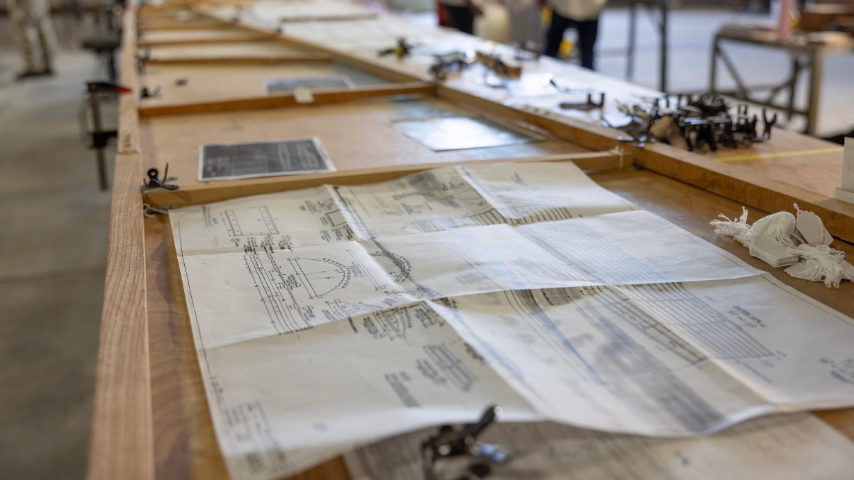
Given only a bunch of loose parts and blueprints, University of California, Irvine students have taken on the challenge of building a replica of a WWI biplane, the Curtiss JN-4, “Jenny.”
At the track there may be 25 engineers watching the data and another 100 back at the shop feeding the driver information, he said. Timmins explained that this gives the driver an edge to not only outlast the other cars, make it to the end, but also be the fastest.
“And that is what makes endurance racing so unique. You can win by just under two seconds after 24 hours of racing,” he explained. That last-lap battle is where year-long preparation pays off. Timmins said, “The driver has been battling that same car for the last 24 hours and it comes down to the last second of the race.”
Cathy Cecere is membership content program manager.
University of Delaware mechanical engineering students take classroom concepts to Daytona, learning more about real-time race data, design decisions, and the demands of endurance racing.

Membership content program manager for ASME
Related Content

Oct 5, 2026
Where Digital Meets Physical


Mechanical engineers become indispensable as they bridge the gap between digital models and physical reality.

Oct 1, 2026
Engineering the Sounds of Silence

Many of the things that engineers create make a lot of noise. Now there’s a crop of engineers trying to turn the volume down for all of us.
Oct 1, 2026
Unlocking the Power of Wave Energy


Researchers at the University of Michigan have developed wave energy converters that may improve energy independence for remote coastal and island communities.

Oct 1, 2026
DOT Final Rule Authorizes Voluntary Use of ASME Standard for Hazardous Materials Transport Tanks