Unlocking the Power of Wave Energy
Unlocking the Power of Wave Energy
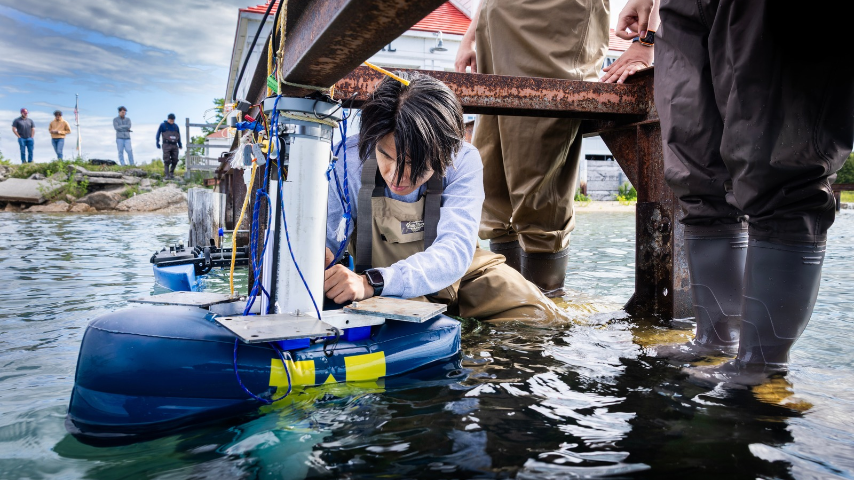
Researchers at the University of Michigan have developed wave energy converters that may improve energy independence for remote coastal and island communities.
Water covers more than two-thirds of the Earth’s surface, and its waves contain a natural source of energy. Much of that energy goes unused, but researchers at the University of Michigan (U-M) College of Engineering are working to change that.
“Our research is motivated by the vast untapped energy available in ocean and lake waves, as well as the need for reliable power in remote coastal and island communities,” said Lei Zuo, the Herbert C. Saddler Professor of Engineering at U-M. “The technical resource of wave energy along the U.S. coastline is estimated to be equivalent to about 34 percent of current U.S. utility-scale electricity generation, and its power density can be five to 10 times higher than that of wind and solar energy.”
Zuo and his team believe that wave energy could be the key to improving energy independence for remote coastal and island communities, as well as for the entire United States. “Using more local sources of electricity, rather than relying on imports from other countries, is important for energy security,” Zuo said.
Wave energy technology is in the early stages of development worldwide, so Zuo’s team has been working for several years with the residents of coastal and island communities to advance the technology for practical uses. The research team recently demonstrated its prototype wave energy converters for residents of nearby Beaver Island, the largest island community in Lake Michigan.
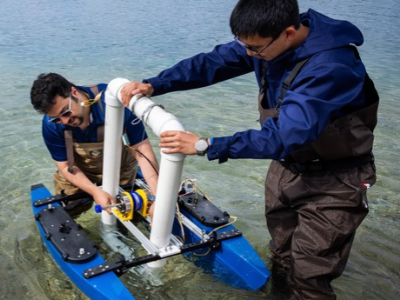 Hanzhi Mou (front right), a doctoral student in naval architecture and marine engineering at U-M, and Saeid Bayat (front left), a postdoctoral researcher in naval architecture and marine engineering, move a wave energy converter. Photo: University of Michigan
“Our work combines engineering co-design, socio-environmental and economic analysis, and community engagement,” Zuo explained. “The prototypes were developed through physical modeling, numerical optimization, laboratory wave-tank testing, and collaboration with Beaver Island residents.”
Hanzhi Mou (front right), a doctoral student in naval architecture and marine engineering at U-M, and Saeid Bayat (front left), a postdoctoral researcher in naval architecture and marine engineering, move a wave energy converter. Photo: University of Michigan
“Our work combines engineering co-design, socio-environmental and economic analysis, and community engagement,” Zuo explained. “The prototypes were developed through physical modeling, numerical optimization, laboratory wave-tank testing, and collaboration with Beaver Island residents.”
U-M researchers met with community members multiple times over the last two years to identify local priorities. Those priorities include reliable power for the island airport and greater energy independence. The researchers hope their wave energy converters can provide navigation lighting for the airport, helping planes take off and land safely. The lighting is also essential for emergency rescues during island fires or natural disasters.
“Beaver Island… depends on underwater power cables as their umbilical cord. [These cables] extend roughly 30 miles from mainland Michigan and can experience outages during severe weather,” Zuo said. “We are exploring whether locally generated wave energy could supplement the existing grid, support critical infrastructure, and improve energy resilience.”
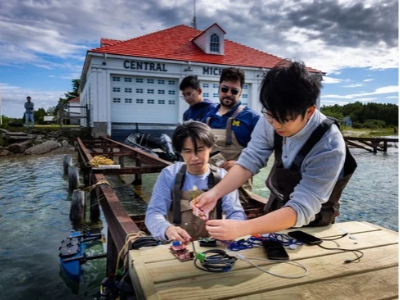 Researchers (postdoctoral researcher Zirui Liu, doctoral student Weihan Lin, postdoctoral researcher Saeid Bayat and doctoral student Hanzhi Mou) connect LEDs and a phone-charging system to their converter. Photo: University of Michigan
Although the waves in Lake Michigan are only about half the size of those in the Atlantic and Pacific oceans, the wave power density is still significant, he said. It is comparable to that found in the oceans of many other countries, including South Korea and China.
Researchers (postdoctoral researcher Zirui Liu, doctoral student Weihan Lin, postdoctoral researcher Saeid Bayat and doctoral student Hanzhi Mou) connect LEDs and a phone-charging system to their converter. Photo: University of Michigan
Although the waves in Lake Michigan are only about half the size of those in the Atlantic and Pacific oceans, the wave power density is still significant, he said. It is comparable to that found in the oceans of many other countries, including South Korea and China.
During recent testing of their two small prototypes, the U-M team powered a light and charged a cell phone. The researchers envision larger wave energy converters that could power navigation lighting, lake-monitoring sensors, communication equipment and other remote infrastructure.
“The two wave energy converters we tested are composed of a floating body and a submerged body,” Zuo said. “As waves move the floating body up and down, the relative motion between the floating and submerged bodies drives a power takeoff system. This motion turns a powertrain connected to an electromagnetic generator. The generated electricity can then be regulated and used directly to power a local electric load or stored in a battery.”
The researchers used a unique “society-engaged system co-design approach” to developing the prototypes, he added.
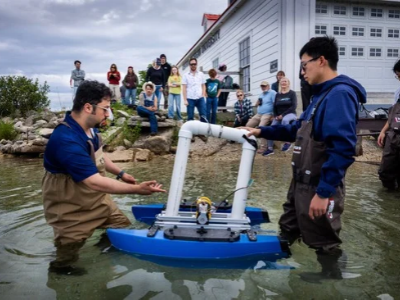 Saeid Bayat (front left), a postdoctoral researcher in naval architecture and marine engineering at U-M, and Hanzhi Mou (front right), a doctoral student in naval architecture and marine engineering, explain how their wave energy converter works. Photo: University of Michigan
“Instead of designing the structure and power takeoff first and adding the controller afterward, we optimize the device geometry, mechanical transmission, generator, and control strategy simultaneously,” Zuo explained. “This integrated co-design approach allows us to improve the overall system performance rather than optimizing each subsystem separately.”
Saeid Bayat (front left), a postdoctoral researcher in naval architecture and marine engineering at U-M, and Hanzhi Mou (front right), a doctoral student in naval architecture and marine engineering, explain how their wave energy converter works. Photo: University of Michigan
“Instead of designing the structure and power takeoff first and adding the controller afterward, we optimize the device geometry, mechanical transmission, generator, and control strategy simultaneously,” Zuo explained. “This integrated co-design approach allows us to improve the overall system performance rather than optimizing each subsystem separately.”
Getting the community involved early and throughout the process was another unique aspect of their work. The residents’ input directly influenced the engineering design, and that was critical to ensuring it would meet the specific needs of Beaver Island.
While the demonstration showed that the researchers successfully harnessed wave energy, their work has not been without its challenges. One of the biggest obstacles was the lack of consensus about best practices for wave energy, Zuo said.
“In the literature, there are more than 1,000 different wave energy converter concepts,” he said. “To address this challenge, we formed a multidisciplinary team and developed system-level, community-centered design tools. We also developed multidimensional metrics to evaluate technological feasibility, economic viability, and socio-environmental acceptance.”
Zuo said places where conventional electricity is difficult to obtain will probably use wave energy first. Potential applications include remote coastal communities, ocean and lake monitoring sensors, autonomous surface or underwater vehicles, and other remote marine infrastructure. Wave energy may also complement wind and solar power, helping to improve reliability and resilience.
“Our next steps are to use our engineering co-design tools and multidimensional assessment framework to improve the designs with community input, increase reliability and power output, and work toward longer-term deployment,” Zuo said. “Throughout this process, we will continue to incorporate community feedback so that the technology develops in a way that is practical, sustainable, and aligned with local needs.”
Claudia Hoffacker is an independent writer from Minneapolis.
“Our research is motivated by the vast untapped energy available in ocean and lake waves, as well as the need for reliable power in remote coastal and island communities,” said Lei Zuo, the Herbert C. Saddler Professor of Engineering at U-M. “The technical resource of wave energy along the U.S. coastline is estimated to be equivalent to about 34 percent of current U.S. utility-scale electricity generation, and its power density can be five to 10 times higher than that of wind and solar energy.”
Zuo and his team believe that wave energy could be the key to improving energy independence for remote coastal and island communities, as well as for the entire United States. “Using more local sources of electricity, rather than relying on imports from other countries, is important for energy security,” Zuo said.
Community collaboration is key
Wave energy technology is in the early stages of development worldwide, so Zuo’s team has been working for several years with the residents of coastal and island communities to advance the technology for practical uses. The research team recently demonstrated its prototype wave energy converters for residents of nearby Beaver Island, the largest island community in Lake Michigan.
Hanzhi Mou (front right), a doctoral student in naval architecture and marine engineering at U-M, and Saeid Bayat (front left), a postdoctoral researcher in naval architecture and marine engineering, move a wave energy converter. Photo: University of Michigan
U-M researchers met with community members multiple times over the last two years to identify local priorities. Those priorities include reliable power for the island airport and greater energy independence. The researchers hope their wave energy converters can provide navigation lighting for the airport, helping planes take off and land safely. The lighting is also essential for emergency rescues during island fires or natural disasters.
“Beaver Island… depends on underwater power cables as their umbilical cord. [These cables] extend roughly 30 miles from mainland Michigan and can experience outages during severe weather,” Zuo said. “We are exploring whether locally generated wave energy could supplement the existing grid, support critical infrastructure, and improve energy resilience.”
Researchers (postdoctoral researcher Zirui Liu, doctoral student Weihan Lin, postdoctoral researcher Saeid Bayat and doctoral student Hanzhi Mou) connect LEDs and a phone-charging system to their converter. Photo: University of Michigan
During recent testing of their two small prototypes, the U-M team powered a light and charged a cell phone. The researchers envision larger wave energy converters that could power navigation lighting, lake-monitoring sensors, communication equipment and other remote infrastructure.
How the U-M prototypes work
“The two wave energy converters we tested are composed of a floating body and a submerged body,” Zuo said. “As waves move the floating body up and down, the relative motion between the floating and submerged bodies drives a power takeoff system. This motion turns a powertrain connected to an electromagnetic generator. The generated electricity can then be regulated and used directly to power a local electric load or stored in a battery.”The researchers used a unique “society-engaged system co-design approach” to developing the prototypes, he added.
Saeid Bayat (front left), a postdoctoral researcher in naval architecture and marine engineering at U-M, and Hanzhi Mou (front right), a doctoral student in naval architecture and marine engineering, explain how their wave energy converter works. Photo: University of Michigan
Getting the community involved early and throughout the process was another unique aspect of their work. The residents’ input directly influenced the engineering design, and that was critical to ensuring it would meet the specific needs of Beaver Island.
While the demonstration showed that the researchers successfully harnessed wave energy, their work has not been without its challenges. One of the biggest obstacles was the lack of consensus about best practices for wave energy, Zuo said.
“In the literature, there are more than 1,000 different wave energy converter concepts,” he said. “To address this challenge, we formed a multidisciplinary team and developed system-level, community-centered design tools. We also developed multidimensional metrics to evaluate technological feasibility, economic viability, and socio-environmental acceptance.”
Many potential uses for wave energy
Zuo said places where conventional electricity is difficult to obtain will probably use wave energy first. Potential applications include remote coastal communities, ocean and lake monitoring sensors, autonomous surface or underwater vehicles, and other remote marine infrastructure. Wave energy may also complement wind and solar power, helping to improve reliability and resilience.“Our next steps are to use our engineering co-design tools and multidimensional assessment framework to improve the designs with community input, increase reliability and power output, and work toward longer-term deployment,” Zuo said. “Throughout this process, we will continue to incorporate community feedback so that the technology develops in a way that is practical, sustainable, and aligned with local needs.”
Claudia Hoffacker is an independent writer from Minneapolis.


As renewable energy gains momentum, oil and natural gas continue to remain primary global energy sources. This collection delves into latest digital trends enabling breakthroughs in energy transformation.