Rocket Science Redesigned
Rocket Science Redesigned
From hybrid rockets to nuclear thermal propulsion, rotation detonation engines to electric ion drives, engineers and scientists are prepping for the next generation of space travel.
It was the end of 2019, and Simon Gwozdz was assembling a space rocket in his parents’ backyard in Malaysia. Neither the location nor his master’s degree credentials were particularly conducive to the project, but Gwozdz and his collaborator, chemist Jamie Anderson, were convinced they were about to revamp rocket science. When a curious neighbor looked over the fence and asked a question, they replied, “We’re building the next generation of space rockets.” Because, as Gwozdz points out, the rocket design is quite outdated by modern standards. Today’s rockets can’t bring humans to Mars, never mind outside of our solar system.
Rocket propulsion is often viewed as cutting-edge technology, yet many of its fundamental principles and propellant systems haven’t changed much since the early advances made during World War II. Modern rockets still rely on the same basic chemical propulsion concepts pioneered in the 1940s. To generate thrust for liftoff, the standard rockets need fuel to burn and an oxidizer for that fuel to react with.
 A test flight of Venus Aerospace’s rotating detonation rocket engine in May 2025. Photo: Venus Aerospace
“Conventional chemical rockets require two things to work, and that’s a source of fuel, and a source of oxidizer,” said Gwozdz, who is now CEO of Equatorial Space, Southeast Asia’s leading rocket propulsion company. And while engineering improvements have increased reliability, thrust, and efficiency, the underlying approach of burning propellant to expel high-speed exhaust remains essentially unchanged.
A test flight of Venus Aerospace’s rotating detonation rocket engine in May 2025. Photo: Venus Aerospace
“Conventional chemical rockets require two things to work, and that’s a source of fuel, and a source of oxidizer,” said Gwozdz, who is now CEO of Equatorial Space, Southeast Asia’s leading rocket propulsion company. And while engineering improvements have increased reliability, thrust, and efficiency, the underlying approach of burning propellant to expel high-speed exhaust remains essentially unchanged.
As space exploration expands to include frequent satellite launches, deep-space missions, and potential travel to Mars, many engineers argue that this mid-20th-century technology has reached its limits. So, to boldly go where no humans have gone before, researchers and space entrepreneurs worldwide are exploring alternatives such as advanced hybrid systems, rotation detonation engines, nuclear thermal propulsion, and electric ion drives.
Existing forms of propellants fall into two categories: solid or liquid. Solid fuel is premixed and liquid fuel is pumped into the rocket’s motor while the rocket is flying. Both have their pros and cons, but neither one is capable of sustaining long-term space travel. They are also expensive, complex, and environmentally polluting.
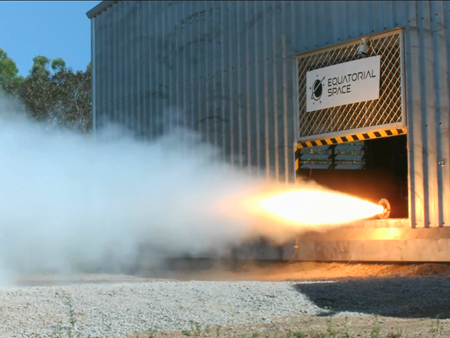 A hot fire test of Equatorial’s H150 hybrid rocket in December 2024. Photo: Equatorial Space
A solid propellant rocket uses a dense, rubber-like mixture of fuel and oxidizer cast into a solid form inside its engine. One such example is ammonium perchlorate composite propellant (APCP), composed of hydroxyl terminated polyputarian (HTPB), a polymer used as fuel, and ammonium perchlorate used as an oxidizer. When ignited, the propellant burns continuously until it is exhausted, producing a powerful and reliable thrust. Since the fuel and oxidizer are already combined, solid rocket motors are mechanically simpler and can remain ready for long periods. However, they are hard to control during flight—once the motor is ignited, the rocket cannot be throttled, shut down, or restarted. They are also highly volatile and prone to explosions, which makes them dangerous to manufacture, transport, and handle, so their use is limited to military or government entities.
A hot fire test of Equatorial’s H150 hybrid rocket in December 2024. Photo: Equatorial Space
A solid propellant rocket uses a dense, rubber-like mixture of fuel and oxidizer cast into a solid form inside its engine. One such example is ammonium perchlorate composite propellant (APCP), composed of hydroxyl terminated polyputarian (HTPB), a polymer used as fuel, and ammonium perchlorate used as an oxidizer. When ignited, the propellant burns continuously until it is exhausted, producing a powerful and reliable thrust. Since the fuel and oxidizer are already combined, solid rocket motors are mechanically simpler and can remain ready for long periods. However, they are hard to control during flight—once the motor is ignited, the rocket cannot be throttled, shut down, or restarted. They are also highly volatile and prone to explosions, which makes them dangerous to manufacture, transport, and handle, so their use is limited to military or government entities.
Behind the Engineering: Artemis Transcends Apollo
In liquid fuel rockets, the fuel and oxidizer are kept in separate tanks and are pumped into a combustion chamber where they mix and burn. This design allows much greater control over the rocket’s performance. Engineers can adjust the flow rates to throttle the engine, shut it down if necessary, and sometimes restart it during flight. That’s why liquid systems are common in spacecraft and launch vehicles that require precise maneuvering. The trade-off is mechanical complexity: liquid rocket engines require moving parts like pumps and valves, which makes them more complicated and expensive to design and operate than solid fuel rockets.
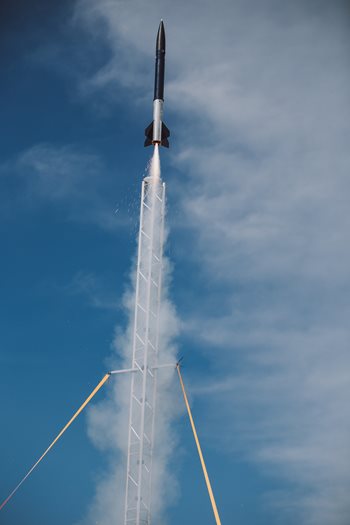 A recent Equatorial hybrid rocket test flight. Photo: Equatorial Space
Equatorial Space is building a hybrid rocket, which aims to combine the best of solid and liquid propellant rockets while fixing the drawbacks of both. However, hybrid rockets use solid fuel and liquid oxidizer, which reduces risks of explosions, but dampens performance.
A recent Equatorial hybrid rocket test flight. Photo: Equatorial Space
Equatorial Space is building a hybrid rocket, which aims to combine the best of solid and liquid propellant rockets while fixing the drawbacks of both. However, hybrid rockets use solid fuel and liquid oxidizer, which reduces risks of explosions, but dampens performance.
“If you have a fuel which is solid and an oxidizer which is liquid, it takes quite a bit of effort to activate them and start combusting in the first place, which is desirable from the safety perspective, but it doesn’t burn very fast,” Gwozdz explained. “If you do not premix HTPB with a solid oxidizer, it turns directly from a solid into a gas, and that insulates the fuel from the heat in the combustion chamber, so you essentially create a cooling film, so your fuel burns too slowly. It doesn’t generate enough thrust to get something into orbit.”
The burning speed is defined by the so-called regression rate of the fuel—the rate at which a solid fuel surface turns into gas and combusts. The higher the regression rate, the faster the fuel burns. After a few years of research, Anderson zeroed-in on what he and Gwozdz believe is a fuel that burns fast enough. Called HRF-1, for high regression fuel, it consists of plastic polymers, which are inert until mixed with oxygen with aluminum powder added for high-temperature burning.
Viewing the Heavens: Designing a Golden Eye for the Sky
“We’re able to achieve the high regression rates, but we get the mechanical stability of a plastic,” so rockets remain safe to use, Anderson explained.
HRF-1 produces 69 percent less greenhouse gas emissions with a price tag of one tenth of the typical cost, which would make it an efficient way to fuel transport to and from space research stations, Gwozdz added.
After Equatorial first launched its Low Altitude Demonstrator in December 2020, the startup was accepted into Techstars Los Angeles Accelerator Spring 2022 Cohort, raised more than $4 million, and landed its first contract in Singapore. “We’re now working on the next iteration,” Gwozdz said.
Another advanced rocket propulsion concept is a rotating detonation rocket engine (RDRE), which produces thrust using continuous detonation waves instead of combustion that’s traditionally used in rocket engines. In conventional rockets, fuel and oxidizer burn smoothly in a combustion chamber, producing expanding gases that exit through a nozzle, creating thrust. In an RDRE, fuel and oxidizer are injected into a ring-shaped combustion chamber where the mixture forms a thin layer of unburned propellant along the chamber walls.
 Houston-based Venus Aerospace’s rotating detonation rocket engine. Photo: Venus Aerospace
An ignition source triggers a detonation wave—a powerful combustion front that travels faster than the speed of sound. As a result, the supersonic detonation wave circulates around the chamber repeatedly and so fast that the exhaust products from the previous detonations can’t exit fast enough. That builds up pressure, allowing for more thrust to be extracted from the same amount of fuel and oxidizer.
Houston-based Venus Aerospace’s rotating detonation rocket engine. Photo: Venus Aerospace
An ignition source triggers a detonation wave—a powerful combustion front that travels faster than the speed of sound. As a result, the supersonic detonation wave circulates around the chamber repeatedly and so fast that the exhaust products from the previous detonations can’t exit fast enough. That builds up pressure, allowing for more thrust to be extracted from the same amount of fuel and oxidizer.
“The flame front spins around so there’s no spinning part in the engine,” explained Andrew Duggleby, chief technology officer and co-founder of Houston-based Venus Aerospace Corp., which recently tested an RDRE rocket. “It’s like a circular racetrack where we have little injectors all the way around. So, we’re pushing fuel and an oxidizer into that racetrack, and then the detonation wave is sort of chasing it.” The expanding gases flow out through the rocket nozzle, generating thrust.
 Andrew Duggleby, co-founder and chief technology officer at Venus Aerospace
As long as fuel and oxidizer are supplied, the rotating detonation waves continue traveling around the chamber. That also allows RDREs to be maneuvered and throttled, making them suitable for deep space missions and landings by manipulating the propellant flow rates. The detonation produces extremely high pressure and temperature due to a more efficient conversion of heat energy into thrust, Duggleby explained. Because detonations release energy more rapidly and at higher pressure than conventional burning, RDREs can potentially produce more thrust from the same amount of propellant.
Andrew Duggleby, co-founder and chief technology officer at Venus Aerospace
As long as fuel and oxidizer are supplied, the rotating detonation waves continue traveling around the chamber. That also allows RDREs to be maneuvered and throttled, making them suitable for deep space missions and landings by manipulating the propellant flow rates. The detonation produces extremely high pressure and temperature due to a more efficient conversion of heat energy into thrust, Duggleby explained. Because detonations release energy more rapidly and at higher pressure than conventional burning, RDREs can potentially produce more thrust from the same amount of propellant.
“This method lets us achieve about a 15 percent efficiency increase,” he said. “That doesn’t sound like a lot, but it actually quadruples how much you can take into space. So, it would quadruple the payload.” If successfully developed, RDREs could make rockets lighter, cheaper, and more efficient than conventional engines, he said.
Another way of propelling humans through the vast cosmos could be nuclear thermal propulsion (NTP). With this method, rockets would carry a small nuclear fission reactor onboard, using the heat produced by a fission (atom-splitting) reactor to propel the spacecraft.
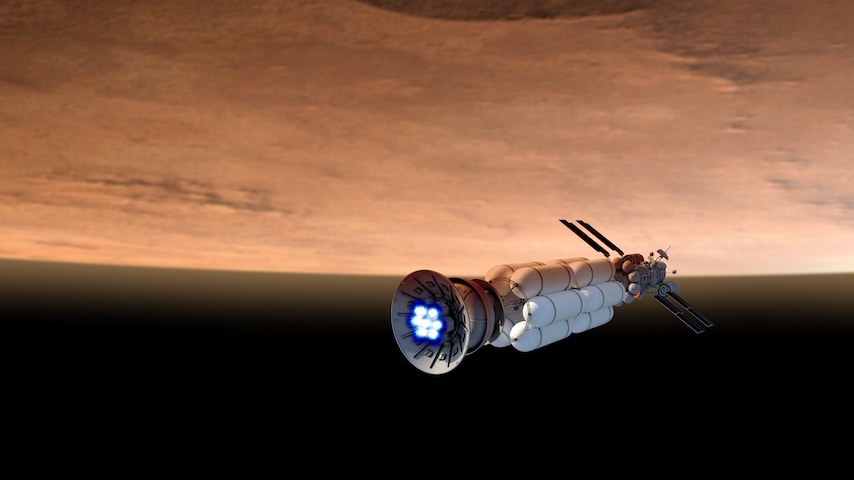
 Destined for Mars, Space Reactor-1 (SR-1) Freedom is humanity's first fission-powered interplanetary spacecraft. It will demonstrate nuclear electric propulsion in deep space. Photo: Idaho National Laboratory/NASA
An NTP system would use liquid hydrogen propellant, heated with the energy generated by the compact nuclear reactor’s core, containing fuel made from enriched uranium. When the uranium atoms undergo nuclear fission, they split into smaller atoms and release massive amounts of energy in the form of heat—the NTP reactors currently in design can reach temperatures above 2,500–3,000 Kelvin, or 4,000–5,000 °F. As hydrogen flows through the channels in the reactor core, it would absorb the heat, reach extremely high temperatures and rapidly expand, shooting out of the nozzle and creating powerful thrust.
Destined for Mars, Space Reactor-1 (SR-1) Freedom is humanity's first fission-powered interplanetary spacecraft. It will demonstrate nuclear electric propulsion in deep space. Photo: Idaho National Laboratory/NASA
An NTP system would use liquid hydrogen propellant, heated with the energy generated by the compact nuclear reactor’s core, containing fuel made from enriched uranium. When the uranium atoms undergo nuclear fission, they split into smaller atoms and release massive amounts of energy in the form of heat—the NTP reactors currently in design can reach temperatures above 2,500–3,000 Kelvin, or 4,000–5,000 °F. As hydrogen flows through the channels in the reactor core, it would absorb the heat, reach extremely high temperatures and rapidly expand, shooting out of the nozzle and creating powerful thrust.
“If you want to get to Mars very quickly, or if you want to get to Mars, not just quickly, but also with a very heavy payload, the nuclear thermal propulsion engines will trade better than chemical rockets,” explained Sebastian Corbisiero, technical director of the Department of Energy Space Reactor Program at Idaho National Laboratory.
More on Nuclear: Fission within Fusion
The reactor is controlled by a set of drums that rotate to turn it on or off, and to adjust for more or less thrust. These drums operate the control rods, which are made of materials that absorb neutrons, such as boron or hafnium. “Of course, this is all based on prediction and modeling, but we haven’t made one yet to prove it,” Corbisiero noted.
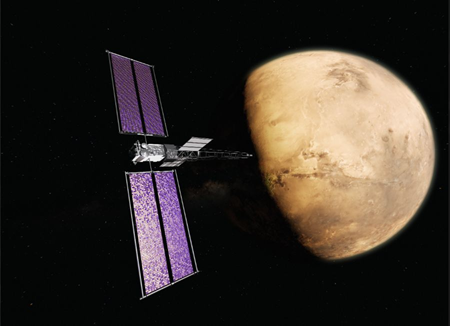
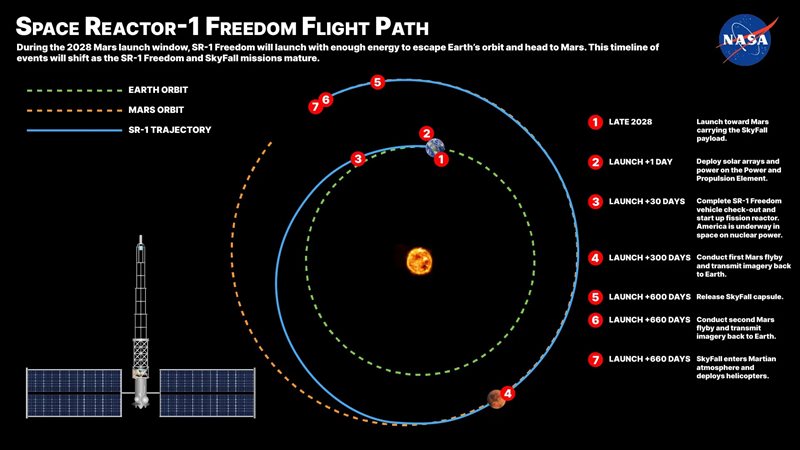 NASA’s Space Reactor-1 Freedom mission concept flight path illustrates the spacecraft’s journey to Mars, including launch, reactor startup, multiple Mars flybys, and deployment of the SkyFall payload during the mission. Image: NASA
NTP rockets will use a different form of uranium fuel. The uranium dioxide used in nuclear reactors on Earth wouldn’t be able to withstand such high temperatures and would melt, causing the spacecraft to lose its source of energy.
NASA’s Space Reactor-1 Freedom mission concept flight path illustrates the spacecraft’s journey to Mars, including launch, reactor startup, multiple Mars flybys, and deployment of the SkyFall payload during the mission. Image: NASA
NTP rockets will use a different form of uranium fuel. The uranium dioxide used in nuclear reactors on Earth wouldn’t be able to withstand such high temperatures and would melt, causing the spacecraft to lose its source of energy.
“The temperatures are too high, so you have to have fuel particles that use more novel material,” said Corbisiero, citing uranium nitride or uranium carbide as such potentially new forms of nuclear fuel, because they’re able to withstand higher temperatures. These novel uranium pellets may also have to be smaller than what’s currently used in on-Earth reactors so that the heat dissipates faster.
Discover the Benefits of ASME Membership
“That’s another area of investigation, which is, how do we get a fuel that can handle these very high temperatures—and doing development and testing for that,” Corbisiero said.
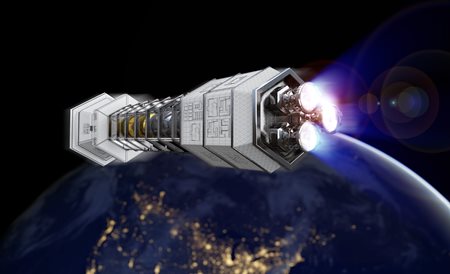 A conceptual rendering of a space nuclear reactor. Photo: Idaho National Laboratory
Another variation of the nuclear engine is nuclear electric propulsion (NEP), which converts fission-generated electricity to ionize and electromagnetically accelerate a gas propellant, such as xenon, for example. In an ion thruster, propellant atoms would be injected into a chamber where they are bombarded by electrons, which strips away their own electrons, so that the atoms become positively charged ions. These ions are then accelerated by powerful electric fields and expelled from the thruster at very high speeds, such as tens of kilometers per second. That produces a small but extremely efficient thrust that builds up velocity over time, Corbisiero explained.
A conceptual rendering of a space nuclear reactor. Photo: Idaho National Laboratory
Another variation of the nuclear engine is nuclear electric propulsion (NEP), which converts fission-generated electricity to ionize and electromagnetically accelerate a gas propellant, such as xenon, for example. In an ion thruster, propellant atoms would be injected into a chamber where they are bombarded by electrons, which strips away their own electrons, so that the atoms become positively charged ions. These ions are then accelerated by powerful electric fields and expelled from the thruster at very high speeds, such as tens of kilometers per second. That produces a small but extremely efficient thrust that builds up velocity over time, Corbisiero explained.
Nuclear-powered rockets will activate their “superpower” only when they are already in orbit. They will still take off from earth using traditional combustion—for safety reasons.
“Once you got into orbit, then you would turn the reactor on and get the propellant flowing—and then embark on whatever mission you wanted to do,” Corbisiero said.
And with that, the era of boldly going where no one has gone before may finally cross from sci-fi to reality.
Lina Zeldovich is a science and technology writer based in Woodside, N.Y. Her most recent book, The Living Medicine: How a Lifesaving Cure Was Nearly Lost—and Why It Will Rescue Us When Antibiotics Fail, was published in October 2024.
Rocket propulsion is often viewed as cutting-edge technology, yet many of its fundamental principles and propellant systems haven’t changed much since the early advances made during World War II. Modern rockets still rely on the same basic chemical propulsion concepts pioneered in the 1940s. To generate thrust for liftoff, the standard rockets need fuel to burn and an oxidizer for that fuel to react with.
A test flight of Venus Aerospace’s rotating detonation rocket engine in May 2025. Photo: Venus Aerospace
As space exploration expands to include frequent satellite launches, deep-space missions, and potential travel to Mars, many engineers argue that this mid-20th-century technology has reached its limits. So, to boldly go where no humans have gone before, researchers and space entrepreneurs worldwide are exploring alternatives such as advanced hybrid systems, rotation detonation engines, nuclear thermal propulsion, and electric ion drives.
Hybrid rockets
Existing forms of propellants fall into two categories: solid or liquid. Solid fuel is premixed and liquid fuel is pumped into the rocket’s motor while the rocket is flying. Both have their pros and cons, but neither one is capable of sustaining long-term space travel. They are also expensive, complex, and environmentally polluting.
A hot fire test of Equatorial’s H150 hybrid rocket in December 2024. Photo: Equatorial Space
Behind the Engineering: Artemis Transcends Apollo
In liquid fuel rockets, the fuel and oxidizer are kept in separate tanks and are pumped into a combustion chamber where they mix and burn. This design allows much greater control over the rocket’s performance. Engineers can adjust the flow rates to throttle the engine, shut it down if necessary, and sometimes restart it during flight. That’s why liquid systems are common in spacecraft and launch vehicles that require precise maneuvering. The trade-off is mechanical complexity: liquid rocket engines require moving parts like pumps and valves, which makes them more complicated and expensive to design and operate than solid fuel rockets.
A recent Equatorial hybrid rocket test flight. Photo: Equatorial Space
“If you have a fuel which is solid and an oxidizer which is liquid, it takes quite a bit of effort to activate them and start combusting in the first place, which is desirable from the safety perspective, but it doesn’t burn very fast,” Gwozdz explained. “If you do not premix HTPB with a solid oxidizer, it turns directly from a solid into a gas, and that insulates the fuel from the heat in the combustion chamber, so you essentially create a cooling film, so your fuel burns too slowly. It doesn’t generate enough thrust to get something into orbit.”
The burning speed is defined by the so-called regression rate of the fuel—the rate at which a solid fuel surface turns into gas and combusts. The higher the regression rate, the faster the fuel burns. After a few years of research, Anderson zeroed-in on what he and Gwozdz believe is a fuel that burns fast enough. Called HRF-1, for high regression fuel, it consists of plastic polymers, which are inert until mixed with oxygen with aluminum powder added for high-temperature burning.
Viewing the Heavens: Designing a Golden Eye for the Sky
“We’re able to achieve the high regression rates, but we get the mechanical stability of a plastic,” so rockets remain safe to use, Anderson explained.
HRF-1 produces 69 percent less greenhouse gas emissions with a price tag of one tenth of the typical cost, which would make it an efficient way to fuel transport to and from space research stations, Gwozdz added.
After Equatorial first launched its Low Altitude Demonstrator in December 2020, the startup was accepted into Techstars Los Angeles Accelerator Spring 2022 Cohort, raised more than $4 million, and landed its first contract in Singapore. “We’re now working on the next iteration,” Gwozdz said.
Rotation detonation engine rockets
Another advanced rocket propulsion concept is a rotating detonation rocket engine (RDRE), which produces thrust using continuous detonation waves instead of combustion that’s traditionally used in rocket engines. In conventional rockets, fuel and oxidizer burn smoothly in a combustion chamber, producing expanding gases that exit through a nozzle, creating thrust. In an RDRE, fuel and oxidizer are injected into a ring-shaped combustion chamber where the mixture forms a thin layer of unburned propellant along the chamber walls.
Houston-based Venus Aerospace’s rotating detonation rocket engine. Photo: Venus Aerospace
“The flame front spins around so there’s no spinning part in the engine,” explained Andrew Duggleby, chief technology officer and co-founder of Houston-based Venus Aerospace Corp., which recently tested an RDRE rocket. “It’s like a circular racetrack where we have little injectors all the way around. So, we’re pushing fuel and an oxidizer into that racetrack, and then the detonation wave is sort of chasing it.” The expanding gases flow out through the rocket nozzle, generating thrust.
Andrew Duggleby, co-founder and chief technology officer at Venus Aerospace
“This method lets us achieve about a 15 percent efficiency increase,” he said. “That doesn’t sound like a lot, but it actually quadruples how much you can take into space. So, it would quadruple the payload.” If successfully developed, RDREs could make rockets lighter, cheaper, and more efficient than conventional engines, he said.
Nuclear propulsion rockets
Another way of propelling humans through the vast cosmos could be nuclear thermal propulsion (NTP). With this method, rockets would carry a small nuclear fission reactor onboard, using the heat produced by a fission (atom-splitting) reactor to propel the spacecraft.
Destined for Mars, Space Reactor-1 (SR-1) Freedom is humanity's first fission-powered interplanetary spacecraft. It will demonstrate nuclear electric propulsion in deep space. Photo: Idaho National Laboratory/NASA
“If you want to get to Mars very quickly, or if you want to get to Mars, not just quickly, but also with a very heavy payload, the nuclear thermal propulsion engines will trade better than chemical rockets,” explained Sebastian Corbisiero, technical director of the Department of Energy Space Reactor Program at Idaho National Laboratory.
More on Nuclear: Fission within Fusion
The reactor is controlled by a set of drums that rotate to turn it on or off, and to adjust for more or less thrust. These drums operate the control rods, which are made of materials that absorb neutrons, such as boron or hafnium. “Of course, this is all based on prediction and modeling, but we haven’t made one yet to prove it,” Corbisiero noted.
NASA’s Space Reactor-1 Freedom mission concept flight path illustrates the spacecraft’s journey to Mars, including launch, reactor startup, multiple Mars flybys, and deployment of the SkyFall payload during the mission. Image: NASA
“The temperatures are too high, so you have to have fuel particles that use more novel material,” said Corbisiero, citing uranium nitride or uranium carbide as such potentially new forms of nuclear fuel, because they’re able to withstand higher temperatures. These novel uranium pellets may also have to be smaller than what’s currently used in on-Earth reactors so that the heat dissipates faster.
Discover the Benefits of ASME Membership
“That’s another area of investigation, which is, how do we get a fuel that can handle these very high temperatures—and doing development and testing for that,” Corbisiero said.
A conceptual rendering of a space nuclear reactor. Photo: Idaho National Laboratory
Nuclear-powered rockets will activate their “superpower” only when they are already in orbit. They will still take off from earth using traditional combustion—for safety reasons.
“Once you got into orbit, then you would turn the reactor on and get the propellant flowing—and then embark on whatever mission you wanted to do,” Corbisiero said.
And with that, the era of boldly going where no one has gone before may finally cross from sci-fi to reality.
Lina Zeldovich is a science and technology writer based in Woodside, N.Y. Her most recent book, The Living Medicine: How a Lifesaving Cure Was Nearly Lost—and Why It Will Rescue Us When Antibiotics Fail, was published in October 2024.
From hybrid rockets to nuclear thermal propulsion, rotation detonation engines to electric ion drives, engineers and scientists are prepping for the next generation of space travel.

Freelance science journalist and author
Related Content


Sep 17, 2026
A Robot Rides the Wind



Sep 16, 2026
Mechanical Engineers Find Purpose in Public Service


Mechanical engineers in public service shape policy, strengthen infrastructure, improve public safety, and solve complex challenges at every government level.
Sep 15, 2026
Octopus-Inspired Robot Gets a Better Grip

A new soft robotic arm shows how distributed sensing and control could help robots move and grasp more like living organisms.

Sep 15, 2026
Animatronics Bring Engineered Storytelling to Life
Mechanical engineers can turn creativity into a career in animatronics, a field that blends technical skill, storytelling, and themed entertainment.