New ‘Super Foam’ Could Help Prevent Injuries and Save Lives
New ‘Super Foam’ Could Help Prevent Injuries and Save Lives
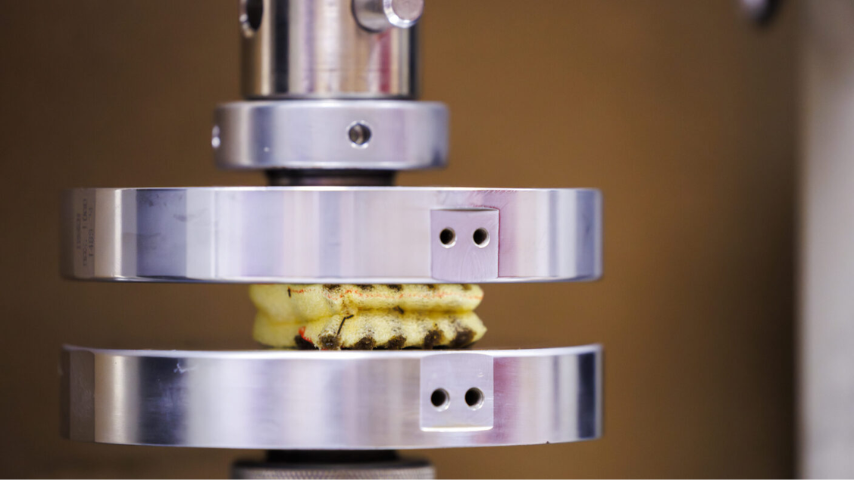
Using a process called In-Foam Additive Manufacturing, Texas A&M researchers created a hybrid composite that is tunable, lightweight, and ultra-durable.
Life is full of risks and potential injuries, and people are always looking for better ways to soften the blow. Researchers at Texas A&M University have partnered with the DEVCOM Army Research Lab (ARL) to develop a new “super foam” that does just that.
The newly developed hybrid super foam absorbs up to 10 times more energy than your average padding, said Mohammad Naraghi, lead researcher and director of the Nanostructured Materials Lab at the Texas A&M College of Engineering. It combines an ordinary foam with 3D-printed injections of stretchy, plastic columns called struts.
“We wanted a foam that is both highly protective and easily tunable, without giving up low weight or large-scale and low-cost manufacturing. Traditional foams are cheap and scalable but hard to fine-tune, while 3D-printed lattices are very tunable but slow and expensive to make,” Naraghi said.
“Our work aims to bridge that gap,” he added. And they were able to do that by using a process called In-Foam Additive Manufacturing (IFAM).
“We started with commercial open-cell foam and used a modified 3D printer to inject liquid elastomer struts directly inside the foam, then cured them in place,” Naraghi said. This IFAM process “lets us draw a controlled architecture of solid columns and trusses through the random pores of the foam.”
In the journal Composite Structures, researchers explained that to create the new foam, they placed a syringe above an ordinary piece of foam. The syringe, filled with a premixed elastomeric resin and connected to an injection needle, was mounted in a modified 3D printer that acted as a computer-controlled gantry.
“The system is programmed in such a way that the syringe needle penetrates the foam at desired locations, orientations, and depths, and injects resin into the foam,” the article says. “The resin fills the cavity created by the needle and solidifies in place resulting in a supporting set of struts that are well-integrated within the foam.”
The new foam “is a hybrid cellular composite—a soft, stochastic foam reinforced by a deterministic 3D network of elastomer struts,” Naraghi said. “Because the foam supports the struts, and the struts reinforce the foam, they carry load synergistically, giving up to about a 10 times improvement in energy absorption and plateau stress with only a few percent added material.”
That synergy is crucial when it comes to providing protection to soldiers in combat. The upgraded foam is likely to be used in a variety of Army applications, including helmets and seat cushions, where it has the potential to reduce injuries and even save lives.
 The 3D printed plastic skeleton bends and stretches as the foam compresses. Video credit: Dr. Mohammad Naraghi/Texas A&M University College of Engineering
Naraghi said he’s excited about the IFAM foam development, but it didn’t happen without a few challenges.
The 3D printed plastic skeleton bends and stretches as the foam compresses. Video credit: Dr. Mohammad Naraghi/Texas A&M University College of Engineering
Naraghi said he’s excited about the IFAM foam development, but it didn’t happen without a few challenges.
One challenge was getting the resin to flow cleanly through the foam without flooding or leaking. This required careful tuning of needle size, injection speed, and resin viscosity, Naraghi said. There was a lot of trial and error involved in getting it right.
Another difficulty was redesigning a standard 3D printer into a reliable “in-foam” printer that could precisely place hundreds of struts inside soft, flexible material, he said. It was also challenging to figure out how strut spacing, diameter, and angle affect strength, energy absorption, and weight. They had to create a large test matrix and run careful experiments to understand those dynamics.
After about two years of work, researchers successfully created this hybrid super foam, which is not only lightweight and ultra-durable but also tunable. By varying the thickness and angles of the struts, the composite can be tuned to change the strength, energy absorption, and comfort level to meet the end user’s personal preferences.
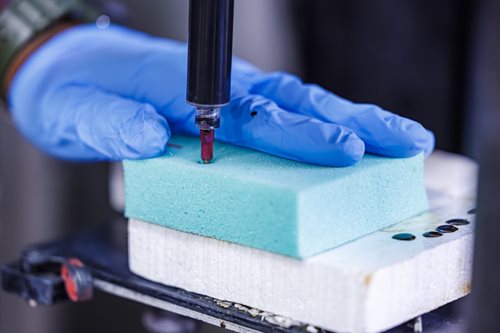 By embedding 3D printed plastic columns into standard foam, researchers created a hybrid “super foam” capable of absorbing up to 10 times more energy than conventional padding.
Image: Abbey Toronjo/Texas A&M University Division of Marketing & Communications
While researchers intend to use the IFAM foam for national defense, it can also be tuned for other applications, including sports and bike helmets, child car seats, automotive and aerospace, and even furniture.
By embedding 3D printed plastic columns into standard foam, researchers created a hybrid “super foam” capable of absorbing up to 10 times more energy than conventional padding.
Image: Abbey Toronjo/Texas A&M University Division of Marketing & Communications
While researchers intend to use the IFAM foam for national defense, it can also be tuned for other applications, including sports and bike helmets, child car seats, automotive and aerospace, and even furniture.
“With our hybrid foam, you could have different zones of your cushion tuned to your different preferences,” Naraghi said. “For instance, firm for the neck, soft for the back, and medium for the legs. It could be entirely customized to a person’s needs, comfort, and physiology.”
And Naraghi said there are some additional characteristics of the super foam that haven’t been fully explored yet. For one, the foam “allows us to have anisotropic behavior, so that you can dissipate not only normal impact but impact that comes at an angle,” he said.
Another development researchers are working on is computer simulations that would allow them to predict the foam’s behaviors, such as energy absorption. “We can always get that through experiments, but experiments are costly,” Naraghi said. “If we can do it with simulations, even better.”
For now, researchers are focusing on putting the IFAM foam to use, which may take another two or three years.
“We are working with people in the Army to further fine tune the behavior,” Naraghi said. “We’re also discussing it with some companies in the U.S. to put it in commercial helmets for sports.”
Claudia Hoffacker is an independent writer in Minneapolis.
The newly developed hybrid super foam absorbs up to 10 times more energy than your average padding, said Mohammad Naraghi, lead researcher and director of the Nanostructured Materials Lab at the Texas A&M College of Engineering. It combines an ordinary foam with 3D-printed injections of stretchy, plastic columns called struts.
“We wanted a foam that is both highly protective and easily tunable, without giving up low weight or large-scale and low-cost manufacturing. Traditional foams are cheap and scalable but hard to fine-tune, while 3D-printed lattices are very tunable but slow and expensive to make,” Naraghi said.
“Our work aims to bridge that gap,” he added. And they were able to do that by using a process called In-Foam Additive Manufacturing (IFAM).
“We started with commercial open-cell foam and used a modified 3D printer to inject liquid elastomer struts directly inside the foam, then cured them in place,” Naraghi said. This IFAM process “lets us draw a controlled architecture of solid columns and trusses through the random pores of the foam.”
Developing the super foam
In the journal Composite Structures, researchers explained that to create the new foam, they placed a syringe above an ordinary piece of foam. The syringe, filled with a premixed elastomeric resin and connected to an injection needle, was mounted in a modified 3D printer that acted as a computer-controlled gantry.
“The system is programmed in such a way that the syringe needle penetrates the foam at desired locations, orientations, and depths, and injects resin into the foam,” the article says. “The resin fills the cavity created by the needle and solidifies in place resulting in a supporting set of struts that are well-integrated within the foam.”
The new foam “is a hybrid cellular composite—a soft, stochastic foam reinforced by a deterministic 3D network of elastomer struts,” Naraghi said. “Because the foam supports the struts, and the struts reinforce the foam, they carry load synergistically, giving up to about a 10 times improvement in energy absorption and plateau stress with only a few percent added material.”
That synergy is crucial when it comes to providing protection to soldiers in combat. The upgraded foam is likely to be used in a variety of Army applications, including helmets and seat cushions, where it has the potential to reduce injuries and even save lives.
The 3D printed plastic skeleton bends and stretches as the foam compresses. Video credit: Dr. Mohammad Naraghi/Texas A&M University College of Engineering
One challenge was getting the resin to flow cleanly through the foam without flooding or leaking. This required careful tuning of needle size, injection speed, and resin viscosity, Naraghi said. There was a lot of trial and error involved in getting it right.
Another difficulty was redesigning a standard 3D printer into a reliable “in-foam” printer that could precisely place hundreds of struts inside soft, flexible material, he said. It was also challenging to figure out how strut spacing, diameter, and angle affect strength, energy absorption, and weight. They had to create a large test matrix and run careful experiments to understand those dynamics.
Wide range of potential uses
After about two years of work, researchers successfully created this hybrid super foam, which is not only lightweight and ultra-durable but also tunable. By varying the thickness and angles of the struts, the composite can be tuned to change the strength, energy absorption, and comfort level to meet the end user’s personal preferences.
By embedding 3D printed plastic columns into standard foam, researchers created a hybrid “super foam” capable of absorbing up to 10 times more energy than conventional padding.
Image: Abbey Toronjo/Texas A&M University Division of Marketing & Communications
“With our hybrid foam, you could have different zones of your cushion tuned to your different preferences,” Naraghi said. “For instance, firm for the neck, soft for the back, and medium for the legs. It could be entirely customized to a person’s needs, comfort, and physiology.”
And Naraghi said there are some additional characteristics of the super foam that haven’t been fully explored yet. For one, the foam “allows us to have anisotropic behavior, so that you can dissipate not only normal impact but impact that comes at an angle,” he said.
Another development researchers are working on is computer simulations that would allow them to predict the foam’s behaviors, such as energy absorption. “We can always get that through experiments, but experiments are costly,” Naraghi said. “If we can do it with simulations, even better.”
For now, researchers are focusing on putting the IFAM foam to use, which may take another two or three years.
“We are working with people in the Army to further fine tune the behavior,” Naraghi said. “We’re also discussing it with some companies in the U.S. to put it in commercial helmets for sports.”
Claudia Hoffacker is an independent writer in Minneapolis.
Using a process called In-Foam Additive Manufacturing, Texas A&M researchers created a hybrid composite that is tunable, lightweight, and ultra-durable.

Independent writer and editor
Related Content


Oct 1, 2026
Engineering the Sounds of Silence

Many of the things that engineers create make a lot of noise. Now there’s a crop of engineers trying to turn the volume down for all of us.


Sep 9, 2026
5 Myths About Borosilicate Glass
SCHOTT's Tina Gallo tackles five myths that may be causing engineers to underestimate borosilicate glass.

Jul 30, 2026
Ion Beams Speed Qualification for Nuclear Materials


By mimicking years of neutron damage in days, ion beam testing could dramatically reduce the time and cost of qualifying materials for advanced nuclear reactors.
Jun 23, 2026
Defects to Boost Strength

New research into the tiniest of metals has revealed that defects can make a nanoscaled object stronger.