Defects to Boost Strength
Defects to Boost Strength
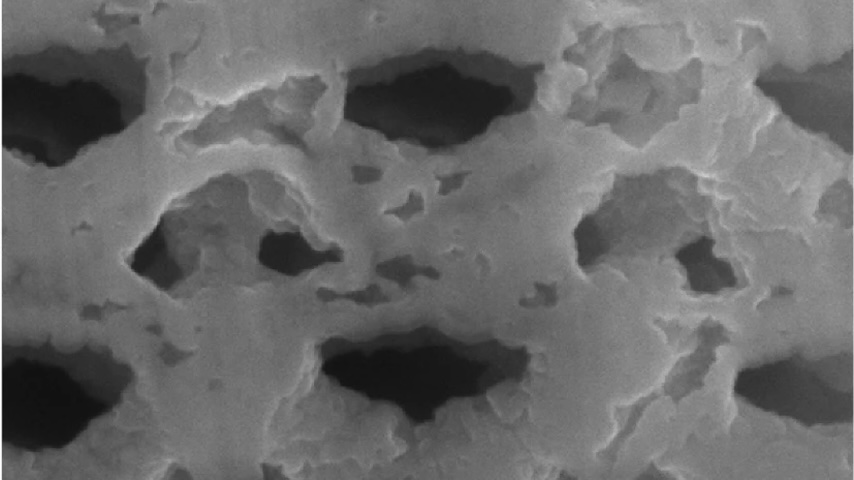
New research into the tiniest of metals has revealed that defects can make a nanoscaled object stronger.
When you reduce the size of an object all the way down to the nano scale, you might expect the properties and structures to remain much the same, and perform the same as a larger object. But CalTech’s team has figured out how to precisely engineer tiny 3D metallic pieces with nanoscale dimensions, but with a twist: defects in the metal or metal alloy materials don’t fail in spite of defects. Instead, they strengthen. The defect-ridden microstructure has the potential to improve medical devices and microchips, among other applications.
“What in general has been inspiring us for the last decade is that at the nanoscale, things are very different, especially for metals,” said Julia R. Greer, the Ruben F. and Donna Mettler Professor of Materials Science, Mechanics, and Medical Engineering at the California Institute of Technology (CalTech). This work was recently published in Nature Communications. The research builds on findings from her team’s work in 2023, which shared the fundamentals of the process: that it’s possible to observe a structural response in a single building block of nanoarchitecture, including the strength. Now, the new research demonstrates greater implications of building an entire architecture around that block.
“We, and several other groups later on, discovered that at the nanoscale, the metals exhibit the so‑called size effect,” Greer said. “When you take, say, a piece of copper or gold, which we know to be very flexible, and then you reduce its dimensions down to sub‑micron, it becomes as strong as steel.”
To make this happen, they use a process called two-photon lithography. This allows them to control the individual voxels, the tiniest features, in a 3D image before using a laser beam to create a shape out of hydrogel. Next, metallic salts are infused in the gel, before heating the structure. The size effect begins, which Greer called “magic.”
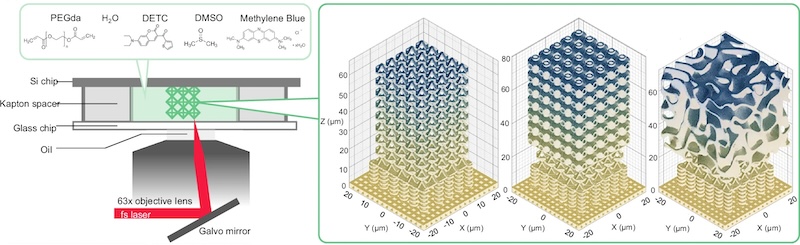 Schematic of the two-photon lithography setup and CAD model of the printed architecture. The bottom square lattice and spring layer are sacrificial, ensuring structural integrity and accommodating for shrinkage during thermal post-processing. Image: Zhang, et al.
“In single crystalline metals, the size effect is called ‘smaller stronger.’ So you can tremendously enhance the strength of materials, especially of metals, by reducing their dimensions down to the micron and sub‑micron scale,” she said.
Schematic of the two-photon lithography setup and CAD model of the printed architecture. The bottom square lattice and spring layer are sacrificial, ensuring structural integrity and accommodating for shrinkage during thermal post-processing. Image: Zhang, et al.
“In single crystalline metals, the size effect is called ‘smaller stronger.’ So you can tremendously enhance the strength of materials, especially of metals, by reducing their dimensions down to the micron and sub‑micron scale,” she said.
The reason why is a structural response. “Because the length scale of each individual building block is comparable to the characteristic length scale of the microstructural feature, they are able to redistribute the load among themselves so the whole structure can still carry the load,” Greer said.
To help others understand the concept better, Greer often shares the analogy of the Eiffel Tower’s construction, including in an explanatory video she made about nanoarchitecture. “The materials are 99 percent air, but strong as steel,” she shared. The Eiffel Tower exhibits the same qualities. “All of those trusses are interconnected, so they’re going to effectively redistribute the load among all of them, so that they each take a little bit.”
Discover the Benefits of ASME Membership
It’s not a lengthy process, but “involved” at each step. “We begin with something soft and squishy like Jell-O, soft and squishy and compliant, not rigid at all. Then we infuse metals into that scaffold, and then burn off the organic to get to the metal oxide (nickel oxide in this case). Then, we get rid of the oxygen by another thermal treatment,” Greer added. “Now the dimensions of that metal are sub-micron, maybe 500 nanometers. Then we build them up into these architectures. This is the smallest metallic 3D structure that’s been made.”
It might be tiny, but fascinating, she said. “The atomic level microstructure is very interesting. It has nano grains, pores, and twins. It’s loaded with microstructural detail that people study as an individual contribution,” Greer explained. “We somehow managed to convince all of these microstructural features to be in the same architecture.”
While mechanical engineers know that typically this would mean low quality with deteriorating strength and ultimately fatigue failure, she says this isn’t the case in this experiment. “It’s very much the opposite, like everything else in nano, it’s upside down,” she continued. “Though it’s loaded with defects and features that typically would degrade the material property, they actually work together in concert to enhance the mechanical properties.”
You Might Also Enjoy: Researchers Develop ‘Super Foam’ That Could Reduce Injuries and Save Lives
Greer had to keep stopping to ask, “Is this real?” It goes against the commonly held belief that regardless of size the metals will have the same strength. “We had to check and double check and triple check, but people are finally adopting size dependent strength,” she said, adding that university classes might take a bit of time to catch up to this new finding.
The team quickly realized “this is going to blow everyone’s mind, because you’re expecting something entirely different than you’ve been feeling comfortable about,” she added. When materials recover rather than failing at the nanoscale, the “upside down” responses in the nano world become a new norm.
Alexandra Frost is an independent writer and content strategist in Cincinnati.
“What in general has been inspiring us for the last decade is that at the nanoscale, things are very different, especially for metals,” said Julia R. Greer, the Ruben F. and Donna Mettler Professor of Materials Science, Mechanics, and Medical Engineering at the California Institute of Technology (CalTech). This work was recently published in Nature Communications. The research builds on findings from her team’s work in 2023, which shared the fundamentals of the process: that it’s possible to observe a structural response in a single building block of nanoarchitecture, including the strength. Now, the new research demonstrates greater implications of building an entire architecture around that block.
Exploring the size effect
“We, and several other groups later on, discovered that at the nanoscale, the metals exhibit the so‑called size effect,” Greer said. “When you take, say, a piece of copper or gold, which we know to be very flexible, and then you reduce its dimensions down to sub‑micron, it becomes as strong as steel.”
To make this happen, they use a process called two-photon lithography. This allows them to control the individual voxels, the tiniest features, in a 3D image before using a laser beam to create a shape out of hydrogel. Next, metallic salts are infused in the gel, before heating the structure. The size effect begins, which Greer called “magic.”
Schematic of the two-photon lithography setup and CAD model of the printed architecture. The bottom square lattice and spring layer are sacrificial, ensuring structural integrity and accommodating for shrinkage during thermal post-processing. Image: Zhang, et al.
The reason why is a structural response. “Because the length scale of each individual building block is comparable to the characteristic length scale of the microstructural feature, they are able to redistribute the load among themselves so the whole structure can still carry the load,” Greer said.
The Eiffel Tower (but tiny)
To help others understand the concept better, Greer often shares the analogy of the Eiffel Tower’s construction, including in an explanatory video she made about nanoarchitecture. “The materials are 99 percent air, but strong as steel,” she shared. The Eiffel Tower exhibits the same qualities. “All of those trusses are interconnected, so they’re going to effectively redistribute the load among all of them, so that they each take a little bit.”
Discover the Benefits of ASME Membership
It’s not a lengthy process, but “involved” at each step. “We begin with something soft and squishy like Jell-O, soft and squishy and compliant, not rigid at all. Then we infuse metals into that scaffold, and then burn off the organic to get to the metal oxide (nickel oxide in this case). Then, we get rid of the oxygen by another thermal treatment,” Greer added. “Now the dimensions of that metal are sub-micron, maybe 500 nanometers. Then we build them up into these architectures. This is the smallest metallic 3D structure that’s been made.”
The implications for further research
It might be tiny, but fascinating, she said. “The atomic level microstructure is very interesting. It has nano grains, pores, and twins. It’s loaded with microstructural detail that people study as an individual contribution,” Greer explained. “We somehow managed to convince all of these microstructural features to be in the same architecture.”
While mechanical engineers know that typically this would mean low quality with deteriorating strength and ultimately fatigue failure, she says this isn’t the case in this experiment. “It’s very much the opposite, like everything else in nano, it’s upside down,” she continued. “Though it’s loaded with defects and features that typically would degrade the material property, they actually work together in concert to enhance the mechanical properties.”
You Might Also Enjoy: Researchers Develop ‘Super Foam’ That Could Reduce Injuries and Save Lives
Greer had to keep stopping to ask, “Is this real?” It goes against the commonly held belief that regardless of size the metals will have the same strength. “We had to check and double check and triple check, but people are finally adopting size dependent strength,” she said, adding that university classes might take a bit of time to catch up to this new finding.
The team quickly realized “this is going to blow everyone’s mind, because you’re expecting something entirely different than you’ve been feeling comfortable about,” she added. When materials recover rather than failing at the nanoscale, the “upside down” responses in the nano world become a new norm.
Alexandra Frost is an independent writer and content strategist in Cincinnati.
New research into the tiniest of metals has revealed that defects can make a nanoscaled object stronger.

Journalist in Cincinnati
Related Content


Sep 9, 2026
5 Myths About Borosilicate Glass
SCHOTT's Tina Gallo tackles five myths that may be causing engineers to underestimate borosilicate glass.


Jul 30, 2026
Ion Beams Speed Qualification for Nuclear Materials


By mimicking years of neutron damage in days, ion beam testing could dramatically reduce the time and cost of qualifying materials for advanced nuclear reactors.

Jun 9, 2026
The Next Era of Programmable Matter
Researchers have unlocked robotic building blocks using electrically heated elements that turn solids to liquids, which allows the material to mimic a wide range of mechanical behaviors.
May 26, 2026
Researchers Develop ‘Super Foam’ That Could Reduce Injuries and Save Lives

Using a process called IFAM, Texas A&M researchers created a hybrid composite that is tunable, lightweight, and ultra-durable.