Printing with Sound Could Reshape Microdevice Manufacturing
Printing with Sound Could Reshape Microdevice Manufacturing
.png?width=854&height=480&ext=.png)
Using sound instead of lasers or heat, this emerging technique delivers ultra-precise, in situ 3D printing with transformative biomedical potential.
Conventional 3D printing methods use either heat or light (lasers) to melt and manipulate materials so they can build structures point by point and layer by layer. A team of researchers led by Muthukumaran Packirisamy, a professor in the Department of Mechanical, Industrial, and Aerospace Engineering at Concordia University in Canada, is using sound to achieve the same outcomes.
“Sound has been used for a variety of other applications. We have ultrasound for medical imaging and ultrasonic cleaning. Ultrasonic energies have also been used to ablate kidney stones and burn tissue,” Packirisamy pointed out. “So we wanted to find out if we can do 3D printing with sound.”
The premise of using sound for additive manufacturing might be appealing, but because additive requires high precision, the process would need “a different interaction between ultrasonic sound and materials,” Packirisamy said. “It’s not just about breaking up something with sound.”
That “different interaction” works by leveraging ultrasonic chemistry. High-frequency (megahertz) sound creates oscillating pressure waves or pulses inside materials. The material’s composition dictates how it reacts to these pulses.
In many polymers, including polydimethylsiloxane (PDMS), which is often used to manufacture microfluidics, the sound waves cause cavitation or tiny bubbles. When these bubbles implode or collapse, the pressure created is enough to cause phase transformations in the material, converting liquid material to a solid.
 From left, researchers Muthukumaran Packirisamy, Mohsen Habibi, and Shervin Foroughi co-authored the recent study on proximal sound printing. Image: Concordia University
“There’s a sharp increase in pressure and a very high increase in temperature over a very tiny region, which changes the chemistry and turns the polymer from a liquid to a solid phase,” Packirisamy explained.
From left, researchers Muthukumaran Packirisamy, Mohsen Habibi, and Shervin Foroughi co-authored the recent study on proximal sound printing. Image: Concordia University
“There’s a sharp increase in pressure and a very high increase in temperature over a very tiny region, which changes the chemistry and turns the polymer from a liquid to a solid phase,” Packirisamy explained.
The temperature inside the bubble cavities caused by sound waves spikes close to 15,000 kelvin and about 1,000 times the surface pressure of the Earth at sea level. The swift and intense reaction localizes the phase transformation to an exact pinprick, enabling the precise printing of objects.
Using ultrasonic chemistry in this manner forms the basis of a series of techniques developed in Packirisamy’s lab: direct sound printing (DSP), holographic direct sound printing (HDSP), and proximal sound printing (PSP). Each of these methods builds on the advantages of the ones that came before it.
In direct sound printing (DSP), a transducer produces a high-frequency sound wave while moving above a pool of liquid PDMS. A robotic arm moves the transducer to deliver the focused sound beam where needed. The generated sound waves essentially “cook” the liquid and create a solid right at each point the transducer traces.
More Sound Engineering: A Device to Tune In or Out
The HDSP technique focuses on printing entire layers at once instead of going point to point. In such a method, the sound waves create an acoustic holographic image using a designed hologram, very similar to creating a pattern by shining a light through a stencil. Because the method creates structures by printing entire layers at the same time, it’s faster than DSP.
The latest version of using sound for 3D printing that the Concordia lab has developed, proximal printing, fixes some of the precision challenges of direct sound printing by bringing the transducer extremely close to the platform where the object is being printed.
Typically, generated sound waves cause the liquid to swirl around, similar to the ripples created when helicopter rotors disturb a water surface. However, when the transducer tip is very close, the sound waves generated don’t cause much swirling (acoustic streaming), making the printing process more easily controlled.
The precision of the image depends on the wavelength of the sound wave. The Concordia research team has demonstrated printing capabilities in the 50 to 100 micron range thus far.
One of the many advantages of using ultrasonic energy for 3D printing is that it can be used to build structures with complex designs in situ with designs that might otherwise be challenging to create. The production of lab-on-a-chip systems and microfluidics, for example, requires extremely fine-grained printing on small devices. In that case, it might be easier to simply use a liquid solution and then solidify needed circuitry onto a platform. Sound-based 3D printing will enable the development of finer microdevices in situ.
Another advantage, Packirisamy said, is that the technique can be used inside media or spaces that traditional 3D printing can’t access. “The beauty of sound waves is that they can penetrate objects and walls and skin so we can do 3D printing inside the human body if needed,” Packirisamy said.
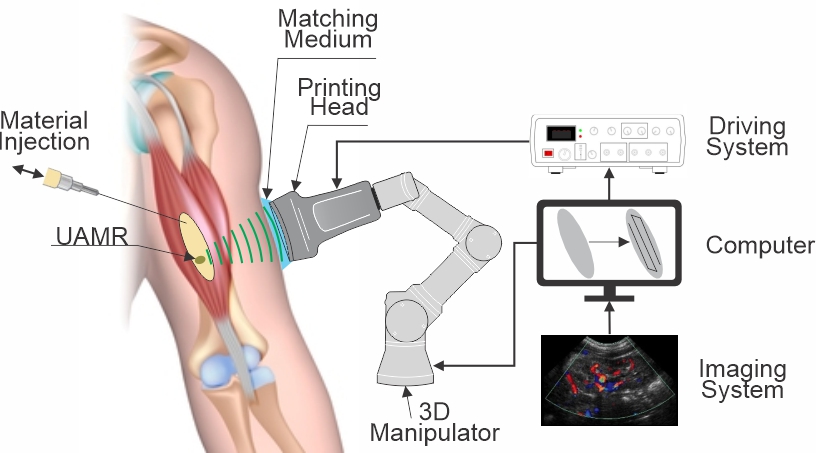 Image: Nature Communications
In the figure shown above, a small amount of liquid PDMS is injected into the body and then manipulated using a robot arm and a transducer “printer head.” The sound waves from the transducer pass through the skin and solidify the targeted liquid resin, depositing it onto a required surface. To adjust the parameters of the structure, operators can change the duration and frequency of the sound wave and the viscosity of the material being used.
Future research in the lab will focus on printing entire 3D structures, including multiple layers, in a single step.
Poornima Apte is a technology writer based in Walpole, Mass.
“Sound has been used for a variety of other applications. We have ultrasound for medical imaging and ultrasonic cleaning. Ultrasonic energies have also been used to ablate kidney stones and burn tissue,” Packirisamy pointed out. “So we wanted to find out if we can do 3D printing with sound.”
The premise of using sound for additive manufacturing might be appealing, but because additive requires high precision, the process would need “a different interaction between ultrasonic sound and materials,” Packirisamy said. “It’s not just about breaking up something with sound.”
Using ultrasonic chemistry
That “different interaction” works by leveraging ultrasonic chemistry. High-frequency (megahertz) sound creates oscillating pressure waves or pulses inside materials. The material’s composition dictates how it reacts to these pulses. In many polymers, including polydimethylsiloxane (PDMS), which is often used to manufacture microfluidics, the sound waves cause cavitation or tiny bubbles. When these bubbles implode or collapse, the pressure created is enough to cause phase transformations in the material, converting liquid material to a solid.
From left, researchers Muthukumaran Packirisamy, Mohsen Habibi, and Shervin Foroughi co-authored the recent study on proximal sound printing. Image: Concordia University
The temperature inside the bubble cavities caused by sound waves spikes close to 15,000 kelvin and about 1,000 times the surface pressure of the Earth at sea level. The swift and intense reaction localizes the phase transformation to an exact pinprick, enabling the precise printing of objects.
Using ultrasonic chemistry in this manner forms the basis of a series of techniques developed in Packirisamy’s lab: direct sound printing (DSP), holographic direct sound printing (HDSP), and proximal sound printing (PSP). Each of these methods builds on the advantages of the ones that came before it.
In direct sound printing (DSP), a transducer produces a high-frequency sound wave while moving above a pool of liquid PDMS. A robotic arm moves the transducer to deliver the focused sound beam where needed. The generated sound waves essentially “cook” the liquid and create a solid right at each point the transducer traces.
More Sound Engineering: A Device to Tune In or Out
The HDSP technique focuses on printing entire layers at once instead of going point to point. In such a method, the sound waves create an acoustic holographic image using a designed hologram, very similar to creating a pattern by shining a light through a stencil. Because the method creates structures by printing entire layers at the same time, it’s faster than DSP.
The latest version of using sound for 3D printing that the Concordia lab has developed, proximal printing, fixes some of the precision challenges of direct sound printing by bringing the transducer extremely close to the platform where the object is being printed.
Typically, generated sound waves cause the liquid to swirl around, similar to the ripples created when helicopter rotors disturb a water surface. However, when the transducer tip is very close, the sound waves generated don’t cause much swirling (acoustic streaming), making the printing process more easily controlled.
The precision of the image depends on the wavelength of the sound wave. The Concordia research team has demonstrated printing capabilities in the 50 to 100 micron range thus far.
Potential applications
One of the many advantages of using ultrasonic energy for 3D printing is that it can be used to build structures with complex designs in situ with designs that might otherwise be challenging to create. The production of lab-on-a-chip systems and microfluidics, for example, requires extremely fine-grained printing on small devices. In that case, it might be easier to simply use a liquid solution and then solidify needed circuitry onto a platform. Sound-based 3D printing will enable the development of finer microdevices in situ. Another advantage, Packirisamy said, is that the technique can be used inside media or spaces that traditional 3D printing can’t access. “The beauty of sound waves is that they can penetrate objects and walls and skin so we can do 3D printing inside the human body if needed,” Packirisamy said.
Image: Nature Communications
In the figure shown above, a small amount of liquid PDMS is injected into the body and then manipulated using a robot arm and a transducer “printer head.” The sound waves from the transducer pass through the skin and solidify the targeted liquid resin, depositing it onto a required surface. To adjust the parameters of the structure, operators can change the duration and frequency of the sound wave and the viscosity of the material being used.
Future research in the lab will focus on printing entire 3D structures, including multiple layers, in a single step.
Poornima Apte is a technology writer based in Walpole, Mass.


Stay up to date on the advances in additive manufacturing. This collection highlights new applications of 3D printing, metal printing methods, materials development, medical devices, and bioprinting.