Using 3D Printing to Manufacture Composite Materials
Using 3D Printing to Manufacture Composite Materials
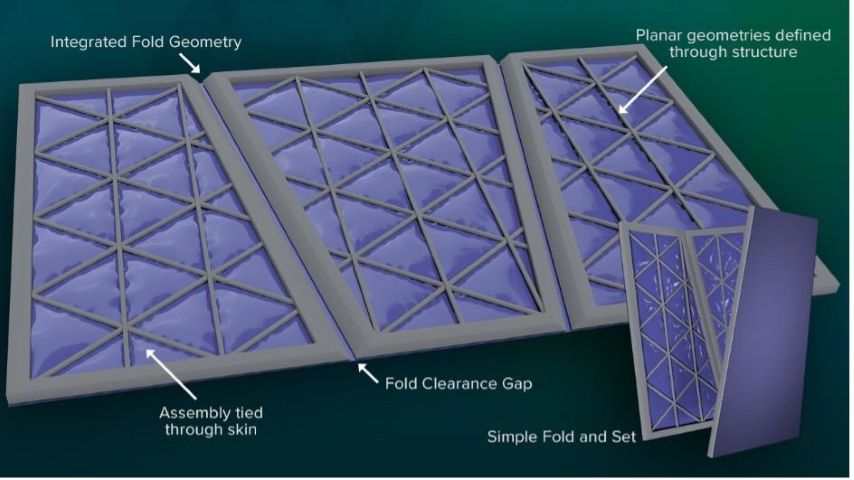
Researchers at Oak Ridge National Laboratory have developed a hybrid 3D-printing process for manufacturing high-strength composite materials, at faster speed and lower cost than existing methods.
Composite manufacturing is the process of combining reinforcement fibers and a resin matrix to create lightweight, high-strength materials. Although traditional composite manufacturing methods such as hand lay-up, resin transfer molding, filament winding, and autoclave molding are highly effective for producing strong, durable components, they often have long lead times and high mold costs that limit design flexibility.
While researching potential methods to produce large molds for composite skin prototypes—including folding paper mockups and then 3D-printing more accurate versions—Steven Guzorek, research engineer at Oak Ridge National Laboratory (ORNL), had an “aha” moment. “I suddenly realized,” he said, “why not print directly onto the composite fabric and eliminate several tooling steps, thereby boosting efficiency and reducing cost?”
Guzorek then assembled a research team and set out to develop this first-of-its-kind 3D-printing method for creating composite materials.
A unique manufacturing approach
ORNL used hybrid materials and a multi-step additive manufacturing (AM) process (without molds)—to produce flat-to-foldable structures that merge flexible and rigid components into a single design.
The structures are composed of a high-strength fabric base such as nylon, glass fiber, or resin-infused composite fibers, followed by an integration or bonding layer such as thermoplastic polyurethane for compatibility and adhesion.
The reinforcing layer was then applied using deposited composite materials, including thermoplastic carbon-fiber acrylonitrile butadiene styrene (ABS) for lightweight structural performance, or thermoset formulations such as styrene-based or epoxy-based resins for enhanced stiffness, geometry control, and durability. The materials bond at the molecular level, forming a strong connection between the grid and the outer layer.
Faster build times
The AM method integrates origami-inspired 3D printing techniques with hybrid composites—materials made from mixed reinforcing components. Because the method does not require molds, this process produces lightweight, cost-efficient structures with faster build times and greater adaptability.
“A big challenge for our research team was materials/process development,” said Guzorek. The printed thermoplastic or resin had to reliably bond to the reinforcement and transfer load, especially in peel and shear.” Another challenge was design complexity—managing folds, joints, and stiffeners without creating collisions or over-constraining the fabric.
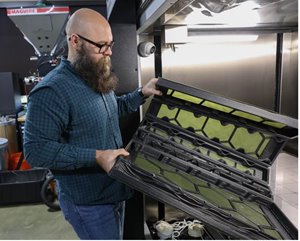 ORNL’s Steven Guzorek demonstrates the Lab’s hybrid 3D printing method. Image: ORNL
1. Material/process pairing that enabled robust bonding with simple processing—for example, (ABS)/thermoplastic polyurethane (TPU) co-melt and interdiffuse at printing temperatures, while compatible epoxies co-cure/crosslink across the interface.
2. Projected deposition/design, where features were printed onto a “fabric/skin in an orientation that effectively creates geometry, that would normally require 5-axis printing,” said Guzorek.
The AM process provided precise control over the material’s form and strength. This flexibility enabled foldable 3D forms without molds or extensive finishing. “I was also surprised by how well the process scaled—from desktop parts to 3-meter structures—without the adhesion and alignment issues we expected at that size,” said Guzorek.
For mechanical engineers, the most interesting aspect of this work is the non-intuitive modeling and load-path design in a folded/formed composite skin. Key steps are:
-
Start with a target 3D geometry
-
Convert it to a triangulated surface “skin” (standard triangle language-like mesh)
-
Design joints and stiffeners directly on the skin to meet load and stiffness requirements
-
Flatten the pattern and generate print paths for fabrication
-
Modeling of the loading and predicting stiffness after forming is especially challenging
The new method enables the production of complex geometries that traditional mold-based methods cannot economically achieve. It also allows the fabrication of objects larger than the printing machine itself, reducing capital costs and boosting production efficiency. In a test print, the researchers found that eliminating molds reduced fabrication time by 95 percent and costs by 90 percent for printing a unique design, compared to conventional mold-based composite manufacturing.
Next steps
These advancement have created opportunities for next-generation composite manufacturing strategies that bypass molds and expand the boundaries of lightweight structural design. ORNL has filed a patent and the team is in the process of preparing the innovation for future licensing.
You May Also Want to Read: Printing with Sound Could Reshape Microdevice Manufacturing
You May Also Want to Read: Printing with Sound Could Reshape Microdevice Manufacturing
The goal is to make the new technology scalable so manufacturers across industries can harness its potential. By broadening access to mold-free hybrid composites, manufacturers can explore new design possibilities and applications for this transformative technology.
“We are now focusing on improved design and modeling tools—automated flattening, feature generation such as joints and stiffeners), and toolpath planning—along with better predictive models for stiffness/strength after forming,” said Guzorek. “Over the next few years, I expect a more streamlined CAD-to-fabrication workflow and more validated structural demonstrations.”
This approach could enable rapid, low-tooling fabrication of lightweight shells and stiffened panels for applications, such as UAV structures, robotic covers, architectural/deployable panels, and custom composite fixtures or tooling.
“An additional point,” noted Guzorek, “is that printing directly onto the fabric can reduce tooling steps and iteration time, making it practical for rapid prototyping of large composite skins with integrated features.”
Mark Crawford is a technology writer in Corrales, N.M.


Stay up to date on the advances in additive manufacturing. This collection highlights new applications of 3D printing, metal printing methods, materials development, medical devices, and bioprinting.