An Easy Way to Detect Short Circuits in Post-Accident EV Batteries
An Easy Way to Detect Short Circuits in Post-Accident EV Batteries
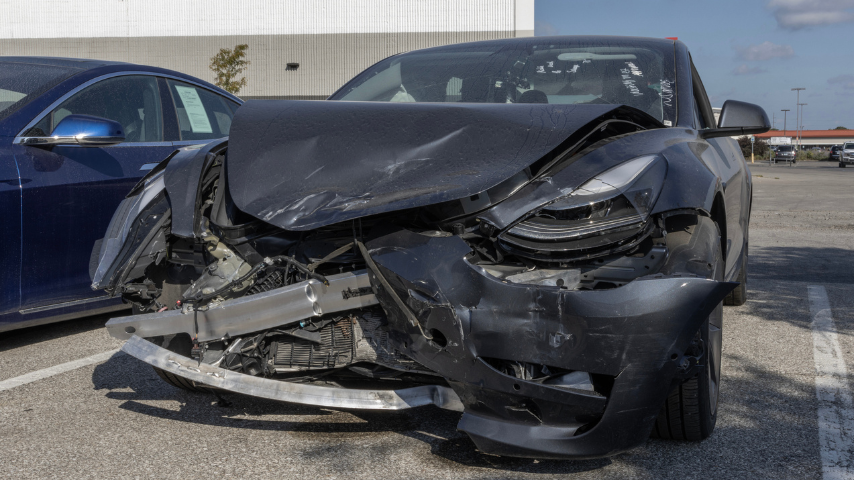
New deployable inspection device provides post-accident EV battery short-circuit diagnostics in about an hour.
Fast and accurate detection of soft short circuits (SCs) in the battery packs of damaged electric vehicles (EVs) is needed to mitigate the potential risk from battery fires that may occur hours, days, or weeks after an accident. EVs involved in accidents may appear externally intact, yet hidden battery damage can later escalate into severe thermal events or fires if proper inspection is not performed.
Despite the rapid growth of the EV market and the potential risk of battery failures after accidents, there are still no well-established or standardized methodologies for assessing battery safety in damaged vehicles. First responders, inspectors, and mechanics often have limited information about battery condition and lack practical tools for rapid on-site assessment.
Driven by this critical safety gap in post-accident EV battery assessment, and its potential technical and societal impacts, a research team led by Jihoon Moon, a Ph.D. candidate in the Department of Mechanical Engineering at Pennsylvania State University, decided to develop a clear, reliable, and practically deployable inspection framework for post-accident battery diagnostics. The result was a first-of-its-kind SC-detection algorithm that works quickly and without prior knowledge of the battery-pack chemistry, capacity, state of charge, or state of health. (This work was sponsored by Idaho National Laboratory and the National Highway Traffic Safety Administration and co-led by INL’s Tanim R. Tanim.)
The proposed universal SC-detection algorithm is designed to be implemented on an inexpensive handheld device that can connect to and monitor the voltages of all cells in a pack. Transient filtering and linear-quadratic state observation provide estimates of normalized SC current for every cell in the pack. Cells with SC-current estimates outside a sigma-based threshold can also be detected.
Simulations, experiments, and EV crash data were used to verify the speed, sensitivity, and accuracy of the algorithm, demonstrating 96 percent accurate detection of 0.0027C SCs for 5S cell groups in the lab, and no false positives for crashed Volkswagen, Chevrolet, and Tesla vehicles without SCs. This multi-step approach monitored terminal voltage, analyzed deviations in normalized short-circuit current, and took less than an hour to complete.
Top research challenges in developing this work were feasibility, generalizability, and real-world applicability. The primary objective was to develop a method that could be deployed for any EV without requiring prior knowledge of the battery system.
“A key challenge arose from the substantial variability in battery systems across EV models and original equipment manufacturers,” Moon said. “Different vehicles use different battery chemistries, such as nickel-manganese-cobalt (NMC) and lithium-iron- phosphate (LFP), as well as different cell capacities and electrical characteristics, including open-circuit voltage (OCV) profiles, internal resistance, and RC parameters. In addition, sensor configurations and measurement quality vary significantly among OEMs, resulting in differences in available voltage and current signals.”
From a practical perspective, after an EV accident, first responders must rapidly assess battery safety on-site without detailed knowledge of the battery pack architecture, chemistry, or sensing system. This creates another problem to solve: developing a universal short-circuit detection framework that is effective across diverse EV platforms while relying only on readily available measurements.
“Ultimately, to address these challenges, we simplified the model structure and designed a tailored estimation framework that minimizes dependence on battery-specific information,” Moon said. “We validated the robustness and applicability of the proposed method using crash-test data from multiple EV platforms.”
One of the biggest surprises was realizing how many important research directions still remain unexplored, even after developing a practical framework for post-accident battery assessment.
Throughout the research, “it became clear that practical deployment introduces additional challenges that had not been fully appreciated,” Moon said. “For example, there is still a need to develop dedicated external diagnostic devices that can rapidly access and assess damaged batteries in real-world post-accident scenarios.”
Another surprising finding was that, although the research approach performed well across multiple conditions, its performance became more limited for LFP batteries under micro short-circuit conditions. This highlights that battery chemistry can significantly influence diagnostic performance and reveal important limitations that need further investigation.
An aspect of this work that will be of particular interest to mechanical engineers is the value of high-fidelity experimental data for validating engineering models or methodologies.
“In many engineering studies,” Moon said, “simulations play an important role in understanding system behavior. However, one well-designed experimental dataset can often be more valuable for validating research than many simulation datasets, particularly when studying detection systems of lithium-ion batteries under crash conditions.”
Because EV crash tests are both costly and time-intensive, experimental data obtained from this research is especially valuable. These datasets provide realistic information on battery behavior under impact conditions and enable rigorous validation of diagnostic and safety assessment methods that would otherwise rely heavily on assumptions or simulations alone.
Another key challenge in post-accident battery diagnostics, Moon noted, is that electric vehicles differ substantially in battery chemistry, electrical characteristics, and sensing systems across manufacturers. “Rather than developing a highly specialized method that works only under ideal assumptions, our approach focused on identifying a framework that is both efficient in practice and theoretically rigorous, while remaining broadly applicable across different EV platforms,” he said.
This research focused on how to efficiently and universally detect accident-induced short circuits in electric vehicle batteries. Moving forward, however, requires a shift from merely solving the problem to identifying its root causes. Specifically, “we need to better understand the mechanisms by which vehicle accidents lead to battery short circuits, as well as how mechanical damage may gradually evolve into short circuits over the long term,” said Moon.
By identifying and analyzing these underlying mechanisms, “we not only can enable faster and more accurate post-accident battery safety assessments, but also contribute to the design and manufacturing of more mechanically robust batteries that better withstand external damage,” said Moon.
Beyond post-accident EV scenarios, this research framework can be extended to non-crash applications, including lithium plating caused by improper battery management and short-circuit-induced failures in battery energy storage systems. These issues have also emerged as significant safety concerns in lithium-ion battery applications.
Perhaps most important, the research demonstrates the success of the philosophy of model simplification combined with tailored estimator design. Rather than relying on highly detailed system-specific information, the team’s approach focused on extracting meaningful diagnostic information from limited and imperfect measurements while maintaining broad applicability.
“Although developed for lithium-ion battery diagnostics, this framework can potentially inspire innovative monitoring and fault-detection systems in other engineering domains where uncertainty, variability, and real-time decision-making are critical, such as structural health monitoring, fault detection in manufacturing systems, predictive maintenance in robotics, or safety assessment in aerospace systems,” Moon concluded.
Mark Crawford is a technology writer in Corrales, N.M.
Despite the rapid growth of the EV market and the potential risk of battery failures after accidents, there are still no well-established or standardized methodologies for assessing battery safety in damaged vehicles. First responders, inspectors, and mechanics often have limited information about battery condition and lack practical tools for rapid on-site assessment.
Driven by this critical safety gap in post-accident EV battery assessment, and its potential technical and societal impacts, a research team led by Jihoon Moon, a Ph.D. candidate in the Department of Mechanical Engineering at Pennsylvania State University, decided to develop a clear, reliable, and practically deployable inspection framework for post-accident battery diagnostics. The result was a first-of-its-kind SC-detection algorithm that works quickly and without prior knowledge of the battery-pack chemistry, capacity, state of charge, or state of health. (This work was sponsored by Idaho National Laboratory and the National Highway Traffic Safety Administration and co-led by INL’s Tanim R. Tanim.)
Groundbreaking prototype
The proposed universal SC-detection algorithm is designed to be implemented on an inexpensive handheld device that can connect to and monitor the voltages of all cells in a pack. Transient filtering and linear-quadratic state observation provide estimates of normalized SC current for every cell in the pack. Cells with SC-current estimates outside a sigma-based threshold can also be detected.
Simulations, experiments, and EV crash data were used to verify the speed, sensitivity, and accuracy of the algorithm, demonstrating 96 percent accurate detection of 0.0027C SCs for 5S cell groups in the lab, and no false positives for crashed Volkswagen, Chevrolet, and Tesla vehicles without SCs. This multi-step approach monitored terminal voltage, analyzed deviations in normalized short-circuit current, and took less than an hour to complete.
Top research challenges in developing this work were feasibility, generalizability, and real-world applicability. The primary objective was to develop a method that could be deployed for any EV without requiring prior knowledge of the battery system.
“A key challenge arose from the substantial variability in battery systems across EV models and original equipment manufacturers,” Moon said. “Different vehicles use different battery chemistries, such as nickel-manganese-cobalt (NMC) and lithium-iron- phosphate (LFP), as well as different cell capacities and electrical characteristics, including open-circuit voltage (OCV) profiles, internal resistance, and RC parameters. In addition, sensor configurations and measurement quality vary significantly among OEMs, resulting in differences in available voltage and current signals.”
From a practical perspective, after an EV accident, first responders must rapidly assess battery safety on-site without detailed knowledge of the battery pack architecture, chemistry, or sensing system. This creates another problem to solve: developing a universal short-circuit detection framework that is effective across diverse EV platforms while relying only on readily available measurements.
“Ultimately, to address these challenges, we simplified the model structure and designed a tailored estimation framework that minimizes dependence on battery-specific information,” Moon said. “We validated the robustness and applicability of the proposed method using crash-test data from multiple EV platforms.”
A few surprises
One of the biggest surprises was realizing how many important research directions still remain unexplored, even after developing a practical framework for post-accident battery assessment.
Throughout the research, “it became clear that practical deployment introduces additional challenges that had not been fully appreciated,” Moon said. “For example, there is still a need to develop dedicated external diagnostic devices that can rapidly access and assess damaged batteries in real-world post-accident scenarios.”
Another surprising finding was that, although the research approach performed well across multiple conditions, its performance became more limited for LFP batteries under micro short-circuit conditions. This highlights that battery chemistry can significantly influence diagnostic performance and reveal important limitations that need further investigation.
For mechanical engineers
An aspect of this work that will be of particular interest to mechanical engineers is the value of high-fidelity experimental data for validating engineering models or methodologies.
“In many engineering studies,” Moon said, “simulations play an important role in understanding system behavior. However, one well-designed experimental dataset can often be more valuable for validating research than many simulation datasets, particularly when studying detection systems of lithium-ion batteries under crash conditions.”
Because EV crash tests are both costly and time-intensive, experimental data obtained from this research is especially valuable. These datasets provide realistic information on battery behavior under impact conditions and enable rigorous validation of diagnostic and safety assessment methods that would otherwise rely heavily on assumptions or simulations alone.
Another key challenge in post-accident battery diagnostics, Moon noted, is that electric vehicles differ substantially in battery chemistry, electrical characteristics, and sensing systems across manufacturers. “Rather than developing a highly specialized method that works only under ideal assumptions, our approach focused on identifying a framework that is both efficient in practice and theoretically rigorous, while remaining broadly applicable across different EV platforms,” he said.
Next steps
This research focused on how to efficiently and universally detect accident-induced short circuits in electric vehicle batteries. Moving forward, however, requires a shift from merely solving the problem to identifying its root causes. Specifically, “we need to better understand the mechanisms by which vehicle accidents lead to battery short circuits, as well as how mechanical damage may gradually evolve into short circuits over the long term,” said Moon.
By identifying and analyzing these underlying mechanisms, “we not only can enable faster and more accurate post-accident battery safety assessments, but also contribute to the design and manufacturing of more mechanically robust batteries that better withstand external damage,” said Moon.
Beyond post-accident EV scenarios, this research framework can be extended to non-crash applications, including lithium plating caused by improper battery management and short-circuit-induced failures in battery energy storage systems. These issues have also emerged as significant safety concerns in lithium-ion battery applications.
Perhaps most important, the research demonstrates the success of the philosophy of model simplification combined with tailored estimator design. Rather than relying on highly detailed system-specific information, the team’s approach focused on extracting meaningful diagnostic information from limited and imperfect measurements while maintaining broad applicability.
“Although developed for lithium-ion battery diagnostics, this framework can potentially inspire innovative monitoring and fault-detection systems in other engineering domains where uncertainty, variability, and real-time decision-making are critical, such as structural health monitoring, fault detection in manufacturing systems, predictive maintenance in robotics, or safety assessment in aerospace systems,” Moon concluded.
Mark Crawford is a technology writer in Corrales, N.M.
New deployable inspection device provides post-accident EV battery short-circuit diagnostics in about an hour.

Writer and editor at MC2 Solutions
Related Content


Sep 25, 2026
ROSEN Group and ASME Foundation Announce Winners of the 2026 Hermann Rosen Award for Pipeline Innovation

Sep 25, 2026
ASME CEO Corner: Engineering Through Times of Change
Sep 25, 2026
Congress Prevents Government Shutdown and Delays OMB Rule
Sep 25, 2026
White House Releases National Security Science and Technology Strategy