Additive Screen Printing: Scalable Manufacturing for Micro-Structured Components
Additive Screen Printing: Scalable Manufacturing for Micro-Structured Components
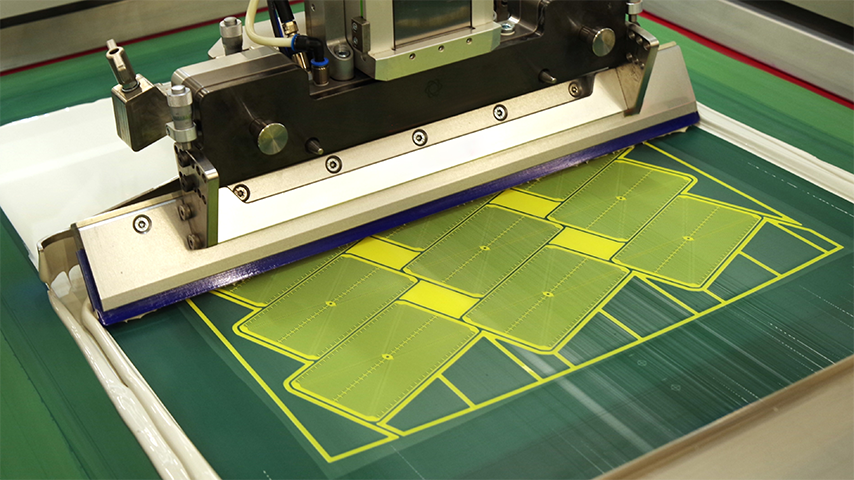
A screen-based additive process enables the mass production of high-resolution metal and ceramic components at industrial scale.
Additive screen printing operates as an industrial manufacturing technology designed to bridge the gap between the geometric freedom of additive manufacturing and the throughput of traditional injection molding.
While other 3D printing methods such as laser powder bed fusion are often limited by speed when scaling to high volumes, additive screen printing utilizes a surface-based deposition method. This allows for the simultaneous production of thousands of micro-precise components in a single operation, independent of the individual part geometry.
The fundamental principle of additive screen printing is based on the layer-by-layer application of a highly filled suspension (high-density paste) through a precision screen. The process follows a cyclical sequence:
Deposition: A polyurethane squeegee presses the material paste through apertures of a patterned screen onto a workpiece carrier. The combination of mesh and photosensitive emulsion defines the part geometry within the screens of each layer in the X and Y axes.
Curing: The applied layer undergoes a brief drying or curing phase by IR or UV to stabilize the structure.
Z-Axis build and structure change: The screen raises by a predetermined increment to define the layer thickness for the next cycle. To enable the fabrication of complex internal structures, screens can be exchanged during this sequence. This capability permits the creation of overprinted channels or closed cavities.
Sintering on demand: Once the "green part" is printed, it is removed from the workpiece carrier. Subsequently, ceramic and metallic components undergo a sintering process to eliminate the binder and densify the particles, achieving the final material properties.
Unlike powder-based systems, this process utilizes a paste containing metal or ceramic particles mixed with a binder system. Because the material is applied only where needed, no de-powdering is necessary, and the green parts can be sintered directly afterward. This suspension typically has a solid content of over 50 percent by volume, resulting in green parts with high inherent stability.
The technology is optimized to manufacture components requiring high resolution and complex internal features, and supports a wide range of materials.
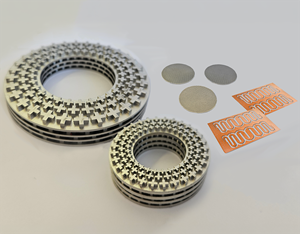 Printed metal parts. Image: Exentis Group
Examples of the various materials include metals like stainless steel (316L) and pure copper, technical ceramics such as aluminum oxide (Al2O3), zirconium oxide (ZrO2), aluminum nitride (AlN), and polymers, as well as porous materials and customized ones.
Printed metal parts. Image: Exentis Group
Examples of the various materials include metals like stainless steel (316L) and pure copper, technical ceramics such as aluminum oxide (Al2O3), zirconium oxide (ZrO2), aluminum nitride (AlN), and polymers, as well as porous materials and customized ones.
Regarding resolution and tolerances, wall thicknesses start from 75 µm in the green state, and internal channels and openings are viable down to 125 µm.
Following the sintering process, components typically achieve densities of up to 99 percent, making them suitable for high-pressure applications.
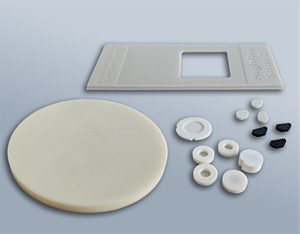 Parts made of technical ceramics. Image: Exentis Group
A distinct capability of the process is the integration of internal features, such as closed cooling channels or hollow structures, without the need for internal support removal. This allows for the manufacturing of complex heat exchangers or fluidic devices where channels follow the contour of the part.
Parts made of technical ceramics. Image: Exentis Group
A distinct capability of the process is the integration of internal features, such as closed cooling channels or hollow structures, without the need for internal support removal. This allows for the manufacturing of complex heat exchangers or fluidic devices where channels follow the contour of the part.
The technology also allows design freedom in the X and Y axes. Ideal parts are flat and up to 400 mm in diameter.
For industrial engineers, the calculation for additive screen printing differs from subtractive or molding methods. The "tooling" is reduced to the screen itself, shifting the economic model toward lower upfront investment, faster iteration cycles, and scalable throughput.
Cost efficiency: The cost of screens is significantly lower than that of injection molding tools.
Lead times: Screen production is completed within days, whereas traditional molds may require months of fabrication and high investments.
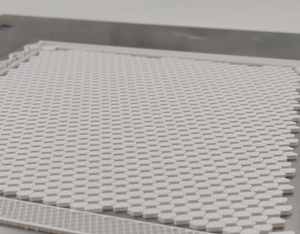 Printed ceramic wire guides on workpiece carrier. Image: Exentis Group
Throughput (unit volume): The build rate is determined by the utilized surface area of the screen rather than the number of individual parts. Unlike laser-based systems, where cycle times increase with the number of components and scan vectors, the cycle time in this system is defined by a single pass of the squeegee. This operation time remains constant regardless of how many parts are printed at the same time. A production system can circulate up to 40 workpiece carriers in a continuous loop, achieving build rates of up to 10,000 cm³/h.
Printed ceramic wire guides on workpiece carrier. Image: Exentis Group
Throughput (unit volume): The build rate is determined by the utilized surface area of the screen rather than the number of individual parts. Unlike laser-based systems, where cycle times increase with the number of components and scan vectors, the cycle time in this system is defined by a single pass of the squeegee. This operation time remains constant regardless of how many parts are printed at the same time. A production system can circulate up to 40 workpiece carriers in a continuous loop, achieving build rates of up to 10,000 cm³/h.
As an example, in the production of ceramic wire guides with dimensions of 6.2 × 3 × 1.4 mm, a single production system can produce 84,000 units per eight-hour shift. This illustrates that volume scales with screen area, regardless of part complexity.
The implementation of additive screen printing in an industrial setting follows a collaborative engineering model. The workflow can be summarized in four key steps, prioritizing the precise realization of customer specifications using the technology's capabilities.
1. Feasibility and design adaptation
The process begins with an evaluation of the client’s CAD data. Application engineers analyze the design for screen printing compatibility, focusing on aspect ratios and wall thickness.
2. Screen and paste
Exentis delivers an all-in-one package, including screens and proprietary paste systems, developed by our in-house material specialists. This ensures that the viscosity of the paste is perfectly matched to the mesh size of the screen, preventing clogging and ensuring sharp edge definition.
3. Prototyping to series
Due to the low cost of tooling, the transition from prototyping to series production is fluid. A screen used for a sample run of 50 parts can technically be used for a production run of 50,000 parts. This eliminates the "ramp-up" friction often seen when moving from 3D printed prototypes to molded production parts.
4. Operational integration
For companies installing the technology in-house, the considered safety aspect simplifies integration. Since the metal or ceramic is bound in a paste, there are no loose powders, eliminating the need for hazardous material handling protocols. However, Exentis offers contract manufacturing as well.
Additive screen printing provides engineers with a scalable method to produce micro-precision parts. It combines the design flexibility of additive manufacturing with the economic logic of industrial printing, offering a viable production route for complex metal and ceramic components.
Srdan Vasic, CCO/CPO at Exentis Group, plays a key role in advancing and commercializing Exentis’ technology platform, overseeing product strategy and driving the company’s commercial growth. He holds a Ph.D. in Materials Engineering and an MBA from ETH Zurich.
While other 3D printing methods such as laser powder bed fusion are often limited by speed when scaling to high volumes, additive screen printing utilizes a surface-based deposition method. This allows for the simultaneous production of thousands of micro-precise components in a single operation, independent of the individual part geometry.
The technology behind the process
The fundamental principle of additive screen printing is based on the layer-by-layer application of a highly filled suspension (high-density paste) through a precision screen. The process follows a cyclical sequence:
Deposition: A polyurethane squeegee presses the material paste through apertures of a patterned screen onto a workpiece carrier. The combination of mesh and photosensitive emulsion defines the part geometry within the screens of each layer in the X and Y axes.
Curing: The applied layer undergoes a brief drying or curing phase by IR or UV to stabilize the structure.
Z-Axis build and structure change: The screen raises by a predetermined increment to define the layer thickness for the next cycle. To enable the fabrication of complex internal structures, screens can be exchanged during this sequence. This capability permits the creation of overprinted channels or closed cavities.
Sintering on demand: Once the "green part" is printed, it is removed from the workpiece carrier. Subsequently, ceramic and metallic components undergo a sintering process to eliminate the binder and densify the particles, achieving the final material properties.
Unlike powder-based systems, this process utilizes a paste containing metal or ceramic particles mixed with a binder system. Because the material is applied only where needed, no de-powdering is necessary, and the green parts can be sintered directly afterward. This suspension typically has a solid content of over 50 percent by volume, resulting in green parts with high inherent stability.
Technical capabilities and materials
The technology is optimized to manufacture components requiring high resolution and complex internal features, and supports a wide range of materials.
Printed metal parts. Image: Exentis Group
Regarding resolution and tolerances, wall thicknesses start from 75 µm in the green state, and internal channels and openings are viable down to 125 µm.
Following the sintering process, components typically achieve densities of up to 99 percent, making them suitable for high-pressure applications.
Parts made of technical ceramics. Image: Exentis Group
The technology also allows design freedom in the X and Y axes. Ideal parts are flat and up to 400 mm in diameter.
Production economics and tooling
For industrial engineers, the calculation for additive screen printing differs from subtractive or molding methods. The "tooling" is reduced to the screen itself, shifting the economic model toward lower upfront investment, faster iteration cycles, and scalable throughput.
Cost efficiency: The cost of screens is significantly lower than that of injection molding tools.
Lead times: Screen production is completed within days, whereas traditional molds may require months of fabrication and high investments.
Printed ceramic wire guides on workpiece carrier. Image: Exentis Group
As an example, in the production of ceramic wire guides with dimensions of 6.2 × 3 × 1.4 mm, a single production system can produce 84,000 units per eight-hour shift. This illustrates that volume scales with screen area, regardless of part complexity.
Engineering workflow and collaboration
The implementation of additive screen printing in an industrial setting follows a collaborative engineering model. The workflow can be summarized in four key steps, prioritizing the precise realization of customer specifications using the technology's capabilities.
1. Feasibility and design adaptation
The process begins with an evaluation of the client’s CAD data. Application engineers analyze the design for screen printing compatibility, focusing on aspect ratios and wall thickness.
2. Screen and paste
Exentis delivers an all-in-one package, including screens and proprietary paste systems, developed by our in-house material specialists. This ensures that the viscosity of the paste is perfectly matched to the mesh size of the screen, preventing clogging and ensuring sharp edge definition.
3. Prototyping to series
Due to the low cost of tooling, the transition from prototyping to series production is fluid. A screen used for a sample run of 50 parts can technically be used for a production run of 50,000 parts. This eliminates the "ramp-up" friction often seen when moving from 3D printed prototypes to molded production parts.
4. Operational integration
For companies installing the technology in-house, the considered safety aspect simplifies integration. Since the metal or ceramic is bound in a paste, there are no loose powders, eliminating the need for hazardous material handling protocols. However, Exentis offers contract manufacturing as well.
Additive screen printing provides engineers with a scalable method to produce micro-precision parts. It combines the design flexibility of additive manufacturing with the economic logic of industrial printing, offering a viable production route for complex metal and ceramic components.
Srdan Vasic, CCO/CPO at Exentis Group, plays a key role in advancing and commercializing Exentis’ technology platform, overseeing product strategy and driving the company’s commercial growth. He holds a Ph.D. in Materials Engineering and an MBA from ETH Zurich.
A screen-based additive process enables the mass production of high-resolution metal and ceramic components at industrial scale.

CCO and CPO, Exentis Group
Sponsored by Exentis Group

Related Content


Sep 25, 2026
ROSEN Group and ASME Foundation Announce Winners of the 2026 Hermann Rosen Award for Pipeline Innovation

Sep 25, 2026
ASME CEO Corner: Engineering Through Times of Change
Sep 25, 2026
Congress Prevents Government Shutdown and Delays OMB Rule
Sep 25, 2026
White House Releases National Security Science and Technology Strategy