Pressure Quenching Superconductors
Pressure Quenching Superconductors
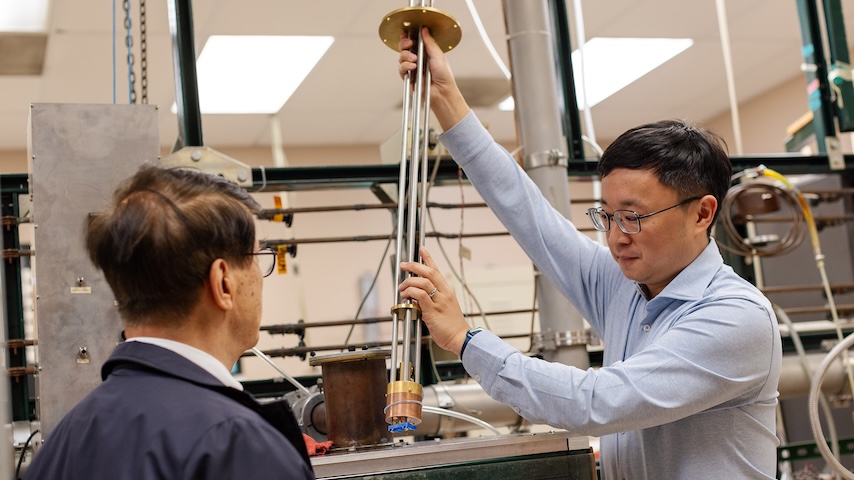
Researchers have set a new ambient-pressure superconductivity record of 151 K (-188 °F), which has the potential to reshape existing infrastructure by enabling resistance-free electricity flow.
Temperature limitations have long stalled the superconductivity records of yttrium-barium compound systems at 93 K (-292 °F). While mercury-based materials eventually pushed the transition temperature to 133 K (-220 °F), further breakthroughs have required massive pressures. However, these physical constraints rendered advanced quantum materials impractical for real-world engineering.
A recent breakthrough at the University of Houston (UH), in partnership with the Texas Center for Superconductivity (TcSUH), finally broke the 33-year-old record of 133 K (-220 °F). By treating pressure as a temporary environment rather than a permanent structural tool, researchers stabilized a 151 K (-188 °F) superconducting state at atmospheric pressure.
This achievement could provide a pathway for ambient pressure applications and offer a mechanical blueprint for high-temperature superconductors that function without massive containment vessels.
Researchers began studying superconductivity in 1911, achieving TC at 4.2 K (-452 °F). The operation that led to this discovery needed liquid helium—a costly and complex requirement. The field reached a milestone in 1973 when niobium-germanium (Nb3Ge) pushed TC to 23.2 K (-418 °F), followed by the 1987 discovery of yttrium barium copper oxide (YBa2Cu3O7), which pushed the record to 93 K (-292 °F) and enabled liquid nitrogen cooling.
More for You: Cloaking Sensitive Tech from Magnetic Fields
By 1993, mercury-cuprates achieved TC at 133 K (-220 °F), a record that stood for more than 30 years. While researchers have pushed TC as high as 250 K (-10 °F) in laboratory settings, these experiments required pressures exceeding 150 GPa (2,176,000 psi), rendering them impractical for the public.
“Researchers in the field tried all kinds of methods to raise TC without much success. While applying pressure can push the temperature higher, you must have infrastructure to maintain it. From a scientific standpoint, that is an obstacle; from an application standpoint, it is a burden that makes the technology impractical,” explained Ching-Wu Chu, UH physics professor, TcSUH founding director, and senior author of the study published in March by the Proceedings of the National Academy of Sciences.
The research team first compressed the sample within a diamond anvil cell to 10–30 gigapascal (GPa). Under a selected load, the transition temperature climbed as the atomic lattice shifted into a more efficient arrangement. To maintain these properties, the team rapidly released the pressure at a specific quench speed while keeping the sample at 4.2 K (-452 °F). The extreme cold kinetically trapped the high-pressure phase, preventing the atoms from shifting back into their original positions. Pressure quenching yielded TC at 151 K (-188 °F)—a state that persisted after the pressure vanished, effectively bypassing the requirement for permanent high-pressure containment.
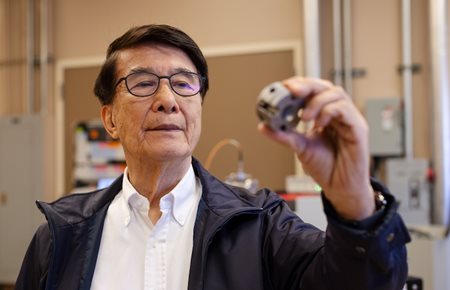 Professor Paul Ching-Wu Chu holds a diamond anvil cell (DAC) in a University of Houston lab. The DAC was used to help the UH team break the temperature record for superconductivity at ambient pressure. Photo: University of Houston
Despite this success, researchers haven’t yet resolved why the high-pressure phase remained locked at ambient pressure. They proposed that the rapid quenching process trapped specific structural defects that acted as internal pins.
Professor Paul Ching-Wu Chu holds a diamond anvil cell (DAC) in a University of Houston lab. The DAC was used to help the UH team break the temperature record for superconductivity at ambient pressure. Photo: University of Houston
Despite this success, researchers haven’t yet resolved why the high-pressure phase remained locked at ambient pressure. They proposed that the rapid quenching process trapped specific structural defects that acted as internal pins.
“We started with a relatively lower energy state, then added pressure to jump into a metastable state with elevated energy. This created an energy barrier. We envisioned that by removing the pressure quickly enough under the right conditions, this barrier helped lock in the phase,” explained Liangzi Deng, assistant professor of physics, principal investigator at the TcSUH, and lead author of the paper. “Even though the material naturally seeks to return to its original state, the barrier remains too high to overcome under certain conditions.”
Identifying the underlying mechanism for pressure-quenching would allow engineers to apply this technique to attain valuable properties in a broader range of advanced materials.
Discover the Benefits of ASME Membership
In transportation, eliminating resistance would spark the mass adoption of ultra-powerful, compact electric motors. High-speed maglev trains would become a standard for travel as they operate with lower infrastructure costs. Electric aviation would also become viable for long-haul flights because superconducting motors provide a superior power-to-weight ratio.
“Many materials demonstrate valuable characteristics under pressure, which we can leverage for specific purposes. For example, we are currently looking at a class of materials involving skyrmions,” Chu explained.
This stabilization would facilitate racetrack memory, where skyrmions would store significantly higher data volumes than current data storage. Because skyrmions measure only a few nanometers, they would permit the packing of massive data volumes into tiny spaces. The synergy between pressure-quenched superconductors and skyrmionics suggested a new class of hybrid devices where superconducting layers would provide a lossless environment for data operations.
The successful preservation of a 151 K (-188 °F) superconducting state through rapid decompression marks a fundamental shift in material engineering. By demonstrating that extreme physical states survived the removal of external force, this research has opened the door to strain-stabilized engineering. High-pressure physics no longer represents a fleeting experiment, but a manufacturing process for the next generation of industrial materials.
Nicole Imeson is an engineer and writer in Calgary, Alta.
A recent breakthrough at the University of Houston (UH), in partnership with the Texas Center for Superconductivity (TcSUH), finally broke the 33-year-old record of 133 K (-220 °F). By treating pressure as a temporary environment rather than a permanent structural tool, researchers stabilized a 151 K (-188 °F) superconducting state at atmospheric pressure.
This achievement could provide a pathway for ambient pressure applications and offer a mechanical blueprint for high-temperature superconductors that function without massive containment vessels.
Critical temperature
Superconductors achieve zero electrical resistance and expel magnetic fields when cooled below a specific critical temperature (TC). In a standard conductor like copper, electrons collide with the atomic lattice, creating friction that manifests as heat and energy loss. In a superconductor, however, the material undergoes a quantum phase transition where electrons form Cooper pairs that flow through the lattice without collisions. This allows an electrical current to persist in a closed loop indefinitely without an external power source.Researchers began studying superconductivity in 1911, achieving TC at 4.2 K (-452 °F). The operation that led to this discovery needed liquid helium—a costly and complex requirement. The field reached a milestone in 1973 when niobium-germanium (Nb3Ge) pushed TC to 23.2 K (-418 °F), followed by the 1987 discovery of yttrium barium copper oxide (YBa2Cu3O7), which pushed the record to 93 K (-292 °F) and enabled liquid nitrogen cooling.
More for You: Cloaking Sensitive Tech from Magnetic Fields
By 1993, mercury-cuprates achieved TC at 133 K (-220 °F), a record that stood for more than 30 years. While researchers have pushed TC as high as 250 K (-10 °F) in laboratory settings, these experiments required pressures exceeding 150 GPa (2,176,000 psi), rendering them impractical for the public.
“Researchers in the field tried all kinds of methods to raise TC without much success. While applying pressure can push the temperature higher, you must have infrastructure to maintain it. From a scientific standpoint, that is an obstacle; from an application standpoint, it is a burden that makes the technology impractical,” explained Ching-Wu Chu, UH physics professor, TcSUH founding director, and senior author of the study published in March by the Proceedings of the National Academy of Sciences.
Pressure quenching
A technique called pressure quenching preserves high-pressure states after researchers remove external forces. In nature, this process creates diamonds by trapping carbon in a dense structure during rapid ascent from the Earth’s mantle. The UH study applied a similar mechanical strategy to the superconductor to overcome the ambient-pressure limit.The research team first compressed the sample within a diamond anvil cell to 10–30 gigapascal (GPa). Under a selected load, the transition temperature climbed as the atomic lattice shifted into a more efficient arrangement. To maintain these properties, the team rapidly released the pressure at a specific quench speed while keeping the sample at 4.2 K (-452 °F). The extreme cold kinetically trapped the high-pressure phase, preventing the atoms from shifting back into their original positions. Pressure quenching yielded TC at 151 K (-188 °F)—a state that persisted after the pressure vanished, effectively bypassing the requirement for permanent high-pressure containment.
Professor Paul Ching-Wu Chu holds a diamond anvil cell (DAC) in a University of Houston lab. The DAC was used to help the UH team break the temperature record for superconductivity at ambient pressure. Photo: University of Houston
“We started with a relatively lower energy state, then added pressure to jump into a metastable state with elevated energy. This created an energy barrier. We envisioned that by removing the pressure quickly enough under the right conditions, this barrier helped lock in the phase,” explained Liangzi Deng, assistant professor of physics, principal investigator at the TcSUH, and lead author of the paper. “Even though the material naturally seeks to return to its original state, the barrier remains too high to overcome under certain conditions.”
Identifying the underlying mechanism for pressure-quenching would allow engineers to apply this technique to attain valuable properties in a broader range of advanced materials.
Superconductors for the future
Ambient pressure, room temperature superconductors hold the promise of a new industrial revolution. In the energy sector, power grids would reach near-perfect efficiency as zero-resistance cables eliminated heat losses. This shift would allow the centralization of renewable plants and enable trans-continental power transport without degradation. Furthermore, superconducting magnetic energy storage would provide near-instantaneous backups for fluctuating grids, stabilizing the global transition away from fossil fuels.Discover the Benefits of ASME Membership
In transportation, eliminating resistance would spark the mass adoption of ultra-powerful, compact electric motors. High-speed maglev trains would become a standard for travel as they operate with lower infrastructure costs. Electric aviation would also become viable for long-haul flights because superconducting motors provide a superior power-to-weight ratio.
Skyrmions
Pressure-quenching technology has also created a path toward ultra-high-density storage via skyrmions. Much like the superconductor study, these nanoscale magnetic vortices traditionally require extreme environments to maintain their integrity at higher temperatures. By implementing pressure quenching, researchers can lock these magnetic knots into a stable state within the material’s lattice at ambient pressure. This would prevent the skyrmions from unfurling, allowing them to serve as permanent, non-volatile bits of information in ambient conditions.“Many materials demonstrate valuable characteristics under pressure, which we can leverage for specific purposes. For example, we are currently looking at a class of materials involving skyrmions,” Chu explained.
This stabilization would facilitate racetrack memory, where skyrmions would store significantly higher data volumes than current data storage. Because skyrmions measure only a few nanometers, they would permit the packing of massive data volumes into tiny spaces. The synergy between pressure-quenched superconductors and skyrmionics suggested a new class of hybrid devices where superconducting layers would provide a lossless environment for data operations.
The successful preservation of a 151 K (-188 °F) superconducting state through rapid decompression marks a fundamental shift in material engineering. By demonstrating that extreme physical states survived the removal of external force, this research has opened the door to strain-stabilized engineering. High-pressure physics no longer represents a fleeting experiment, but a manufacturing process for the next generation of industrial materials.
Nicole Imeson is an engineer and writer in Calgary, Alta.
Researchers have set a new ambient-pressure superconductivity record of 151 K (-188 °F), which has the potential to reshape existing infrastructure by enabling resistance-free electricity flow.

Principal at Vertica Engineering and freelance writer
Related Content


Oct 22, 2026
Developing Talent Where Impact Happens

How the E4C Fellowship helps early-career engineers build skills in sustainable development and energy access, featuring fellows from ASU’s LEAPS lab.
Oct 21, 2026
Manufacturing Engineer Shares and Adapts

Connections are vital to create networking, training, and community engagement opportunities, along with access to critical resources.

Oct 21, 2026
ESOPs Makes Mechanical Engineers Stakeholders


Mechanical engineers are uniquely positioned to shift into fast-growing sectors.

Oct 20, 2026
The Evolution of the Plug-In Hybrid