A PFAS-Free Membrane for Cleaner Hydrogen
A PFAS-Free Membrane for Cleaner Hydrogen

Ultra-thin silica film could replace industry-standard materials that rely on “forever chemicals.”
In a world eager to decarbonize, hydrogen is touted as one of the cleanest fuels of the future. Yet, the way most of it is produced today is problematic, as it’s heavily reliant on fossil fuels and carbon-intensive methods.
“Hydrogen is already an important source of energy,” said Dan Esposito, associate professor of chemical engineering at Columbia University, noting the $250-billion hydrogen industry currently supports dozens of activities. Since nearly all hydrogen production involves carbon-intensive methods, Esposito’s team is pursuing cheaper and greener means.
Electrolyzers rely on a thin membrane that blocks O2 and H2 molecules while allowing positively charged hydrogen atoms—called protons—to pass through. Today, the industry standard membrane material is Nafion, a type of per- and polyfluoroalkyl substance (PFAS) with forever chemicals that persist in the environment for decades.
Funded through the U.S. Department of Energy’s Advanced Research Projects Agency–Energy (ARPA-E) program, Esposito’s team has developed an environmentally friendly PFAS-free silica-based film as an alternative to Nafion.
More for You: Surface Roughness Accelerates Hydrogen Embrittlement
Esposito’s group began exploring this idea years earlier, when working on catalytic materials coated with nanoscopic oxide layers to improve performance and stability. Those experiments revealed an unexpected finding: the coatings were selectively permeable, allowing certain ions to pass through while blocking others.
“That’s when we started thinking, could we take this a step further?” Esposito said. “Could we make these nanoscopic oxide layers thicker and actually use them as membranes inside an electrochemical device? At face value, it sounded a little crazy because the thicknesses we were talking about are orders of magnitude thinner than a conventional membrane used in a fuel cell or electrolyzer.”
“Partly, the breakthrough came from the ability to manufacture these silicon oxide membranes at the thicknesses we need and at large scales,” Esposito said. “Forge Nano has state-of-the-art atomic layer deposition (ALD) tools that can coat layer by layer at incredible precision and speed—much faster than we could ever achieve using a standard deposition tool.”
The silica-based film that Esposito’s team evaluated is normally a poor conductor of protons. However, by making it ultrathin—less than a micron thick—they drastically reduced resistance while maintaining mechanical strength and chemical stability.
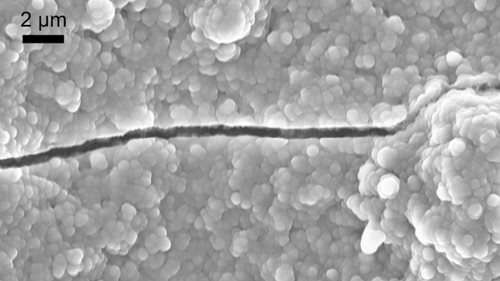 Water electrolysis requires thin membranes to produce hydrogen. But microscopic cracks can let hydrogen leak across the membrane to the oxygen side. Columbia researchers have developed an electrochemical method to selectively seal these defects. Image: Columbia University
“For comparison, Nafion membranes commonly used in commercial electrolyzers are roughly 180 microns thick—two to three times the thickness of a human hair,” Esposito said. “Our silica membranes are about 1/1000th of that, only a few hundred nanometers thick. Resistance depends on both conductivity and thickness, so by going this thin, we can get the performance we need.”
Water electrolysis requires thin membranes to produce hydrogen. But microscopic cracks can let hydrogen leak across the membrane to the oxygen side. Columbia researchers have developed an electrochemical method to selectively seal these defects. Image: Columbia University
“For comparison, Nafion membranes commonly used in commercial electrolyzers are roughly 180 microns thick—two to three times the thickness of a human hair,” Esposito said. “Our silica membranes are about 1/1000th of that, only a few hundred nanometers thick. Resistance depends on both conductivity and thickness, so by going this thin, we can get the performance we need.”
Producing such thin membranes introduced new problems. Tiny imperfections in the form of microscopic pinholes or cracks could allow hydrogen and oxygen to mix, creating potentially explosive conditions.
“It only takes a few pinholes per square centimeter to make the whole thing unsafe,” Esposito said.
To counter that, the researchers devised a new electrochemical sealing technique. They applied short bursts of electric current, triggering local chemical reactions that deposited nanoscopic “plugs” precisely in the defective spots, while leaving the rest of the membrane untouched.
“We figured out that you have to apply a pulse of energy, rather than a continuous current,” Esposito explained. “If you try to seal it continuously, you change the pH everywhere and end up clogging the whole membrane, not just the holes. The pulsed approach made all the difference.”
“That was the moment we knew it worked,” Esposito said. “It was one of those times in research when all the pieces finally clicked together. We realized we had achieved something that not only matched but outperformed the commercial gold standard and did it without harmful materials.”
Discover the Benefits of ASME Membership
The results, published in ACS Nano, showed that these oxide membranes could meet or even exceed commercial performance expectations while removing nearly all PFAS content from the device.
Esposito and his collaborators are now scaling up from small laboratory membranes to prototypes suitable for industrial electrolyzers.
The potential markets extend beyond hydrogen. He said the same technology that enables ultrathin, defect-free membranes has potential for use in fuel cells, flow batteries, water purification, and various chemical manufacturing processes.
Less than 0.1 percent of hydrogen produced today is made using electrolysis. To sustainably increase that, the industry needs high-performing and environmentally responsible membranes, Esposito said.
“For now, our main goal is to help make hydrogen production more sustainable and affordable,” he added.
Annemarie Mannion is a technology writer in Chicago.
“Hydrogen is already an important source of energy,” said Dan Esposito, associate professor of chemical engineering at Columbia University, noting the $250-billion hydrogen industry currently supports dozens of activities. Since nearly all hydrogen production involves carbon-intensive methods, Esposito’s team is pursuing cheaper and greener means.
A cleaner way
Esposito’s team focused on water electrolysis, a process that uses electricity to power a reactor—called an electrolyzer—to split water (H2O) molecules into hydrogen (H2) and oxygen (O2).Electrolyzers rely on a thin membrane that blocks O2 and H2 molecules while allowing positively charged hydrogen atoms—called protons—to pass through. Today, the industry standard membrane material is Nafion, a type of per- and polyfluoroalkyl substance (PFAS) with forever chemicals that persist in the environment for decades.
Funded through the U.S. Department of Energy’s Advanced Research Projects Agency–Energy (ARPA-E) program, Esposito’s team has developed an environmentally friendly PFAS-free silica-based film as an alternative to Nafion.
More for You: Surface Roughness Accelerates Hydrogen Embrittlement
Esposito’s group began exploring this idea years earlier, when working on catalytic materials coated with nanoscopic oxide layers to improve performance and stability. Those experiments revealed an unexpected finding: the coatings were selectively permeable, allowing certain ions to pass through while blocking others.
“That’s when we started thinking, could we take this a step further?” Esposito said. “Could we make these nanoscopic oxide layers thicker and actually use them as membranes inside an electrochemical device? At face value, it sounded a little crazy because the thicknesses we were talking about are orders of magnitude thinner than a conventional membrane used in a fuel cell or electrolyzer.”
Partnerships
The concept became viable thanks to a collaboration with two industrial partners: Nel Hydrogen, a global manufacturer of electrolyzers, and Forge Nano, a company specializing in atomic layer deposition (ALD). The ARPA-E funding enabled the team to combine Columbia’s materials research with industry-level manufacturing capabilities.“Partly, the breakthrough came from the ability to manufacture these silicon oxide membranes at the thicknesses we need and at large scales,” Esposito said. “Forge Nano has state-of-the-art atomic layer deposition (ALD) tools that can coat layer by layer at incredible precision and speed—much faster than we could ever achieve using a standard deposition tool.”
The silica-based film that Esposito’s team evaluated is normally a poor conductor of protons. However, by making it ultrathin—less than a micron thick—they drastically reduced resistance while maintaining mechanical strength and chemical stability.
Water electrolysis requires thin membranes to produce hydrogen. But microscopic cracks can let hydrogen leak across the membrane to the oxygen side. Columbia researchers have developed an electrochemical method to selectively seal these defects. Image: Columbia University
Producing such thin membranes introduced new problems. Tiny imperfections in the form of microscopic pinholes or cracks could allow hydrogen and oxygen to mix, creating potentially explosive conditions.
“It only takes a few pinholes per square centimeter to make the whole thing unsafe,” Esposito said.
To counter that, the researchers devised a new electrochemical sealing technique. They applied short bursts of electric current, triggering local chemical reactions that deposited nanoscopic “plugs” precisely in the defective spots, while leaving the rest of the membrane untouched.
“We figured out that you have to apply a pulse of energy, rather than a continuous current,” Esposito explained. “If you try to seal it continuously, you change the pH everywhere and end up clogging the whole membrane, not just the holes. The pulsed approach made all the difference.”
Cleaner production ahead
After months of trials, the breakthrough finally came when the team tested one of its newly sealed membranes. The results were impressive: hydrogen crossover, or the rate at which the gas leaked through the membrane, was 100 times lower than Nafion, despite being hundreds of times thinner.“That was the moment we knew it worked,” Esposito said. “It was one of those times in research when all the pieces finally clicked together. We realized we had achieved something that not only matched but outperformed the commercial gold standard and did it without harmful materials.”
Discover the Benefits of ASME Membership
The results, published in ACS Nano, showed that these oxide membranes could meet or even exceed commercial performance expectations while removing nearly all PFAS content from the device.
Esposito and his collaborators are now scaling up from small laboratory membranes to prototypes suitable for industrial electrolyzers.
The potential markets extend beyond hydrogen. He said the same technology that enables ultrathin, defect-free membranes has potential for use in fuel cells, flow batteries, water purification, and various chemical manufacturing processes.
Less than 0.1 percent of hydrogen produced today is made using electrolysis. To sustainably increase that, the industry needs high-performing and environmentally responsible membranes, Esposito said.
“For now, our main goal is to help make hydrogen production more sustainable and affordable,” he added.
Annemarie Mannion is a technology writer in Chicago.


Explore ASME's commitment to sustainability, addressing climate challenges through innovation, policy, & workforce development. Get informed and involved!