A Landmark in Typecasting
A Landmark in Typecasting
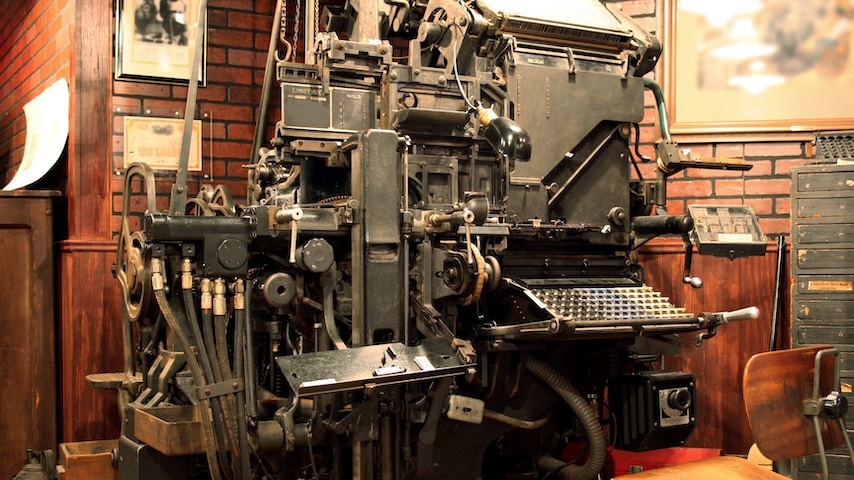
Invented in 1882, the linotype machine revolutionized the printing industry and unleashed an explosion of printed material worldwide.
Most school age children learn about Johannes Gutenberg and the revolutionary printing press with movable type that he invented back in the mid-15th century. But ask someone if they’ve heard of Ottmar Mergenthaler, and chances are that they haven’t. While Gutenberg’s press set the groundwork for the modern printing industry, it was Mergenthaler’s invention, the linotype machine, that mechanized typesetting and made the printed word accessible in ways it never had been before.
In fact, ASME designated the linotype machine as a Historic Mechanical Engineering Landmark in July 2005, bestowing a plaque to the International Printing Museum in Carson, Calif.
But the linotype machine’s impact goes beyond simply facilitating the printing process. The mechanical marvel’s history spans nearly a century and made the heyday of newspapers and mass-market books possible by making production faster and the finished products more affordable.
In the centuries between Gutenberg’s press and the linotype machine’s invention in 1886, the printing process remained mostly unchanged. Although printing presses got faster in the 19th century, ultimately individual letters were still cast with hand molds, then printers would take those letters and assemble a page, one letter at a time, before a page would be moved into a printing press, ink applied, then the page put to paper. When production was complete on that page, all those letters had to be returned to the type case by hand. Then the whole process would repeat.
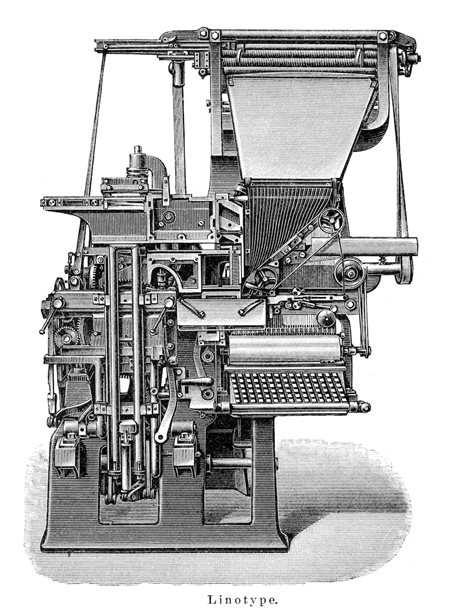 Photo: Getty Images
“The race to mechanize typesetting really started to begin around in the 1820s. There were various attempts at how to mechanize the process of putting letters together for printing newspapers and books,” explained Mark Barbour, executive director and founding curator of the International Printing Museum, home to one of the world’s largest and most comprehensive collections of antique printing machinery and graphic arts equipment. And several linotype machines.
Photo: Getty Images
“The race to mechanize typesetting really started to begin around in the 1820s. There were various attempts at how to mechanize the process of putting letters together for printing newspapers and books,” explained Mark Barbour, executive director and founding curator of the International Printing Museum, home to one of the world’s largest and most comprehensive collections of antique printing machinery and graphic arts equipment. And several linotype machines.
Another Landmark: The Birth of Practical Aviation
“So, if you think of a typical small newspaper in 1850, it was four pages thick and every one was assembled one letter at a time. You think of a book—up until 1890, that had to be assembled one letter at a time and put away,” he said. “And in Gutenberg’s day, this is revolutionary because it allowed for the reproduction of books to move away from manuscripts, of having to hand write a book.”
One of the greatest examples of this, of course, was with the Bible. In five years, the press could produce 180 Bibles, compared to a team of scribes taking three to five years to complete just one, Barbour said.
“It doesn’t sound like that big of a number, but that was only the beginning in 1450. By 1500, 12 million books had been printed all over Europe with the new process,” he said.
In the 400-odd years that followed, that process—at least on the typesetting side—remained unchanged. But in the mid-1850s, the newspaper industry in particular was desperate to mechanize the process, Barbour said, because it took an army of employees to set type every day—especially on a daily newspaper like The New York Times or The Los Angeles Times.
“If you think of a column of type on the front page of the newspaper, one person in six or seven hours can set half of a column down to the fold. You’re looking at 100–200 people setting type every day. And then putting it away, which takes about two-thirds the amount of the time is to take it out," he said. “The newspapers even got to the point where it was more cost effective to cast the type, set the type, print from the type, then melt the type. That was cheaper than putting it away.”
Mergenthaler fell into the typesetting race unintentionally. He left his home in Hetschel, Germany at age 18 and emigrated to Baltimore, Md., in 1872—the same year that Christopher Latham Sholes perfected the typewriter in Milwaukee, Barbour said. He grew his burgeoning engineering skills by working in his uncle’s Baltimore watchmaking shop.
“At that time, if you were applying for a patent in the 19th century, you had to submit a working miniature model of your invention. Who else would you go to but a watchmaker? They knew how to take large, complicated machines and miniaturize them,” Barbour said. “In that process, somebody comes into the shop and was working on a typesetting kind of a device, and Ottmar is working on it. He’s in his 20s at this time. And he looks at it, he knew nothing about the printing process, but he just looked at it from an engineering standpoint and said, you’re taking the wrong approach. And so, he went back and forth with this guy and he basically got sucked into the typesetting race not as a printer, nor as somebody who was looking to change the world, but his engineering genius just kicks in.”
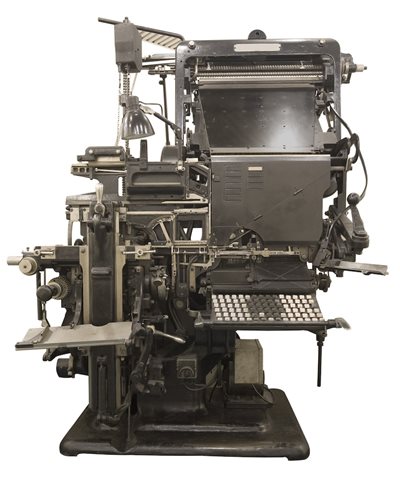 Photo: Getty Images
Borrowing from the freshly invented typewriter, the linotype machine is equipped with a keyboard of its own, albeit with a much different setup. The 90-key set up featured 30 lowercase letters on the left, 30 uppercase letters on the right, and 30 numbers and punctuation keys in the middle.
Photo: Getty Images
Borrowing from the freshly invented typewriter, the linotype machine is equipped with a keyboard of its own, albeit with a much different setup. The 90-key set up featured 30 lowercase letters on the left, 30 uppercase letters on the right, and 30 numbers and punctuation keys in the middle.
“On a mechanical typewriter, you have to put a bit of effort to press down on a key. You can’t approach a Linotype keyboard the same way. It’s a light touch,” Barbour explained. “Probably the closest to that in the typing world would be an IBM Selectric, which was the BMW of electric typewriters.”
While the QWERTY keyboard was designed to help the typewriter’s mechanical bars not jam up, the linotype keyboard operates the machine’s multiple cams. Above the keyboard was a magazine that held rectangular brass matrices, or casting dies for each letter. Hit a key and the cam cycles, opening the gate for just one of the matrices to fall and start to assemble a line of text in the first elevator.
“To the left of the keyboard is a lever to put in a mechanical word space. That itself is another part of Mergenthaler’s genius in developing that device. So the left hand is really working the first two rows of keys. The right hand is working the rest of the lowercase letters and then along with the capitals,” Barbour explained. “When you look at the hands of a linotype typist, it’s a much different look than, say, a secretary on an IBM. The left hand is a little bit more stationary and the right hand is sort of moving around the keyboard to get the other characters.”
Then, by pushing down on another lever, that line of matrices moves over in front of a casting device. A plunger descends and ejects hot molten metal—around 550 °F—into the matrices, casting a line of letters on a single bar of metal called a slug.
“The metal is an alloy of lead, tin, and antimony—the same alloy for the most part as Gutenberg developed in 1450. But instead of having one letter come out, it now cast and ejected one line of the book or one line of the column of the newspaper,” Barbour said.
Each slug was trimmed and lined up in a galley, where typesetters arrange pages of print before everything is locked into a chase, or metal frame, that’s sent to the printer.
Discover the Benefits of ASME Membership
But after the linotype makes the slug, those letters have to go back to the magazine.
“After the line is ejected, the machine has an elevator that descends down and mechanically picks up all the matrices, brings them back up to the top of the machine, and then pushes them toward the magazine holder,” Barbour said. “They’re suspended on a bar. And then, a mechanical sorting method returns each matrix to its correct slot in the magazine.”
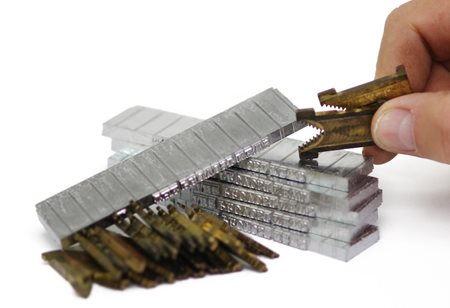 Brass matrices and metal slugs. Photo: Getty Images
At the top of each brass matrix is a mechanical binary code; each one has a unique set of teeth, seven on each side. So as the matrices move through, once they find the correct spot along the bar, they simply drop down into the correct spot in the magazine.
Brass matrices and metal slugs. Photo: Getty Images
At the top of each brass matrix is a mechanical binary code; each one has a unique set of teeth, seven on each side. So as the matrices move through, once they find the correct spot along the bar, they simply drop down into the correct spot in the magazine.
“In the middle of the 20th century, [university] engineering departments would have one of these machines either close by or in the department in order to study all the mechanical principles because they’re all visible,” Barbour said. “There’s a set of seven cams in the back of the machine and an elevator going up and down. The shape of that cam is directing the movement of the casting pot. And all of that is visible. So, Mergenthaler’s work as an engineer is still impacting young engineers. For him to create what that machine needed to do and solving it mechanically, that’s the genius.”
As for the slugs, once the pages are printed, they’re simply melted down to be reused in the next round. New type was cast every day. The linotype machine allowed operators to cast anywhere from three to six lines a minute.
“The machine came out in 1886. By 1900, it became a world standard. As I describe it to our guests, both young and old, it was the Macintosh of 125 years ago,” Barbour said.
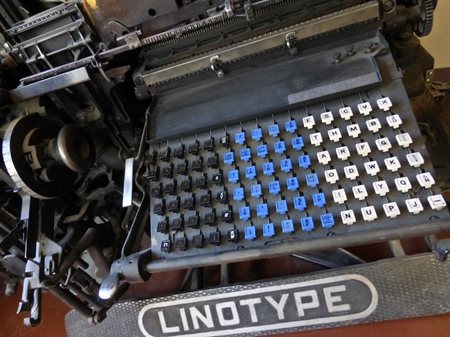 Photo: Getty Images
With the launch of the machine in 1886, Mergenthaler also founded the Mergenthaler Linotype Company. There were multiple models of the linotype machine throughout the century that followed, as various improvements were made to the technology.
Photo: Getty Images
With the launch of the machine in 1886, Mergenthaler also founded the Mergenthaler Linotype Company. There were multiple models of the linotype machine throughout the century that followed, as various improvements were made to the technology.
“We have what’s called the square base [at the International Printing Museum], which had a very square, solid base to it, which then became the star base, which the ASME plaque is on—the Model 1 Star Base from 1894. Then the machine really looked the same into the 1960s,” Barbour said.
The Mergenthaler Linotype Company, which was renamed simply the Linotype Company by around 1890 (when Mergenthaler was ejected by the board), sold about 366 of just the square base machines globally.
A Quiz to Test Your Knoweldge: Printing Revolutionized
Once the linotype hit the market, it triggered an explosion of printed materials. Newspapers could go far beyond the standard four to 12 pages, scaling up to be the massive 100–150-page newspapers that were commonplace in the 1960s and 1970s.
Printers around the world continued to use linotypes for nearly a century, and when lithography came around, larger shops were a bit slower to abandon the technology just because of how invested they were in it. The Los Angeles Times stopped using its crew of 120 linotypes in 1974. The New York Times famously stopped using its linotypes, which numbered 160 at peak, on July 1, 1978. David Loeb Weiss created a documentary about the end of “hot type” and the introduction of computers on that final day at the Times called, “Farewell, Etaoin Shrdlu.”
That phrase, a bit of inside knowledge from the printing industry, comes from the linotype’s keyboard: the left-most columns on both the lowercase and uppercase sections spell out etaoin shrdlu.
“One of the tricks they would do if they end up spelling something wrong, instead of correcting it, or if they knew it was wrong, they would send the next line in and on that next line, they would run their fingers down the first and second row of keys. And just by running your fingers down like a piano, it would release one of each matrices. It would spell out etaoin shrdlu,” Barbour explained. “What that meant to the next department who assembles the columns together as a page, the composition, when they went down on the column and they saw etaoin shrdlu, that meant take out the previous line. Well, every once in a while, they didn’t catch it. You’d be reading your newspaper and then all of a sudden you see etaoin shrdlu.”
After Mergenthaler departed from the Linotype Company, he set up the Ottmar Mergenthaler Machine Shop in Baltimore, where he sold parts for the linotype. He died at 45 from tuberculosis, but his engineering legacy lives on.
“Every major city in the world was using a linotype and it revolutionized communication. Just like Gutenberg and what he did fueled the Renaissance, the Reformation, and the establishment of Western civilization—450 years later, this is the technology that then unleashes communication,” he said. “Periodicals, books, encyclopedias, dictionaries, paperback books—all this became readily available and accessible because of one man’s invention. And it’s a name that nobody knows. You learn about Graham Bell, you learn about Thomas Edison, you learn about all these other great inventors, and you hear nothing about Mergenthaler. And his machine did so much. Edison described the linotype as the eighth wonder of the world.”
Louise Poirier is managing editor.
In fact, ASME designated the linotype machine as a Historic Mechanical Engineering Landmark in July 2005, bestowing a plaque to the International Printing Museum in Carson, Calif.
But the linotype machine’s impact goes beyond simply facilitating the printing process. The mechanical marvel’s history spans nearly a century and made the heyday of newspapers and mass-market books possible by making production faster and the finished products more affordable.
Linotype’s predecessor
In the centuries between Gutenberg’s press and the linotype machine’s invention in 1886, the printing process remained mostly unchanged. Although printing presses got faster in the 19th century, ultimately individual letters were still cast with hand molds, then printers would take those letters and assemble a page, one letter at a time, before a page would be moved into a printing press, ink applied, then the page put to paper. When production was complete on that page, all those letters had to be returned to the type case by hand. Then the whole process would repeat.
Photo: Getty Images
Another Landmark: The Birth of Practical Aviation
“So, if you think of a typical small newspaper in 1850, it was four pages thick and every one was assembled one letter at a time. You think of a book—up until 1890, that had to be assembled one letter at a time and put away,” he said. “And in Gutenberg’s day, this is revolutionary because it allowed for the reproduction of books to move away from manuscripts, of having to hand write a book.”
One of the greatest examples of this, of course, was with the Bible. In five years, the press could produce 180 Bibles, compared to a team of scribes taking three to five years to complete just one, Barbour said.
“It doesn’t sound like that big of a number, but that was only the beginning in 1450. By 1500, 12 million books had been printed all over Europe with the new process,” he said.
The typesetting race
In the 400-odd years that followed, that process—at least on the typesetting side—remained unchanged. But in the mid-1850s, the newspaper industry in particular was desperate to mechanize the process, Barbour said, because it took an army of employees to set type every day—especially on a daily newspaper like The New York Times or The Los Angeles Times.
“If you think of a column of type on the front page of the newspaper, one person in six or seven hours can set half of a column down to the fold. You’re looking at 100–200 people setting type every day. And then putting it away, which takes about two-thirds the amount of the time is to take it out," he said. “The newspapers even got to the point where it was more cost effective to cast the type, set the type, print from the type, then melt the type. That was cheaper than putting it away.”
Mergenthaler fell into the typesetting race unintentionally. He left his home in Hetschel, Germany at age 18 and emigrated to Baltimore, Md., in 1872—the same year that Christopher Latham Sholes perfected the typewriter in Milwaukee, Barbour said. He grew his burgeoning engineering skills by working in his uncle’s Baltimore watchmaking shop.
“At that time, if you were applying for a patent in the 19th century, you had to submit a working miniature model of your invention. Who else would you go to but a watchmaker? They knew how to take large, complicated machines and miniaturize them,” Barbour said. “In that process, somebody comes into the shop and was working on a typesetting kind of a device, and Ottmar is working on it. He’s in his 20s at this time. And he looks at it, he knew nothing about the printing process, but he just looked at it from an engineering standpoint and said, you’re taking the wrong approach. And so, he went back and forth with this guy and he basically got sucked into the typesetting race not as a printer, nor as somebody who was looking to change the world, but his engineering genius just kicks in.”
How it works
Photo: Getty Images
“On a mechanical typewriter, you have to put a bit of effort to press down on a key. You can’t approach a Linotype keyboard the same way. It’s a light touch,” Barbour explained. “Probably the closest to that in the typing world would be an IBM Selectric, which was the BMW of electric typewriters.”
While the QWERTY keyboard was designed to help the typewriter’s mechanical bars not jam up, the linotype keyboard operates the machine’s multiple cams. Above the keyboard was a magazine that held rectangular brass matrices, or casting dies for each letter. Hit a key and the cam cycles, opening the gate for just one of the matrices to fall and start to assemble a line of text in the first elevator.
“To the left of the keyboard is a lever to put in a mechanical word space. That itself is another part of Mergenthaler’s genius in developing that device. So the left hand is really working the first two rows of keys. The right hand is working the rest of the lowercase letters and then along with the capitals,” Barbour explained. “When you look at the hands of a linotype typist, it’s a much different look than, say, a secretary on an IBM. The left hand is a little bit more stationary and the right hand is sort of moving around the keyboard to get the other characters.”
Then, by pushing down on another lever, that line of matrices moves over in front of a casting device. A plunger descends and ejects hot molten metal—around 550 °F—into the matrices, casting a line of letters on a single bar of metal called a slug.
“The metal is an alloy of lead, tin, and antimony—the same alloy for the most part as Gutenberg developed in 1450. But instead of having one letter come out, it now cast and ejected one line of the book or one line of the column of the newspaper,” Barbour said.
Each slug was trimmed and lined up in a galley, where typesetters arrange pages of print before everything is locked into a chase, or metal frame, that’s sent to the printer.
Discover the Benefits of ASME Membership
But after the linotype makes the slug, those letters have to go back to the magazine.
“After the line is ejected, the machine has an elevator that descends down and mechanically picks up all the matrices, brings them back up to the top of the machine, and then pushes them toward the magazine holder,” Barbour said. “They’re suspended on a bar. And then, a mechanical sorting method returns each matrix to its correct slot in the magazine.”
Brass matrices and metal slugs. Photo: Getty Images
“In the middle of the 20th century, [university] engineering departments would have one of these machines either close by or in the department in order to study all the mechanical principles because they’re all visible,” Barbour said. “There’s a set of seven cams in the back of the machine and an elevator going up and down. The shape of that cam is directing the movement of the casting pot. And all of that is visible. So, Mergenthaler’s work as an engineer is still impacting young engineers. For him to create what that machine needed to do and solving it mechanically, that’s the genius.”
As for the slugs, once the pages are printed, they’re simply melted down to be reused in the next round. New type was cast every day. The linotype machine allowed operators to cast anywhere from three to six lines a minute.
“The machine came out in 1886. By 1900, it became a world standard. As I describe it to our guests, both young and old, it was the Macintosh of 125 years ago,” Barbour said.
Lasting impact
Photo: Getty Images
“We have what’s called the square base [at the International Printing Museum], which had a very square, solid base to it, which then became the star base, which the ASME plaque is on—the Model 1 Star Base from 1894. Then the machine really looked the same into the 1960s,” Barbour said.
The Mergenthaler Linotype Company, which was renamed simply the Linotype Company by around 1890 (when Mergenthaler was ejected by the board), sold about 366 of just the square base machines globally.
A Quiz to Test Your Knoweldge: Printing Revolutionized
Once the linotype hit the market, it triggered an explosion of printed materials. Newspapers could go far beyond the standard four to 12 pages, scaling up to be the massive 100–150-page newspapers that were commonplace in the 1960s and 1970s.
Printers around the world continued to use linotypes for nearly a century, and when lithography came around, larger shops were a bit slower to abandon the technology just because of how invested they were in it. The Los Angeles Times stopped using its crew of 120 linotypes in 1974. The New York Times famously stopped using its linotypes, which numbered 160 at peak, on July 1, 1978. David Loeb Weiss created a documentary about the end of “hot type” and the introduction of computers on that final day at the Times called, “Farewell, Etaoin Shrdlu.”
That phrase, a bit of inside knowledge from the printing industry, comes from the linotype’s keyboard: the left-most columns on both the lowercase and uppercase sections spell out etaoin shrdlu.
“One of the tricks they would do if they end up spelling something wrong, instead of correcting it, or if they knew it was wrong, they would send the next line in and on that next line, they would run their fingers down the first and second row of keys. And just by running your fingers down like a piano, it would release one of each matrices. It would spell out etaoin shrdlu,” Barbour explained. “What that meant to the next department who assembles the columns together as a page, the composition, when they went down on the column and they saw etaoin shrdlu, that meant take out the previous line. Well, every once in a while, they didn’t catch it. You’d be reading your newspaper and then all of a sudden you see etaoin shrdlu.”
After Mergenthaler departed from the Linotype Company, he set up the Ottmar Mergenthaler Machine Shop in Baltimore, where he sold parts for the linotype. He died at 45 from tuberculosis, but his engineering legacy lives on.
“Every major city in the world was using a linotype and it revolutionized communication. Just like Gutenberg and what he did fueled the Renaissance, the Reformation, and the establishment of Western civilization—450 years later, this is the technology that then unleashes communication,” he said. “Periodicals, books, encyclopedias, dictionaries, paperback books—all this became readily available and accessible because of one man’s invention. And it’s a name that nobody knows. You learn about Graham Bell, you learn about Thomas Edison, you learn about all these other great inventors, and you hear nothing about Mergenthaler. And his machine did so much. Edison described the linotype as the eighth wonder of the world.”
Louise Poirier is managing editor.
Invented in 1882, the linotype machine revolutionized the printing industry and unleashed an explosion of printed material worldwide.

Managing editor, Mechanical Engineering magazine
Related Content

Oct 14, 2026
How Glass Is Quietly Shaping the Future of Automotive Engineering

Oct 12, 2026
From Disruption to Optimization: The Role of Simulation in Modern Refining

Digital simulation is helping refiners improve efficiency, troubleshoot operational challenges, and adapt to an increasingly complex energy landscape.

Oct 12, 2026
Podcast: Standards as the Backbone of Nuclear & Fusion Energy
Lester Su and Dale Matthews explore how codes and standards support quality and innovation as nuclear and fusion technologies continue to advance.

Oct 7, 2026
Better Listening Builds Better Careers


For engineers, better listening can reveal critical information, strengthen trust, and lead to smarter decisions.