Looking Within from Without
Looking Within from Without
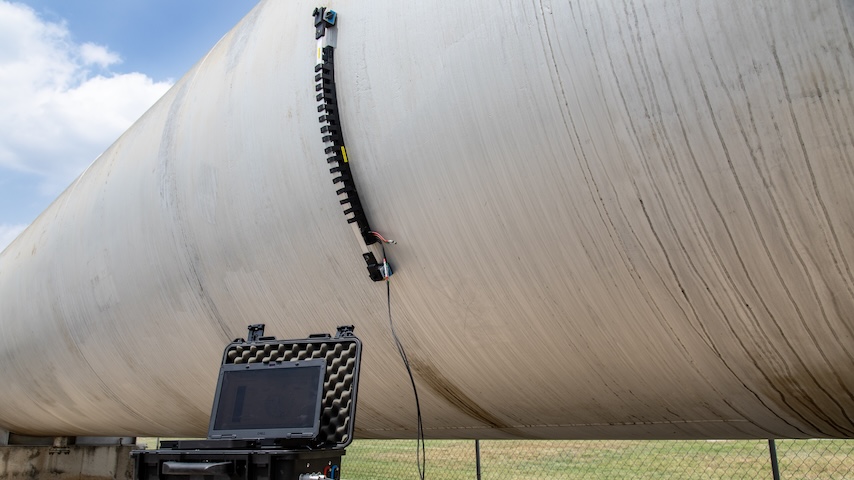
Containers don’t last forever and finding out when they’re breaking down is a costly affair. A magnetostrictive probe is here to help.
Storage tanks are not inert objects that do their jobs indefinitely, free of cost after the initial outlay. Whether they’re for water, chemicals, petroleum, or anything else, storage tanks are subject to their environment, both inside and out, susceptible to corrosion, and need to be inspected every five to 10 years.
And that is no simple matter. If the tank holds petrochemicals, for instance, it has to be taken out of production, emptied, and then inspected inside. It’s still a hazardous environment when empty, so inspectors must wear hazmat suits. Robotic alternatives can be expensive as well, so no matter how it’s done, an inspection is likely to cost several hundreds of thousands of dollars.
But now there’s another way.
“We have been developing long range guided wave inspection sensors and equipment,” said Sergey Vinogradov, an engineer at the Southwest Research Institute (SwRI), who spearheaded the development of the Magnetostrictive Transducer Probe. “That means that you can mount a sensor at a fixed position, for example, on a pipe, or on a plate, and it will generate a low frequency vibration—or low frequency ultrasound—which will penetrate the structure and travel a long distance. And in cases where there are any anomalies in a structure, this same sensor will collect this data, and it can tell you where the anomaly is located.”
Inspection from the outside is not a completely new idea. For more than 20 years, technology has been available for inspecting pipelines using piezoelectric transducers. However, this method alone is not sufficient to provide inspection in the case where the waves need to travel several meters in the tank bottom, especially in the presence of generalized corrosion.
What Vinogradov and his team did was use shear horizontal guided ultrasonic waves with a single sensor split into segments. Shear waves are perfect for the job as they move sideways, and they don’t change velocity with changes in frequency. So, unlike compressional guided waves, they don’t attenuate when they hit fluids and liner materials. These probes are combined with additional techniques to differentiate between signals arising from the tank bottom and wall.
Another Sensor Application: A Mighty Wind Project
This “full matrix capture mode,” as it’s called, produces a high-resolution map of corrosion in a storage tank bottom or wall.
“We use a total focusing method to generate an image,” Vinogradov said. “The image is a two-dimensional map of what is happening in the structure.” Corrosion damage is not seen in just one locale, but also where it spreads around a structure. And SwRI has also produced specialized software to help interpret that map and to generate a report ranking structure health and the severity of any found anomalies.
The product has only recently hit the market, but it’s already been used on multiple water storage tanks. And the new system has the potential to work in any situation where corrosion needs to be detected to prevent its growth. It’s also been used on pipes with diameters as small as four inches and water pipes as large as 55 inches in diameter. But there’s no reason it couldn’t be used with fuel tanks, boilers, ship hulls, and anything else with an inside that needs to be inspected from the outside.
There is, however, one blind spot that the new probe can’t penetrate: lap welds. With that type of joinery, the innermost layer is invisible to the guided waves.
Discover the Benefits of ASME Membership
“We can’t completely substitute for a full tank bottom inspection if there are lap welds,” said Jay Fisher, program director of nondestructive evaluation at SwRI. “But the key thing is that a lot of the damage happens near the shell and the outside, and that’s where we do the best. So, in that sense, it can be seen as supplementary, for between the inspections that cause a shutdown of the tank.”
Though the probe is currently available for use, SwRI is still making some refinements. The team is finalizing how the software combines data from multiple sensor positions and looking at how the beam appears different when it’s on a smaller diameter tank. Researchers are also tweaking the system to make it a more commercially oriented product.
Regardless, thanks to the efforts of the SwRI, companies all over the world now have the option of inspecting their tanks without shutting them down, emptying them, or putting humans into their toxic interiors.
Michael Abrams is a technology writer in Westfield, N.J.
And that is no simple matter. If the tank holds petrochemicals, for instance, it has to be taken out of production, emptied, and then inspected inside. It’s still a hazardous environment when empty, so inspectors must wear hazmat suits. Robotic alternatives can be expensive as well, so no matter how it’s done, an inspection is likely to cost several hundreds of thousands of dollars.
But now there’s another way.
“We have been developing long range guided wave inspection sensors and equipment,” said Sergey Vinogradov, an engineer at the Southwest Research Institute (SwRI), who spearheaded the development of the Magnetostrictive Transducer Probe. “That means that you can mount a sensor at a fixed position, for example, on a pipe, or on a plate, and it will generate a low frequency vibration—or low frequency ultrasound—which will penetrate the structure and travel a long distance. And in cases where there are any anomalies in a structure, this same sensor will collect this data, and it can tell you where the anomaly is located.”
Looking inside
Inspection from the outside is not a completely new idea. For more than 20 years, technology has been available for inspecting pipelines using piezoelectric transducers. However, this method alone is not sufficient to provide inspection in the case where the waves need to travel several meters in the tank bottom, especially in the presence of generalized corrosion.
What Vinogradov and his team did was use shear horizontal guided ultrasonic waves with a single sensor split into segments. Shear waves are perfect for the job as they move sideways, and they don’t change velocity with changes in frequency. So, unlike compressional guided waves, they don’t attenuate when they hit fluids and liner materials. These probes are combined with additional techniques to differentiate between signals arising from the tank bottom and wall.
Another Sensor Application: A Mighty Wind Project
This “full matrix capture mode,” as it’s called, produces a high-resolution map of corrosion in a storage tank bottom or wall.
“We use a total focusing method to generate an image,” Vinogradov said. “The image is a two-dimensional map of what is happening in the structure.” Corrosion damage is not seen in just one locale, but also where it spreads around a structure. And SwRI has also produced specialized software to help interpret that map and to generate a report ranking structure health and the severity of any found anomalies.
Further refinements
The product has only recently hit the market, but it’s already been used on multiple water storage tanks. And the new system has the potential to work in any situation where corrosion needs to be detected to prevent its growth. It’s also been used on pipes with diameters as small as four inches and water pipes as large as 55 inches in diameter. But there’s no reason it couldn’t be used with fuel tanks, boilers, ship hulls, and anything else with an inside that needs to be inspected from the outside.
There is, however, one blind spot that the new probe can’t penetrate: lap welds. With that type of joinery, the innermost layer is invisible to the guided waves.
Discover the Benefits of ASME Membership
“We can’t completely substitute for a full tank bottom inspection if there are lap welds,” said Jay Fisher, program director of nondestructive evaluation at SwRI. “But the key thing is that a lot of the damage happens near the shell and the outside, and that’s where we do the best. So, in that sense, it can be seen as supplementary, for between the inspections that cause a shutdown of the tank.”
Though the probe is currently available for use, SwRI is still making some refinements. The team is finalizing how the software combines data from multiple sensor positions and looking at how the beam appears different when it’s on a smaller diameter tank. Researchers are also tweaking the system to make it a more commercially oriented product.
Regardless, thanks to the efforts of the SwRI, companies all over the world now have the option of inspecting their tanks without shutting them down, emptying them, or putting humans into their toxic interiors.
Michael Abrams is a technology writer in Westfield, N.J.
Containers don’t last forever and finding out when they’re breaking down is a costly affair. A magnetostrictive probe is here to help.

Freelance writer based in New Jersey
Related Content

Jul 15, 2026
Water Barrier Seeks to Protect Sailors from Jet Noise

Researchers are testing water barriers as a way to reduce the dangerous jet noise levels naval personnel experience while working on aircraft carriers.

Jul 14, 2026
Articul8 AI and ASME Announce Industry-First Domain-Specific GenAI Model for Engineering Standards
Jul 14, 2026
A Better Step for People with Above-Knee Amputations
MIT researchers designed an affordable prosthetic foot that helps people with above-knee amputations achieve a more natural stride.

Jul 13, 2026
ASME Comments on OMB’s Proposed Revisions to the Guidance for Federal Financial Assistance