Cloaking Sensitive Tech from Magnetic Fields
Cloaking Sensitive Tech from Magnetic Fields

A device magnetically “cloaks” sensitive electronic components using superconductors and soft ferromagnets, and can be customized for irregular shapes.
Unwanted magnetic fields can disrupt the operation of precision instruments, sensors, and electronic components, leading to signal distortion, data errors, or equipment malfunction. This is a growing concern in environments such as hospitals, power grids, aerospace systems, and scientific laboratories, where increasingly sensitive technologies require effective protection from magnetic interference.
Intrigued by the idea of magnetic cloaks and how they could be used to protect sensitive electronics and sensors, Harold Ruiz, head of the Green Energy and Transport Research Group and associate professor in electrical machines and power systems at the University of Leicester in the UK, decided to research this topic more thoroughly.
“The first time I heard about magnetic cloaking was in 2012, during the Applied Superconductivity Conference in Portland, Ore.,” Ruiz said. “I immediately found the idea intellectually elegant and conceptually powerful but also realized that it was fundamentally limited from the engineering and material science perspectives. The solution was analytical, constrained in geometry, and required very specific and often impractical material properties for both the superconductor and the ferromagnet.”
Ruiz saw that the cloaking problem required a different mathematical and computational approach to move beyond idealized cases. The “aha” moment was realizing that cloaking should not be treated as a “fixed analytical recipe, but as an optimization control problem, looking for the right material properties where functional metastructures could produce the magnetic behavior we want,” he continued. “That insight stayed with me for years, until the right expertise and funding aligned to make it possible.”
Ruiz assembled a team of engineers at the university that set out to prove, for the first time, that practical cloaks can be engineered using superconductors and soft ferromagnets in forms that can be reasonably manufactured.
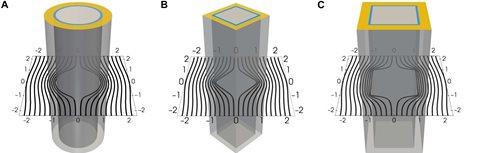 3D renderings of cloaking pipes with cross sections of: (A) circular, (B) diamond, and (C) square geometries. Image: “Designing functional magnetic cloaks for real-world geometries,” Guo et al.
Using computational and theoretical techniques such as advanced mathematical modeling and high-performance simulations based on real-world parameters, the team developed a new physics-informed design framework that allows magnetic cloaks to be created for objects of any shape. These cloaks also maintain their effectiveness across a broad range of field strengths and frequencies. The framework is based on superconducting-ferromagnetic (SC-SFM) bilayers and leverages full Maxwell equations to realize cloaking solutions for arbitrarily shaped structures. The framework extends beyond cylinders to noncircular and complex geometries—including faceted and multi-lobed designs—by optimizing spatially varying permeability profiles
3D renderings of cloaking pipes with cross sections of: (A) circular, (B) diamond, and (C) square geometries. Image: “Designing functional magnetic cloaks for real-world geometries,” Guo et al.
Using computational and theoretical techniques such as advanced mathematical modeling and high-performance simulations based on real-world parameters, the team developed a new physics-informed design framework that allows magnetic cloaks to be created for objects of any shape. These cloaks also maintain their effectiveness across a broad range of field strengths and frequencies. The framework is based on superconducting-ferromagnetic (SC-SFM) bilayers and leverages full Maxwell equations to realize cloaking solutions for arbitrarily shaped structures. The framework extends beyond cylinders to noncircular and complex geometries—including faceted and multi-lobed designs—by optimizing spatially varying permeability profiles
The researchers faced several major challenges. The first was physical: understanding how soft ferromagnetic materials interact with type-II superconductors in a quantitative, predictive way. These materials are both highly non-linear, and their interaction strongly affects energy losses, field distributions, and overall performance.
“Early on, it was not clear whether stacking superconductors and ferromagnets would be beneficial or counterproductive in practical devices, with very counterintuitive results and contrasting expectations found in the literature. We were successful in identifying the optimal range of magnetic permeabilities that maximize performance and minimize losses in superconducting-ferromagnetic metastructures,” Ruiz said. “That work showed that effective designs do not require extreme or exotic materials, which was an important result from an engineering standpoint.”
Discover the Benefits of ASME Membership
A major surprise was how non-intuitive the interaction was between superconductors and ferromagnets. Initially, Ruiz assumed that increasing the magnetic permeability of the ferromagnetic layer would monotonically improve shielding performance. In reality, the system is highly non-linear; beyond a certain point, higher permeability can actually degrade performance. “This finding significantly narrowed the range of materials required for practical cloaks and shields, which is good news for real-world engineering,” he said.
The most relevant aspect of this work for mechanical engineers is that it transforms magnetic-field control from a materials-selection problem into a design problem. Instead of asking what material we should use, we ask what shape, material distribution, and configuration produce the desired magnetic behavior under real operating conditions.
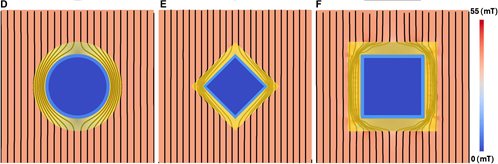 The optimized magnetic cloaking results for each geometry. Image: “Designing functional magnetic cloaks for real-world geometries,” Guo et al.
This approach is directly applicable to electromechanical systems such as motors, generators, actuators, and sensors, where magnetic fields interact with mechanical structures, thermal constraints, and manufacturability limits. “The framework we developed explicitly incorporates geometry, material properties, and physical constraints, making it compatible with mechanical design workflows and multi-physics optimization,” Ruiz said.
The optimized magnetic cloaking results for each geometry. Image: “Designing functional magnetic cloaks for real-world geometries,” Guo et al.
This approach is directly applicable to electromechanical systems such as motors, generators, actuators, and sensors, where magnetic fields interact with mechanical structures, thermal constraints, and manufacturability limits. “The framework we developed explicitly incorporates geometry, material properties, and physical constraints, making it compatible with mechanical design workflows and multi-physics optimization,” Ruiz said.
The key innovation in the research is the shift from analytical, geometry-specific solutions to a general optimization-based framework. “Rather than prescribing how a magnetic cloak or shield must look, we let physics and optimization determine the optimal design,” Ruiz added.
The process is similar to topology optimization used in structural mechanics but applied to electromagnetic fields. The method allowed the team to co-design shape and material function simultaneously, enabling solutions that would be extremely difficult, or even impossible, to be derived analytically.
In the near term, the team is focused on experimental validation and manufacturability, moving from numerical designs to real prototypes. This involves testing the concepts under realistic conditions and understanding tolerances, robustness, and scalability.
Looking ahead, “I see this research evolving into a general design methodology for magnetic systems, applicable across multiple sectors,” Ruiz said. “While cloaking captured public attention, the broader impact lies in magnetic-field optimization for energy, transport, medical technologies, and advanced manufacturing.”
For example, potential applications include shielding components in fusion reactors, protecting medical imaging systems, and isolating quantum sensors in navigation or communication systems.
The framework is also not limited to cloaking, Ruiz stressed. It can also be applied to optimize magnetic field homogeneity, reduce stray fields, improve efficiency, and protect sensitive components in a wide range of technologies. “Any field where magnetic fields must be shaped precisely within tight spatial and mechanical constraints could benefit from this approach,” he said.
Mark Crawford is a technology writer in Corrales, N.M.
Intrigued by the idea of magnetic cloaks and how they could be used to protect sensitive electronics and sensors, Harold Ruiz, head of the Green Energy and Transport Research Group and associate professor in electrical machines and power systems at the University of Leicester in the UK, decided to research this topic more thoroughly.
“The first time I heard about magnetic cloaking was in 2012, during the Applied Superconductivity Conference in Portland, Ore.,” Ruiz said. “I immediately found the idea intellectually elegant and conceptually powerful but also realized that it was fundamentally limited from the engineering and material science perspectives. The solution was analytical, constrained in geometry, and required very specific and often impractical material properties for both the superconductor and the ferromagnet.”
Ruiz saw that the cloaking problem required a different mathematical and computational approach to move beyond idealized cases. The “aha” moment was realizing that cloaking should not be treated as a “fixed analytical recipe, but as an optimization control problem, looking for the right material properties where functional metastructures could produce the magnetic behavior we want,” he continued. “That insight stayed with me for years, until the right expertise and funding aligned to make it possible.”
A design framework
Ruiz assembled a team of engineers at the university that set out to prove, for the first time, that practical cloaks can be engineered using superconductors and soft ferromagnets in forms that can be reasonably manufactured.
3D renderings of cloaking pipes with cross sections of: (A) circular, (B) diamond, and (C) square geometries. Image: “Designing functional magnetic cloaks for real-world geometries,” Guo et al.
Not an easy task
The researchers faced several major challenges. The first was physical: understanding how soft ferromagnetic materials interact with type-II superconductors in a quantitative, predictive way. These materials are both highly non-linear, and their interaction strongly affects energy losses, field distributions, and overall performance.
“Early on, it was not clear whether stacking superconductors and ferromagnets would be beneficial or counterproductive in practical devices, with very counterintuitive results and contrasting expectations found in the literature. We were successful in identifying the optimal range of magnetic permeabilities that maximize performance and minimize losses in superconducting-ferromagnetic metastructures,” Ruiz said. “That work showed that effective designs do not require extreme or exotic materials, which was an important result from an engineering standpoint.”
Discover the Benefits of ASME Membership
A major surprise was how non-intuitive the interaction was between superconductors and ferromagnets. Initially, Ruiz assumed that increasing the magnetic permeability of the ferromagnetic layer would monotonically improve shielding performance. In reality, the system is highly non-linear; beyond a certain point, higher permeability can actually degrade performance. “This finding significantly narrowed the range of materials required for practical cloaks and shields, which is good news for real-world engineering,” he said.
For mechanical engineers
The most relevant aspect of this work for mechanical engineers is that it transforms magnetic-field control from a materials-selection problem into a design problem. Instead of asking what material we should use, we ask what shape, material distribution, and configuration produce the desired magnetic behavior under real operating conditions.
The optimized magnetic cloaking results for each geometry. Image: “Designing functional magnetic cloaks for real-world geometries,” Guo et al.
The key innovation in the research is the shift from analytical, geometry-specific solutions to a general optimization-based framework. “Rather than prescribing how a magnetic cloak or shield must look, we let physics and optimization determine the optimal design,” Ruiz added.
The process is similar to topology optimization used in structural mechanics but applied to electromagnetic fields. The method allowed the team to co-design shape and material function simultaneously, enabling solutions that would be extremely difficult, or even impossible, to be derived analytically.
Next steps
In the near term, the team is focused on experimental validation and manufacturability, moving from numerical designs to real prototypes. This involves testing the concepts under realistic conditions and understanding tolerances, robustness, and scalability.
Looking ahead, “I see this research evolving into a general design methodology for magnetic systems, applicable across multiple sectors,” Ruiz said. “While cloaking captured public attention, the broader impact lies in magnetic-field optimization for energy, transport, medical technologies, and advanced manufacturing.”
For example, potential applications include shielding components in fusion reactors, protecting medical imaging systems, and isolating quantum sensors in navigation or communication systems.
The framework is also not limited to cloaking, Ruiz stressed. It can also be applied to optimize magnetic field homogeneity, reduce stray fields, improve efficiency, and protect sensitive components in a wide range of technologies. “Any field where magnetic fields must be shaped precisely within tight spatial and mechanical constraints could benefit from this approach,” he said.
Mark Crawford is a technology writer in Corrales, N.M.
A device magnetically “cloaks” sensitive electronic components using superconductors and soft ferromagnets, and can be customized for irregular shapes.

Writer and editor at MC2 Solutions
Related Content


Sep 25, 2026
ROSEN Group and ASME Foundation Announce Winners of the 2026 Hermann Rosen Award for Pipeline Innovation

Sep 25, 2026
ASME CEO Corner: Engineering Through Times of Change
Sep 25, 2026
Congress Prevents Government Shutdown and Delays OMB Rule
Sep 25, 2026
White House Releases National Security Science and Technology Strategy