Immersive Tech on the Alert
Immersive Tech on the Alert
Notifying long-time workers to construction site hazards can be difficult, so researchers are exploring how immersive technology can help—and developing an augmented reality system to assist.
On an active road construction site, danger is constant. Warning alarms beep, lights blink, heavy equipment rumbles, and nearby traffic moves past only feet away from workers. Yet those sights and sounds that are designed to keep workers safe can gradually lose their impact through repeated exposure.
Over time, construction workers can become desensitized to familiar hazards, tuning out those flashing lights and blaring alarms as they focus on completing their tasks. That loss of attention can have serious consequences, particularly in roadway work zones where workers face significant risks.
The National Institute for Occupational Safety and Health reports that struck-by incidents—when a worker is hit by a vehicle, piece of equipment, or another object—accounted for about 1,800 fatal injuries and more than 167,000 nonfatal injuries between 2011 and 2021.
Namgyun Kim, assistant professor in the Department of Construction Science in the College of Architecture at Texas A&M University, is investigating how immersive technologies, neuroscience, and artificial intelligence can help workers remain attentive to hazards that have become so routine they go unnoticed.
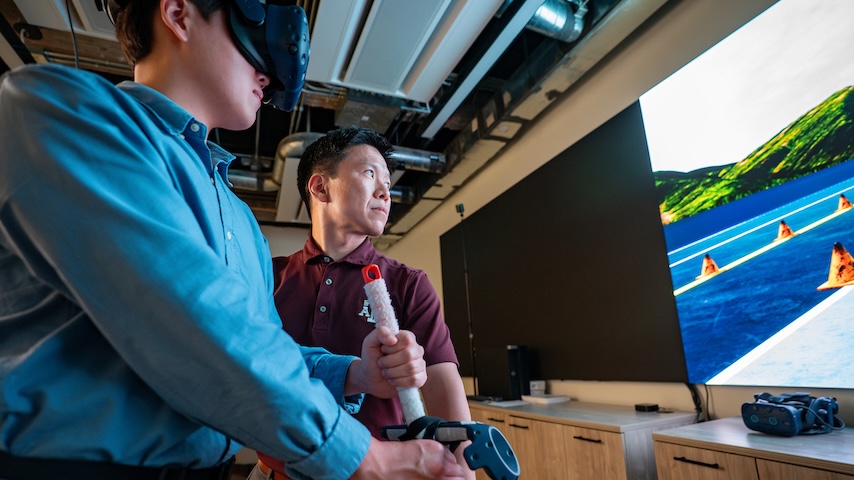
 Researchers are using virtual reality, brain activity monitoring, field observations, and AI-powered augmented reality systems to develop new approaches to improving construction safety. Photo: Namgyun Kim/Texas A&M
“This is an important scientific finding because it provides neurophysiological evidence of sensory habituation in construction workers,” Kim said. “Repeated exposure to warning alarms in everyday work appears to reduce the amount of attention workers allocate to those alarms over time, even though they continue to hear them.”
Researchers are using virtual reality, brain activity monitoring, field observations, and AI-powered augmented reality systems to develop new approaches to improving construction safety. Photo: Namgyun Kim/Texas A&M
“This is an important scientific finding because it provides neurophysiological evidence of sensory habituation in construction workers,” Kim said. “Repeated exposure to warning alarms in everyday work appears to reduce the amount of attention workers allocate to those alarms over time, even though they continue to hear them.”
To study what sort of training can affect how workers make decisions in busy construction zones, Kim collaborated with Brian Anderson, who leads the university’s Learning and Attention Lab, and Changbum Ryan Ahn, professor in the Department of Architectural Engineering at Seoul National University, to delve into how workers perceive and respond to workplace hazards. Together, they are using virtual reality, brain activity monitoring, field observations, and AI-powered augmented reality systems to develop new approaches to improving construction safety.
Discover the Benefits of ASME Membership
Their research examines whether immersive, experience-based training can reduce the gradual decline in attention that occurs after repeated exposure to the same risks.
In one iteration of the study, Kim’s lab developed a virtual roadway construction environment where workers completed routine tasks while exposed to warning alarms and nearby construction equipment. Using eye-tracking technology, researchers measured whether participants noticed surrounding hazards. If a worker failed to respond appropriately, the system prompted a simulated accident, recreating the type of struck-by incidents that occur on real roadway projects. A later study used electrical feedback, a mild jolt synchronized with the virtual accident, to make the experience more vivid and memorable for the trainees.
“The central idea behind our VR training is not repetition, it is creating a single memorable learning experience that changes future behavior,” he said. “This is an example of adaptive learning where the outcome depends directly on the trainee’s decisions.”
The team also evaluated workers approximately one to two weeks after training, measuring workers’ behavioral and neurological changes.
“While longer-term follow-up studies are certainly needed, our findings provide strong evidence that immersive training can produce meaningful and measurable improvements in safety-related behavior and neurological responses in the critical period immediately following training,” he explained.
Rather than relying on frequent refresher courses, Kim’s research focuses on making the initial training experience impactful enough to influence future behavior.
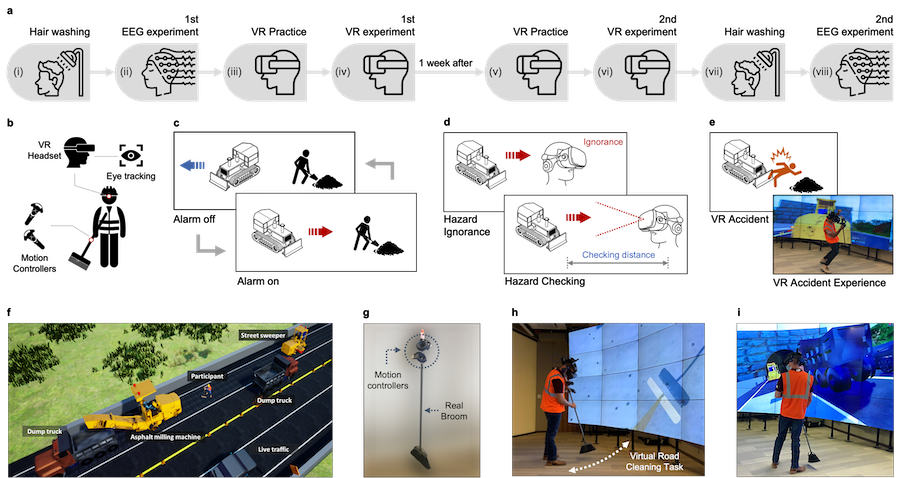 The research team ran through multiple simulations to better understand hazards and responses in the field. Image: Namgyun Kim/Texas A&M
“We believe the future of immersive safety training is not necessarily training workers more often but making each training experience memorable enough to influence behavior long after the headset comes off,” Kim said.
The research team ran through multiple simulations to better understand hazards and responses in the field. Image: Namgyun Kim/Texas A&M
“We believe the future of immersive safety training is not necessarily training workers more often but making each training experience memorable enough to influence behavior long after the headset comes off,” Kim said.
Although virtual reality offers highly immersive training, Kim acknowledged practical challenges to implementing it across large construction organizations.
“The first barrier is cost,” he noted. “However, in our view, the greater challenge is not the initial equipment cost but the time required to train large numbers of workers.”
Because only a limited number of VR headsets are typically available, training large workforces can become time-consuming and disruptive.
To address that challenge, Kim is developing an AI-powered augmented reality system that delivers site-specific safety training directly within workers’ actual jobsites.
AI is becoming increasingly capable of identifying hazards in construction images, Kim said.
You Might Also Enjoy: A New Generation of Rebar
“AI can systematically examine many parts of an image without becoming distracted or overlooking less obvious details,” he added.
Still, he emphasized that AI should support, not replace, experienced safety professionals.
“At present, I see AI as a highly capable decision-support tool rather than a complete replacement for an experienced safety professional,” Kim said. “The technology can continuously monitor complex environments and draw attention to potential hazards, while humans provide the contextual judgment necessary to decide whether a situation is truly unsafe.”
The technologies are intended to complement existing safety programs rather than replace traditional safety orientations or toolbox talks, Kim explained.
Next steps include combining virtual reality, augmented reality, and artificial intelligence into fully automated, worksite-specific training systems.
“Ultimately, our goal is to provide workers with the right safety training for the right hazards at the right time, before they begin work,” he said.
Annemarie Mannion is a technology writer in Chicago.
Over time, construction workers can become desensitized to familiar hazards, tuning out those flashing lights and blaring alarms as they focus on completing their tasks. That loss of attention can have serious consequences, particularly in roadway work zones where workers face significant risks.
The National Institute for Occupational Safety and Health reports that struck-by incidents—when a worker is hit by a vehicle, piece of equipment, or another object—accounted for about 1,800 fatal injuries and more than 167,000 nonfatal injuries between 2011 and 2021.
Namgyun Kim, assistant professor in the Department of Construction Science in the College of Architecture at Texas A&M University, is investigating how immersive technologies, neuroscience, and artificial intelligence can help workers remain attentive to hazards that have become so routine they go unnoticed.
Groundwork
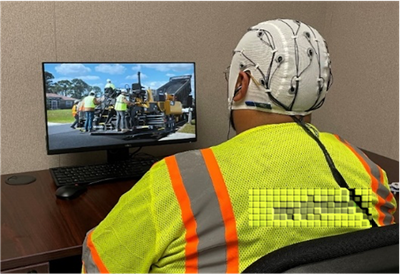
In one of its studies, which has been running for eight years now, the team used electroencephalography (EEG) sensors in virtual settings to compare the brain activity of construction workers to individuals who had no construction experience. They found that experienced construction workers registered warning alarms at a basic sensory level, but repeated exposure seemed to reduce the attention their brains gave those sounds. The workers could hear the alarms but were less likely to process them as meaningful warnings.
Researchers are using virtual reality, brain activity monitoring, field observations, and AI-powered augmented reality systems to develop new approaches to improving construction safety. Photo: Namgyun Kim/Texas A&M
To study what sort of training can affect how workers make decisions in busy construction zones, Kim collaborated with Brian Anderson, who leads the university’s Learning and Attention Lab, and Changbum Ryan Ahn, professor in the Department of Architectural Engineering at Seoul National University, to delve into how workers perceive and respond to workplace hazards. Together, they are using virtual reality, brain activity monitoring, field observations, and AI-powered augmented reality systems to develop new approaches to improving construction safety.
Discover the Benefits of ASME Membership
Their research examines whether immersive, experience-based training can reduce the gradual decline in attention that occurs after repeated exposure to the same risks.
In one iteration of the study, Kim’s lab developed a virtual roadway construction environment where workers completed routine tasks while exposed to warning alarms and nearby construction equipment. Using eye-tracking technology, researchers measured whether participants noticed surrounding hazards. If a worker failed to respond appropriately, the system prompted a simulated accident, recreating the type of struck-by incidents that occur on real roadway projects. A later study used electrical feedback, a mild jolt synchronized with the virtual accident, to make the experience more vivid and memorable for the trainees.
“The central idea behind our VR training is not repetition, it is creating a single memorable learning experience that changes future behavior,” he said. “This is an example of adaptive learning where the outcome depends directly on the trainee’s decisions.”
Tech impacts
To determine whether improvements observed during virtual training carried over into real construction sites, the researchers took their study to the streets and roadways. Workers completed virtual training before returning to active highway work zones, where researchers observed their behavior around live traffic. After the training, workers demonstrated greater vigilance, including spending more time watching approaching vehicles while performing roadway maintenance tasks.The team also evaluated workers approximately one to two weeks after training, measuring workers’ behavioral and neurological changes.
“While longer-term follow-up studies are certainly needed, our findings provide strong evidence that immersive training can produce meaningful and measurable improvements in safety-related behavior and neurological responses in the critical period immediately following training,” he explained.
Rather than relying on frequent refresher courses, Kim’s research focuses on making the initial training experience impactful enough to influence future behavior.
The research team ran through multiple simulations to better understand hazards and responses in the field. Image: Namgyun Kim/Texas A&M
Although virtual reality offers highly immersive training, Kim acknowledged practical challenges to implementing it across large construction organizations.
“The first barrier is cost,” he noted. “However, in our view, the greater challenge is not the initial equipment cost but the time required to train large numbers of workers.”
Because only a limited number of VR headsets are typically available, training large workforces can become time-consuming and disruptive.
To address that challenge, Kim is developing an AI-powered augmented reality system that delivers site-specific safety training directly within workers’ actual jobsites.
AI is becoming increasingly capable of identifying hazards in construction images, Kim said.
You Might Also Enjoy: A New Generation of Rebar
“AI can systematically examine many parts of an image without becoming distracted or overlooking less obvious details,” he added.
Still, he emphasized that AI should support, not replace, experienced safety professionals.
“At present, I see AI as a highly capable decision-support tool rather than a complete replacement for an experienced safety professional,” Kim said. “The technology can continuously monitor complex environments and draw attention to potential hazards, while humans provide the contextual judgment necessary to decide whether a situation is truly unsafe.”
The technologies are intended to complement existing safety programs rather than replace traditional safety orientations or toolbox talks, Kim explained.
Next steps include combining virtual reality, augmented reality, and artificial intelligence into fully automated, worksite-specific training systems.
“Ultimately, our goal is to provide workers with the right safety training for the right hazards at the right time, before they begin work,” he said.
Annemarie Mannion is a technology writer in Chicago.
Notifying long-time workers to construction site hazards can be difficult, so researchers are exploring how immersive technology can help—and developing an augmented reality system to assist.

Freelance writer based in Chicago
Related Content


Oct 1, 2026
Engineering the Sounds of Silence

Many of the things that engineers create make a lot of noise. Now there’s a crop of engineers trying to turn the volume down for all of us.
Sep 29, 2026
An Engineering Landmark in Tractor Innovation

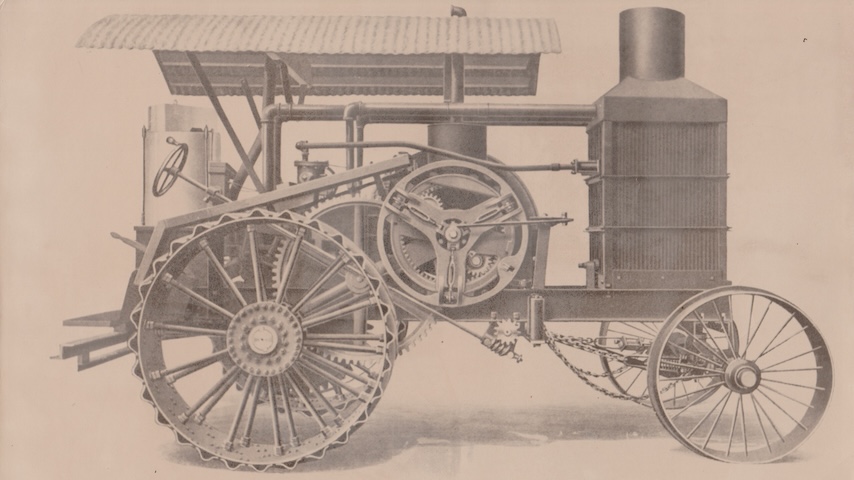
The Hart-Parr Model 3 is the first tractor to be mass produced with an internal combustion engine, earning its designation as a Historical Mechanical Engineering Landmark.
Sep 3, 2026
5 Mechanical Innovations to Watch in 2026

From adaptive safety belts to biomechanical drug delivery, these recent mechanical engineering breakthroughs are setting the stage for the future.
Sep 1, 2026
The Next Robotics Frontier


The robotics industry often focuses on scale, automation, and valuations. But a quieter group of founders is instead asking what robotics have overlooked as they innovate with compassion in mind.