Grit and Persistence Are Critical for Engineering
Grit and Persistence Are Critical for Engineering
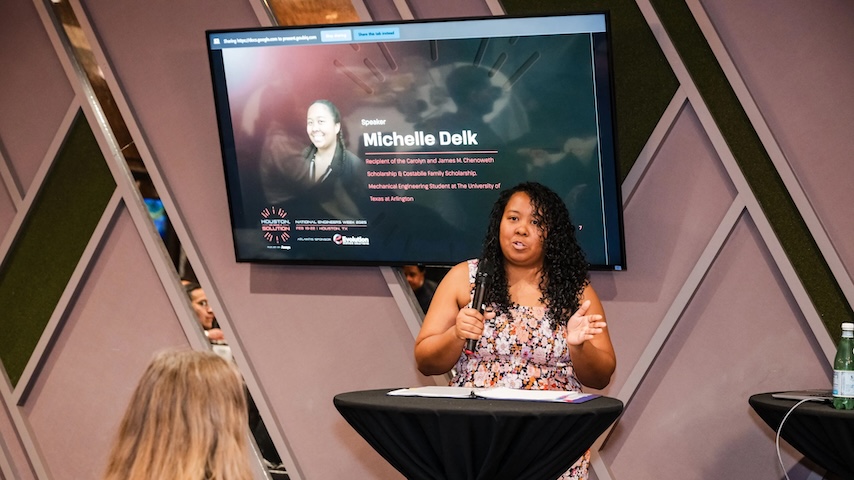
Multiple setbacks have not stopped this ASME Member from embracing opportunity and pursuing a graduate degree in engineering.
As a single mom and person of color, Michelle Delk may not be your typical graduate engineering student. But with the help of a supportive network, “you realize that we belong in those spaces,” she said.
Currently researching projects related to digital twin technologies at the University of Texas at Arlington (UTA), Delk’s lab work involves simulations and analysis in parallel to large digital systems.
Her message to others who may be considering pursuing an engineering degree is simple, but personal. “You don’t have to be the perfect student to be worthy of investment, and that goes for you, investing in yourself,” Delk said.
Delk is happy to witness the change that is happening. And she is grateful for the professors and other mentors who really believed in her, even when she didn’t believe in herself.
 Michelle Delk
It wasn’t always clear that she would find herself doing this important work. Although neither of her parents attended college, they always encouraged her to pursue a technical profession. And there were others that encouraged her and saw potential.
Michelle Delk
It wasn’t always clear that she would find herself doing this important work. Although neither of her parents attended college, they always encouraged her to pursue a technical profession. And there were others that encouraged her and saw potential.
When Delk first started college as a biology major, she was by all means a traditional student. Even though she found some success in her biology classes, she hated them.
“My professor at the time was a retired aerospace engineer, and so his whole class was geared toward those types of problems, and I liked it,” she said. One day he asked her why she was pursuing a major that she didn’t like, to which she responded, “I don’t really know,” Delk admitted.
It was then that life just happened. Delk ended up pregnant and eventually stopped going to school. And after her son Levi was born, Delk said she “realized he’s pretty brilliant. So, I was like, I guess I had better get back to school and keep up with him.”
Being a single parent does have its upsides—for one, the situation she found herself in forced her to be more focused, “more intentional, more resilient than I ever thought I could be. So, every minute I spend studying or working in the lab has to matter,” she said.
Delk arranges her schedule around the responsibilities and deadlines that come with work, school, and her son. There’s no room for procrastination, second guessing, or worrying about the pressure to do well. “I know what I need to do, and I pursue it with everything I’ve got,” she said. “Giving up is not an option.”
In fact, Delk suggested that making outreach a part of any career should always be a goal. “I try to do it as often as I can,” the young mother explained. “I know I’m pretty busy, but I especially enjoy the events that allow kids to come along. Those are my favorite.”
The last event that she was part of had her reaching out in an underserved Fort Worth, Texas community. “I can talk to the kids, but I also love talking to the parents,” she said. “It’s almost like they’re not sure that they can. And then they see it. And it’s tangible.”
Discover the Benefits of ASME Membership
The biggest obstacle to success is usually you, she explained. “You are your own worst obstacle,” she said. It was actually Delk’s high school calculus teacher who helped her understand her own aptitude. After her baby was born and she returned to school, she started at her local community college.
About a year and a half later, she transferred to UTA. It was there that she met her thermodynamic professor—also the ASME Student Section Advisor. Beyond the Student Section, ASME stepped up in another very personal way for Delk, who explained that when she began to pursue an undergraduate degree it was impossible for her parents to offer any financial support.
At the time, Delk and her son shared a living space with her brother. “Together, we built a supportive household, balancing work, school, and family responsibilities. Then, unexpectedly, my brother passed away in a tragic car accident,” she recalled.
The loss was devastating but it forced Delk to “regroup and refocus on how to move forward.” Through her mentor, Dereje Angonafer, presidential distinguished professor in the Department of Mechanical and Aerospace Engineering at UTA, she learned that ASME offered merit-based scholarships. Ultimately, Delk earned two ASME engineering scholarships that supported the completion of her undergrad work and set her on the path to begin her graduate studies and research.
“You’re allowed to have setbacks, and still be worthy of every opportunity,” Delk said, and added that grit and persistence are just as powerful as a perfect transcript. “You know I really like what being an engineer has taught me, because it’s a mindset,” she added.
She now is using her training to teach her son how to approach problems “like an engineer.” Delk understands the importance of thinking critically and asking questions. “And also knowing that failure is part of the process and not the end of it,” she said.
Cathy Cecere is membership content program manager.
Currently researching projects related to digital twin technologies at the University of Texas at Arlington (UTA), Delk’s lab work involves simulations and analysis in parallel to large digital systems.
Her message to others who may be considering pursuing an engineering degree is simple, but personal. “You don’t have to be the perfect student to be worthy of investment, and that goes for you, investing in yourself,” Delk said.
Road to the future
Engineering is still a major that “doesn’t see women very often, let alone women of color,” Delk added. This situation creates pressure to perform. “So, you look around, and it can be daunting, being the only one that that kind of looks like you in the room,” she continued. “You carry the pressure of your own goals, but also the hopes and goals of the community. You’re trying to set a precedent for the next girls that’ll come behind you.”Delk is happy to witness the change that is happening. And she is grateful for the professors and other mentors who really believed in her, even when she didn’t believe in herself.
Michelle Delk
When Delk first started college as a biology major, she was by all means a traditional student. Even though she found some success in her biology classes, she hated them.
“My professor at the time was a retired aerospace engineer, and so his whole class was geared toward those types of problems, and I liked it,” she said. One day he asked her why she was pursuing a major that she didn’t like, to which she responded, “I don’t really know,” Delk admitted.
It was then that life just happened. Delk ended up pregnant and eventually stopped going to school. And after her son Levi was born, Delk said she “realized he’s pretty brilliant. So, I was like, I guess I had better get back to school and keep up with him.”
Being a single parent does have its upsides—for one, the situation she found herself in forced her to be more focused, “more intentional, more resilient than I ever thought I could be. So, every minute I spend studying or working in the lab has to matter,” she said.
Delk arranges her schedule around the responsibilities and deadlines that come with work, school, and her son. There’s no room for procrastination, second guessing, or worrying about the pressure to do well. “I know what I need to do, and I pursue it with everything I’ve got,” she said. “Giving up is not an option.”
Helping out
Delk plans to eventually pursue her doctorate and knows that she has the ability to reach out to others when she needs support or help. “Go find your village,” she advised. “I don’t know where I would be if it wasn’t for people that were there to support me.” And if you don’t have that support system, “go find it, because you are not getting an extra award for doing it alone,” she said.In fact, Delk suggested that making outreach a part of any career should always be a goal. “I try to do it as often as I can,” the young mother explained. “I know I’m pretty busy, but I especially enjoy the events that allow kids to come along. Those are my favorite.”
The last event that she was part of had her reaching out in an underserved Fort Worth, Texas community. “I can talk to the kids, but I also love talking to the parents,” she said. “It’s almost like they’re not sure that they can. And then they see it. And it’s tangible.”
Discover the Benefits of ASME Membership
The biggest obstacle to success is usually you, she explained. “You are your own worst obstacle,” she said. It was actually Delk’s high school calculus teacher who helped her understand her own aptitude. After her baby was born and she returned to school, she started at her local community college.
About a year and a half later, she transferred to UTA. It was there that she met her thermodynamic professor—also the ASME Student Section Advisor. Beyond the Student Section, ASME stepped up in another very personal way for Delk, who explained that when she began to pursue an undergraduate degree it was impossible for her parents to offer any financial support.
At the time, Delk and her son shared a living space with her brother. “Together, we built a supportive household, balancing work, school, and family responsibilities. Then, unexpectedly, my brother passed away in a tragic car accident,” she recalled.
The loss was devastating but it forced Delk to “regroup and refocus on how to move forward.” Through her mentor, Dereje Angonafer, presidential distinguished professor in the Department of Mechanical and Aerospace Engineering at UTA, she learned that ASME offered merit-based scholarships. Ultimately, Delk earned two ASME engineering scholarships that supported the completion of her undergrad work and set her on the path to begin her graduate studies and research.
Engineering is hard
Delk understands that pursuing an engineering degree is difficult, but so long as students keep their goals in sight, “and want it more than anything,” there is not a single class, difficult professor, or any struggle that will stop you, she said.“You’re allowed to have setbacks, and still be worthy of every opportunity,” Delk said, and added that grit and persistence are just as powerful as a perfect transcript. “You know I really like what being an engineer has taught me, because it’s a mindset,” she added.
She now is using her training to teach her son how to approach problems “like an engineer.” Delk understands the importance of thinking critically and asking questions. “And also knowing that failure is part of the process and not the end of it,” she said.
Cathy Cecere is membership content program manager.
Multiple setbacks have not stopped this ASME Member from embracing opportunity and pursuing a graduate degree in engineering.

Membership content program manager for ASME
Related Content


Feb 5, 2026
Engineers are Optimistic, but AI Skills Gaps Continue
U.S. STEM professionals remain cautiously optimistic, but AI skills gaps and governance issues highlight the need for stronger training and workforce strategies.
Feb 5, 2026
Root Causes and Failure Analyses
This thermal scientist investigates fires and explosions, finds root causes, and adds to the critical knowledge of thermal and flow-related accidents.

Feb 4, 2026
Accelerating from Vehicle Test Engineer to CEO
This engineer’s unique expertise is working to fill the talent pipeline amid an automotive revolution.

Feb 4, 2026
Paying Mechanical Engineers in Professional Services

Mechanical engineers who work in professional services deliver complex projects and deliverables. Add retiring staff and wages are up and are expected to rise.