Engineers are Optimistic, but AI Skills Gaps Continue
Engineers are Optimistic, but AI Skills Gaps Continue

Most U.S. STEM professionals are optimistic about innovation, but AI skills gaps pose major challenges, highlighting the need for better governance, training, and workforce investment.
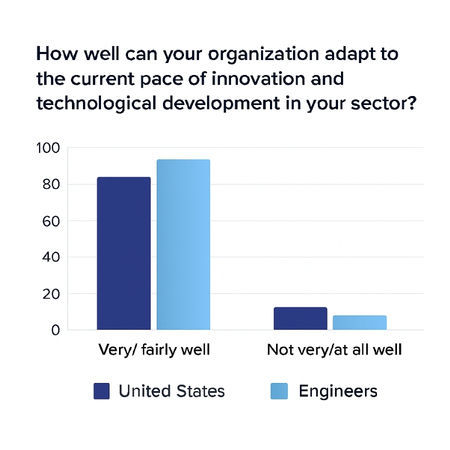
Only 9 percent of U.S. STEM professionals recently surveyed—including engineers and life scientists—are pessimistic when it comes to their organizations’ ability to keep up with innovation and technological developments. And overall, the Specialist Staffing Group found when they talked to nearly 5,400 industry professionals across leading industrial countries that only 16 percent reported that their companies were “not very” or “not at all” well positioned when it comes to their abilities to adapt.
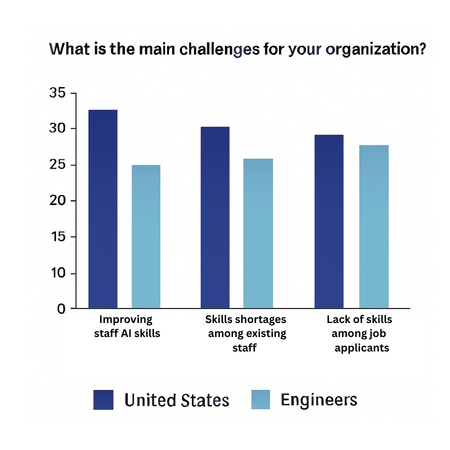
But there are challenges, especially when it comes to artificial intelligence (AI). Thirty-two percent of U.S. STEM professionals report that improving staff AI skills as their most important challenge. This compares with 23 percent of engineers worldwide who, looking ahead for the next 12 months, report that improving staff AI skills is the main challenge facing their organizations.
Against the backdrop of the U.S. ranking 18th overall in the Specialist Staffing Group’s global STEM Skills Index, and placing 4th among the G7 list, U.S. STEM professionals “are cautiously optimistic,” explained Matt McManus, president, Specialist Staffing Group.
 Source: Specialist Staffing Group
In the report, “STEM Skills Index,” the placement firm that specialized in scientists, technologists, engineers, and mathematicians reported that despite the U.S. being a global economic leader, when it comes to STEM Skills, the nation is a mixed bag. The U.S. is the home of world-leading universities and renowned tech hubs. Silicon Valley, MIT, and NASA drive “strong rankings in Engineering and Technology stakes,” but overall, STEM education performance lags behind Europe and Asia.
Source: Specialist Staffing Group
In the report, “STEM Skills Index,” the placement firm that specialized in scientists, technologists, engineers, and mathematicians reported that despite the U.S. being a global economic leader, when it comes to STEM Skills, the nation is a mixed bag. The U.S. is the home of world-leading universities and renowned tech hubs. Silicon Valley, MIT, and NASA drive “strong rankings in Engineering and Technology stakes,” but overall, STEM education performance lags behind Europe and Asia.
McManus explained that the positivity of U.S. engineers and life scientists reflects “a bit of a split between leaders and frontline staff.” He gives the example that about half of those surveyed say that “AI is already fully integrated into core strategy.” However, McManus made clear that “more than half of the STEM professionals we surveyed said they use unauthorized AI on a weekly basis, which tells us the appetite to innovate is there, even if the governance isn’t yet.”
McManus further pointed out that eight out of 10 employers say skills gaps are already hitting revenue, so while optimism is high, engineers are especially aware that progress relies on structured investment in skills. “Mechanical Engineers in particular,” he explained, “are balancing rapid advances in automation, digital twins, and AI-driven design. They know the race isn’t just to adopt new tech but to enhance their own skills fast enough to use it safely and effectively.”
When asked about the best tools to face the challenge of improving staff AI skills, McManus explained that the most appropriate tool is not any single platform. He suggested that the best tool is “a culture of safe, sanctioned experimentation.”
 Source: Specialist Staffing Group
Twenty-two percent of engineers worldwide report that controlling staff use of AI is an organizational challenge. “Engineers told us that hands-on learning within approved frameworks is key,” McManus explained. “Organizations should focus on governance of AI use and offering approved tools.” This is especially true since, according to the survey, more than half of STEM professionals admit to using unauthorized AI tools weekly.
Source: Specialist Staffing Group
Twenty-two percent of engineers worldwide report that controlling staff use of AI is an organizational challenge. “Engineers told us that hands-on learning within approved frameworks is key,” McManus explained. “Organizations should focus on governance of AI use and offering approved tools.” This is especially true since, according to the survey, more than half of STEM professionals admit to using unauthorized AI tools weekly.
“This means the tool isn’t just training, it’s a framework that enables safe, scaled adoption,” he added to the notion of AI governance. “Too often ‘shadow’ AI fills a gap left by slow corporate adoption.” He added that successful engineering firms are now introducing AI sandboxes and structured AI literacy programs, which allow experimentation with clear data security boundaries.
For engineering employers, the real worry isn’t about being replaced by AI, it is being misled by it. “When it comes to generative AI, employers often fear loss of control, data bias, and compliance issues,” McManus said. “Even when outsourcing tasks to AI, the bigger worry is not just cost or speed, it’s risk and trust. If AI output is wrong, unmonitored, or insecure, that issue greatly outweighs any efficiency gains.”
McManus said that if technical skills are causing project delays, it’s time to reframe them as strategic opportunities. “Start with an audit of current workflows: if skills gaps are threatening revenues (80 percent of our respondents fear this) then swift planning is needed,” he explained.
 Implement a dual track, McManus said. “Hire the missing skills and reskill / upskill the existing workforce,” he explained. “Simultaneously, lock in governance and approved tooling so that you reduce back-end delays from uncontrolled usage. There’s the potential to bring in targeted contract expertise to stabilize delivery and in parallel upskill existing engineers in automation, analytics, and digital-twin environments.”
But the reality is that skilled STEM talent is often “choice-rich,” McManus said. “So workforce strategy must be multidimensional.”
Cathy Cecere is membership content program manager.
But there are challenges, especially when it comes to artificial intelligence (AI). Thirty-two percent of U.S. STEM professionals report that improving staff AI skills as their most important challenge. This compares with 23 percent of engineers worldwide who, looking ahead for the next 12 months, report that improving staff AI skills is the main challenge facing their organizations.
U.S. STEM professionals’ optimism
Against the backdrop of the U.S. ranking 18th overall in the Specialist Staffing Group’s global STEM Skills Index, and placing 4th among the G7 list, U.S. STEM professionals “are cautiously optimistic,” explained Matt McManus, president, Specialist Staffing Group.
Source: Specialist Staffing Group
McManus explained that the positivity of U.S. engineers and life scientists reflects “a bit of a split between leaders and frontline staff.” He gives the example that about half of those surveyed say that “AI is already fully integrated into core strategy.” However, McManus made clear that “more than half of the STEM professionals we surveyed said they use unauthorized AI on a weekly basis, which tells us the appetite to innovate is there, even if the governance isn’t yet.”
McManus further pointed out that eight out of 10 employers say skills gaps are already hitting revenue, so while optimism is high, engineers are especially aware that progress relies on structured investment in skills. “Mechanical Engineers in particular,” he explained, “are balancing rapid advances in automation, digital twins, and AI-driven design. They know the race isn’t just to adopt new tech but to enhance their own skills fast enough to use it safely and effectively.”
Tools needed
When asked about the best tools to face the challenge of improving staff AI skills, McManus explained that the most appropriate tool is not any single platform. He suggested that the best tool is “a culture of safe, sanctioned experimentation.”
Source: Specialist Staffing Group
“This means the tool isn’t just training, it’s a framework that enables safe, scaled adoption,” he added to the notion of AI governance. “Too often ‘shadow’ AI fills a gap left by slow corporate adoption.” He added that successful engineering firms are now introducing AI sandboxes and structured AI literacy programs, which allow experimentation with clear data security boundaries.
For engineering employers, the real worry isn’t about being replaced by AI, it is being misled by it. “When it comes to generative AI, employers often fear loss of control, data bias, and compliance issues,” McManus said. “Even when outsourcing tasks to AI, the bigger worry is not just cost or speed, it’s risk and trust. If AI output is wrong, unmonitored, or insecure, that issue greatly outweighs any efficiency gains.”
The future
McManus said that if technical skills are causing project delays, it’s time to reframe them as strategic opportunities. “Start with an audit of current workflows: if skills gaps are threatening revenues (80 percent of our respondents fear this) then swift planning is needed,” he explained.
AI Expectations, Soft Skills, and Young Professionals
As generative AI revolutionizes STEM, employers are growing wary of investing in upskilling and devoting precious energy to seemingly endless transformation.
But the reality is that skilled STEM talent is often “choice-rich,” McManus said. “So workforce strategy must be multidimensional.”
Cathy Cecere is membership content program manager.


Learning is a lifelong journey. Explore our growing collection of free learning resources and articles.