Dual-Gate Design Boosts Graphene Sensor Performance
Dual-Gate Design Boosts Graphene Sensor Performance
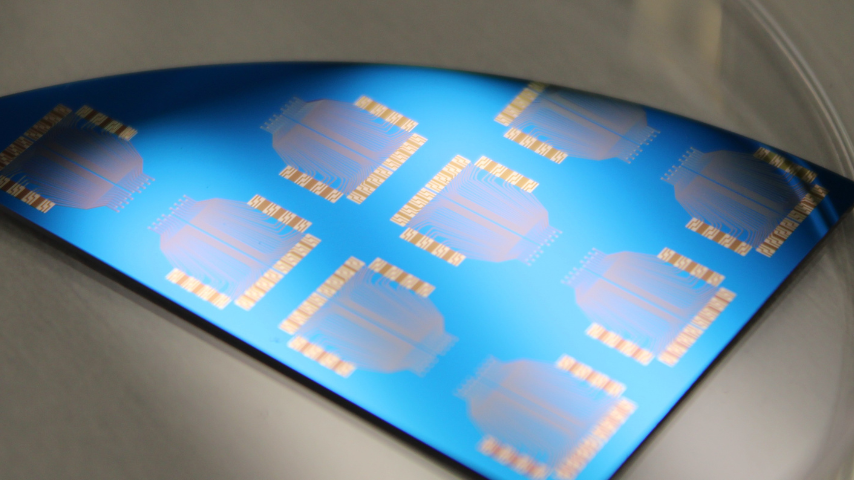
A new dual-gate graphene transistor design could make ultrasensitive sensors more stable, tunable, and dependable in complex environments.
In applications from healthcare to environmental monitoring, ultrasensitive sensing devices are fundamentally changing what is possible by detecting elements at the microscopic level.
A team at Pennsylvania State University (PSU) is leading research in this area with support from the U.S. National Science Foundation. They have developed a device that takes advanced sensor design to the next level, improving the ability to detect ultra-low concentrations of substances dissolved in complex fluids such as blood, air, and wastewater, with the potential to eventually reach single-molecule detection limits while maintaining sensitivity and accuracy.
According to Vinay Kammarchedu, a doctoral candidate in electrical engineering who is part of the PSU team, using graphene instead of silicon is the key to better designs. The reason for this is that graphene field-effect transistors (GFETs) have a larger surface area, higher carrier mobility, lower intrinsic noise, improved biocompatibility, and more flexibility.
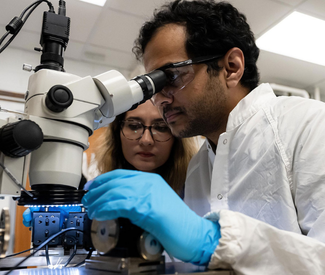 From left, Aida Ebrahimi and Vinay Kammarchedu work on the dual-gate GFET in the PSU lab. Photo: Jaydyn Isiminger, PSU
Most GFETs in use today are single-gate devices, Kammarchedu explained. The gate acts as a controller that modulates the electrical conductivity of the graphene channel, adjusting the concentration of charge carriers to control how much current flows through the system. When a target molecule binds to the receptor, it alters the electrical charge distribution on the graphene surface.
From left, Aida Ebrahimi and Vinay Kammarchedu work on the dual-gate GFET in the PSU lab. Photo: Jaydyn Isiminger, PSU
Most GFETs in use today are single-gate devices, Kammarchedu explained. The gate acts as a controller that modulates the electrical conductivity of the graphene channel, adjusting the concentration of charge carriers to control how much current flows through the system. When a target molecule binds to the receptor, it alters the electrical charge distribution on the graphene surface.
“Sensitivity is graphene’s strength,” he said, “but sensitivity is also its Achilles heel because it binds with a lot of things we don’t want to detect.”
Taking measurements with graphene sensors requires constant adjustments to open and close the gate, and this degrades performance over time, with devices experiencing signal drift, charge trapping, and insufficient signal amplification.
Kammarchedu and research lead Aida Ebrahimi, Thomas and Sheila Roell Early Career Associate Professor of Electrical Engineering, are eliminating these limitations with their new, dual-gated GFET design.
“We adjusted the design to have two gates so we can control the current flowing through the system,” Kammarchedu said.
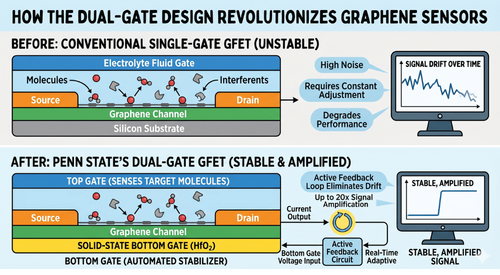 An AI-generated schematic shows how the dual-gate design stabilizes and amplifies signals.
In the two-gate device, the top gate is an electrolyte fluid gate that interacts directly with the target molecules, while the high-k bottom gate acts as an automated stabilizer. Instead of constantly sweeping voltages to find the signal, this architecture uses an active feedback loop.
An AI-generated schematic shows how the dual-gate design stabilizes and amplifies signals.
In the two-gate device, the top gate is an electrolyte fluid gate that interacts directly with the target molecules, while the high-k bottom gate acts as an automated stabilizer. Instead of constantly sweeping voltages to find the signal, this architecture uses an active feedback loop.
When target molecules interact with the top gate and cause a shift in the surface potential, an external feedback circuit senses the resulting change in current and automatically adjusts the bottom gate voltage to maintain the transistor’s optimal operating point. Keeping a constant current running through the system removes a primary cause of signal drift, and incorporating a feedback system in one of the gates makes it possible to more accurately track the impact molecules have on the sensor’s voltage.
Aida Ebrahimi explained that the new device enables signal amplification with less drift and a better signal-to-noise ratio than single-gate designs. It also can be tuned in real time for adaptive sensing, an important advantage because amplification depends on the ionic strength of the liquid being tested. For example, moving a sensor from a highly salty fluid, such as blood, to freshwater typically requires recalibration because the liquid’s electrical properties have changed.
Since the hardware handles the amplification and drift correction natively, the two-gate GFET can perform testing in real time directly in complex environments, accurately measuring small shifts in biological markers, like proteins, neurotransmitters, and harmful chemicals.
This innovation is a game changer. It can improve food safety and environmental monitoring, open the door to tracking neurodegenerative disorders, provide a flexible biointerface, and has applications in biodefense, Ebrahimi said.
For example, commercial sensing devices are being used today to test for ions like phosphates and nitrates in soil and water. “Now, imagine that we use a device with higher sensitivity and less drift that delivers greater reliability,” she said.
 Devices used in healthcare also are candidates for two-gate GFETs. One example is a chip based on silicon and transistor technology that was introduced more than a decade ago for use in DNA sequencing. The silicon chip detects changes in pH, or proton concentration. With the technology developed and tested by Ebrahimi and Kammarchedu, it is possible to replace less sensitive silicon chips with their GFET design, which is much more sensitive to proton concentration.
By testing their design across seven operational modes in a range of analytes that included neurotransmitters, volatile organic compounds, environmental contaminants, and proteins, the team discovered that the dual mode fixed configuration yielded the best results. In many cases, the two-gate GFETs delivered up to 20 times greater signal gain, more than 15 times less drift, seven times higher signal-to-noise ratio, and greater sensitivity to a wide range of chemical and biological signals.
While the two-gate GFET represents a major leap forward in sensor technology, Ebrahimi emphasized that it is an evolving platform, and more work must be done to fully optimize it for real-world applications. Some of that work is already underway.
Judy Murray is an independent writer in Houston.
A team at Pennsylvania State University (PSU) is leading research in this area with support from the U.S. National Science Foundation. They have developed a device that takes advanced sensor design to the next level, improving the ability to detect ultra-low concentrations of substances dissolved in complex fluids such as blood, air, and wastewater, with the potential to eventually reach single-molecule detection limits while maintaining sensitivity and accuracy.
A two-gate approach to better sensing
According to Vinay Kammarchedu, a doctoral candidate in electrical engineering who is part of the PSU team, using graphene instead of silicon is the key to better designs. The reason for this is that graphene field-effect transistors (GFETs) have a larger surface area, higher carrier mobility, lower intrinsic noise, improved biocompatibility, and more flexibility.
From left, Aida Ebrahimi and Vinay Kammarchedu work on the dual-gate GFET in the PSU lab. Photo: Jaydyn Isiminger, PSU
“Sensitivity is graphene’s strength,” he said, “but sensitivity is also its Achilles heel because it binds with a lot of things we don’t want to detect.”
Taking measurements with graphene sensors requires constant adjustments to open and close the gate, and this degrades performance over time, with devices experiencing signal drift, charge trapping, and insufficient signal amplification.
Kammarchedu and research lead Aida Ebrahimi, Thomas and Sheila Roell Early Career Associate Professor of Electrical Engineering, are eliminating these limitations with their new, dual-gated GFET design.
“We adjusted the design to have two gates so we can control the current flowing through the system,” Kammarchedu said.
An AI-generated schematic shows how the dual-gate design stabilizes and amplifies signals.
When target molecules interact with the top gate and cause a shift in the surface potential, an external feedback circuit senses the resulting change in current and automatically adjusts the bottom gate voltage to maintain the transistor’s optimal operating point. Keeping a constant current running through the system removes a primary cause of signal drift, and incorporating a feedback system in one of the gates makes it possible to more accurately track the impact molecules have on the sensor’s voltage.
Aida Ebrahimi explained that the new device enables signal amplification with less drift and a better signal-to-noise ratio than single-gate designs. It also can be tuned in real time for adaptive sensing, an important advantage because amplification depends on the ionic strength of the liquid being tested. For example, moving a sensor from a highly salty fluid, such as blood, to freshwater typically requires recalibration because the liquid’s electrical properties have changed.
Since the hardware handles the amplification and drift correction natively, the two-gate GFET can perform testing in real time directly in complex environments, accurately measuring small shifts in biological markers, like proteins, neurotransmitters, and harmful chemicals.
From complex fluids to real-world uses
This innovation is a game changer. It can improve food safety and environmental monitoring, open the door to tracking neurodegenerative disorders, provide a flexible biointerface, and has applications in biodefense, Ebrahimi said.For example, commercial sensing devices are being used today to test for ions like phosphates and nitrates in soil and water. “Now, imagine that we use a device with higher sensitivity and less drift that delivers greater reliability,” she said.
Inclusive Wearable Sensors Improve Equity in Health Care
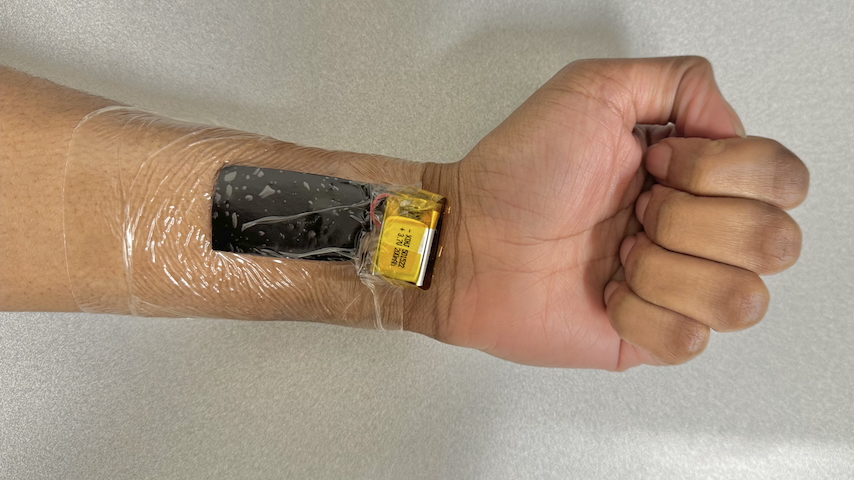
Existing pulse oximetry level sensors can get confused when a person’s skin has more melanin. A new sensor is changing that.
By testing their design across seven operational modes in a range of analytes that included neurotransmitters, volatile organic compounds, environmental contaminants, and proteins, the team discovered that the dual mode fixed configuration yielded the best results. In many cases, the two-gate GFETs delivered up to 20 times greater signal gain, more than 15 times less drift, seven times higher signal-to-noise ratio, and greater sensitivity to a wide range of chemical and biological signals.
While the two-gate GFET represents a major leap forward in sensor technology, Ebrahimi emphasized that it is an evolving platform, and more work must be done to fully optimize it for real-world applications. Some of that work is already underway.
Judy Murray is an independent writer in Houston.
A new dual-gate graphene transistor design could make ultrasensitive sensors more stable, tunable, and dependable in complex environments.

Professional writer, strategist, content developer, owner of Word Source
Related Content


Aug 24, 2026
Engineering Students Tackle Cheap Fashion
Fast fashion is piling up and a team at the American University of Beirut is working on solutions.


Aug 21, 2026
Quiz: ASME Career Center


Test your knowledge of mechanical engineering careers, from salaries and skills to job outlook, using information from the ASME Career Center.

Aug 21, 2026
USA Act Highlights Importance of U.S. Leadership in International Standards
Aug 21, 2026
Alert: Stop the Pro Codes Act