An Inflatable Apple Picker
An Inflatable Apple Picker
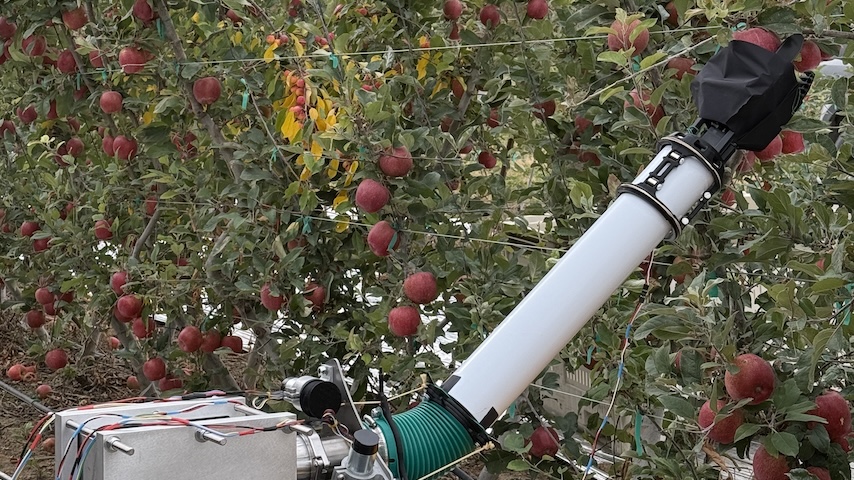
An expandable soft robot can gently pluck a piece of fruit in around 25 seconds.
Apples are an iconic global food that grow on nearly every continent and have thousands of delicious cultivars. Commercial harvesting, however, is a far cry from idyllic apple picking in the fall. It is a risky business that requires laborers to scale ladders, endure exposure to the elements, and work long hours during a short harvest season. One way to alleviate this core challenge is deploying soft robots.
Researchers from Washington State University (WSU) have fabricated a harvesting robot with an everting inflatable fabric manipulator (EIFM) arm. Paired with a soft gripper, the lightweight system can detect, reach, grasp, pluck, and release an apple. The intention is for the robot to work alongside humans, ultimately improving an orchard’s yield and protecting against lost revenue.
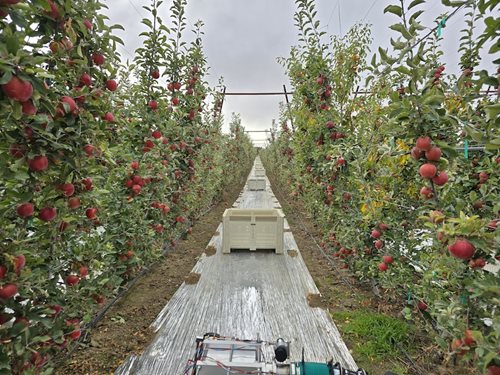 Photo: Ryan Dorosh/WSU
The two-foot retractable robotic arm developed by Ming Luo, professor at the WSU School of Mechanical and Materials Engineering, along with graduate student Ryan Dorosh, can retrieve an apple in about 25 seconds. The work was completed under WSU’s Mechanically-Intelligent Autonomous Robotics (MIAR) Laboratory and recently published in the journal, Smart Agricultural Technology.
Photo: Ryan Dorosh/WSU
The two-foot retractable robotic arm developed by Ming Luo, professor at the WSU School of Mechanical and Materials Engineering, along with graduate student Ryan Dorosh, can retrieve an apple in about 25 seconds. The work was completed under WSU’s Mechanically-Intelligent Autonomous Robotics (MIAR) Laboratory and recently published in the journal, Smart Agricultural Technology.
“One of the main challenges with developing an apple harvesting robot is how modern orchards are trained with linear branches or on a trellis, which creates a 2.5D plane,” Luo explained. “Our objective was to design a simple, low-cost robot that can operate within those simple tree structures, where most apples are not obstructed by obstacles, without overcomplicating the engineering work.”
The robot’s EIFM structure has a surprising connection to car dealerships: dancing inflatable advertisements.
“Imagine a wacky flailing tube man, take the top end, and pull it inside of itself to make a pressurized tube. We can then change its length by pulling or releasing the material inside the tube,” Dorosh said. “Because the arm is made of flexible fabric, it doesn’t pose a risk to the fruit itself, the tree, or nearby workers.”
You Might Also Enjoy: Strawberry Picking Using AI Vision, Silicone Fingers, and a Fan
Anchored to a metal base, the roughly 50-pound system is an improvement over the bulkier designs of robotics with linear actuators or 6 degrees of freedom (DoF) arms. Testing demonstrates that it consistently supports the weight of apples from 0.3 to 0.5 pounds. The EIFM design is also affordable, with the prototype costing around $5,000. This is partially thanks to the inexpensive inflatable material, which is roughly $20. Since orchard equipment like tractors, mowers, and cider presses are easily five-figure expenditures, the modest price also matches the reality that many growers struggle with slim profit margins.
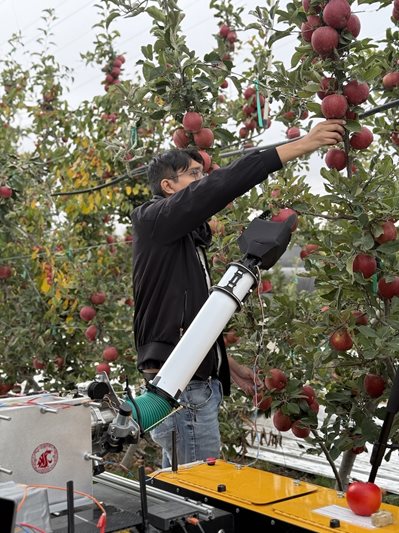 Photo: Ryan Dorosh/WSU
“Another configuration is to place the robot at ground level, which can reduce the need for laborers to bend and twist,” Luo added.
Photo: Ryan Dorosh/WSU
“Another configuration is to place the robot at ground level, which can reduce the need for laborers to bend and twist,” Luo added.
The current vision system uses rudimentary color and shape detection. Since apples can be covered by leaves or grow in clusters, a more sophisticated perception system will be employed in the future.
Discover the Benefits of ASME Membership
“The final system is being developed by our collaborators at the WSU Center for Precision & Automated Agricultural Systems (CPAAS) and Cornell University,” Dorosh noted. “This will use an AI image detection to find apples within a given image frame from a camera. Since we use RGB-D cameras and LiDAR systems, we can use the apple location in the image frame to determine its approximate location in 3D space.”
While the robot’s visual system, EIFM arm, and gripper work in unison, the unit is also intended to be modular. This potential to swap in different components paves the way for the bot to perform additional orchard tasks like pruning and pollination.
“A little modification and the base robot could work well in different agricultural sectors or even go into other industries,” Dorosh added. “This adaptability has been one of the most interesting and impactful parts of the project.”
Jennie Morton is an engineering and construction writer based in Iowa.
Researchers from Washington State University (WSU) have fabricated a harvesting robot with an everting inflatable fabric manipulator (EIFM) arm. Paired with a soft gripper, the lightweight system can detect, reach, grasp, pluck, and release an apple. The intention is for the robot to work alongside humans, ultimately improving an orchard’s yield and protecting against lost revenue.
Inspired by wacky inflatables
Agricultural growers are facing employee shortages stemming from retirement, waning interest from upcoming generations, and decreasing availability in migrant workers. Yet labor needs remain high. In Washington State alone, 40,000–50,000 seasonal workers are needed annually, according to estimates from the U.S. Department of Agriculture. Robotic pickers can offer a sweet spot that prevents fruit from rotting on the ground.
Photo: Ryan Dorosh/WSU
“One of the main challenges with developing an apple harvesting robot is how modern orchards are trained with linear branches or on a trellis, which creates a 2.5D plane,” Luo explained. “Our objective was to design a simple, low-cost robot that can operate within those simple tree structures, where most apples are not obstructed by obstacles, without overcomplicating the engineering work.”
The robot’s EIFM structure has a surprising connection to car dealerships: dancing inflatable advertisements.
“Imagine a wacky flailing tube man, take the top end, and pull it inside of itself to make a pressurized tube. We can then change its length by pulling or releasing the material inside the tube,” Dorosh said. “Because the arm is made of flexible fabric, it doesn’t pose a risk to the fruit itself, the tree, or nearby workers.”
You Might Also Enjoy: Strawberry Picking Using AI Vision, Silicone Fingers, and a Fan
Anchored to a metal base, the roughly 50-pound system is an improvement over the bulkier designs of robotics with linear actuators or 6 degrees of freedom (DoF) arms. Testing demonstrates that it consistently supports the weight of apples from 0.3 to 0.5 pounds. The EIFM design is also affordable, with the prototype costing around $5,000. This is partially thanks to the inexpensive inflatable material, which is roughly $20. Since orchard equipment like tractors, mowers, and cider presses are easily five-figure expenditures, the modest price also matches the reality that many growers struggle with slim profit margins.
Human collaboration
Embodying the phrase “many hands make light work,” the EIFM robot will support harvest efficiency. Consider that the average orchard size in Washington is 100 acres, according to the Washington Apple Commission. The scale alone makes it difficult to collect every ripe apple across the equivalent of 75 football fields. A fleet of robotic pickers will help more produce make it to market. The EIFM robot can be placed on harvest assist machines, which are essentially scissors lifts adapted to agricultural terrain. It will pick alongside workers as the platform boosts them to reach top branches.
Photo: Ryan Dorosh/WSU
The current vision system uses rudimentary color and shape detection. Since apples can be covered by leaves or grow in clusters, a more sophisticated perception system will be employed in the future.
Discover the Benefits of ASME Membership
“The final system is being developed by our collaborators at the WSU Center for Precision & Automated Agricultural Systems (CPAAS) and Cornell University,” Dorosh noted. “This will use an AI image detection to find apples within a given image frame from a camera. Since we use RGB-D cameras and LiDAR systems, we can use the apple location in the image frame to determine its approximate location in 3D space.”
While the robot’s visual system, EIFM arm, and gripper work in unison, the unit is also intended to be modular. This potential to swap in different components paves the way for the bot to perform additional orchard tasks like pruning and pollination.
“A little modification and the base robot could work well in different agricultural sectors or even go into other industries,” Dorosh added. “This adaptability has been one of the most interesting and impactful parts of the project.”
Jennie Morton is an engineering and construction writer based in Iowa.
An expandable soft robot can gently pluck a piece of fruit in around 25 seconds.

Freelance writer based in Iowa
Related Content

Jun 16, 2026
Single Chip Combines Memory and Computation
A hardware advancement takes inspiration from the human brain’s neural network.


Jun 12, 2026
Quiz: A Trolley’s Trucks and Frogs
Although streetcars are more of a novelty these days, innovative engineering made them possible. See what you know with this ASME quiz.

Jun 10, 2026
Blog: Designing for AI Workloads
Data center cooling is evolving to more efficiently manage higher power densities.
May 21, 2026
Touchless Movement Through Fluidic Torque


Fluid-generated torque generated by microrobot swarms can move passive objects in surprising ways—without the need for physical contact.