Artificial Muscles That Move to Sound
Artificial Muscles That Move to Sound
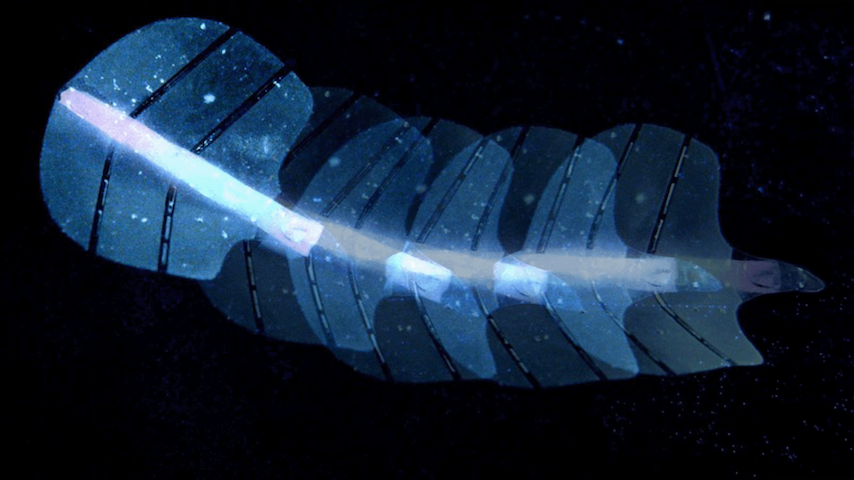
Microbubbles of varying sizes embedded in polymers have different acoustic responses, which can help move artificial muscles made from this material.
A breakdancer performs a “wave” by managing muscle rigidity and tension to unlock seemingly frozen poses in the arms or legs to deliver smooth motions. Researchers at ETH Zürich are researching how they can use sound to create similar movements in artificial muscles in work that has promising biomedical applications ahead.
Getting artificial muscles to move is not a new research area and scientists have done so by growing and manipulating tissue on 3D printed muscles or by using electro-hydraulic techniques to move the components.
The acoustics-based equivalent, however, is underexplored, if at all, said Daniel Ahmed, the Professor of Acoustic Robotics for Life Sciences and Healthcare at ETH Zürich.
The key is to create sets of small bubbles of various sizes—small, medium, and large—in a polymer muscle mass, each of which will respond differently to applied ultrasound waves. The varying responses in resonance cause the entire muscle to move. Ahmed likens the concept to creating resonance in musical instruments where thick guitar strings resonate at lower frequencies while thinner ones, like violins, do so at higher frequencies.
More for You: New Sound-Based 3D Printing Method Enables Finer, Faster Microdevices
If all the bubbles in a membrane are the same size, it simply bends in response to the signal amplitude. If the bubbles are different sizes, they respond at different frequencies, which produces an undulatory movement. “By using the resonance characteristics of microbubbles, we can create different modes of oscillation,” Ahmed said.
To test this thesis, the research team constructed arrays of three sets of microbubble arrays in polydimethylsiloxane (PDMS), a polymer-based material, using lithographic techniques. Two sets of these arrays, with micrometer-sized bubbles, formed the pectoral fins of a 4-centimeter-wide “stingraybot,” a flat and flexible piece of polymer.
When researchers apply ultrasound stimulation, the stingraybot glides through the water without any cabling. Applying one sweeping frequency through the entire structure creates an undulating motion that pushes the stingraybot through. Even a low-power wave can have a significant impact because the microbubbles amplify the acoustic response. The team will be developing a transducer to deliver the required ultrasound waves.
The stingraybot’s utility is being tested for both the bladder and the stomach, smaller organs that are easier to navigate. The unit has already worked in porcine cardiac applications. “Right now it’s a very simple one-layer mechanism but we are also creating a multi-layer system for targeted drug delivery, electrical stimulation and even wound healing using ultrasound,” Ahmed said.
Discover the Benefits of ASME Membership
Another goal is manipulating the structure on the surface of the brain, an otherwise notoriously difficult organ to work on, to deliver drugs and mechanical stimuli.
Future research will also focus on fine-tuning the movement of the robot to be more fine-grained, which can be executed by incorporating more arrays with a wider size range of bubbles. For example, having six arrays instead of three can enable the robot to have a sharper range of motion.
In addition, the research team is planning on incorporating machine learning in the working of the robot so it can recognize sensitive structures in the bladder or other organs and be trained to avoid them. In this way, using precision movements of the robot can help surgeons avoid injury from more invasive procedures.
Essentially the stingraybot is a blank slate for the many therapeutic ways in which soft biomaterials can be used in the human body. There are many stages before we get there, including obtaining approval for using PDMS as a biocompatible material, but early research looks promising.
Poornima Apte is a technology writer based in Walpole, Mass.
Getting artificial muscles to move is not a new research area and scientists have done so by growing and manipulating tissue on 3D printed muscles or by using electro-hydraulic techniques to move the components.
The acoustics-based equivalent, however, is underexplored, if at all, said Daniel Ahmed, the Professor of Acoustic Robotics for Life Sciences and Healthcare at ETH Zürich.
Tailoring the muscle for movement
Sound’s advantage lies in its ease of use. Instead of relying on complex 3D-printing mechanisms to manage movement, the technique could instead use readily available ultrasound techniques. Doing so without using wires is an attractive bonus for biomedical applications inside the human body.The key is to create sets of small bubbles of various sizes—small, medium, and large—in a polymer muscle mass, each of which will respond differently to applied ultrasound waves. The varying responses in resonance cause the entire muscle to move. Ahmed likens the concept to creating resonance in musical instruments where thick guitar strings resonate at lower frequencies while thinner ones, like violins, do so at higher frequencies.
More for You: New Sound-Based 3D Printing Method Enables Finer, Faster Microdevices
If all the bubbles in a membrane are the same size, it simply bends in response to the signal amplitude. If the bubbles are different sizes, they respond at different frequencies, which produces an undulatory movement. “By using the resonance characteristics of microbubbles, we can create different modes of oscillation,” Ahmed said.
To test this thesis, the research team constructed arrays of three sets of microbubble arrays in polydimethylsiloxane (PDMS), a polymer-based material, using lithographic techniques. Two sets of these arrays, with micrometer-sized bubbles, formed the pectoral fins of a 4-centimeter-wide “stingraybot,” a flat and flexible piece of polymer.
When researchers apply ultrasound stimulation, the stingraybot glides through the water without any cabling. Applying one sweeping frequency through the entire structure creates an undulating motion that pushes the stingraybot through. Even a low-power wave can have a significant impact because the microbubbles amplify the acoustic response. The team will be developing a transducer to deliver the required ultrasound waves.
Next steps and potential applications
“One of the many special abilities of our robot is that it can conform to any contour and take its shape,” Ahmed said. Medical professionals can leverage this capability to have drugs piggyback on the stingraybot and have it travel to specific regions of the bladder and the stomach, for example. To do so, the flexible stingraybot can fold into a capsule and be swallowed. Once the capsule dissolves inside the human body, the stingraybot can then be guided to the desired location through ultrasound waves. Such targeted drug delivery is much more desirable, improving the efficacy of the medicine.The stingraybot’s utility is being tested for both the bladder and the stomach, smaller organs that are easier to navigate. The unit has already worked in porcine cardiac applications. “Right now it’s a very simple one-layer mechanism but we are also creating a multi-layer system for targeted drug delivery, electrical stimulation and even wound healing using ultrasound,” Ahmed said.
Discover the Benefits of ASME Membership
Another goal is manipulating the structure on the surface of the brain, an otherwise notoriously difficult organ to work on, to deliver drugs and mechanical stimuli.
Future research will also focus on fine-tuning the movement of the robot to be more fine-grained, which can be executed by incorporating more arrays with a wider size range of bubbles. For example, having six arrays instead of three can enable the robot to have a sharper range of motion.
In addition, the research team is planning on incorporating machine learning in the working of the robot so it can recognize sensitive structures in the bladder or other organs and be trained to avoid them. In this way, using precision movements of the robot can help surgeons avoid injury from more invasive procedures.
Essentially the stingraybot is a blank slate for the many therapeutic ways in which soft biomaterials can be used in the human body. There are many stages before we get there, including obtaining approval for using PDMS as a biocompatible material, but early research looks promising.
Poornima Apte is a technology writer based in Walpole, Mass.
Microbubbles of varying sizes embedded in polymers have different acoustic responses, which can help move artificial muscles made from this material.

Technology writer
Related Content


Oct 1, 2026
Engineering the Sounds of Silence

Many of the things that engineers create make a lot of noise. Now there’s a crop of engineers trying to turn the volume down for all of us.
Sep 29, 2026
An Engineering Landmark in Tractor Innovation

The Hart-Parr Model 3 is the first tractor to be mass produced with an internal combustion engine, earning its designation as a Historical Mechanical Engineering Landmark.
Sep 15, 2026
Octopus-Inspired Robot Gets a Better Grip


A new soft robotic arm shows how distributed sensing and control could help robots move and grasp more like living organisms.
Sep 3, 2026
5 Mechanical Innovations to Watch in 2026

From adaptive safety belts to biomechanical drug delivery, these recent mechanical engineering breakthroughs are setting the stage for the future.