The Old Mill Grinds On
The Old Mill Grinds On
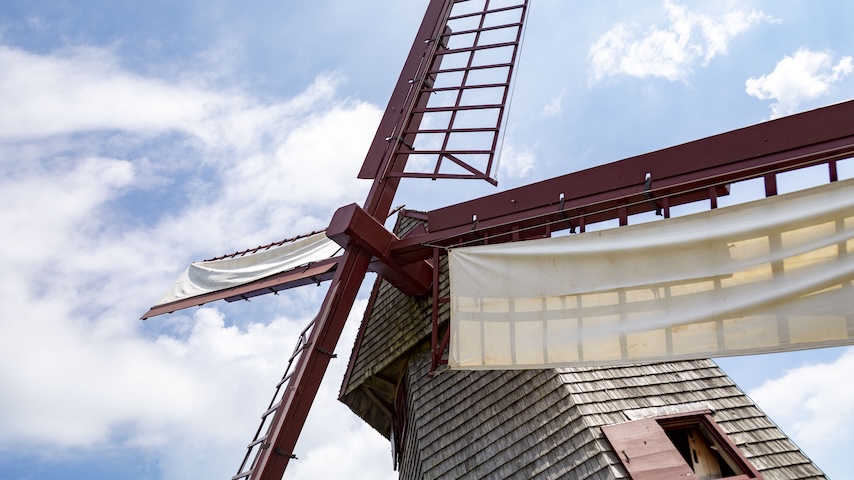
Designated as an ASME Historic Mechanical Engineering Landmark in 1992, the Old Mill is the oldest operating smock-type windmill in the United States.
The first settlers of the land we now call the United States ground their meal the hard way: they put a big rock on a bigger rock and turned it. The method worked but was labor intensive, to put it mildly.
But in the middle of the 18th century a sailor and Nantucket resident named Nathan Wilbur decided to try something new.
Actually, it wasn’t new at all. Across the water, in the old world, people had been using windmills to grind grain for hundreds of years. Wilbur, thanks to his line of work, knew all about it. He’d taken several trips to Holland and had seen its smock type windmills in action (so named for the apron-like appearance).
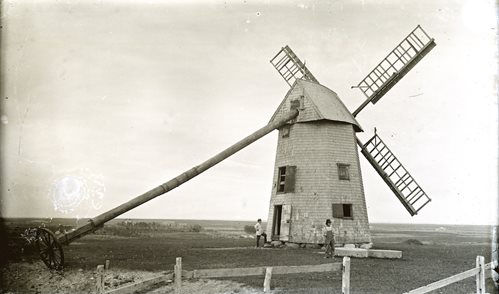 Photo: Nantucket Historical Association
When he first brought back the concept and tried to explain it to his fellow Early American islanders, they scoffed (reportedly). But knowing, as he did from first-hand experience, how the wind could make life easier, he set out to construct his own mill, in 1745 or 1746, using lumber salvaged from a shipwreck. The resultant labor-saver convinced the villagers his efforts had all been worthwhile. Subsequent to Wilbur’s success, the people of Nantucket built four more windmills of similar design. Wilbur may have been involved in the construction of some of them, but he did not own them.
Photo: Nantucket Historical Association
When he first brought back the concept and tried to explain it to his fellow Early American islanders, they scoffed (reportedly). But knowing, as he did from first-hand experience, how the wind could make life easier, he set out to construct his own mill, in 1745 or 1746, using lumber salvaged from a shipwreck. The resultant labor-saver convinced the villagers his efforts had all been worthwhile. Subsequent to Wilbur’s success, the people of Nantucket built four more windmills of similar design. Wilbur may have been involved in the construction of some of them, but he did not own them.
The Old Mill went on to become, and still is, the country’s oldest working windmill.
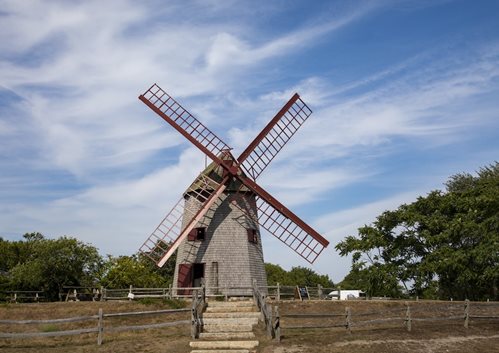 Photo: Nantucket Historical Association
What’s most remarkable about the design is that the gears do the main business sit in a little square-based triangle-roofed house atop the otherwise octagonal structure. At the base of this cap is a circular wooden track that fits in a wooden groove at the top of the tower. This allows the cap to be turned so that the vanes are always facing into the wind. A “tail pole,” that extends from the cap to the ground, can be pushed to rotate this uppermost structure.
Photo: Nantucket Historical Association
What’s most remarkable about the design is that the gears do the main business sit in a little square-based triangle-roofed house atop the otherwise octagonal structure. At the base of this cap is a circular wooden track that fits in a wooden groove at the top of the tower. This allows the cap to be turned so that the vanes are always facing into the wind. A “tail pole,” that extends from the cap to the ground, can be pushed to rotate this uppermost structure.
“We’ve used a pickup truck with a rope attached to the beam to help pull it into the direction that we want it to go,” said Niles Parker, executive director at the Nantucket Historical Association (NHA). “But you can do it with multiple people as well—it may have been done with a horse or a mule or something like that, originally.”
More for You: Pumping It Up at Rocky River
At ground level, that pole is attached to a wheel which rolls on a stone track that circles the windmill. But, after nearly 300 years, those stones are a little uneven. And the octagonal structure has shifted over the years too, making it harder to turn the cap into the wind. That’s not all that’s uneven. Though 80-odd-percent of the mill is estimated to be of original material, no one is sure what parts are original and what parts aren’t.
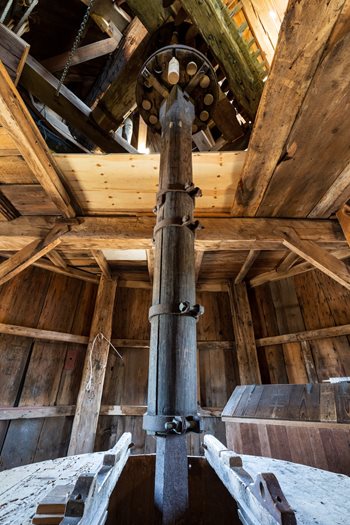 Photo: Nantucket Historical Association
“We’re, in effect, doing a stick-by-stick analysis of the structure that looks at what was original—what was replaced in the 1890s, what was replaced in the 1930s, what was replaced in the 1950s, then 1980s, and looking at the fasteners, looking at the way the wood was cut, looking at how it was put together, looking at what we have photographs of, so on and so forth,” Parker said.
Photo: Nantucket Historical Association
“We’re, in effect, doing a stick-by-stick analysis of the structure that looks at what was original—what was replaced in the 1890s, what was replaced in the 1930s, what was replaced in the 1950s, then 1980s, and looking at the fasteners, looking at the way the wood was cut, looking at how it was put together, looking at what we have photographs of, so on and so forth,” Parker said.
That the NHA’s efforts at preservation are not the first the windmill has seen is both a blessing and a curse. It’s a blessing because, without those previous attempts, it may have gone the way of its four neighbors on the hill. It’s a curse in that some of those efforts were less than well documented and altered things that wouldn’t likely be altered with today’s restoration ethos.
“For hundreds of years historic preservation wasn’t necessarily a thing,” Parker said. “They were just trying to keep the mill working and replace things as they saw fit.” That means the parts of the mill are a hodgepodge of different materials added at different times. In the 1980s and 1990s that included injecting polymers into wood to keep it from rotting, a preservation approach no longer recommended today.
Historic preservation of the mill started in earnest in the 1890s. By then the mill was still working, but not producing as much as it once had, primarily because water wheels were doing similar work with greater consistency and volume and the meal they produced could be imported to Nantucket. When the last mill owner passed away, the Old Mill went up for auction and the NHA purchased it, which made it the second building the association acquired.
Another ASME Landmark: One Cap to Bottle Them All
For a century, the mill would send its product to anyone in the country that sent in an order. The health department put an end to that some decades ago, but visitors still come and watch the mill turn corn to meal.
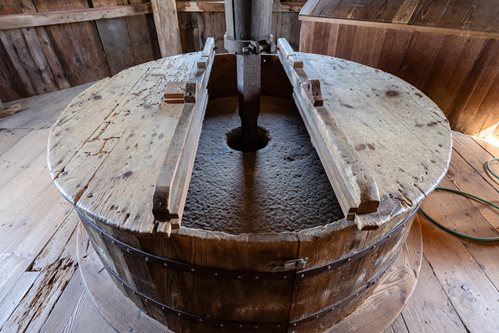 Photo: Nantucket Historical Association
“When you get a nice consistent wind in July and August coming out of the Southwest at 15 miles-an-hour, and it’s just steady all day—that’s an ideal time to be grinding corn,” Parker said.
Photo: Nantucket Historical Association
“When you get a nice consistent wind in July and August coming out of the Southwest at 15 miles-an-hour, and it’s just steady all day—that’s an ideal time to be grinding corn,” Parker said.
But tourists hoping to glimpse the mill in action will have to wait a few years as the current restoration is by no means a quick fix-me-up. “This is kind of like peeling an onion,” Parker said. “When we started to remove the exterior shingles—which had been put on in the 1990s, most recently—we started to see a whole collection of various types of wood, and ages of wood, and conditions of wood, and it opens up some questions.” Soon they will remove the tail pole and eventually the cap. “Once the top is off, we’ll have full access to that track that's at the top of the mill structure to make sure that it is level. And if there’s any replacement that we need to do in there we can do it at that time,” he said.
“It’s really exciting to dive into every aspect of this thing and see what we learn and come up with a new vision for how to run it,” Parker said. “It’s not just restoration but also figuring things out.”
Michael Abrams is a technology writer in Westfield, N.J.
But in the middle of the 18th century a sailor and Nantucket resident named Nathan Wilbur decided to try something new.
Actually, it wasn’t new at all. Across the water, in the old world, people had been using windmills to grind grain for hundreds of years. Wilbur, thanks to his line of work, knew all about it. He’d taken several trips to Holland and had seen its smock type windmills in action (so named for the apron-like appearance).
Photo: Nantucket Historical Association
The Old Mill went on to become, and still is, the country’s oldest working windmill.
A grinding process
The design of the Old Mill, as it’s now known, is both simple and clever. The wind pushes against four vanes which turn a giant gear of iron reinforced wood, which spins perpendicular to the ground. The teeth of this gear, also wood, fit into another vertical gear which looks something like a cylindrical bird cage. And that cage, in turn, turns the granite stones (quarried from Quincy, Mass.) that do the actual grinding. The mill also has its own brake to pause grinding without having to take down the cloth of the vanes. The whole setup is capable of churning out roughly 5,000 pounds of meal a year.
Photo: Nantucket Historical Association
“We’ve used a pickup truck with a rope attached to the beam to help pull it into the direction that we want it to go,” said Niles Parker, executive director at the Nantucket Historical Association (NHA). “But you can do it with multiple people as well—it may have been done with a horse or a mule or something like that, originally.”
More for You: Pumping It Up at Rocky River
At ground level, that pole is attached to a wheel which rolls on a stone track that circles the windmill. But, after nearly 300 years, those stones are a little uneven. And the octagonal structure has shifted over the years too, making it harder to turn the cap into the wind. That’s not all that’s uneven. Though 80-odd-percent of the mill is estimated to be of original material, no one is sure what parts are original and what parts aren’t.
Preserve and repair
To fix these issues and answer that question, the NHA has decided to do a massive overhaul. The endeavor is part restoration and part explorative research.
Photo: Nantucket Historical Association
That the NHA’s efforts at preservation are not the first the windmill has seen is both a blessing and a curse. It’s a blessing because, without those previous attempts, it may have gone the way of its four neighbors on the hill. It’s a curse in that some of those efforts were less than well documented and altered things that wouldn’t likely be altered with today’s restoration ethos.
“For hundreds of years historic preservation wasn’t necessarily a thing,” Parker said. “They were just trying to keep the mill working and replace things as they saw fit.” That means the parts of the mill are a hodgepodge of different materials added at different times. In the 1980s and 1990s that included injecting polymers into wood to keep it from rotting, a preservation approach no longer recommended today.
Historic preservation of the mill started in earnest in the 1890s. By then the mill was still working, but not producing as much as it once had, primarily because water wheels were doing similar work with greater consistency and volume and the meal they produced could be imported to Nantucket. When the last mill owner passed away, the Old Mill went up for auction and the NHA purchased it, which made it the second building the association acquired.
Another ASME Landmark: One Cap to Bottle Them All
For a century, the mill would send its product to anyone in the country that sent in an order. The health department put an end to that some decades ago, but visitors still come and watch the mill turn corn to meal.
Photo: Nantucket Historical Association
But tourists hoping to glimpse the mill in action will have to wait a few years as the current restoration is by no means a quick fix-me-up. “This is kind of like peeling an onion,” Parker said. “When we started to remove the exterior shingles—which had been put on in the 1990s, most recently—we started to see a whole collection of various types of wood, and ages of wood, and conditions of wood, and it opens up some questions.” Soon they will remove the tail pole and eventually the cap. “Once the top is off, we’ll have full access to that track that's at the top of the mill structure to make sure that it is level. And if there’s any replacement that we need to do in there we can do it at that time,” he said.
“It’s really exciting to dive into every aspect of this thing and see what we learn and come up with a new vision for how to run it,” Parker said. “It’s not just restoration but also figuring things out.”
Michael Abrams is a technology writer in Westfield, N.J.
Designated as an ASME Historic Mechanical Engineering Landmark in 1992, the Old Mill is the oldest operating smock-type windmill in the United States.

Freelance writer based in New Jersey
Related Content

Sep 21, 2026
Using 3D Printing to Manufacture Composite Materials



Sep 18, 2026
Quiz: ASME Professional and Student Sections


Test your knowledge of ASME professional and student sections, including their benefits, activities, resources, and recognition programs.
Sep 17, 2026
A Robot Rides the Wind


Sep 16, 2026
Mechanical Engineers Find Purpose in Public Service

Mechanical engineers in public service shape policy, strengthen infrastructure, improve public safety, and solve complex challenges at every government level.