Move with the Current
Move with the Current
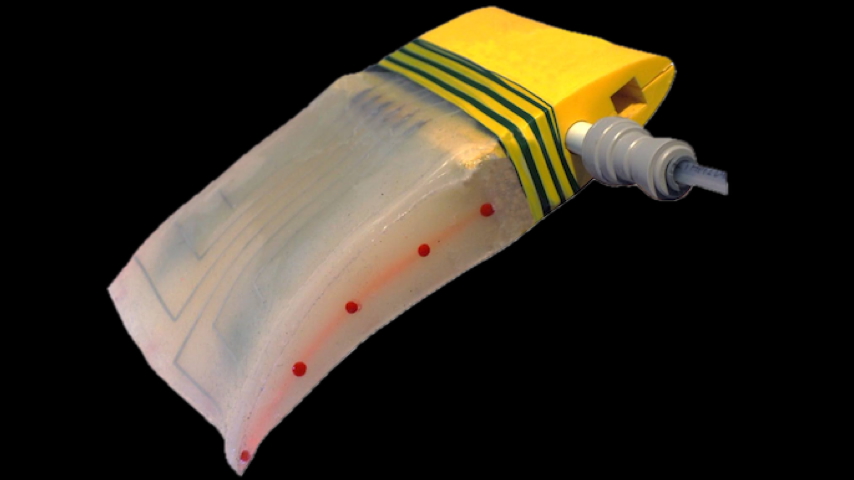
A new soft robotic wing allows underwater systems to move with more stability.
Jellyfish, manta rays, eels, and other sea creatures appear to move effortlessly in the water, easily stabilizing themselves against the underwater currents that move against them. Most autonomous underwater vehicles (AUVs), however, are stiff and unyielding—and those more rigid bodies mean they must expend a great deal of energy to counteract the motion of the water.
“Most of these AUVs are designed in a straight line, torpedo-style, and can move forward very efficiently but that’s it,” said Leo Micklem, a roboticist who formerly worked at the University of Southampton in the United Kingdom and is currently at Portland State University. “If you want some level of maneuverability, you are relying on what are basically big boxes with propellers on all sides to move it around in the water. It’s just not efficient. So, we started to think about how we could get better biological control, introducing the idea of proprioception to the system.”
Mimicking proprioception, the body’s internal sense of position, movement, and force, is a challenging task. But Micklem, who had been working on the design of a soft robotic wing while at the University of Southampton, and colleagues teamed up with researchers at the University of Edinburgh to make use of an innovative new electronic skin (e-skin) they had designed to enhance robotic gripping systems. The e-skin acts somewhat like nerve cells, sensing changes in the air to guide the way the grippers move in space. This research, “Harnessing proprioception in aquatic soft wings enables hybrid passive-active disturbance rejection,” was recently published in Nature.
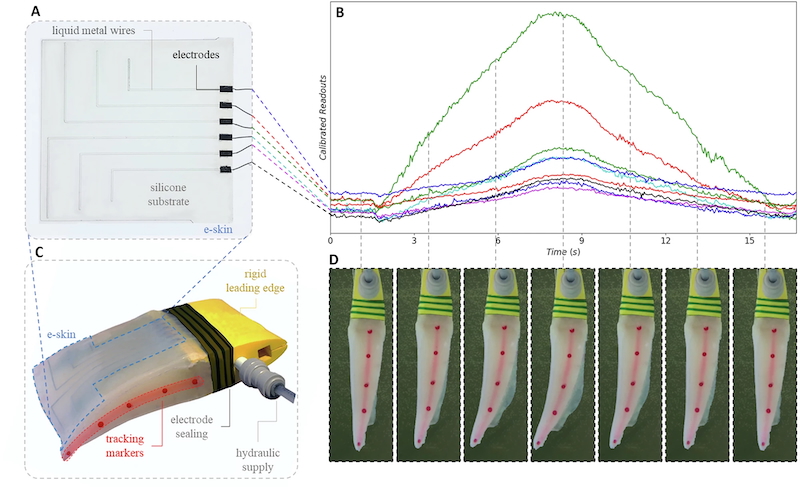 (A) The e-skin structure showing the thin silicone layer with six liquid-metal wires. (B) Calibrated capacitance readouts. (C) The soft robotic foil. (D) The corresponding foil deformation to the readouts over one actuation cycle. Image: Leo Micklem, et al.
While there are a range of one-dimensional sensors on the market that can capture one bending mode, Micklem said, the e-skin offered the team the potential to perceive forces underwater, helping them achieve a high-resolution response to the “complex shapes and geometries” seen in moving water.
(A) The e-skin structure showing the thin silicone layer with six liquid-metal wires. (B) Calibrated capacitance readouts. (C) The soft robotic foil. (D) The corresponding foil deformation to the readouts over one actuation cycle. Image: Leo Micklem, et al.
While there are a range of one-dimensional sensors on the market that can capture one bending mode, Micklem said, the e-skin offered the team the potential to perceive forces underwater, helping them achieve a high-resolution response to the “complex shapes and geometries” seen in moving water.
“We knew that the system worked in air,” he said. “But we needed to make it work underwater—and if we could, we knew it would give us a lot more stability than other approaches.”
Translating the e-skin’s capabilities in air to an underwater environment, Micklem said, was “quite tricky,” requiring the research group to rethink how to train the model that governed movement.
Discover the Benefits of ASME Membership
“The way the sensors work is you measure relative capacitance between the various lengths of liquid metal wires. When you’re underwater, those signals are always changing,” he explained. “So, we had to train the model underwater, using image capture from a single camera…it was a real iterative process but one that ultimately allowed us to show that this works as a proof of concept.”
When the team tested the new wing by subjecting it to underwater disturbances of different shapes and magnitudes, they found it performed better than both rigid wings and other types of soft wing designs. For example, they saw it could respond up to four times faster than similar AUV soft wings without the e-skin. In addition, the soft wing/e-skin design consumed five times less energy than systems that currently use thermal energy to change shape in response to environmental changes. While the wing has only, thus far, been tested in the laboratory, the results potentially translate into huge improvements in stability, responsiveness, and efficiency for underwater systems, Micklem said.
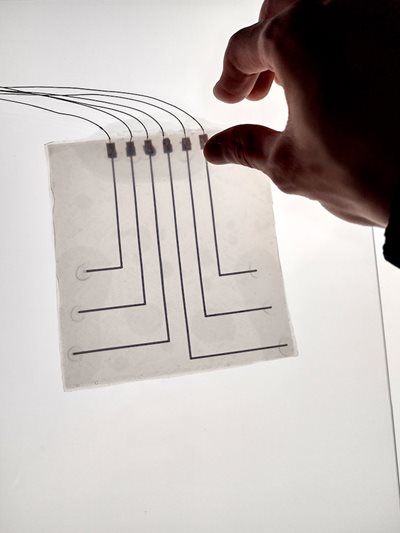 The e-skin can sense subtle changes caused by water currents. Photo: Leo Micklem
When asked what’s next, Micklem said he and his colleagues continue to improve upon the design—and consider how to scale it for use in a real underwater environment.
The e-skin can sense subtle changes caused by water currents. Photo: Leo Micklem
When asked what’s next, Micklem said he and his colleagues continue to improve upon the design—and consider how to scale it for use in a real underwater environment.
“How do we integrate this on to an underwater vehicle and start testing it out in real flow conditions? At the moment, we’ve tested this design in only experimental facilities with four sensors. Everything has been super precise and measured,” he explained. “And, in soft robotics, we see moving from proving concepts to implementation in real world applications is quite a difficult step.”
He is, however, optimistic that this concept can improve AUVs in the future—thanks to its bio-inspired design. And he hopes that other engineers who are working on a challenging design problems remember there is a “huge amount of inspiration in the world around us.”
“If we’re given the space and freedom to be creative with natural inspiration, rather than just replicate what [different animals] do, and take the concepts, the physics, and the ideas into our research space, we can come up with some really interesting solutions that have the capacity to even outperform their biological counterparts,” he said. “Always remember there’s not just one way to move forward.”
Kayt Sukel is a technology writer and author in Kansas City.
“Most of these AUVs are designed in a straight line, torpedo-style, and can move forward very efficiently but that’s it,” said Leo Micklem, a roboticist who formerly worked at the University of Southampton in the United Kingdom and is currently at Portland State University. “If you want some level of maneuverability, you are relying on what are basically big boxes with propellers on all sides to move it around in the water. It’s just not efficient. So, we started to think about how we could get better biological control, introducing the idea of proprioception to the system.”
Mimicking proprioception, the body’s internal sense of position, movement, and force, is a challenging task. But Micklem, who had been working on the design of a soft robotic wing while at the University of Southampton, and colleagues teamed up with researchers at the University of Edinburgh to make use of an innovative new electronic skin (e-skin) they had designed to enhance robotic gripping systems. The e-skin acts somewhat like nerve cells, sensing changes in the air to guide the way the grippers move in space. This research, “Harnessing proprioception in aquatic soft wings enables hybrid passive-active disturbance rejection,” was recently published in Nature.
(A) The e-skin structure showing the thin silicone layer with six liquid-metal wires. (B) Calibrated capacitance readouts. (C) The soft robotic foil. (D) The corresponding foil deformation to the readouts over one actuation cycle. Image: Leo Micklem, et al.
“We knew that the system worked in air,” he said. “But we needed to make it work underwater—and if we could, we knew it would give us a lot more stability than other approaches.”
Translating the e-skin’s capabilities in air to an underwater environment, Micklem said, was “quite tricky,” requiring the research group to rethink how to train the model that governed movement.
Discover the Benefits of ASME Membership
“The way the sensors work is you measure relative capacitance between the various lengths of liquid metal wires. When you’re underwater, those signals are always changing,” he explained. “So, we had to train the model underwater, using image capture from a single camera…it was a real iterative process but one that ultimately allowed us to show that this works as a proof of concept.”
When the team tested the new wing by subjecting it to underwater disturbances of different shapes and magnitudes, they found it performed better than both rigid wings and other types of soft wing designs. For example, they saw it could respond up to four times faster than similar AUV soft wings without the e-skin. In addition, the soft wing/e-skin design consumed five times less energy than systems that currently use thermal energy to change shape in response to environmental changes. While the wing has only, thus far, been tested in the laboratory, the results potentially translate into huge improvements in stability, responsiveness, and efficiency for underwater systems, Micklem said.
The e-skin can sense subtle changes caused by water currents. Photo: Leo Micklem
“How do we integrate this on to an underwater vehicle and start testing it out in real flow conditions? At the moment, we’ve tested this design in only experimental facilities with four sensors. Everything has been super precise and measured,” he explained. “And, in soft robotics, we see moving from proving concepts to implementation in real world applications is quite a difficult step.”
He is, however, optimistic that this concept can improve AUVs in the future—thanks to its bio-inspired design. And he hopes that other engineers who are working on a challenging design problems remember there is a “huge amount of inspiration in the world around us.”
“If we’re given the space and freedom to be creative with natural inspiration, rather than just replicate what [different animals] do, and take the concepts, the physics, and the ideas into our research space, we can come up with some really interesting solutions that have the capacity to even outperform their biological counterparts,” he said. “Always remember there’s not just one way to move forward.”
Kayt Sukel is a technology writer and author in Kansas City.
A new soft robotic wing allows underwater systems to move with more stability.

Freelance writer, author, and ghostwriter
Related Content


Sep 24, 2026
A Blurry Microscope Image Rewrote How Frost Spreads


Sep 23, 2026
Computer Model Could Improve Sustainability for Construction Industry


MIT researchers developed an accessible computer model that helps engineers design practical truss structures with less material, reducing carbon emissions.

Sep 23, 2026
From Student Section Builder to Aerospace Engineer


Rebuilding a ASME student section and mentoring student leaders, Kenny Madden gained the technical, professional, and leadership skills needed to pursue an aerospace career.
Sep 21, 2026
Using 3D Printing to Manufacture Composite Materials