From Mechanical Engineer to Cobbler
From Mechanical Engineer to Cobbler

Alex Stanzel went from manufacturing and quality engineering to resoling footwear and handcrafting custom shoes—then brought millions along for the ride on TikTok.
A video featuring Alex the Cobbler may someday come up on your TikTok “For You” feed. He could be resoling a shoe, foxing a sneaker, replacing a tongue, or just bringing us along as he gives new life to worn footwear. But all his videos tell viewers one story—the unlikely journey from mechanical engineer to cordwainer, to cobbler, and finally content creator.
But making shoes, repairing footwear, and filming the entire process was never a conscious decision for Alex Stanzel. At the very beginning, “I was just trying to make a bunch of different stuff,” he admitted. Never a sneaker head, the New Jersey native just liked building things. Out of boredom and the joy of making something from scratch, Stanzel tried his hand at making a pair of shoes. “I drew a pair and thought, ‘it would be cool to try and make this,’” he said.
Stanzel holds a bachelor’s degree in mechanical engineering from Loyola University and has worked as a manufacturing engineer and quality engineer. He definitely has the attributes of an engineer with his inclination to take things apart to see how they work—and the need to put them back together in better than working order.
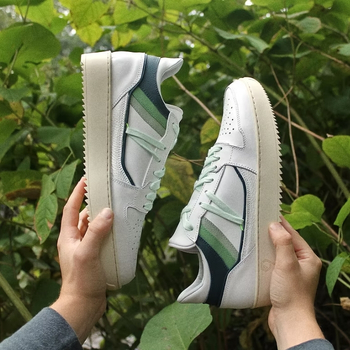 “Splitter” handcrafted sneakers. Photo: Polychrome Footwear
“As a kid I was always interested in cars and I wanted to become an automotive engineer,” Stanzel explained as the reason for pursuing a degree in mechanical engineering. And now, after he has found a real life’s passion (at least for now), he still leans on the problem-solving mentality of an engineer.
“Splitter” handcrafted sneakers. Photo: Polychrome Footwear
“As a kid I was always interested in cars and I wanted to become an automotive engineer,” Stanzel explained as the reason for pursuing a degree in mechanical engineering. And now, after he has found a real life’s passion (at least for now), he still leans on the problem-solving mentality of an engineer.
“That’s a lot of what putting together shoes and fixing shoes is,” he explained. “Figuring out how to take something apart and put it back together, and I think a lot of that kind of meshes pretty well with the engineering mind.” And while the component parts of shoes are not metal gears and compressor pumps, the job does involve a lot of knowledge of materials and applications such as the use of rubber molds for custom-made soles, selecting appropriate materials, and even 3D printing parts that are hard to source.
Stanzel currently shares his world on the TikTok platform as @alex.cobbler. His slideshow video, “My Journey to Becoming a Cobbler” recently went viral. So far, 16.7 million people have watched him evolve as a completely self-taught shoemaker. They view his first creation in 2012 when he was still in high school, watch his evolution through college breaks and during semesters of study, up until today.
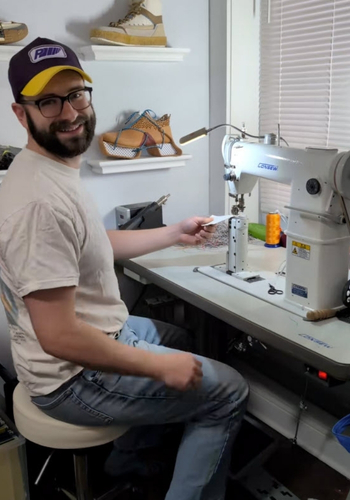 Alex Stanzel using a Consew 228R-11 Sewing Machine. Photo: @cobbler.Alex on TikTok
His first engineering job took him to Baltimore, where he set up his hobby in his bedroom. And then he decided to tackle more “challenging and cool designs.” Finally his engineering career brought him back to the Garden State. His work, which really had no goals or boundaries before 2021, led to a shoe model. Seven prototypes later, he had a model he could sell to customers. A second model was introduced in 2023, still all handmade. And customized orders still come in.
Alex Stanzel using a Consew 228R-11 Sewing Machine. Photo: @cobbler.Alex on TikTok
His first engineering job took him to Baltimore, where he set up his hobby in his bedroom. And then he decided to tackle more “challenging and cool designs.” Finally his engineering career brought him back to the Garden State. His work, which really had no goals or boundaries before 2021, led to a shoe model. Seven prototypes later, he had a model he could sell to customers. A second model was introduced in 2023, still all handmade. And customized orders still come in.
That same year he took the leap and became a full-time cobbler for Golden Goose. He presents his job in a day in the life video where he takes the viewer along inside the SoHo store where resoling is the “meat and potatoes” of the business. He describes a backlog of nearly 500 pairs (1,000 shoes) that need attention for this problem at any one time.
It was engineering that funded his footwear education. After selling his own shoes for a few short years, his full-time cobbler’s job has taught him a lot about his craft. “The environment here is really great,” he said of Golden Goose. “There are a lot of similarly creative people here that I can bounce ideas off of, and that’s wonderful as far as expectations go.”
Being on TikTok was a natural offshoot of Stanzel’s craft. He is not always happy to take the extra time it takes to set up the camera, edit the video, and upload each to the platform, but he knows it is worth it. And a new POV camera that he could just clip onto his hat has helped him post regularly.
And the content he presents has brought people not only interested in shoe repair but also curious in his brand, Polychrome Footwear. For Stanzel the two areas could not be more different. “Shoemaking to me is kind of like putting a puzzle together,” he said as he discussed taking constituent parts and piecing them together to make something functional. “When you’re fixing something and when you’re making something—that’s very different.”
He pointed out that his background in shoe making has allowed him to go about repairing shoes differently than a traditional cobbler. And since working in shoe repair, his overall perception of the trade has changed. Stanzel has gotten invaluable lessons that have opened his shoemaking up to possibilities he never thought about prior to being a cobbler.
“Someone who makes shoes, is a cordwainer,” Stanzel explained of the trade that does more than fix footwear but allows those who seek his services a pair of shoes that is custom-made, uses premium materials, and fit well. People’s feet are not only different from other people’s feet but from each other, Stanzel explained. And manufacturers are just not equipped for that reality. Custom-made shoes are going to be more expensive, he admitted. “But you’re going to have something that fits and is comfortable not only when you put it on the first time, but when you put it on the 200th time.”
Stanzel’s journey is really unique, but his message is universal. And that is why people will continue to watch Stanzel make shoes and repair shoes. Let’s face it, for many who watch him, he is the only cobbler/cordwainer they know.
And how many people can say that their hobby has turned into a full-time job, let alone an artisan profession with creations they can be proud of? Stanzel makes it clear that it’s “OK to fail.” In 2026 that sentiment is often lost, he added.
 “Social media has kind of made this expectation that if you’re doing something, it has to look a certain way,” he explained. “And that’s definitely not the case. As you saw the first few shoes I made were terrible. And the best way is just to try something and fail at it and get better at it.”
Stanzel admitted the progression to full-time cobbler and self-employed shoemaker has been slow, but one that has been fun and has allowed him to learn at his own pace. “It took me [at least] five years to be comfortable wearing shoes that I’ve made,” he said. “And it took me another… four years after that to be able to sell shoes to people.”
The cobbler admitted he is not a quick learner by design. “I did things at my own pace, and even if I was failing, I was still enjoying putting stuff together,” he explained.
At this point, Stanzel is not setting any expectations, but still is “working towards making things happen.” The dream has always been, for Stanzel, to work for himself, with his own studio and workshop. “So I can work on whatever I want, whenever I want,” he admitted.
Cathy Cecere is membership content program manager.
But making shoes, repairing footwear, and filming the entire process was never a conscious decision for Alex Stanzel. At the very beginning, “I was just trying to make a bunch of different stuff,” he admitted. Never a sneaker head, the New Jersey native just liked building things. Out of boredom and the joy of making something from scratch, Stanzel tried his hand at making a pair of shoes. “I drew a pair and thought, ‘it would be cool to try and make this,’” he said.
From engineer to cordwainer
Stanzel holds a bachelor’s degree in mechanical engineering from Loyola University and has worked as a manufacturing engineer and quality engineer. He definitely has the attributes of an engineer with his inclination to take things apart to see how they work—and the need to put them back together in better than working order.
“Splitter” handcrafted sneakers. Photo: Polychrome Footwear
“That’s a lot of what putting together shoes and fixing shoes is,” he explained. “Figuring out how to take something apart and put it back together, and I think a lot of that kind of meshes pretty well with the engineering mind.” And while the component parts of shoes are not metal gears and compressor pumps, the job does involve a lot of knowledge of materials and applications such as the use of rubber molds for custom-made soles, selecting appropriate materials, and even 3D printing parts that are hard to source.
This is what you call customized
Stanzel currently shares his world on the TikTok platform as @alex.cobbler. His slideshow video, “My Journey to Becoming a Cobbler” recently went viral. So far, 16.7 million people have watched him evolve as a completely self-taught shoemaker. They view his first creation in 2012 when he was still in high school, watch his evolution through college breaks and during semesters of study, up until today.
Alex Stanzel using a Consew 228R-11 Sewing Machine. Photo: @cobbler.Alex on TikTok
That same year he took the leap and became a full-time cobbler for Golden Goose. He presents his job in a day in the life video where he takes the viewer along inside the SoHo store where resoling is the “meat and potatoes” of the business. He describes a backlog of nearly 500 pairs (1,000 shoes) that need attention for this problem at any one time.
From engineer to cobbler
It was engineering that funded his footwear education. After selling his own shoes for a few short years, his full-time cobbler’s job has taught him a lot about his craft. “The environment here is really great,” he said of Golden Goose. “There are a lot of similarly creative people here that I can bounce ideas off of, and that’s wonderful as far as expectations go.” Being on TikTok was a natural offshoot of Stanzel’s craft. He is not always happy to take the extra time it takes to set up the camera, edit the video, and upload each to the platform, but he knows it is worth it. And a new POV camera that he could just clip onto his hat has helped him post regularly.
And the content he presents has brought people not only interested in shoe repair but also curious in his brand, Polychrome Footwear. For Stanzel the two areas could not be more different. “Shoemaking to me is kind of like putting a puzzle together,” he said as he discussed taking constituent parts and piecing them together to make something functional. “When you’re fixing something and when you’re making something—that’s very different.”
He pointed out that his background in shoe making has allowed him to go about repairing shoes differently than a traditional cobbler. And since working in shoe repair, his overall perception of the trade has changed. Stanzel has gotten invaluable lessons that have opened his shoemaking up to possibilities he never thought about prior to being a cobbler.
“Someone who makes shoes, is a cordwainer,” Stanzel explained of the trade that does more than fix footwear but allows those who seek his services a pair of shoes that is custom-made, uses premium materials, and fit well. People’s feet are not only different from other people’s feet but from each other, Stanzel explained. And manufacturers are just not equipped for that reality. Custom-made shoes are going to be more expensive, he admitted. “But you’re going to have something that fits and is comfortable not only when you put it on the first time, but when you put it on the 200th time.”
It’s all in the journey
Stanzel’s journey is really unique, but his message is universal. And that is why people will continue to watch Stanzel make shoes and repair shoes. Let’s face it, for many who watch him, he is the only cobbler/cordwainer they know. And how many people can say that their hobby has turned into a full-time job, let alone an artisan profession with creations they can be proud of? Stanzel makes it clear that it’s “OK to fail.” In 2026 that sentiment is often lost, he added.
Steam Locomotive Rededication Speaks to its Significance
The #611 Class J Steam Locomotive engine, the last U.S. coal-fired passenger locomotives, was recently rededicated, 41 years after its original designation as a ASME Landmark in 1984.
Stanzel admitted the progression to full-time cobbler and self-employed shoemaker has been slow, but one that has been fun and has allowed him to learn at his own pace. “It took me [at least] five years to be comfortable wearing shoes that I’ve made,” he said. “And it took me another… four years after that to be able to sell shoes to people.”
The cobbler admitted he is not a quick learner by design. “I did things at my own pace, and even if I was failing, I was still enjoying putting stuff together,” he explained.
At this point, Stanzel is not setting any expectations, but still is “working towards making things happen.” The dream has always been, for Stanzel, to work for himself, with his own studio and workshop. “So I can work on whatever I want, whenever I want,” he admitted.
Cathy Cecere is membership content program manager.
Alex Stanzel went from manufacturing and quality engineering to resoling footwear and handcrafting custom shoes—then brought millions along for the ride on TikTok.

Membership content program manager for ASME
Related Content

Oct 5, 2026
Where Digital Meets Physical


Mechanical engineers become indispensable as they bridge the gap between digital models and physical reality.

Oct 1, 2026
Engineering the Sounds of Silence

Many of the things that engineers create make a lot of noise. Now there’s a crop of engineers trying to turn the volume down for all of us.

Oct 1, 2026
Unlocking the Power of Wave Energy


Researchers at the University of Michigan have developed wave energy converters that may improve energy independence for remote coastal and island communities.

Oct 1, 2026
DOT Final Rule Authorizes Voluntary Use of ASME Standard for Hazardous Materials Transport Tanks