Engineers Scale Up Smart Ceramic Composites
Engineers Scale Up Smart Ceramic Composites
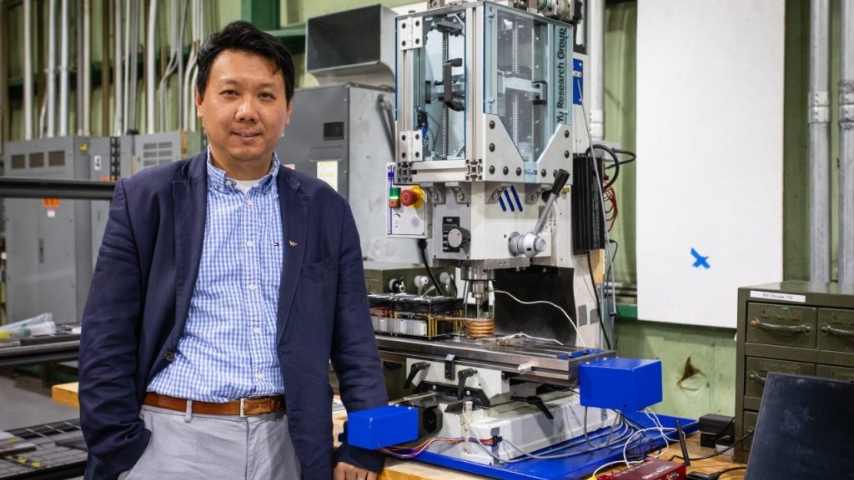
Using solid-state additive manufacturing, researchers embed shape memory ceramic particles in ductile metal, creating a tough, multifunctional composite that retains transformation behavior at scale.
For more than a decade, researchers have known that certain ceramics can behave in extraordinary ways. Under the right thermal or mechanical stimulus, they undergo a reversible martensitic phase transformation.
This solid-state rearrangement of crystal structure can enable superelasticity, energy dissipation, and temperature-sensitive response. In principle, they behave like shape memory alloys such as Nitinol. In practice, they fracture.
At Virginia Tech, materials scientist Hang Yu has spent much of his career wrestling with that paradox. “Ceramics are brittle,” Yu said. “You can see the shape memory effect at the microscale, in small pillars. But if you try to make something bulk, the grains compete with each other during transformation. That creates stress concentrations and the material fails.”
The long-standing challenge has been scaling smart ceramics beyond laboratory-scale demonstrations without sacrificing their functionality. Now, Yu and colleagues Donnie Erb and Nikhil Gotawala have demonstrated a path forward. They embed shape memory ceramic particles inside a ductile metal matrix using an emerging solid-state additive manufacturing process.
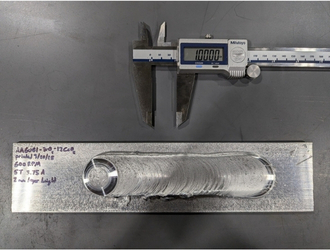 Printed smart composite. Photo: Virginia Tech
The result is a structurally robust, multi-functional composite that retains the ceramic’s transformation-driven behavior while achieving bulk manufacturability. The team’s research appeared in Materials Science and Engineering R: Reports.
Printed smart composite. Photo: Virginia Tech
The result is a structurally robust, multi-functional composite that retains the ceramic’s transformation-driven behavior while achieving bulk manufacturability. The team’s research appeared in Materials Science and Engineering R: Reports.
The breakthrough builds on work dating back to Yu’s postdoctoral research at MIT, where microscale ceramic pillars were shown to exhibit superelastic and shape memory effects. “It was very encouraging,” Yu said. “But the question was always: How do we make something bigger without worrying about fracture?”
Simply fabricating a bulk ceramic component was not viable. In polycrystalline ceramics, individual grains transform into different orientations under load. This creates internal incompatibility and crack initiation. Alternative architectures—granular packings or foams—offered partial solutions but limited structural load-bearing capacity.
The team’s answer was composite design. Instead of relying on a continuous ceramic phase, they dispersed shape memory ceramic microparticles within a metallic matrix. The metal provides structural integrity and ductility, while the embedded particles undergo reversible phase transformation under stress or temperature changes.
Yu likens the structure to “chocolate chips in a cookie.” The ceramic particles are discrete, surrounded by metal rather than neighboring grains. This isolation prevents the transformation-induced grain-to-grain conflicts that typically plague monolithic ceramics.
Importantly, the composite does not yet exhibit a macroscopic shape memory effect. Because only the ceramic inclusions transform—not the metal matrix—the bulk material does not recover its original shape in the way a shape memory alloy would. But the local transformations still provide functional benefits: vibration damping, stress sensing, and energy dissipation.
“When the ceramic particles transform,” Yu explained, “they absorb and dissipate energy. You can design the system so even small mechanical vibrations trigger transformation. That gives you intrinsic damping capability.”
While composite concepts are not new, the team’s advance hinges on how the material is made. Yu’s laboratory is known for pioneering work in additive friction stir deposition (AFSD), a solid-state additive manufacturing process in which a rotating tool plastically deforms and consolidates feedstock without melting it.
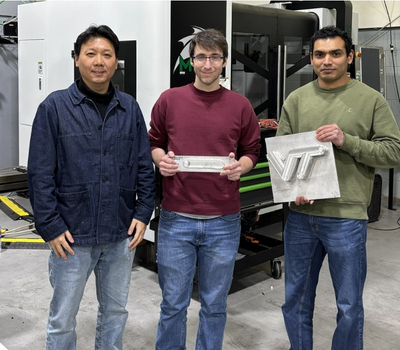 Left to right: Hang Yu; Donnie Erb with a single-track smart composite printed using additive friction stir deposition; and Nikhil Gotawala holding a ‘VT’-shaped aluminum alloy component printed using additive friction stir deposition. Photo: Virginia Tech
Unlike powder-bed fusion or conventional sintering, AFSD relies on severe plastic deformation and frictional heating to induce material flow and bonding. Consolidation occurs in seconds rather than hours, and porosity is minimized through mechanical forcing rather than slow diffusion.
Left to right: Hang Yu; Donnie Erb with a single-track smart composite printed using additive friction stir deposition; and Nikhil Gotawala holding a ‘VT’-shaped aluminum alloy component printed using additive friction stir deposition. Photo: Virginia Tech
Unlike powder-bed fusion or conventional sintering, AFSD relies on severe plastic deformation and frictional heating to induce material flow and bonding. Consolidation occurs in seconds rather than hours, and porosity is minimized through mechanical forcing rather than slow diffusion.
“Most materials research shows something very small,” Yu said. “We make large parts. That’s closer to real-world applications.”
In this work, aluminum and copper served as matrix metals. To introduce ceramic particles, the team developed a patterned drilling strategy in the metal feedstock prior to deposition. Instead of filling a single cavity, they distributed multiple holes in a specific arrangement. During the stirring and flow of AFSD, this pattern enabled uniform particle distribution.
Erb, who developed both experimental strategies and a supporting mechanics framework, described the approach as a materials design problem as much as a manufacturing one. “The metal has to effectively transfer load to the ceramic,” he said. “We built a framework to predict which metal–ceramic pairs will trigger phase transformation under stress.”
That theoretical model helps guide material selection for future applications. Rather than relying on trial and error, the team can now evaluate candidate combinations based on stiffness mismatch, stress transfer efficiency, and transformation thresholds.
The current work is exploratory. The researchers have not yet optimized trade-offs between stiffness and sensitivity or strength and transformation fidelity. “At this stage, we’re asking: Can we see the effect at all?” Erb said. “Now that we know we can, we can tailor the ceramic and metal to specific applications.”
 One immediate goal is reducing the stress required to activate transformation. At present, relatively high loads are needed. The team is exploring modifications to ceramic composition and particle size to lower activation thresholds and potentially achieve super elastic behavior within the composite.
Another line of work involves modeling the thermomechanical history of the material during printing. Gotawala, whose background spans mechanical engineering and materials science, has focused on simulating material flow, strain rates, and temperature evolution during AFSD. These parameters influence particle distribution and residual stress states.
“Understanding how the material flows during processing is critical,” Gotawala said. “That determines how uniformly the particles spread and how they experience thermomechanical history.”
For mechanical engineers, the broader implication may be a shift in mindset. Traditionally, mechanical design assumes fixed material properties. Engineers manipulate geometry—trusses, lattices, thickness variations—to achieve desired performance. In contrast, materials design alters functionality at the microstructural level.
“With this composite, we’re embedding functionality into the material itself,” Yu said. “You may not need complex geometry to get energy dissipation. The material provides it.”
The additive nature of AFSD further expands design space. The process can fabricate complex geometries while integrating functional particles, enabling multi-scale energy dissipation. At the macro level, a lattice or truss structure can deform and absorb impact. At the micro level, ceramic particles undergo phase transformation, providing additional damping.
“You can combine structural design and material design,” Yu said. “That opens possibilities.”
Potential applications span aerospace, defense, infrastructure, and sporting goods—anywhere vibration damping or impact mitigation is valuable. Surface cladding is one promising near-term approach. A structural metal component could be coated with the smart composite layer, adding damping capability without redesigning the entire part.
Adoption will depend on cost competitiveness and integration with existing systems. Tooling is also a constraint, particularly for higher-strength matrix materials such as steels or titanium alloys, which require expensive, wear-resistant tool heads.
Still, AFSD offers advantages in speed, scalability, and even sustainability. Despite this momentum, the researchers emphasize that they are at the beginning of a new chapter.
“We’ve shown that we can scale this up and retain functionality,” Erb said. “Now the question is: How far can we push it?”
Yu agrees. “This is combining two things we’ve worked on for years—smart ceramics and additive friction stir deposition. There are many directions to go from here.”
For a field that has long struggled to translate brittle smart materials into bulk applications, that combination may prove transformative.
Cassandra Kelly is a technology writer in Columbus, Ohio.
This solid-state rearrangement of crystal structure can enable superelasticity, energy dissipation, and temperature-sensitive response. In principle, they behave like shape memory alloys such as Nitinol. In practice, they fracture.
At Virginia Tech, materials scientist Hang Yu has spent much of his career wrestling with that paradox. “Ceramics are brittle,” Yu said. “You can see the shape memory effect at the microscale, in small pillars. But if you try to make something bulk, the grains compete with each other during transformation. That creates stress concentrations and the material fails.”
A Composite Solution
The long-standing challenge has been scaling smart ceramics beyond laboratory-scale demonstrations without sacrificing their functionality. Now, Yu and colleagues Donnie Erb and Nikhil Gotawala have demonstrated a path forward. They embed shape memory ceramic particles inside a ductile metal matrix using an emerging solid-state additive manufacturing process.
Printed smart composite. Photo: Virginia Tech
The breakthrough builds on work dating back to Yu’s postdoctoral research at MIT, where microscale ceramic pillars were shown to exhibit superelastic and shape memory effects. “It was very encouraging,” Yu said. “But the question was always: How do we make something bigger without worrying about fracture?”
Simply fabricating a bulk ceramic component was not viable. In polycrystalline ceramics, individual grains transform into different orientations under load. This creates internal incompatibility and crack initiation. Alternative architectures—granular packings or foams—offered partial solutions but limited structural load-bearing capacity.
The team’s answer was composite design. Instead of relying on a continuous ceramic phase, they dispersed shape memory ceramic microparticles within a metallic matrix. The metal provides structural integrity and ductility, while the embedded particles undergo reversible phase transformation under stress or temperature changes.
Yu likens the structure to “chocolate chips in a cookie.” The ceramic particles are discrete, surrounded by metal rather than neighboring grains. This isolation prevents the transformation-induced grain-to-grain conflicts that typically plague monolithic ceramics.
Importantly, the composite does not yet exhibit a macroscopic shape memory effect. Because only the ceramic inclusions transform—not the metal matrix—the bulk material does not recover its original shape in the way a shape memory alloy would. But the local transformations still provide functional benefits: vibration damping, stress sensing, and energy dissipation.
“When the ceramic particles transform,” Yu explained, “they absorb and dissipate energy. You can design the system so even small mechanical vibrations trigger transformation. That gives you intrinsic damping capability.”
Manufacturing breakthrough
While composite concepts are not new, the team’s advance hinges on how the material is made. Yu’s laboratory is known for pioneering work in additive friction stir deposition (AFSD), a solid-state additive manufacturing process in which a rotating tool plastically deforms and consolidates feedstock without melting it.
Left to right: Hang Yu; Donnie Erb with a single-track smart composite printed using additive friction stir deposition; and Nikhil Gotawala holding a ‘VT’-shaped aluminum alloy component printed using additive friction stir deposition. Photo: Virginia Tech
“Most materials research shows something very small,” Yu said. “We make large parts. That’s closer to real-world applications.”
In this work, aluminum and copper served as matrix metals. To introduce ceramic particles, the team developed a patterned drilling strategy in the metal feedstock prior to deposition. Instead of filling a single cavity, they distributed multiple holes in a specific arrangement. During the stirring and flow of AFSD, this pattern enabled uniform particle distribution.
Erb, who developed both experimental strategies and a supporting mechanics framework, described the approach as a materials design problem as much as a manufacturing one. “The metal has to effectively transfer load to the ceramic,” he said. “We built a framework to predict which metal–ceramic pairs will trigger phase transformation under stress.”
That theoretical model helps guide material selection for future applications. Rather than relying on trial and error, the team can now evaluate candidate combinations based on stiffness mismatch, stress transfer efficiency, and transformation thresholds.
Next steps
The current work is exploratory. The researchers have not yet optimized trade-offs between stiffness and sensitivity or strength and transformation fidelity. “At this stage, we’re asking: Can we see the effect at all?” Erb said. “Now that we know we can, we can tailor the ceramic and metal to specific applications.”
Origami Inspires Bendable 3D-Printed Ceramics
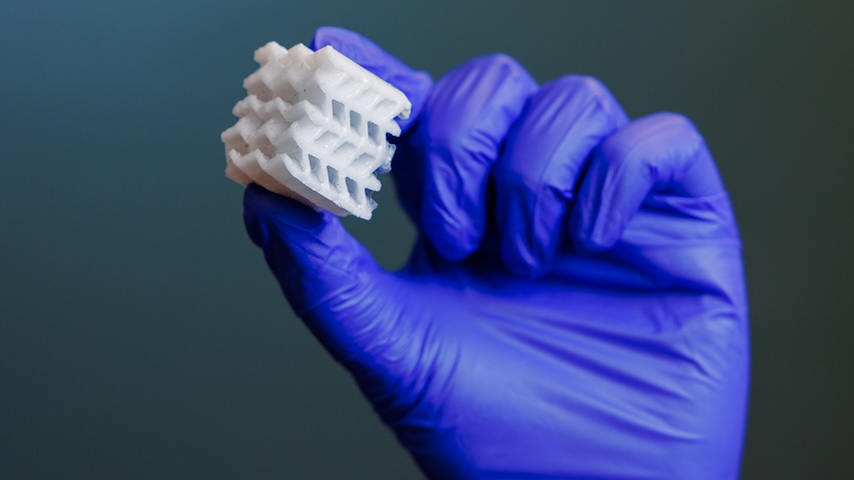
Multidisciplinary research brought together origami, materials science, and 3D printing to yield flexible ceramic structures.
Another line of work involves modeling the thermomechanical history of the material during printing. Gotawala, whose background spans mechanical engineering and materials science, has focused on simulating material flow, strain rates, and temperature evolution during AFSD. These parameters influence particle distribution and residual stress states.
“Understanding how the material flows during processing is critical,” Gotawala said. “That determines how uniformly the particles spread and how they experience thermomechanical history.”
For mechanical engineers, the broader implication may be a shift in mindset. Traditionally, mechanical design assumes fixed material properties. Engineers manipulate geometry—trusses, lattices, thickness variations—to achieve desired performance. In contrast, materials design alters functionality at the microstructural level.
“With this composite, we’re embedding functionality into the material itself,” Yu said. “You may not need complex geometry to get energy dissipation. The material provides it.”
The additive nature of AFSD further expands design space. The process can fabricate complex geometries while integrating functional particles, enabling multi-scale energy dissipation. At the macro level, a lattice or truss structure can deform and absorb impact. At the micro level, ceramic particles undergo phase transformation, providing additional damping.
“You can combine structural design and material design,” Yu said. “That opens possibilities.”
Design implications
Potential applications span aerospace, defense, infrastructure, and sporting goods—anywhere vibration damping or impact mitigation is valuable. Surface cladding is one promising near-term approach. A structural metal component could be coated with the smart composite layer, adding damping capability without redesigning the entire part.Adoption will depend on cost competitiveness and integration with existing systems. Tooling is also a constraint, particularly for higher-strength matrix materials such as steels or titanium alloys, which require expensive, wear-resistant tool heads.
Still, AFSD offers advantages in speed, scalability, and even sustainability. Despite this momentum, the researchers emphasize that they are at the beginning of a new chapter.
“We’ve shown that we can scale this up and retain functionality,” Erb said. “Now the question is: How far can we push it?”
Yu agrees. “This is combining two things we’ve worked on for years—smart ceramics and additive friction stir deposition. There are many directions to go from here.”
For a field that has long struggled to translate brittle smart materials into bulk applications, that combination may prove transformative.
Cassandra Kelly is a technology writer in Columbus, Ohio.


Stay up to date on the advances in additive manufacturing. This collection highlights new applications of 3D printing, metal printing methods, materials development, medical devices, and bioprinting.